Bund Agroforestry Projects: A Practical Guide to Trees Along Farm Boundaries
Published
, 19 minute read
Share this article
Quick summary: Learn how bund agroforestry works, why polygon mapping is tricky, and how digital MRV unlocks scalable, audit-ready tree monitoring.
Bund agroforestry is the practice of planting trees along the raised earthen boundaries (bunds) that separate crop fields, rather than inside the fields themselves. It is one of the most widely adopted forms of agroforestry in smallholder geographies because it adds trees, income, soil protection and carbon value without sacrificing crop area. The hard part is not planting the trees it is measuring, monitoring and verifying them at scale.
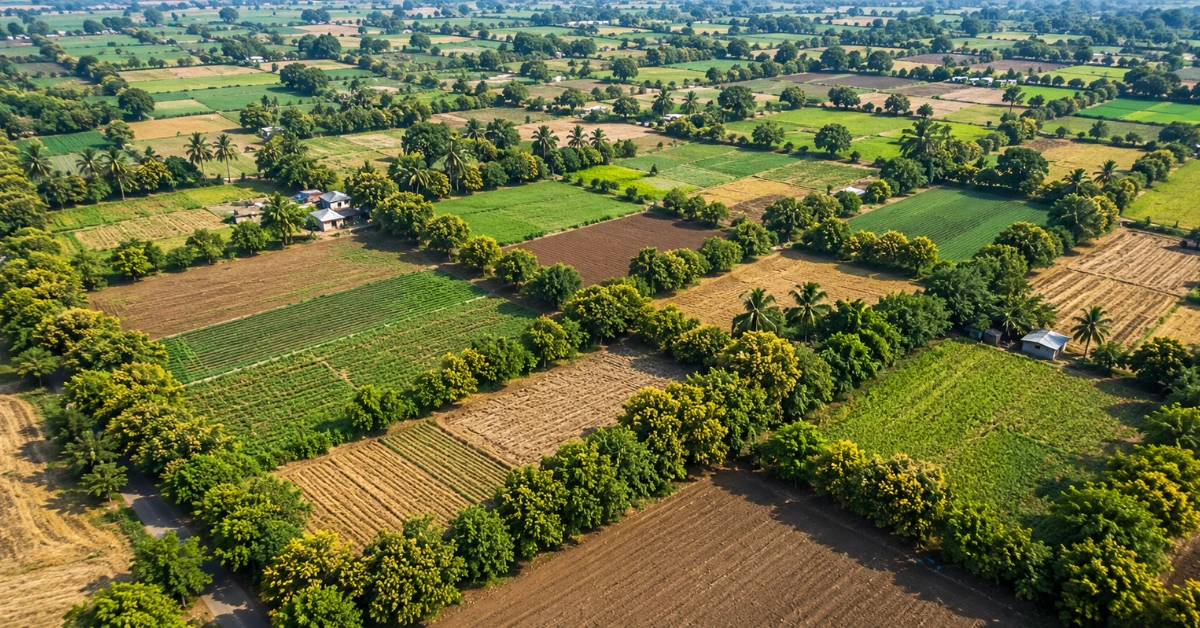
Walk through any smallholder landscape in India, sub-Saharan Africa, or Southeast Asia and you will see them single rows of neem, mango, casuarina or gliricidia threaded along the raised earthen ridges between paddy, millet, or vegetable fields. Farmers have been planting trees on bunds for generations. What is new is the pressure to count them.
Corporate net-zero commitments, voluntary carbon markets, and ESG-linked sourcing programs have turned every bund tree into a potential data point. The question is no longer whether bund agroforestry works decades of field evidence say it does. The question is how to onboard farmers, map narrow boundaries, geo-tag thousands of trees, track survival, and turn all of it into audit-ready reporting that a carbon registry or EU buyer will accept.
This guide walks through what bund agroforestry actually is, why smallholders prefer it, where projects break down, and what a credible digital monitoring stack looks like.
Key Takeaways
Three things to know: 1) Bund agroforestry plants trees on farm boundaries, delivering soil, water, biodiversity, income and carbon benefits without reducing crop area. 2) The biggest operational bottleneck is not agronomy it is polygon mapping, tree ownership, and survival tracking across thousands of narrow shared boundaries. 3) Digital MRV platforms (geo-tagging, farm polygon mapping, audit trails) are what make these projects fundable, verifiable and scalable for carbon and ESG programs.
What Are Bunds in Agriculture?
Bunds are raised earthen ridges or embankments built along the edge or contour of a field. They are one of the oldest soil and water conservation structures in agriculture, especially common across the Indian subcontinent, the Sahel, and rice-growing regions of Southeast Asia.
The role bunds play
Hold back rainwater long enough for it to infiltrate the soil instead of running off
Trap topsoil and reduce erosion on sloping land
Mark legal and customary farm boundaries between neighbours
Provide a planting strip that does not compete with the main crop
Field bunds vs plantation blocks
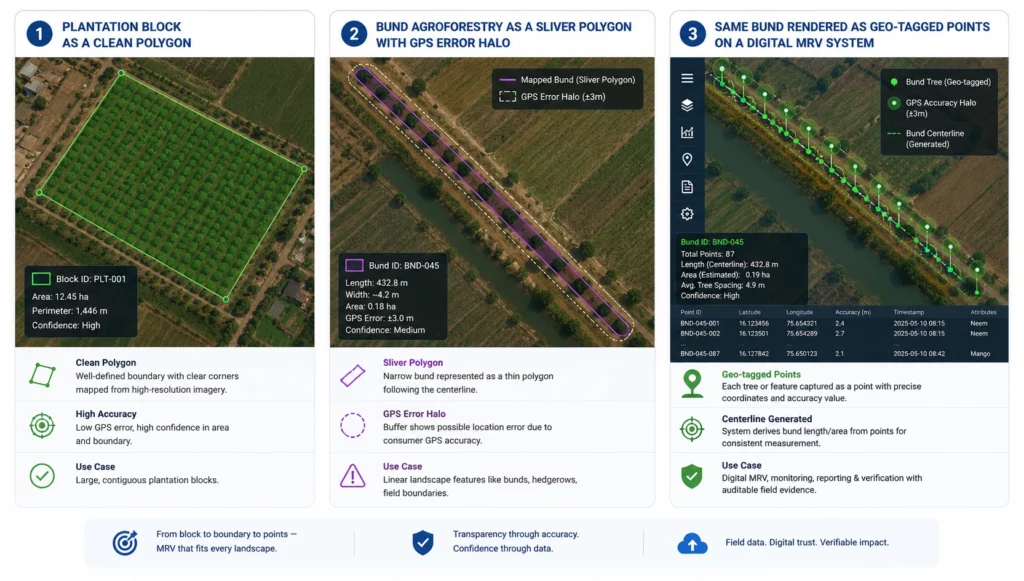
This distinction matters for monitoring. Field bunds are linear a narrow strip a metre or two wide running between cultivated fields. Plantation blocks are dense, contiguous areas planted only with trees. A one-hectare plantation block might hold 1,100 trees in a tidy grid. The same hectare in bund agroforestry might hold 60–80 trees stretched along several hundred metres of boundary, often shared between two or three farmers. That linear geometry is what makes everything downstream mapping, ownership, carbon accounting harder.
What Is Bund Agroforestry?
Bund agroforestry is a boundary-planting agroforestry system where trees are integrated along the bunds of crop fields rather than inside them. The trees and the main crop share the same land parcel but occupy spatially distinct zones crops in the middle, trees on the edge. This is the defining feature that makes it attractive to smallholders.
Where you see it
India: Neem, mango, gliricidia and bamboo on paddy and millet bunds across Karnataka, Maharashtra, Tamil Nadu and Bihar
East Africa: Grevillea, casuarina and calliandra on maize and tea boundaries in Kenya, Rwanda and Ethiopia
Southeast Asia: Leucaena, gliricidia and fruit trees on rice paddies and home-garden borders in Indonesia, Vietnam and the Philippines
In all three regions, bund agroforestry has emerged less as a deliberate scientific design and more as a generational adaptation farmers planting what feeds them, protects soil, and does not get in the way of the main crop. Today, the same systems are being formally enrolled in carbon and sustainability programs.
Discover how agroforestry supports sustainable agriculture and why it is gaining momentum across global supply chains and climate initiatives.
Bund agroforestry stacks six measurable benefits improved soil health, water conservation, additional income, biodiversity, carbon sequestration, and windbreak protection onto land that is already in agricultural use. Few other rural interventions deliver this combination without trade-offs.
Improved Soil Health
Tree roots stabilise the bund itself and pump nutrients up from deeper soil layers. Leaf litter from species like gliricidia and leucaena adds nitrogen and organic matter to the topsoil, reducing fertiliser dependency over time.
Water Conservation
Trees increase infiltration and reduce surface runoff. In semi-arid regions, mature bund trees can measurably raise local soil moisture and reduce the velocity at which monsoon rains wash sediment off the field.
Additional Farmer Income
Fruit (mango), fodder (gliricidia, leucaena), fuelwood (casuarina), timber (grevillea) and medicinal uses (neem) all open income streams that crops alone cannot. For smallholders managing one or two hectares, even 50–100 productive boundary trees can meaningfully diversify household income.
Biodiversity Enhancement
Boundary trees act as habitat corridors and re-introduce structural diversity into monoculture landscapes. Birds, pollinators and beneficial insects return to fields where bund trees provide nesting and refuge.
Carbon Sequestration
Above-ground biomass and tree-root systems lock away carbon dioxide. Bund trees may be fewer in number per hectare than a plantation block, but spread across millions of smallholder farms they represent one of the largest untapped reservoirs of nature-based climate mitigation in the Global South.
Windbreak Protection
A row of mature trees breaks wind speed by 40–60% on the leeward side, reducing crop desiccation, protecting flowers from blow-off during pollination, and lowering moisture stress in dry-season crops.
Open Bunds vs Closed Bunds
Open bunds let water drain freely between fields; closed bunds hold water inside the field for irrigation. The choice between them is driven by rainfall, crop type, and soil and it changes how trees are planted, monitored, and counted.
What are open bund systems?
Open bunds are low ridges with gaps or culverts that allow excess water to drain. They are common in upland crops, millet, vegetables, and any field where waterlogging would damage the crop. Trees on open bunds tolerate periodic drying neem, casuarina, and grevillea are typical.
What are closed bund systems?
Closed bunds are continuous, sealed ridges built to retain standing water the classic geometry of paddy rice fields and water-harvesting plots. Trees here must tolerate periodic waterlogging or be planted only on the outer face of the bund. Mango, gliricidia and leucaena are common where the bund is wide enough.
Which configuration is more common?
Globally, open bund systems dominate by area because rainfed agriculture covers more land than irrigated paddy. But in monsoon Asia, closed paddy bunds are where the densest and most numerous bund trees are found, particularly across Bihar, West Bengal, Bangladesh and the deltas of Vietnam and Myanmar.
Attribute
Open Bunds
Closed Bunds
Water behaviour
Drains freely between fields
Retains standing water
Typical crops
Millet, vegetables, upland cereals
Paddy rice, water-harvesting plots
Common tree species
Neem, casuarina, grevillea
Mango, gliricidia, leucaena
Tree density per km of bund
Moderate (every 5–8 m)
High (every 3–5 m)
Mapping complexity
Lower — fewer overlaps
Higher — denser, narrower, more shared boundaries
Explore how agroforestry contributes to carbon outcomes and discover the strategies organizations are using to design, monitor, and scale successful agroforestry programs.
Why Bund Agroforestry Is Popular Among Smallholders
Smallholders favour bund agroforestry because it costs almost nothing, takes almost no crop area, and pays back across multiple time horizons fodder this season, fuelwood next year, timber in a decade. It is the rare intervention that does not ask farmers to choose.
Minimal impact on crop area
A two-hectare farm planted with trees on bunds loses perhaps 2–4% of its productive area. Compared with a block plantation that would consume the entire field, this is the difference between adoption and rejection.
Multi-purpose tree species
Most bund species deliver more than one product. Gliricidia gives nitrogen-fixing fodder, fuelwood, and a quick-growing canopy. Mango gives fruit, shade and timber. This stacking is what smallholders price into the decision.
Lower investment requirements
Seedling cost is low, no land has to be cleared, no irrigation needs to be redesigned. Many programs distribute saplings for free or at subsidised cost, making the on-ground cash outlay close to zero.
Long-term livelihood benefits
Bund agroforestry builds an asset that compounds. A neem planted today is income, shade, and inheritance for the next generation. This long-tail economics is exactly why bund agroforestry has survived in farmer practice for centuries before becoming a carbon project category.
Smallholders adopt bund agroforestry not because they have read the agronomy literature, but because the system matches the actual decision rules they use minimise downside, diversify income streams, plant what you can eat or sell, and never give up cropable land.
Common Tree Species Used in Bund Agroforestry
Neem, mango, gliricidia, grevillea, casuarina and leucaena are the six species that dominate bund plantings across South Asia and Africa. Each was selected by farmers not foresters for a specific combination of resilience, utility and growth rate.
Species
Primary use
Best suited for
Carbon profile
Neem
Medicinal, biopesticide, shade
Semi-arid open bunds, India
Moderate, long-lived
Mango
Fruit, timber, shade
Sub-humid bunds, paddy edges
High biomass, long-lived
Gliricidia
Fodder, green manure, fuelwood
Closed bunds, mixed cropping
Fast carbon accrual, coppices well
Grevillea
Timber, fuelwood, shade
East African highlands
High, fast-growing
Casuarina
Fuelwood, windbreak, pulp
Coastal and sandy soils
Very high, nitrogen-fixing
Leucaena
Fodder, fuelwood, green manure
Drylands, mixed bund systems
Fast, nitrogen-fixing
Species choice changes the entire MRV story. A grevillea-heavy project in Kenya will have different carbon accrual curves, survival risks and inventory cadence than a neem-heavy project in Rajasthan. Any monitoring system has to handle that diversity at the tree level, not the average.
Challenges in Bund Agroforestry Projects
The agronomy is the easy part. The hard part is governance, ownership, monitoring and replacement at scale, across thousands of farmers and tens of thousands of trees. These are the operational frictions where most bund agroforestry programs stall.
Shared Boundaries Between Farmers
A bund is usually shared between two adjacent farmers. Who plants? Who waters? Who benefits when the tree produces? Programs that do not resolve this upfront watch trees die from neglect or get cut by the farmer who feels they have no claim.
Tree Ownership Issues
Carbon programs need to attribute every tree to a specific farmer. On bunds, this is often unclear and the legal record (where one exists) rarely captures bund-line plantings. Without resolved ownership, no payment can be made and no carbon credit can be issued.
Survival Monitoring
Seedling mortality in the first two years can run from 15% to 40% depending on rainfall, browsing pressure and species. Without a structured monitoring cadence, programs report planting numbers not surviving numbers and lose credibility with auditors and funders.
Species Diversity
A real bund landscape mixes six or eight species across thousands of farms. Generic growth curves do not apply. Monitoring systems have to know which species is at which GPS point, with which farmer, planted in which year.
Replacement Tracking
When a tree dies and is replanted, the project carbon math changes. Replacements have a new planting date, a new carbon curve and (often) a new species. Few paper-based systems track this; most carbon registries now require it.
Long-Term Maintenance
Bund trees need protection from grazing, pruning to keep them from shading the crop, and periodic gap-filling. A program that pays for planting but not for ten years of stewardship leaves farmers without incentive to keep the trees alive.
What project teams are actually hired to do: • Prove the trees exist and survived (audit-ready evidence) • Attribute every tree to a farmer (for payment + ownership) • Capture species, year and growth at the tree level (for carbon math) • Report impact in a form a carbon registry or buyer will accept • Scale all of the above to 10,000+ farmers without breaking the field operations team
Why Polygon Mapping Is Difficult in Bund Agroforestry
Polygon mapping in bund agroforestry projects is difficult because the trees are arranged in narrow linear strips along shared, irregular boundaries geometry that breaks the standard plot-polygon assumptions used in EUDR mapping, carbon registries and remote sensing tools. This is the single biggest reason bund agroforestry programs struggle to translate field reality into auditable data.
Discover why polygon mapping plays a critical role in carbon and compliance initiatives and learn the best practices for building trustworthy geospatial records.
Most polygon mapping tools assume an area a square paddock, a coffee plot, a polygon of palm. A bund is a line, often only a metre or two wide. Drawing a polygon around a single row of trees produces a sliver shape that some satellite layers and GIS tools cannot process reliably, and that carbon registries flag for review.
Narrow boundary strips
GPS error in low-end smartphones can range from 3 to 10 metres. On a 2-metre-wide bund, that error puts half your trees outside the polygon you drew. Without high-accuracy capture (RTK or post-processed kinematic) or careful field protocols, geo-data on bund trees is structurally noisy.
Neighbouring farmer overlaps
Because bunds are shared, a single line of trees can sit between Farmer A’s polygon and Farmer B’s polygon. If the trees are counted once for Farmer A and once for Farmer B, the project double-counts. If they are counted only once, one farmer loses payment. Resolving this requires explicit attribution logic, not just geometry.
Carbon accounting challenges
Voluntary carbon registries Verra, Gold Standard, Plan Vivo increasingly demand tree-level geo-data with provenance. Linear bund geometry does not fit cleanly into hectare-based biomass models, forcing project developers to use point-based tree inventories layered onto farm polygons. That is technically achievable but operationally heavy without the right MRV platform.
The mismatch between linear bund geometry and area-based polygon tooling is the single most common reason agroforestry projects get downgraded or rejected during third-party audit even when the trees themselves are real and growing.
Tree Monitoring in Bund Agroforestry
Credible tree monitoring in bund agroforestry rests on four data points captured per tree: a geo-tagged location, a photo, a survival status, and a periodic growth measurement. Without all four, the project cannot defend itself in audit.
Discover the key methods and technologies used to monitor trees in agroforestry systems and learn how digital tools can help scale impact across landscapes.
Every tree is captured as a GPS point with metadata species, planting date, farmer ID, plot ID. Modern field apps capture this in seconds and store it offline for later sync, which is essential in low-connectivity areas.
Photo evidence
A timestamped, GPS-stamped photo at planting and at each subsequent visit creates an immutable evidence trail. Auditors increasingly require this as the minimum bar for proof of existence, especially for carbon credits.
Survival rate monitoring
A scheduled cadence typically 3, 12 and 24 months after planting captures whether each tree is still alive. Survival rate is the single most important number in any agroforestry project; without it, all downstream impact claims are speculative.
Growth measurements
Diameter at breast height (DBH) and tree height feed directly into biomass equations and carbon calculations. Captured every 12–24 months, these measurements anchor the carbon claim in observation, not in averages from a literature table.
Carbon Sequestration in Bund Agroforestry
Bund trees sequester carbon in three pools above-ground biomass, below-ground roots, and soil organic carbon and across millions of smallholder farms they represent a material reservoir of low-cost nature-based mitigation. The maths is real; the proof is what is hard.
How bund trees store carbon
A mature neem on a bund can store roughly 200–300 kg of CO₂-equivalent over a 20-year horizon, depending on growth conditions. Multiply by 50–80 trees per hectare of bund-equivalent linear length, then by tens or hundreds of thousands of farmers in a program, and the total reaches industrially relevant scale.
Why bund systems matter for climate action
Unlike plantation blocks, bund agroforestry does not compete with food production. This makes it one of the few climate interventions that delivers carbon sequestration, farmer income, and food security on the same hectare a stack that policymakers, donors, and carbon buyers increasingly prioritise.
Potential role in carbon projects
Bund agroforestry is eligible under most major voluntary carbon standards, provided the project can produce tree-level evidence and demonstrate additionality (the trees would not have been planted without the project). The eligibility is well established. The operational MRV that is where projects either succeed or stall.
Designing a bund agroforestry project? See how TraceX’s Digital MRV platform handles farmer onboarding, polygon mapping and tree-level monitoring in one system.
Why Digital MRV Is Important for Bund Agroforestry Projects
Digital MRV (Measurement, Reporting and Verification) turns bund agroforestry from a well-meaning intervention into a fundable, auditable, scalable program. Without it, every program runs on field notebooks, hopeful estimates, and reports that fall apart under audit scrutiny.
Farm digitization
Every farmer’s plot is captured as a digital record boundaries, ownership, planted area, crop history. This becomes the spine on which every tree-level event hangs.
Polygon mapping
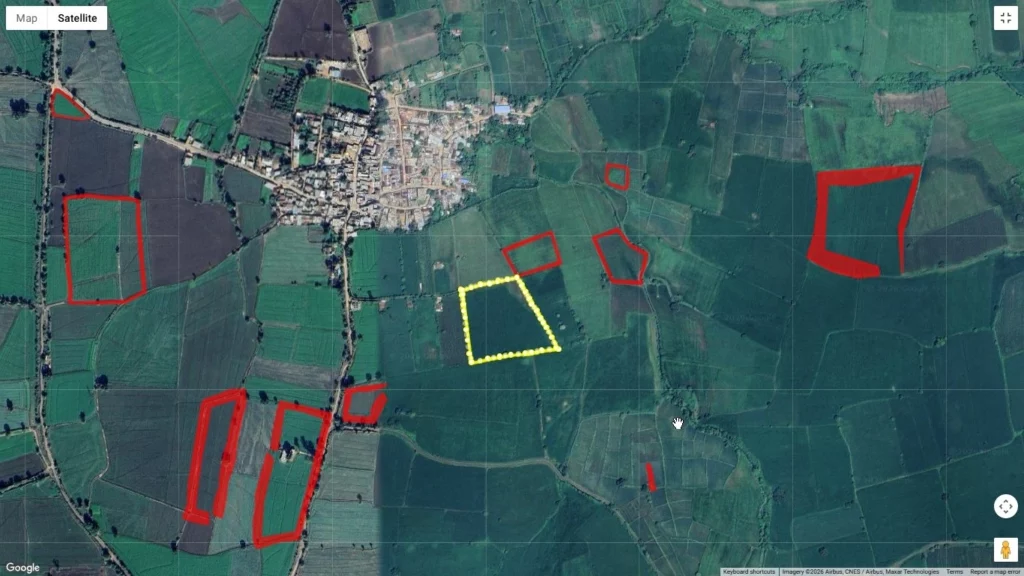
Farm polygons are drawn either by field officers walking the boundary with a GPS app or by validating remote-sensing-derived polygons against satellite imagery. Bund lines are captured as linear features layered onto the polygon, with each tree as a point feature on that line.
Tree geo-tagging
Each tree gets a unique ID, GPS location, species, planting date, and farmer attribution. This is the unit of record for every downstream metric survival, growth, carbon.
Audit trails
Every action planted, photographed, measured, replaced is recorded with timestamp, user, and (ideally) blockchain-backed immutability. When a third-party auditor arrives, the project does not scramble. The history is already there.
Impact reporting
CSRD, TNFD, SBTi, Verra, Gold Standard every reporting framework now wants tree-level, traceable evidence. Digital MRV makes that reporting a query, not a months-long manual data assembly exercise.
Discover how dMRV is helping agroforestry projects scale impact, improve transparency, and support carbon and sustainability objectives.
TraceX brings together farmer onboarding, polygon mapping, tree inventory, monitoring, and ESG/carbon reporting in a single Digital MRV platform purpose-built for emerging-market agroforestry. The platform was designed from the start for the operational reality of bund systems narrow boundaries, smallholder devices, intermittent connectivity, and audit-grade evidence requirements.
Farmer onboarding
Multilingual, offline-first mobile apps let field officers register farmers, capture KYC, geotag plots, and record household profiles without needing connectivity. Once the device hits a network, everything syncs.
Farm polygon mapping
GPS polygon capture validated against satellite imagery. For bund systems, linear features are captured as line geometries layered on the parcel polygon, so trees on shared boundaries can be attributed unambiguously to the correct farmer.
Tree inventory management
Every tree is registered with a unique ID, species, planting date, GPS location, photo and farmer attribution. Replacements, mortality and growth measurements are captured against the same record preserving a continuous lifecycle history per tree.
Monitoring and verification
Configurable monitoring cadences (3 / 12 / 24 months) drive structured field visits. Survival, growth and condition data feed dashboards in real time. Photo evidence with GPS and timestamp is immutable and exportable for third-party audit.
ESG and carbon reporting
One-click export of audit-ready reports aligned to CSRD, SBTi, SBTN, TNFD and the major voluntary carbon registries. Blockchain-backed data integrity ensures the same numbers appear in the buyer report, the registry submission, and the internal dashboard.
Book a personalized demo with TraceX experts to see how our platform can help digitize field operations, strengthen impact reporting, and support carbon and sustainability goals across your agroforestry initiatives.
Bund Trees May Be Small, but Their Impact Is Significant
Trees on bunds are easy to dismiss because there are few of them per hectare and they sit at the margins of the field. That is exactly why they are powerful. They cost nothing in crop area, they stack six measurable benefits, and they accumulate across millions of smallholders into a climate, livelihood and biodiversity dividend nothing else can match.
The pivot from agronomic possibility to verifiable program rests on one thing digital infrastructure. Farmer onboarding at scale. Polygon and linear feature mapping. Tree-level geo-tagging and lifecycle tracking. Audit-ready reports a buyer or registry will accept on first submission. That is the work TraceX exists to do.
Bund agroforestry is not new. What is new is the ability to count it, prove it, and pay for it at the scale climate goals now demand.
Frequently Asked Questions (FAQ’s)
What is bund agroforestry and why is it important?
Bund agroforestry is the practice of planting trees along the raised earthen boundaries of crop fields. It is important because it delivers soil conservation, water retention, additional farmer income, biodiversity, carbon sequestration and windbreak protection all without reducing the cropped area, which makes it uniquely attractive in smallholder landscapes across India, Africa and Southeast Asia.
Why is polygon mapping difficult in bund agroforestry projects?
Polygon mapping is difficult because bund trees are arranged in narrow linear strips along shared, irregular field boundaries. Standard area-based polygon tools struggle with sliver geometries, GPS error often exceeds the bund width, and shared boundaries between farmers create attribution problems. Resolving this requires a Digital MRV platform that supports linear features and point-based tree inventories alongside farm polygons.
Which tree species are best for bund agroforestry?
The most widely used species are neem (medicinal, shade), mango (fruit, timber), gliricidia (fodder, green manure), grevillea (timber, fuelwood), casuarina (windbreak, fuelwood) and leucaena (fodder, nitrogen fixation). Species choice depends on rainfall, soil, bund type (open vs closed) and the farmer’s priority fodder, fuel, fruit or carbon.
Can bund agroforestry generate carbon credits?
Yes. Bund agroforestry is eligible under most major voluntary carbon registries including Verra, Gold Standard and Plan Vivo, provided the project can demonstrate additionality and provide tree-level geo-tagged evidence with survival monitoring and growth data. Digital MRV is what makes that evidence layer practically possible at smallholder scale.
How does digital MRV help in bund agroforestry projects?
Digital MRV (Measurement, Reporting and Verification) replaces paper notebooks with a structured digital system that captures farmer profiles, farm polygons, tree-level geo-tags, photo evidence, survival data and growth measurements. It produces audit-ready reports aligned to CSRD, TNFD and carbon registry standards turning bund agroforestry from a well-intentioned activity into a fundable, scalable program.
Start using TraceX
Transparency, Trust, & Success for your Climate Journey.
We use cookies on our website to give you the most relevant experience by remembering your preferences and repeat visits. By clicking “Accept All”, you consent to the use of ALL the cookies. However, you may visit "Cookie Settings" to provide a controlled consent.
This website uses cookies to improve your experience while you navigate through the website. Out of these, the cookies that are categorized as necessary are stored on your browser as they are essential for the working of basic functionalities of the website. We also use third-party cookies that help us analyze and understand how you use this website. These cookies will be stored in your browser only with your consent. You also have the option to opt-out of these cookies. But opting out of some of these cookies may affect your browsing experience.
Necessary cookies are absolutely essential for the website to function properly. These cookies ensure basic functionalities and security features of the website, anonymously.
Cookie
Duration
Description
cookielawinfo-checkbox-analytics
11 months
This cookie is set by GDPR Cookie Consent plugin. The cookie is used to store the user consent for the cookies in the category "Analytics".
cookielawinfo-checkbox-functional
11 months
The cookie is set by GDPR cookie consent to record the user consent for the cookies in the category "Functional".
cookielawinfo-checkbox-necessary
11 months
This cookie is set by GDPR Cookie Consent plugin. The cookies is used to store the user consent for the cookies in the category "Necessary".
cookielawinfo-checkbox-others
11 months
This cookie is set by GDPR Cookie Consent plugin. The cookie is used to store the user consent for the cookies in the category "Other.
cookielawinfo-checkbox-performance
11 months
This cookie is set by GDPR Cookie Consent plugin. The cookie is used to store the user consent for the cookies in the category "Performance".
viewed_cookie_policy
11 months
The cookie is set by the GDPR Cookie Consent plugin and is used to store whether or not user has consented to the use of cookies. It does not store any personal data.
Functional cookies help to perform certain functionalities like sharing the content of the website on social media platforms, collect feedbacks, and other third-party features.
Performance cookies are used to understand and analyze the key performance indexes of the website which helps in delivering a better user experience for the visitors.
Analytical cookies are used to understand how visitors interact with the website. These cookies help provide information on metrics the number of visitors, bounce rate, traffic source, etc.
Advertisement cookies are used to provide visitors with relevant ads and marketing campaigns. These cookies track visitors across websites and collect information to provide customized ads.
Download the 2026 Traceability Scorecard and Benchmark Your Supply Chain Across 10 Critical Capabilities.
Download our eBook
Don’t Wait for an Audit to Find Your EUDR Gaps
The 2026 Simplification Package changes how HS codes, DDS pass-through and geolocation rules apply to you. Get the free guide and 20-point readiness checklist before enforcement catches you unprepared.