Biochar dMRV: A Complete Guide to Monitoring, Reporting, and Verifying Biochar Carbon Removal
Published
, 16 minute read
Share this article
Quick summary: Biochar dMRV (digital Monitoring, Reporting, and Verification) is the technology stack that captures, processes, and submits the data needed to issue biochar carbon removal credits. It connects feedstock sourcing, pyrolysis production, biochar output testing, and end-use application into a single digital record one that registries, Validation and Verification Bodies (VVBs), and corporate buyers can audit without […]
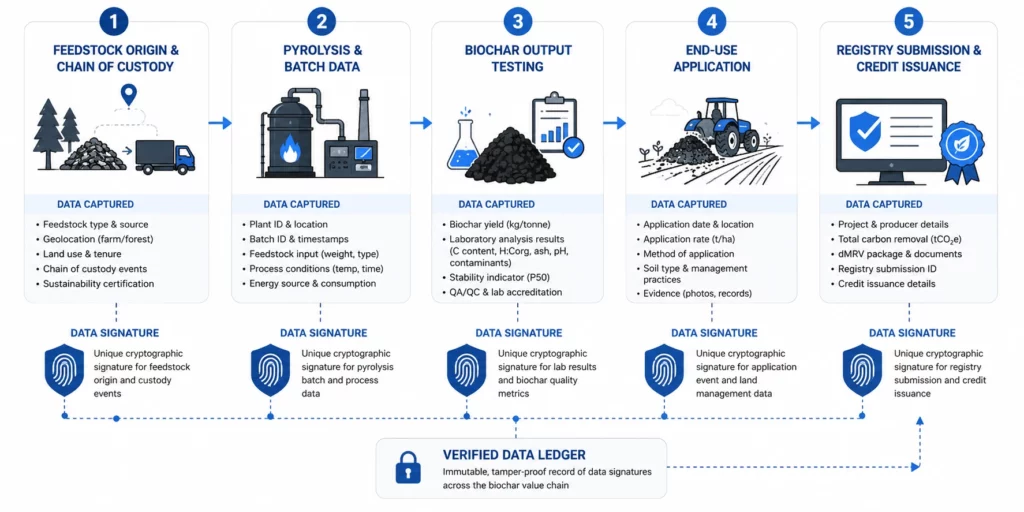
Biochar dMRV (digital Monitoring, Reporting, and Verification) is the technology stack that captures, processes, and submits the data needed to issue biochar carbon removal credits. It connects feedstock sourcing, pyrolysis production, biochar output testing, and end-use application into a single digital record one that registries, Validation and Verification Bodies (VVBs), and corporate buyers can audit without ambiguity. In practice, biochar dMRV replaces the spreadsheets, paper logs, and disconnected tools most early projects relied on with a continuous, sensor-fed, blockchain-anchored evidence trail.
This guide walks through the six operational layers of biochar dMRV feedstock traceability, measurement, carbon accounting, verification, platform technology, and procurement and what each one demands from project developers in 2026.
Key Takeaways Biochar dMRV is the digital system that tracks every step of a biochar carbon project from feedstock origin to carbon credit issuance in a format that registries like Puro.earth and Verra accept as audit evidence. Three things separate credible biochar projects from rejected ones: verifiable feedstock chain of custody, batch-level production data, and conservative carbon accounting tied to recognized methodologies. Spreadsheets and PDFs no longer pass VVB scrutiny. Purpose-built dMRV platforms that combine IoT, AI document parsing, and immutable audit trails are now the operating standard for any biochar project targeting credits at scale.
What Is Biochar dMRV?
The biochar market is scaling fast but verification is the bottleneck. • The global biochar market was valued at roughly USD 600M in 2023 and is forecast to surpass USD 3B by 2030 (Source: Grand View Research, 2024). • Puro.earth has issued more biochar CO2 Removal Certificates than any other engineered removal category as of 2024 • Verra’s VM0044 methodology for biochar carbon sequestration was approved in 2023 (Source: Verra, 2023). • Carbon buyer due diligence rejection rate for biochar credits without digital MRV evidence: estimated 30–50%
The demand for biochar carbon removal is real, the methodologies exist, but the deals fall apart when project developers cannot produce data that holds up to verification. That gap is exactly what dMRV closes.
Why Feedstock Traceability Is the Foundation of Every Biochar Carbon Project
Feedstock traceability is the single largest determinant of whether a biochar project earns issuance. If a registry or VVB cannot verify where the biomass came from, when it was harvested, who handled it, and whether it is sustainable, the entire project’s carbon math collapses regardless of how efficient the pyrolysis unit is. This is why every credible methodology (Puro.earth, Verra VM0044, EBC) front-loads feedstock requirements before measurement requirements.
Why Feedstock Traceability Matters in Biochar Carbon Projects
Biochar’s carbon removal claim depends on a counterfactual: the biomass would otherwise have decomposed and released its carbon back to the atmosphere. That counterfactual is only credible if the feedstock is:
Sustainably sourced — no deforestation, no land-use change, no displacement of food crops
Traceable to a known origin — farm, forestry residue site, sawmill, agro-processor
Documented through chain of custody — every transfer, weighing, and storage event logged
Verifiable against a defined baseline — what would have happened to this biomass otherwise
Without a digital feedstock record, a project cannot defend its baseline. And without a defensible baseline, it cannot defend its credits.
Chain of Custody for Biochar Feedstocks
A chain of custody (CoC) for biochar feedstock typically spans 4–7 nodes: farm/forestry site → aggregator/transporter → storage yard → pyrolysis facility. Every node needs three data points captured digitally:
Identity — who owns or moved the biomass (supplier ID, farm polygon, GPS log)
Quantity — weight on arrival and departure, ideally with weighbridge integration
Quality — moisture content, species mix, contamination flags, photos timestamped to the event
Feedstock Risk Management in Biochar Projects
Feedstock risk falls into four categories the dMRV system must surveil continuously:
Sourcing risk — origin legality, deforestation linkage, land tenure disputes
Continuity risk — single-supplier dependency, transport disruption, regulatory changes
A modern biochar dMRV platform from TraceX runs satellite-validated geolocation checks on every farm or forestry polygon supplying biomass, flags risk in real time, and stores the evidence in a tamper-proof ledger that VVBs can audit later.
How Digital Traceability Supports Puro.earth, Verra, and Other Carbon Standards
Both Puro.earth and Verra require feedstock data submitted as part of the project description and ongoing monitoring reports. The gap most projects hit: registries do not just want a number they want the evidence chain behind the number.
Digital traceability satisfies this requirement by exposing four things to the verifier: (1) where the data was captured, (2) when, (3) by whom, and (4) whether it has been altered since capture. Blockchain-anchored audit logs make tampering detectable; offline-first mobile capture extends evidence collection to remote farms where most agricultural residue is sourced.
What Data Should a Biochar dMRV System Capture?
A biochar dMRV system needs to capture three data classes continuously: biomass inputs, production conditions, and biochar outputs. Missing any one of these breaks the carbon math. The discipline is not in collecting more data it is in collecting the right data, batch-by-batch, in a way that survives independent audit.
Digital Monitoring for Biochar Production Facilities
At the pyrolysis stage, the dMRV system must monitor:
Reactor temperature profile (highest treatment temperature, HTT) — drives carbon stability and permanence
Residence time at HTT
Energy input and source (electricity, gas, syngas combustion)
Operating uptime and downtime per batch
Operator ID and shift log
These signals come from thermocouples, energy meters, and PLC outputs piped directly into the dMRV platform. Manual transcription introduces drift and creates a question every VVB asks: ‘How do we know this is the actual operating data?’
Capturing Biomass Inputs and Biochar Outputs Digitally
Every batch needs an input–output mass balance:
Biomass input weight (dry basis)
Biochar output weight
Conversion ratio (typically 25–35% for woody biomass at 500–700°C)
Carbon content of biochar (% C, lab-analyzed)
Hydrogen-to-organic-carbon (H/Corg) ratio — proxy for permanence under Puro.earth and EBC
This is where most early-stage projects fall over. They have rough biomass weights, no biochar weights, no lab analysis, and a notebook estimate of conversion ratio. A dMRV platform forces this discipline at the moment of operation — not three months later when a buyer asks for the data.
Moisture Content Tracking in Biochar Carbon Projects
Moisture content matters because it changes the carbon math. A 100 kg pile of biomass at 30% moisture only contains 70 kg of dry biomass and carbon claims must be on a dry-weight basis.
Best practice for moisture tracking in dMRV:
Sample moisture on arrival (handheld meter or oven-dried sample)
Sample again before feed-in to the reactor
Log photos of the sample, the meter reading, and the timestamp
Calculate dry-basis input automatically inside the dMRV system
Batch-Level Monitoring for Biochar Production
Every credit issued traces back to a specific batch. If batch-level data is missing or aggregated, the auditor cannot verify the issuance. Batch-level monitoring means assigning a unique batch ID at the moment biomass enters the reactor, and linking every downstream record output weight, lab analysis, application site, sale to buyer to that ID.
See how TraceX captures batch-level biochar data automatically from biomass weighing to lab results in a single audit-ready timeline.
How Biochar Carbon Removal Is Calculated and Accounted For
Biochar carbon removal is calculated as net carbon stored, adjusted for permanence, minus project emissions. The formula looks simple. The defensibility of every input is where verification lives or dies.
Biochar Carbon Removal Methodologies Explained
The two most active methodologies in 2026 are Puro.earth’s Biochar Methodology and Verra’s VM0044. The European Biochar Certificate (EBC) C-Sink is also widely accepted, especially in EU-linked transactions.
Dimension
Puro.earth Biochar
Verra VM0044
Type of credit
CO₂ Removal Certificate (CORC)
Verified Carbon Unit (VCU) for biochar
Permanence threshold
100+ years (adjusted by H/Corg)
Long-term storage; adjusted by recalcitrance
Feedstock scope
Sustainable biomass, waste-based preferred
Multiple eligible biomass categories
MRV approach
Production-side measurement + annual verification
Project-specific monitoring plan + verification
Adoption (2024–2026)
Largest engineered removal issuer
Growing under VCM 3.0 reform
The practical difference for a project developer is verification cadence and granularity Puro.earth pushes toward continuous production-side data (which is exactly what dMRV is built for), while Verra leans on a documented monitoring plan with periodic verification.
How Biochar Carbon Removal Is Calculated
The simplified equation that sits behind every biochar credit issuance:
Net CO₂ Removed = (Biochar mass × % Carbon × 3.667 × Permanence factor) − Project Emissions Where: • Biochar mass = dry mass of biochar produced per batch (tonnes) • % Carbon = measured carbon fraction (typically 70–90%) • 3.667 = stoichiometric conversion factor (C → CO₂) • Permanence factor = decay-adjusted fraction stable >100 years (function of H/Corg) • Project Emissions = feedstock transport, pyrolysis energy, biochar transport, application emissions
Every variable on the right-hand side needs a verifiable data source. That is the entire reason dMRV exists.
Biochar Carbon Permanence: What Project Developers Need to Know
Permanence, how long the biochar’s carbon remains stable in soil is the most scrutinized variable in biochar accounting. The conservative consensus, supported by EBC and Puro.earth, uses the H/Corg ratio as the permanence proxy:
H/Corg < 0.4 → 100+ year stability assumed (typical for high-temperature biochar)
H/Corg 0.4–0.7 → reduced credit fraction, often discounted
H/Corg > 0.7 → generally ineligible for permanence-based credits
This is why pyrolysis temperature and residence time monitoring (from Cluster 2) feed directly into carbon accounting. They are not separate workstreams.
Measuring Carbon Sequestration in Biochar Projects
Sequestration measurement combines lab analysis with operational data. Lab data — % C, H/Corg, ash, volatile matter is captured per batch and stored against the batch ID. Operational data biomass dry mass in, biochar mass out, energy used is pulled directly from the dMRV system. The credit calculation runs automatically against these inputs, eliminating the manual Excel reconciliation that introduces error and audit risk.
How Biochar Carbon Credits Are Verified
Verification is where dMRV stops being a ‘nice to have’ and becomes the project’s defense. A VVB is paid to find weaknesses in the project’s claim. The job of the dMRV system is to make those weaknesses non-existent or trivially answerable.
Preparing Biochar Projects for Third-Party Verification
VVBs typically run two passes: a desk review of the project description and monitoring report, and a site visit. The desk review queries cluster around five themes:
Feedstock origin and sustainability evidence
Batch-level production data continuity (no gaps)
Lab analysis chain of custody and accreditation
Calculation methodology and conservative assumptions
Audit-Ready Documentation for Biochar Carbon Projects
Audit-ready means three things, in order:
Complete: every required data point is present for every batch in the monitoring period
Verifiable: the data has a provenance trail who captured it, when, and on which device or sensor
Immutable: the data cannot be quietly altered after the fact; any correction is logged with reason and timestamp
This is exactly the discipline TraceX’s blockchain-backed data layer enforces by default making the ‘how do we know this hasn’t been changed’ question answerable in one click rather than a week of forensics.
dMRV for Puro.earth Biochar Projects
Puro.earth’s methodology expects production-side measurement and an annual verification cycle. The dMRV system needs to produce, on demand:
Monthly biomass input and biochar output records
Lab certificates per batch (% C, H/Corg, moisture, ash)
End-use evidence (where biochar was applied or stored)
dMRV for Verra Biochar Methodologies
Verra’s VM0044 anchors on a project-specific monitoring plan registered at validation. The plan itself becomes the verification contract. dMRV makes this manageable by mapping every data field in the monitoring plan to a structured capture point in the platform so when verification happens, the report exports against the plan’s exact requirements.
Why Spreadsheets Fail and What a Modern Biochar dMRV Platform Looks Like
Spreadsheets fail biochar projects for one structural reason: they cannot prove integrity. Excel rows can be edited silently. Files can be lost. Formulas can drift. None of these create issues when the data is internal they create existential issues when the data is the basis for a credit being issued, sold, and retired against a corporate net-zero claim.
Why Spreadsheets Fail for Biochar Carbon Projects
The five failure modes we see most often:
No audit trail — edits are invisible
Version sprawl — three versions of the same monitoring file, none reconciled
Manual transcription error — sensor reads typed by hand into a cell
No real-time visibility — the project manager finds out about a missing batch six months later
Not buyer-ready — corporate buyers’ due diligence teams reject spreadsheet evidence
Building a Biochar dMRV System: The Modern Stack
Layer
Spreadsheet-based MRV
Modern dMRV Platform (e.g., TraceX)
Feedstock capture
Paper logs, manual entry
Mobile app with GPS, photos, offline mode
Production data
Daily summary in Excel
Direct sensor feed, batch-level capture
Lab integration
PDFs emailed, manually transcribed
Lab API or scanned upload tied to batch ID
Carbon math
Excel formulas, manual review
Methodology-tied calculation engine
Audit trail
Effectively none
Immutable, blockchain-anchored event log
VVB readiness
2–6 weeks per query cycle
Sub-day query response with evidence packs
Registry submission
Manual document assembly
One-click export aligned to methodology
IoT and Sensors in Biochar Monitoring
The most useful IoT data points for biochar dMRV are reactor temperature (thermocouples), feedstock and biochar weights (weighbridge integration), energy meters, and moisture probes. The goal is not to instrument everything it is to instrument the variables that drive the credit calculation.
AI and Automation for Biochar MRV
AI shows up in three high-leverage places: (1) document parsing — extracting structured data from lab PDFs and supplier emails automatically, (2) anomaly detection — flagging a batch where conversion ratio is statistically off, and (3) risk scoring — flagging suppliers whose origin polygons sit in higher-risk geographies. TraceX uses agentic AI for exactly this in EUDR document parsing the same capability transfers directly to biochar feedstock document handling.
Blockchain for Biochar Carbon Credits: Hype or Value?
Useful, but not as a marketing decoration. Blockchain delivers concrete value when it is the substrate for the audit log: it makes data tampering detectable, gives every project event a permanent timestamp, and lets multiple parties (project developer, lab, VVB, buyer) verify the same record without trusting one central database. It is less useful as a separate ‘token’ wrapper around the credit unless integrated with the registry directly.
Digital Platforms for Biochar Carbon Management
A modern biochar dMRV platform combines: mobile + offline data capture for feedstock, sensor and weighbridge integrations for production, lab data ingestion, methodology-aligned calculation engines, blockchain-anchored audit logs, and one-click registry-aligned exports. TraceX’s Digital MRV platform was built around exactly this stack applied across biochar, regenerative agriculture, clean water, and biodiversity projects.
What Biochar Project Developers Actually Need from dMRV
The Job
What It Really Means
Get to issuance faster
Stop losing 8–14 weeks per verification cycle on data reconciliation.
Defend the project to a VVB
Answer any question with evidence in minutes, not weeks.
Onboard new feedstock suppliers without slowing operations
Capture KYC, land polygon, sustainability evidence in the field, offline if needed.
Prove integrity to buyers and ratings agencies
Produce a tamper-evident record that survives independent scrutiny.
Scale beyond pilot
Move from one site, one batch, one buyer — to multi-site, continuous issuance.
How TraceX Powers Biochar dMRV End-to-End
TraceX’s Digital MRV Platform was built to digitize the exact data architecture this pillar describes and it overlaps with the company’s compliance and sourcing platforms to handle the feedstock layer most pure-play carbon tools ignore.
What that looks like in practice for a biochar project:
Feedstock layer — digital supplier onboarding with geotagged polygons, sustainability checks, satellite validation, and offline-first mobile capture for remote sites.
Production layer — batch-level capture of biomass inputs, biochar outputs, moisture, energy use, and reactor conditions; lab data ingestion tied to batch ID.
Carbon accounting layer — methodology-aligned calculation engines for Puro.earth, Verra, and EBC; conservative permanence handling based on H/Corg.
Verification layer — audit-ready reports, immutable event logs on blockchain-backed infrastructure, evidence packs exportable in registry-required formats.
Integration layer — ERP and procurement integrations so feedstock spend, supplier data, and credit issuance live in the same source of truth.
See exactly how TraceX captures, calculates, and verifies biochar carbon data mapped to your target methodology (Puro.earth, Verra VM0044, or EBC).
Conclusion: Build the System Before You Need It
The biochar projects that issue credits at scale in 2026 share one trait: they treated dMRV as foundational infrastructure, not a compliance add-on. They captured feedstock data the day they signed their first supplier. They instrumented production from batch one. They mapped their carbon math to a recognized methodology before they ever talked to a verifier. And they chose a platform that could carry the data forward as the project grew.
The reverse is more common and more costly. Projects that retrofit dMRV during verification routinely lose 8–14 weeks per cycle, face higher VVB query volumes, and watch buyers walk away when due diligence reveals integrity gaps.
If you are planning, scaling, or verifying a biochar carbon project set the data architecture up correctly from the start.
Frequently Asked Questions (FAQ’s)
What is biochar dMRV?
Biochar dMRV is the digital system that monitors, reports, and verifies the data behind biochar carbon removal projects. It captures feedstock origin, pyrolysis production conditions, biochar lab results, and end-use evidence in a continuous, audit-ready record that registries like Puro.earth and Verra accept for credit issuance.
Why is feedstock traceability so important in biochar carbon projects?
Because the carbon removal claim depends on a counterfactual — that the biomass would otherwise have decomposed and released CO₂. Without verifiable feedstock origin and chain of custody, the registry and VVB cannot defend the baseline, and the project’s credits cannot be issued or retired confidently.
Can I run a biochar dMRV system on spreadsheets?
Technically yes, but it rarely passes scaled verification. Spreadsheets lack the audit trail, version control, and tamper-evidence that VVBs and corporate buyers now expect. Most projects that started on spreadsheets eventually migrate to a purpose-built dMRV platform during their first verification cycle.
What’s the difference between Puro.earth and Verra for biochar?
Puro.earth issues CO₂ Removal Certificates (CORCs) with a focus on production-side measurement and annual verification. Verra issues Verified Carbon Units (VCUs) under VM0044, which anchors on a project-specific monitoring plan validated at the start. The dMRV requirements overlap heavily but the verification cadence and document structure differ.
How does TraceX support biochar carbon projects?
TraceX’s Digital MRV Platform digitizes the full project lifecycle from supplier onboarding and feedstock chain of custody, to batch-level production data, lab integration, methodology-aligned carbon accounting, and registry-ready reporting. Its blockchain-backed audit layer addresses the integrity question VVBs and buyers ask first.
Start using TraceX
Transparency, Trust, & Success for your Climate Journey.
We use cookies on our website to give you the most relevant experience by remembering your preferences and repeat visits. By clicking “Accept All”, you consent to the use of ALL the cookies. However, you may visit "Cookie Settings" to provide a controlled consent.
This website uses cookies to improve your experience while you navigate through the website. Out of these, the cookies that are categorized as necessary are stored on your browser as they are essential for the working of basic functionalities of the website. We also use third-party cookies that help us analyze and understand how you use this website. These cookies will be stored in your browser only with your consent. You also have the option to opt-out of these cookies. But opting out of some of these cookies may affect your browsing experience.
Necessary cookies are absolutely essential for the website to function properly. These cookies ensure basic functionalities and security features of the website, anonymously.
Cookie
Duration
Description
cookielawinfo-checkbox-analytics
11 months
This cookie is set by GDPR Cookie Consent plugin. The cookie is used to store the user consent for the cookies in the category "Analytics".
cookielawinfo-checkbox-functional
11 months
The cookie is set by GDPR cookie consent to record the user consent for the cookies in the category "Functional".
cookielawinfo-checkbox-necessary
11 months
This cookie is set by GDPR Cookie Consent plugin. The cookies is used to store the user consent for the cookies in the category "Necessary".
cookielawinfo-checkbox-others
11 months
This cookie is set by GDPR Cookie Consent plugin. The cookie is used to store the user consent for the cookies in the category "Other.
cookielawinfo-checkbox-performance
11 months
This cookie is set by GDPR Cookie Consent plugin. The cookie is used to store the user consent for the cookies in the category "Performance".
viewed_cookie_policy
11 months
The cookie is set by the GDPR Cookie Consent plugin and is used to store whether or not user has consented to the use of cookies. It does not store any personal data.
Functional cookies help to perform certain functionalities like sharing the content of the website on social media platforms, collect feedbacks, and other third-party features.
Performance cookies are used to understand and analyze the key performance indexes of the website which helps in delivering a better user experience for the visitors.
Analytical cookies are used to understand how visitors interact with the website. These cookies help provide information on metrics the number of visitors, bounce rate, traffic source, etc.
Advertisement cookies are used to provide visitors with relevant ads and marketing campaigns. These cookies track visitors across websites and collect information to provide customized ads.
Download the 2026 Traceability Scorecard and Benchmark Your Supply Chain Across 10 Critical Capabilities.
Download our eBook
Don’t Wait for an Audit to Find Your EUDR Gaps
The 2026 Simplification Package changes how HS codes, DDS pass-through and geolocation rules apply to you. Get the free guide and 20-point readiness checklist before enforcement catches you unprepared.