Benefits of Restoration: Real, But Only If You Can Prove Them
Published
, 8 minute read
Share this article
Quick summary: The benefits of restoration — carbon, biodiversity, water, livelihoods — are real, but only bankable if measured. See why planting isn’t restoring, and how to prove outcomes.
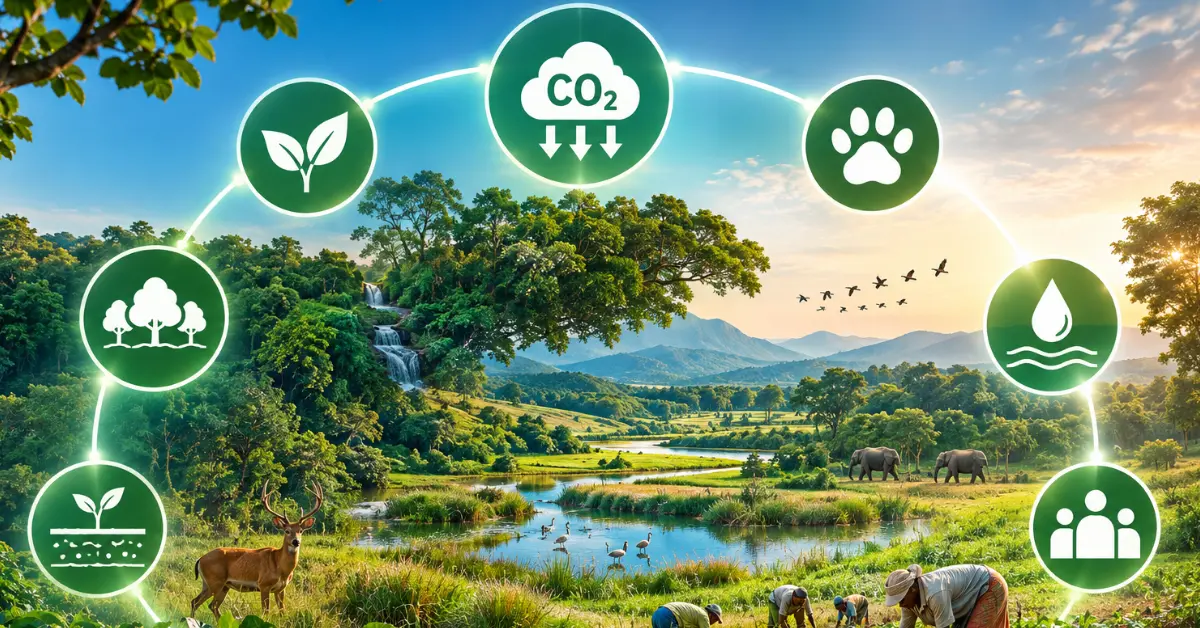
The main benefits of restoration are carbon sequestration, biodiversity recovery, cleaner and more reliable water, healthier soil, stronger climate resilience, and rural livelihoods and the economics are compelling, with the EU estimating every euro invested in restoration returns several times over. But two things are usually left out. First, these benefits belong to real restoration surviving, ecologically appropriate, whole-ecosystem restoration not to one-off tree planting; planting is not the same as restoring. Second, the benefits only become value finance, carbon and biodiversity credits, verified nature claims when they are measured and verified over time. The benefit that unlocks all the others is proof.
Key Takeaways
The benefits are real and well-evidenced. Carbon, biodiversity, water, soil, resilience and livelihoods the benefits of restoration are backed by global science and strong economic returns.
Planting is not restoring. The benefits belong to surviving, ecologically whole restoration not to tree-planting events, and carbon-first monocultures can even harm biodiversity.
A benefit is a promise until it’s measured. Outcomes play out over decades; without monitoring you can’t know whether the benefit actually happened.
Proof is what unlocks finance. Carbon and biodiversity credits, corporate nature claims and Nature Restoration Law targets all depend on verifiable outcomes.
Can you prove your restoration actually worked?
See how TraceX measures and verifies restoration outcomes carbon, biodiversity and survival so the benefits become bankable value.
The benefits of restoration are among the least controversial ideas in sustainability. Ecological restoration returning degraded forests, wetlands, peatlands, grasslands, mangroves, soils and farmland to health delivers a well-evidenced bundle of gains: it sequesters carbon, revives biodiversity, cleans and regulates water, rebuilds soil, buffers communities against floods and drought, and supports rural livelihoods. Note that restoration is broader than reforestation: planting trees is one tool, but restoring a peatland or a river can matter just as much.
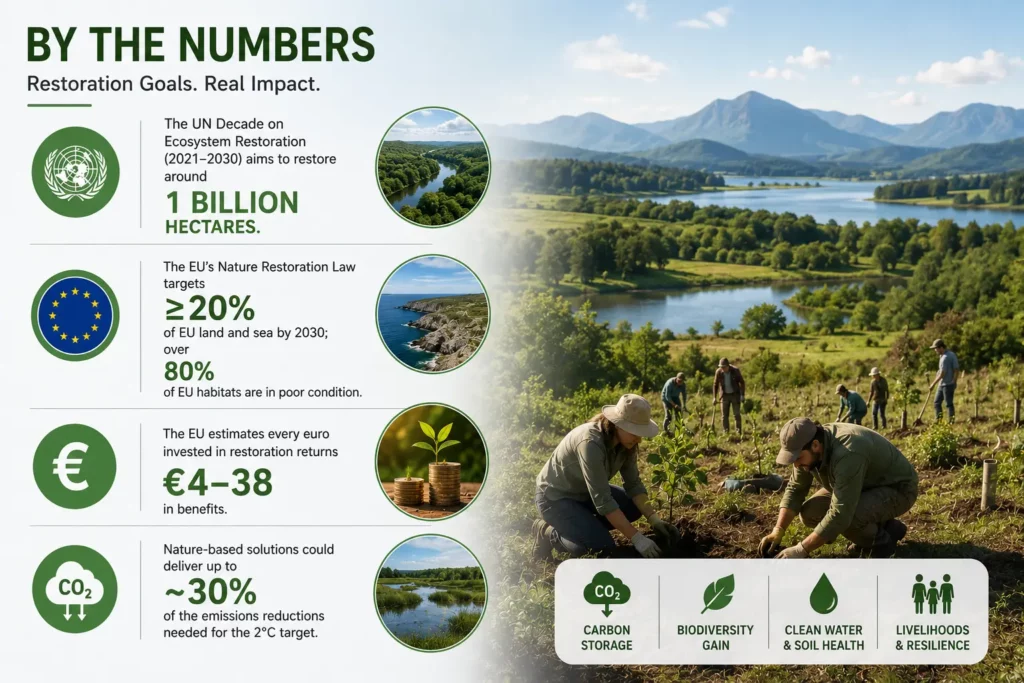
The momentum is real. The UN Decade on Ecosystem Restoration (2021–2030) aims to set restoration in motion across roughly a billion hectares; the Kunming-Montreal framework commits countries to restoring 30% of degraded ecosystems by 2030; and the EU’s Nature Restoration Law, in force since August 2024, sets binding targets to restore at least 20% of EU land and sea by 2030. The economics reinforce the case: the European Commission estimates every euro invested in restoration returns several times over through services like water regulation, carbon capture and flood protection. So if the benefits are this clear, why does so much restoration still fail? Because a benefit on paper and a benefit in the ground are two very different things.
Why the Benefits of Restoration Are a Proof Problem
Every benefit of restoration is a claim about the future carbon that will be stored, biodiversity that will return, water that will be regulated and the future has to actually arrive. Two things decide whether it does.
The first is that planting is not restoring. The world is full of tree-planting events where seedlings are put in the ground and abandoned, the wrong species are used, or a biodiverse habitat is replaced with a carbon-focused monoculture. Research is now explicit that a ‘tree-centric’, carbon-first approach can produce suboptimal or even negative outcomes for biodiversity. The benefits of restoration accrue only to restoration that is ecologically appropriate and, above all, that survives not to the photo taken on planting day.
The second is time. Restoration outcomes unfold over years and decades, and until they are measured, every benefit is a promise. Did the carbon stay stored, or did a fire reverse it? Did biodiversity recover, or did an invasive species take over? Did the community keep stewarding the land, or did it revert? Without monitoring, nobody knows and unverifiable outcomes cannot become finance. Carbon and biodiversity credits, corporate nature claims and Nature Restoration Law reporting all rest on measurement, reporting and verification. So the benefit that unlocks every other benefit of restoration is proof: planting is an event, restoration is an outcome, and only measurement tells them apart.
Africa’s Great Green Wall set out to restore a belt of degraded Sahel. Early efforts that simply planted seedlings and moved on saw high mortality, while the approach that worked protecting and nurturing natural regrowth delivered far more surviving trees per dollar. The benefits were real only where the restoration actually lived. The lesson: track survival, not seedlings planted.
Farmer-managed natural regeneration: less planting, more restoration
Across the Sahel, farmer-managed natural regeneration protecting and pruning the living rootstock already in the soil has regreened vast areas more cheaply and durably than planting campaigns. It is the clearest proof that restoration is an outcome, not a planting count. The lesson: the goal is a functioning ecosystem, not a number of trees.
Mangroves: the right site or nothing
Mangrove restoration promises exceptional ‘blue carbon,’ coastal protection and fisheries revival yet many mangrove planting projects fail because seedlings go into the wrong species or the wrong hydrology and simply die. The benefit depends entirely on doing it right and confirming it took. The lesson: verify establishment and survival, not just the number planted.
Discover How Regenerative Agriculture Builds Resilient Supply Chains
Restoration carbon projects have faced hard scrutiny over over-crediting, weak additionality and reversal when fires strike. The financial benefit of restoration is only as good as the measurement, reporting and verification behind the credit. The lesson: credible MRV satellite plus ground data plus permanence is what makes the benefit bankable.
How to Turn the Benefits of Restoration Into Verified Value
A platform built for restoration should do six things.
Set a baseline and monitor over time. Capture starting conditions and track change with satellite plus ground data, so outcomes are measured, not assumed.
Track survival, not seedlings planted. Follow what actually establishes and lives, because a planting count is not a restoration outcome.
Measure carbon and biodiversity together. Quantify both, so carbon goals don’t quietly erode the biodiversity the ecosystem depends on.
Build credit-grade MRV. Produce measurement, reporting and verification robust enough for carbon and biodiversity markets including permanence and reversal monitoring.
Track livelihoods and stewardship. Record community participation, benefit-sharing and tenure, because restoration only lasts when people are invested in it.
Make outcomes claim-ready. Turn verified data into evidence that stands up for corporate nature claims and Nature Restoration Law reporting.
Unlock the Power of DMRV for High-Integrity Carbon Credits
TraceX’s Digital Measurement, Reporting, and Verification (DMRV) platform helps organizations manage restoration projects by digitizing the entire monitoring and verification lifecycle. It enables field teams to capture baseline and restoration data through mobile applications, monitor project areas using satellite imagery and geospatial analytics, and collect evidence on tree survival, biodiversity, and land-use changes over time. The platform consolidates field observations, remote sensing data, and project documentation into a centralized system, providing transparent, audit-ready reporting for carbon standards, investors, and sustainability programs. By automating data collection, monitoring progress, and supporting credible verification, TraceX helps restoration projects demonstrate measurable environmental impact, improve project integrity, and streamline the generation of high-quality carbon credits and sustainability reports.
Turn the benefits of restoration into proof and proof into funding.
TraceX sets baselines, monitors carbon, biodiversity and survival over time, and builds credit-grade MRV so your restoration’s benefits are measured, verified and bankable.
Native species and a whole ecosystem, not a monoculture
Species and habitat indicators — not tree counts
Water & soil health
Restored hydrology and soil structure
Soil organic carbon, water-table and water-quality data
Climate resilience
Functioning, connected landscapes
Landscape connectivity and ecosystem-condition metrics
Livelihoods
Community stewardship and benefit-sharing
Income, participation and land-tenure tracking
Benefits of Restoration: Readiness Checklist
Before you claim a benefit, confirm you can prove it.
✓A baseline was captured before restoration began.
✓Outcomes are monitored over time with satellite and ground data.
✓Survival is tracked not just the number of trees or seedlings planted.
✓Carbon and biodiversity are measured together, not carbon alone.
✓MRV is robust enough for carbon and biodiversity credits, including permanence.
✓Community participation, benefit-sharing and tenure are recorded.
✓Verified outcomes are ready for nature claims and Nature Restoration Law reporting.
Frequently Asked Questions
What are the main benefits of ecosystem restoration?
Carbon sequestration, biodiversity recovery, cleaner and more reliable water, healthier soil, greater climate resilience, and rural livelihoods alongside strong economic returns, with the EU estimating several euros of benefit for every euro invested.
Is restoration the same as reforestation?
No. Reforestation replanting or regrowing forest is one type of restoration. Ecosystem restoration is broader, covering wetlands, peatlands, grasslands, mangroves, soils, rivers and degraded farmland, each with its own benefits and methods.
Why do so many restoration projects fail?
Often because planting is treated as the goal rather than a surviving, functioning ecosystem wrong species, wrong site, no aftercare, or carbon-focused monocultures. Without monitoring, failure can go unnoticed for years.
How do restoration benefits become carbon or biodiversity credits?
Through credible measurement, reporting and verification (MRV): a baseline, ongoing monitoring of carbon and biodiversity, and permanence checks. Without verifiable outcomes, benefits cannot be turned into tradable credits or defensible claims.
What does the EU Nature Restoration Law require?
It sets binding targets to put restoration measures in place across at least 20% of EU land and sea by 2030, expanding to all degraded ecosystems by 2050, backed by national restoration plans and monitoring.
Start using TraceX
Transparency, Trust, & Success for your Climate Journey.
We use cookies on our website to give you the most relevant experience by remembering your preferences and repeat visits. By clicking “Accept All”, you consent to the use of ALL the cookies. However, you may visit "Cookie Settings" to provide a controlled consent.
This website uses cookies to improve your experience while you navigate through the website. Out of these, the cookies that are categorized as necessary are stored on your browser as they are essential for the working of basic functionalities of the website. We also use third-party cookies that help us analyze and understand how you use this website. These cookies will be stored in your browser only with your consent. You also have the option to opt-out of these cookies. But opting out of some of these cookies may affect your browsing experience.
Necessary cookies are absolutely essential for the website to function properly. These cookies ensure basic functionalities and security features of the website, anonymously.
Cookie
Duration
Description
cookielawinfo-checkbox-analytics
11 months
This cookie is set by GDPR Cookie Consent plugin. The cookie is used to store the user consent for the cookies in the category "Analytics".
cookielawinfo-checkbox-functional
11 months
The cookie is set by GDPR cookie consent to record the user consent for the cookies in the category "Functional".
cookielawinfo-checkbox-necessary
11 months
This cookie is set by GDPR Cookie Consent plugin. The cookies is used to store the user consent for the cookies in the category "Necessary".
cookielawinfo-checkbox-others
11 months
This cookie is set by GDPR Cookie Consent plugin. The cookie is used to store the user consent for the cookies in the category "Other.
cookielawinfo-checkbox-performance
11 months
This cookie is set by GDPR Cookie Consent plugin. The cookie is used to store the user consent for the cookies in the category "Performance".
viewed_cookie_policy
11 months
The cookie is set by the GDPR Cookie Consent plugin and is used to store whether or not user has consented to the use of cookies. It does not store any personal data.
Functional cookies help to perform certain functionalities like sharing the content of the website on social media platforms, collect feedbacks, and other third-party features.
Performance cookies are used to understand and analyze the key performance indexes of the website which helps in delivering a better user experience for the visitors.
Analytical cookies are used to understand how visitors interact with the website. These cookies help provide information on metrics the number of visitors, bounce rate, traffic source, etc.
Advertisement cookies are used to provide visitors with relevant ads and marketing campaigns. These cookies track visitors across websites and collect information to provide customized ads.
Download the 2026 Traceability Scorecard and Benchmark Your Supply Chain Across 10 Critical Capabilities.
Download our eBook
Don’t Wait for an Audit to Find Your EUDR Gaps
The 2026 Simplification Package changes how HS codes, DDS pass-through and geolocation rules apply to you. Get the free guide and 20-point readiness checklist before enforcement catches you unprepared.