Battery Due Diligence Obligations: What Articles 47 to 52 Require Before August 2027
Published
, 7 minute read
Share this article
Quick summary: Battery Due Diligence Obligations under Articles 47 to 52 apply from 18 August 2027. See who is in scope, what each article requires and how to prepare.
Battery due diligence obligations are the supply chain rules in Articles 47 to 52 of the EU Battery Regulation (EU) 2023/1542. From 18 August 2027, in-scope companies placing batteries on the EU market must run a due diligence policy for cobalt, natural graphite, lithium and nickel, backed by a management system, risk management, verification by a notified body and public disclosure.
Battery due diligence obligations turn responsible sourcing from a sustainability promise into a verified legal duty. The start date moved once already, from August 2025 to August 2027, but the work behind it has not shrunk. Mapping refiners and mines takes months, notified body capacity is limited, and the battery passport will soon point every buyer to your due diligence report.
Key takeaways
Application date: 18 August 2027, after Regulation (EU) 2025/1561 postponed the original 18 August 2025 date.
Scope: operators with net turnover of EUR 40 million or more, or part of a group above that level (Article 47). A proposed rise to EUR 150 million is still pending.
Materials: cobalt, natural graphite, lithium, nickel and their chemical compounds (Annex X).
Not self-declared: a notified body must verify the policy and audit it periodically.
Retention: records must be kept for 10 years after the last battery made under the policy is placed on the market.
Download our eBook
Explore the key steps, challenges and considerations for building a reliable Battery Passport strategy.
In plain terms, battery due diligence obligations require you to know, assess and act on the risks behind four critical raw materials.
Who: economic operators that place batteries on the market or put them into service in the EU.
What: cobalt, natural graphite, lithium and nickel used in battery manufacturing.
Which risks: air, water, soil, biodiversity, human health, occupational safety, labour rights including child labour, human rights and community life.
Benchmark: internationally recognised instruments such as the OECD minerals guidance and the UN Guiding Principles.
Battery due diligence obligations apply across battery categories, so a portable battery importer above the threshold is in scope just as an EV cell maker is. The test is turnover, not battery type.
The shift that matters: your supplier declaration is no longer the evidence. A notified body will ask how you verified it.
The battery passport goes live before the due diligence duty does.
The obligation itself starts in August 2027.
Date
Milestone
Source
26 July 2026
Commission guidelines on applying the due diligence requirements due
Art. 48(5), as amended
18 February 2027
Battery passport mandatory for EV, LMT and industrial batteries above 2 kWh
Art. 77
18 August 2027
Battery due diligence obligations apply
Art. 48(1), as amended by Reg. (EU) 2025/1561
Between February and August 2027 the passport will be live while the battery due diligence obligations behind its sourcing field are not yet enforceable. Companies that finish early can fill it from day one, which is a visible signal to OEM buyers.
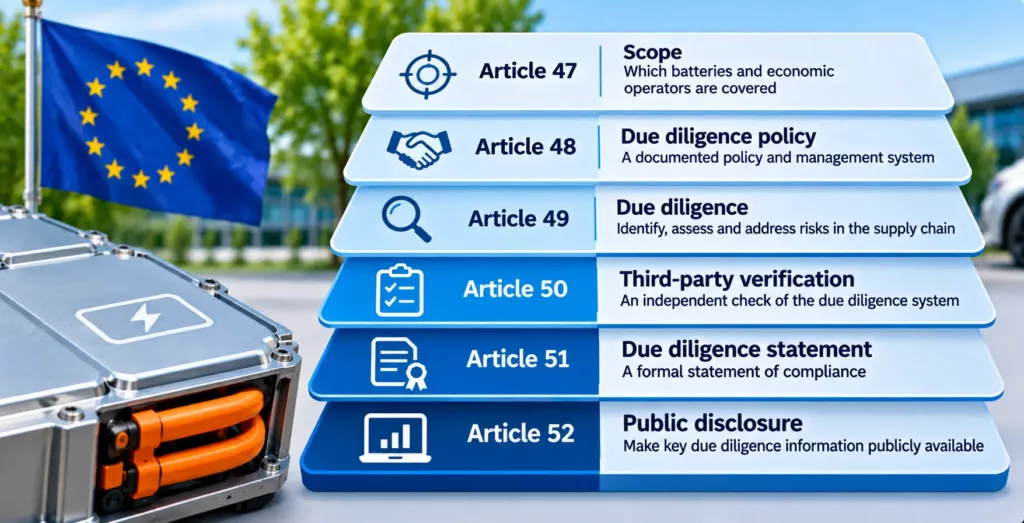
Battery Due Diligence Obligations by Article: 47 to 52
Each article adds one layer, from scope to public reporting.
Articles 47 and 48 set who is covered and the core duty.
Articles 49 and 50 define the systems and risk work.
Articles 51 and 52 cover verification and disclosure.
Article 47: Battery Due Diligence Exemption
The chapter does not apply to operators with net turnover below EUR 40 million in the financial year before last, unless they belong to a group that exceeds that figure on a consolidated basis. Check the group figure, not just the entity.
Article 48: Battery Due Diligence Policy Obligation
In-scope operators meet their battery due diligence obligations by setting up and implementing due diligence policies, having them verified by a notified body and periodically audited, and keeping documentation for 10 years after the last battery under the policy reaches the market.
Understand which battery categories fall within the scope of the EU Battery Regulation and its Digital Product Passport requirements.
Article 49: Battery Due Diligence Management System
Battery due diligence obligations start inside the company. You must adopt and communicate a policy, write it into supplier contracts, assign senior management responsibility and run a chain of custody or traceability system that identifies upstream actors. Records include supplier details, country of origin and quantities, plus a grievance mechanism.
Article 50: Battery Due Diligence Risk Management
Risk management is where battery due diligence obligations become operational. Operators identify and assess the Annex X risks in their supply chain, report findings to senior management and adopt a risk management plan. Responses range from continuing trade while mitigating, to suspending or ending a supplier relationship.
Explore the key compliance requirements under the EU Battery Regulation and its Digital Product Passport framework
Article 51: Battery Due Diligence Third-Party Verification
A notified body checks that the policy meets the Regulation, then audits it over time. Limited notified body capacity was a main reason for postponing battery due diligence obligations, so booking verification late is a real risk.
Article 52: Battery Due Diligence Disclosure
Verification reports go to market surveillance authorities on request, relevant information goes to immediate downstream buyers, and a public report on the policy is published online, currently every year. That report feeds the passport’s responsible sourcing field.
Battery Due Diligence Obligations: Manual vs Platform Compliance
Spreadsheets can start work on battery due diligence obligations; they rarely survive an audit.
Compare effort, audit readiness and passport linkage.
Platform capabilities shown are pending confirmation.
Requirement
Manual (email + spreadsheets)
TraceX platform
Upstream supplier mapping (Art. 49)
Tier 1 only; deeper tiers rely on goodwill
Multi-tier mapping to mine and refiner
Risk assessment (Art. 50)
Periodic, inconsistent scoring
Continuous scoring per Annex X category
Notified body evidence (Art. 51)
Scattered files, version gaps
Single audit trail per material
Public report (Art. 52)
Rebuilt from scratch each cycle
Report generated from live data
10-year retention (Art. 48)
Depends on staff and folders
Time-stamped archive
Battery Due Diligence Obligations Software Checklist
Use these questions when you evaluate any solution.
Does it reach beyond tier 1 suppliers to smelters, refiners and mines?
Does it score risk against all nine Annex X risk categories?
Can a notified body follow the evidence trail without your team rebuilding it?
Does it produce the Article 52 public report and downstream disclosures?
Can it feed due diligence data into your battery passport?
Will it adapt if Omnibus changes alter thresholds or reporting frequency?
If a vendor cannot show the trail from mine to verification report, your battery due diligence obligations stay on your team’s desk.
Frequently Asked Questions
When do battery due diligence obligations apply?
Battery due diligence obligations apply from 18 August 2027. Regulation (EU) 2025/1561 moved the date from 18 August 2025 to give companies and notified bodies more time.
Do battery due diligence obligations apply to SMEs?
Not if net turnover is below EUR 40 million and the company is not part of a larger group above that level. A proposal to raise the threshold to EUR 150 million has not yet been confirmed in the Official Journal.
Which raw materials are covered?
Cobalt, natural graphite, lithium and nickel, plus chemical compounds based on them that are needed to make battery active materials.
Can industry schemes or certifications replace our own due diligence?
No. Schemes recognised by the Commission under Article 53 can support compliance, but the operator remains responsible for its policy and its notified body verification.
How does due diligence link to the battery passport?
The passport must carry responsible sourcing information from the Article 52 report, required once the obligations apply in August 2027.
What happens if a company does not comply?
Member States set penalties, and market surveillance authorities can require corrective action, including restricting batteries on the market.
Start using TraceX
Transparency, Trust, & Success for your Climate Journey.
We use cookies on our website to give you the most relevant experience by remembering your preferences and repeat visits. By clicking “Accept All”, you consent to the use of ALL the cookies. However, you may visit "Cookie Settings" to provide a controlled consent.
This website uses cookies to improve your experience while you navigate through the website. Out of these, the cookies that are categorized as necessary are stored on your browser as they are essential for the working of basic functionalities of the website. We also use third-party cookies that help us analyze and understand how you use this website. These cookies will be stored in your browser only with your consent. You also have the option to opt-out of these cookies. But opting out of some of these cookies may affect your browsing experience.
Necessary cookies are absolutely essential for the website to function properly. These cookies ensure basic functionalities and security features of the website, anonymously.
Cookie
Duration
Description
cookielawinfo-checkbox-analytics
11 months
This cookie is set by GDPR Cookie Consent plugin. The cookie is used to store the user consent for the cookies in the category "Analytics".
cookielawinfo-checkbox-functional
11 months
The cookie is set by GDPR cookie consent to record the user consent for the cookies in the category "Functional".
cookielawinfo-checkbox-necessary
11 months
This cookie is set by GDPR Cookie Consent plugin. The cookies is used to store the user consent for the cookies in the category "Necessary".
cookielawinfo-checkbox-others
11 months
This cookie is set by GDPR Cookie Consent plugin. The cookie is used to store the user consent for the cookies in the category "Other.
cookielawinfo-checkbox-performance
11 months
This cookie is set by GDPR Cookie Consent plugin. The cookie is used to store the user consent for the cookies in the category "Performance".
viewed_cookie_policy
11 months
The cookie is set by the GDPR Cookie Consent plugin and is used to store whether or not user has consented to the use of cookies. It does not store any personal data.
Functional cookies help to perform certain functionalities like sharing the content of the website on social media platforms, collect feedbacks, and other third-party features.
Performance cookies are used to understand and analyze the key performance indexes of the website which helps in delivering a better user experience for the visitors.
Analytical cookies are used to understand how visitors interact with the website. These cookies help provide information on metrics the number of visitors, bounce rate, traffic source, etc.
Advertisement cookies are used to provide visitors with relevant ads and marketing campaigns. These cookies track visitors across websites and collect information to provide customized ads.