EUDR Compliance for Soy Exporters: How to Stay EU-Eligible Before 30 December 2026
Published
, 7 minute read
Share this article
Quick summary: EUDR compliance for soy exporters: the geolocation, legality and traceability data EU buyers need to file a DDS, by origin, before 30 December 2026.
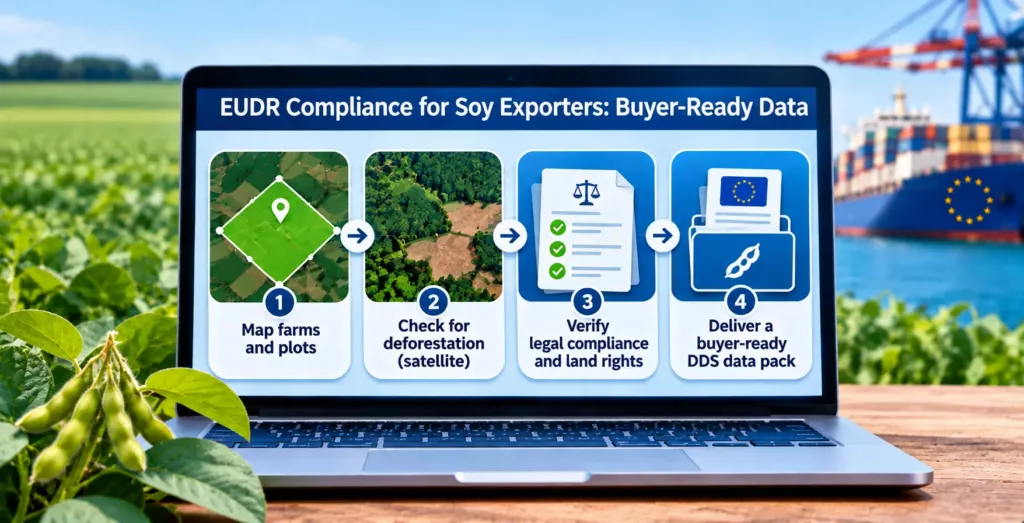
EUDR compliance for soy exporters means supplying EU buyers with the plot-level geolocation, legality evidence and traceability records they need to file a Due Diligence Statement (DDS) for soybeans, soya flour, soybean oil or soybean meal. From 30 December 2026, soy that cannot be traced to plots free of deforestation after 31 December 2020 cannot be placed on the EU market, so exporters without this data lose EU buyers.
Key takeaways
The EU importer usually files the DDS, but the filing rests entirely on data the exporter supplies.
Brazil, Argentina and Paraguay are standard risk, so EU buyers run full due diligence and will ask for more evidence.
Blending traced and untraced beans breaks compliance for the whole lot.
RTRS or ProTerra certification supports risk mitigation but never replaces plot geolocation or the DDS.
Download our eBook
Assess your EUDR readiness, uncover data gaps, and take proactive steps towards stronger compliance.
EUDR compliance for soy exporters has become a condition of EU market access, not a sustainability extra. The European Commission’s May 2026 simplification package confirmed there will be no further delay, so EU buyers need complete supplier data well before 30 December 2026.
In plain language, EUDR compliance means proving that every shipment of soy was grown on land not deforested after 2020, was produced legally, and can be traced back to its plots.
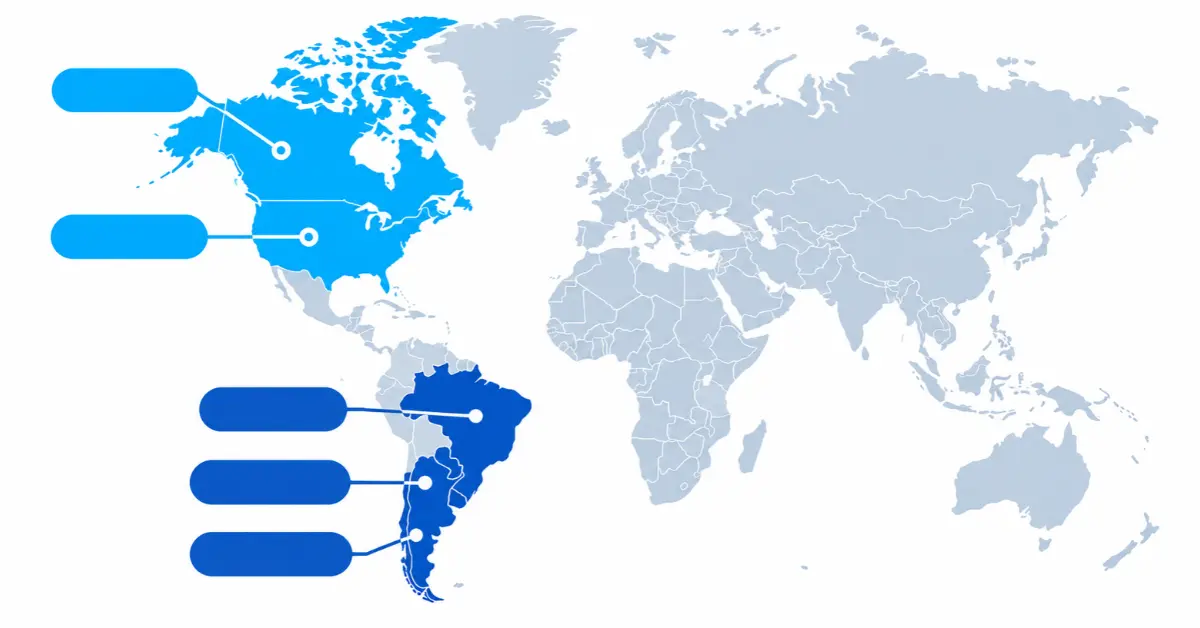
The commercial stakes are large. Brazil exported a record 23.3 million tonnes of soymeal in 2025 and supplies about half of the EU’s soybean meal imports, according to FEFAC, while Argentine and Paraguayan crushers are already marketing EUDR-ready volume. This guide to EUDR compliance for soy exporters covers who is responsible, what buyers expect by origin, and the data package that keeps you on approved supplier lists.
EUDR Compliance for Soy Exporters: Who Is Responsible for What
Exporters rarely file the DDS, but they own the evidence behind it.
How the exporter role differs from the EU importer role
Which soy products EU buyers will ask about
Soy Exporter Role vs EU Importer Role
Under Regulation (EU) 2025/2650, due diligence and DDS filing sit with the operator that first places soy on the EU market, normally the EU importer. If a non-EU company sells directly onto the EU market, the first EU-established company that makes the product available is treated as the operator. Either way, the filing depends on what the exporter provides.
Downstream EU companies no longer file their own statements, so every compliance question now lands on the importer, and the importer passes it straight to you. That is why EUDR compliance for soy exporters is really about data readiness.
Soy Products EU Buyers Will Ask About
Annex I of Regulation (EU) 2023/1115 covers soya beans (HS 1201), soya flour and meal (HS 1208 10), soya-bean oil (HS 1507) and soybean oilcake and residues (HS 2304). Meat, eggs and dairy from soy-fed animals are out of scope. A draft delegated act on product scope, published in May 2026, may still adjust coverage.
EU authorities must check 3% of operators sourcing from standard-risk countries each year, so importers buying from Brazil, Argentina or Paraguay will favour suppliers whose files are audit-ready. Strong EUDR compliance for soy exporters is now a sales advantage in those origins.
EUDR Compliance for Soy Exporters: The Data Package EU Buyers Need
Four evidence sets decide whether your soy can be filed.
Geolocation, deforestation-free proof, legality and batch traceability
Soy Plot Geolocation
The core of EUDR compliance for soy exporters is plot data. A single point is acceptable for plots up to 4 hectares; larger plots need a polygon. Every plot that could have contributed to a shipment must be listed, including indirect suppliers feeding your silos.
Soy Deforestation-Free Evidence
Screen each plot against the 31 December 2020 cut-off with satellite imagery and keep the results. Buyers will want to see how clearing alerts were checked, not just a pass or fail, so stored screening results are a core part of EUDR compliance for soy exporters.
Soy Legality Documentation
Provide evidence that production followed the laws of the country of production: land-use rights, environmental permits, labour, tax and anti-corruption rules. In Brazil, CAR registration and regional moratorium commitments are useful inputs, not substitutes.
Soy Batch Traceability and Segregation
Link each silo, crush lot and vessel back to its contributing plots. Untraced beans cannot be blended into a compliant lot, so segregated or identity-preserved flows are the practical route to EUDR compliance for soy exporters.
EUDR Soy Compliance Challenges for Exporters
Bulk handling creates gaps that buyers now refuse to absorb.
Indirect and smallholder suppliers without mapped plots
Commingling in silos, crushers and vessels
Every EU buyer asking for data in a different format
EU buyers will not choose the cheapest soy; they will choose the soy they can file.
Most exporters already hold some of this data, but it sits across cooperatives, agronomy teams and spreadsheets. Certifications such as RTRS or ProTerra help with risk mitigation, yet they never replace plot-level geolocation or verifiable evidence. Closing these gaps is where EUDR compliance for soy exporters turns from a cost into contract retention.
TraceX’s EUDR compliance solution, turns EUDR compliance for soy exporters into one repeatable workflow. Field teams map farms through an offline mobile app in 15 languages, and the platform validates GeoJSON polygons and screens plots against global forest datasets, flags post-2020 clearing through satellite alerts and shares DDS-ready data packs with EU buyers
The legal methodology was validated by Maruszkin Law Firm, the platform is ISO 27001, SOC 1 and SOC 2 compliant, and an African soy processor already runs supplier GeoJSON uploads and risk assessment on it. Typical onboarding takes four weeks.
See how TraceX maps farms, screens deforestation risk and packages buyer-ready EUDR data for Brazilian, Argentine, Paraguayan and US soy.
Can it map farms offline and validate points and polygons against the 4-hectare rule?
Does it screen plots against the 31 December 2020 cut-off with documented datasets?
Can it link silo, crush and vessel lots back to every contributing plot?
Can it onboard indirect and smallholder suppliers in local languages?
Can it share buyer-ready data packs for each shipment?
Is the legal methodology independently reviewed, and is data security certified?
Frequently Asked Questions
Do soy exporters file the EUDR DDS themselves?
Soy exporters do not file the DDS. The operator that first places soy on the EU market files it, normally the EU importer. Exporters supply the geolocation, legality and traceability data behind it.
When does EUDR compliance for soy exporters apply?
EUDR compliance for soy exporters applies from 30 December 2026, when large and medium EU operators must file. Micro and small operators follow on 30 June 2027.
Does US soy still need geolocation?
Yes. Low-risk status simplifies the buyer’s risk assessment, but plot geolocation is still required.
Is RTRS-certified soy automatically EUDR compliant?
No. Certification supports risk mitigation but does not replace plot-level geolocation, verifiable evidence or the DDS.
What happens if an exporter cannot provide plot data?
The EU buyer cannot file a DDS, so the soy cannot be placed on the EU market. Buyers will move volume to suppliers who can provide the data.
Start using TraceX
Transparency, Trust, & Success for your Climate Journey.
We use cookies on our website to give you the most relevant experience by remembering your preferences and repeat visits. By clicking “Accept All”, you consent to the use of ALL the cookies. However, you may visit "Cookie Settings" to provide a controlled consent.
This website uses cookies to improve your experience while you navigate through the website. Out of these, the cookies that are categorized as necessary are stored on your browser as they are essential for the working of basic functionalities of the website. We also use third-party cookies that help us analyze and understand how you use this website. These cookies will be stored in your browser only with your consent. You also have the option to opt-out of these cookies. But opting out of some of these cookies may affect your browsing experience.
Necessary cookies are absolutely essential for the website to function properly. These cookies ensure basic functionalities and security features of the website, anonymously.
Cookie
Duration
Description
cookielawinfo-checkbox-analytics
11 months
This cookie is set by GDPR Cookie Consent plugin. The cookie is used to store the user consent for the cookies in the category "Analytics".
cookielawinfo-checkbox-functional
11 months
The cookie is set by GDPR cookie consent to record the user consent for the cookies in the category "Functional".
cookielawinfo-checkbox-necessary
11 months
This cookie is set by GDPR Cookie Consent plugin. The cookies is used to store the user consent for the cookies in the category "Necessary".
cookielawinfo-checkbox-others
11 months
This cookie is set by GDPR Cookie Consent plugin. The cookie is used to store the user consent for the cookies in the category "Other.
cookielawinfo-checkbox-performance
11 months
This cookie is set by GDPR Cookie Consent plugin. The cookie is used to store the user consent for the cookies in the category "Performance".
viewed_cookie_policy
11 months
The cookie is set by the GDPR Cookie Consent plugin and is used to store whether or not user has consented to the use of cookies. It does not store any personal data.
Functional cookies help to perform certain functionalities like sharing the content of the website on social media platforms, collect feedbacks, and other third-party features.
Performance cookies are used to understand and analyze the key performance indexes of the website which helps in delivering a better user experience for the visitors.
Analytical cookies are used to understand how visitors interact with the website. These cookies help provide information on metrics the number of visitors, bounce rate, traffic source, etc.
Advertisement cookies are used to provide visitors with relevant ads and marketing campaigns. These cookies track visitors across websites and collect information to provide customized ads.