EUDR Low-Risk Countries: Why Low Risk Does Not Mean Exempt from Compliance
Published
, 9 minute read
Share this article
Quick summary: Understand how EUDR low-risk classification affects due diligence, geolocation, supplier data and traceability under Article 13.
Does sourcing from an EUDR low-risk countries mean your business is exempt from compliance? Not necessarily. When discussing the EU Deforestation Regulation (EUDR), country risk classification is often misunderstood.
A supplier may be based in Canada, the United States or Australia all classified as low-risk countries under the EU’s benchmarking system. Does this mean products sourced from these countries are automatically exempt from EUDR requirements?
No.
A low-risk classification can simplify certain due diligence obligations, but it does not remove a relevant product from the scope of the EUDR. For businesses sourcing timber, pulp, paper, packaging and other regulated commodities, understanding this distinction is essential.
Key Takeaways
Low-risk does not mean EUDR-exempt: Products covered by the EUDR must still meet the regulation’s requirements, regardless of the country’s risk classification.
Simplified due diligence is conditional: Eligible operators sourcing exclusively from low-risk countries may benefit from simplified due diligence under Article 13, provided the specified conditions are met.
Information collection remains mandatory: Businesses must still collect the relevant information required under Article 9, including product details, country of production and applicable geolocation data.
Supply-chain complexity matters: Operators must consider risks associated with mixing products from different origins, circumvention and complex supply chains.
Risk signals cannot be ignored: If information indicates a risk of non-compliance, businesses may need to carry out further checks and apply the full due diligence requirements.
Technology remains important: Digital traceability systems can help businesses maintain supplier records, geolocation data, product information and supporting evidence, even when simplified due diligence applies.
Download our eBook
Assess your EUDR readiness, uncover data gaps, and take proactive steps towards stronger compliance.
Under Article 29 of the EUDR, the European Commission classifies countries into three categories based on the risk of producing relevant commodities associated with deforestation and forest degradation.
The three categories are:
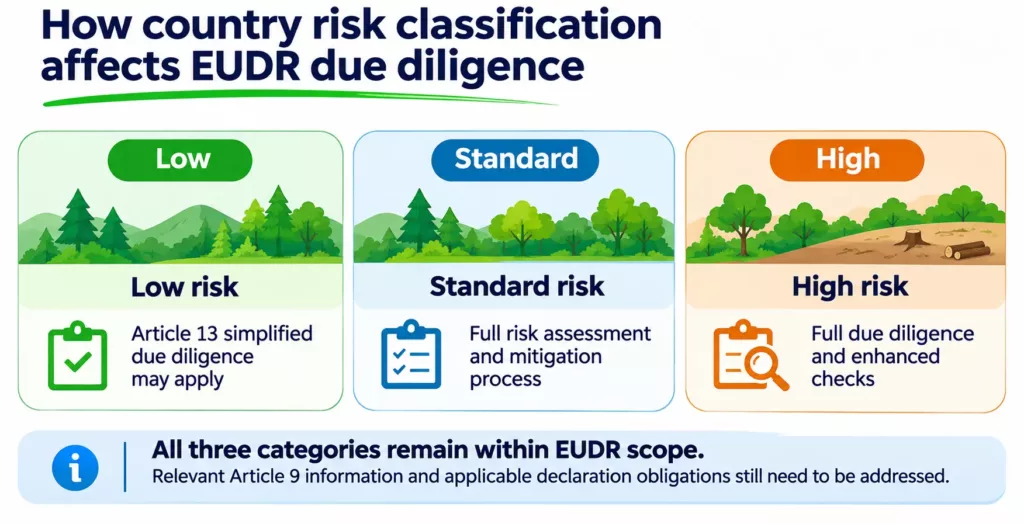
Low-risk countries: Countries assessed as presenting a low risk of producing relevant commodities that do not comply with EUDR requirements.
Standard-risk countries: Countries that are not classified as either low or high risk.
High-risk countries: Countries assessed as presenting a high risk of producing relevant commodities associated with deforestation or forest degradation.
The current European Commission classification identifies four high-risk countries:
Belarus
North Korea
Myanmar
Russia
Countries such as Canada, the United States, Australia, China and all EU Member States are classified as low risk.
The remaining countries not classified as low or high risk fall under the standard-risk category.
This classification determines the level of due diligence and the risk-based approach to regulatory checks. It does not determine whether a relevant commodity or product is covered by the EUDR.
Explore our blog to understand the country risk categories, their implications for businesses, and how the classification influences the due diligence process.
What does low-risk classification actually change?
The main benefit of low-risk classification is the possibility of applying simplified due diligence under Article 13.
Where an operator establishes that all relevant commodities and products originate exclusively from low-risk countries or regions, and has assessed supply-chain complexity and the risks of circumvention or mixing with products of unknown, standard-risk or high-risk origin, it may benefit from simplified due diligence.
Under these conditions, the operator is generally not required to carry out the full risk assessment under Article 10 or risk mitigation measures under Article 11.
However, this does not mean that the operator can skip the entire due diligence process.
Important obligations remain:
Collect the information required under Article 9.
Obtain the relevant supplier, product and production information.
Collect the required geolocation information.
Maintain a due diligence system.
Assess supply-chain complexity and the possibility of circumvention or mixing.
Submit the applicable DDS or simplified declaration, according to the operator’s role and the relevant rules.
If new information indicates a risk of non-compliance, the operator must fulfil the full risk assessment and mitigation obligations.
Explore our blog to understand the EUDR risk assessment process, the key risk factors to consider, and how businesses can strengthen their due diligence workflows.
Why low-risk sourcing does not eliminate traceability requirements
Consider a European paper manufacturer importing virgin pulp from Canada.
Canada is classified as a low-risk country. The manufacturer may therefore be eligible for simplified due diligence if the conditions under Article 13 are met.
However, the manufacturer still needs to establish the relevant information about the product and its origin.
This may include:
Supplier and product identification.
Quantity and country of production.
Required production geolocation.
Relevant wood species information.
Supporting information on legal production.
Records demonstrating the supply chain’s origin and integrity.
A purchase order stating “Canadian origin – low risk” does not provide all the information required under Article 9.
Country benchmarking simplifies the applicable due diligence steps; it does not replace the underlying information requirements.
What happens when low-risk and standard-risk materials are mixed?
This is where the practical challenge becomes more significant.
A manufacturer may source virgin pulp from Canada and combine it with pulp from another country classified as standard risk.
Alternatively, a trader may consolidate materials from suppliers whose original sourcing locations are not fully documented.
In these situations, the operator cannot assume that the entire product qualifies for simplified due diligence merely because one supplier or one component originates in a low-risk country.
Article 13 specifically requires operators to assess the risk of mixing with products of unknown origin or origin in standard-risk or high-risk countries.
Where the operator cannot establish that all relevant commodities and products originate exclusively from low-risk countries or regions, the conditions for simplified due diligence may not be satisfied.
This makes material-level traceability important, particularly for businesses dealing with multiple sourcing regions, suppliers and production batches.
What this means for North American pulp and paper suppliers
North America is an important sourcing region for businesses purchasing wood, pulp and paper products.
The low-risk classification of Canada and the United States can offer a simplified due diligence pathway for eligible sourcing operations.
However, European importers and manufacturers should not treat country classification as a substitute for supplier data management.
They should establish processes to:
Verify sourcing origin: Confirm where the relevant wood commodity was produced rather than relying only on the supplier’s registered address or dispatch location.
Collect geolocation information: Maintain the required coordinates or polygon information associated with relevant production plots.
Maintain species information: Capture the common and scientific names of relevant wood species where required.
Track material movement: Connect incoming wood and pulp shipments with procurement, inventory and production records.
Assess mixing risks: Establish whether materials from unknown, standard-risk or high-risk origins have entered the supply chain.
Retain supporting evidence: Keep supplier declarations, sourcing information and relevant records available for competent-authority checks.
Low-risk sourcing versus standard-risk sourcing
The distinction can be summarised as follows:
Compliance area
Low-risk origin
Standard-risk origin
Article 9 information collection
Required
Required
Geolocation information
Required
Required
Due diligence system
Required
Required
Article 10 risk assessment
Generally not required if Article 13 conditions are met
Required
Article 11 risk mitigation
Generally not required if Article 13 conditions are met
Required where risk is not negligible
Applicable declaration
Required according to the operator’s role
Required according to the operator’s role
The distinction is therefore not between regulated and unregulated products. It is between different levels of due diligence under the same regulatory framework.
How digital traceability supports low-risk and standard-risk sourcing
Even when a business qualifies for simplified due diligence, it still needs reliable information about suppliers, products and sourcing origins.
For businesses operating across multiple countries, this information can become difficult to manage through spreadsheets, email and disconnected ERP systems.
Digital traceability can help businesses:
Maintain centralised supplier and sourcing records.
Capture and validate plot-level geolocation.
Record relevant wood species and product information.
Connect procurement and incoming material batches.
Track material movement across processing and manufacturing.
Identify and document the origin of mixed inputs.
Maintain due diligence evidence and declaration references.
TraceX EUDR Solutions helps businesses connect supplier onboarding, geospatial information, procurement, inventory, manufacturing and batch-level traceability through digital workflows.
This supports businesses in organising the information needed to apply the appropriate EUDR due diligence process, whether their sourcing originates in low-risk, standard-risk or high-risk countries.
Ready to strengthen your EUDR readiness?
Explore how our platform can support your compliance workflows.
Conclusion: Low-risk sourcing is not a substitute for EUDR readiness
The EUDR country benchmarking system is designed to make due diligence proportionate to the risk associated with different sourcing origins.
For businesses sourcing from low-risk countries, Article 13 can reduce the need for full risk assessment and mitigation when its conditions are satisfied.
But the core information requirements remain.
A business cannot treat low-risk country classification as an exemption from product scope, supplier information, geolocation or applicable declaration requirements.
For European importers, pulp producers, paper manufacturers and timber businesses, the priority should be to maintain visibility into the origin and movement of relevant materials.
Low-risk sourcing may simplify due diligence. It does not eliminate the need to know where your products came from.
Frequently Asked Questions
1. If my products come from an EUDR low-risk country, am I exempt from EUDR compliance?
No. Low-risk classification does not exempt products or businesses from the EUDR. Eligible operators may benefit from simplified due diligence under Article 13, but they must still meet applicable information collection and submission requirements. The products must also satisfy the deforestation-free and legal production requirements.
2. Can businesses sourcing exclusively from low-risk countries skip due diligence?
Not entirely. Eligible operators may be able to follow simplified due diligence, meaning they are generally not required to conduct the full risk assessment and mitigation steps under Articles 10 and 11. However, they must still collect the information required under Article 9 and meet the conditions for using the simplified procedure.
3. Does sourcing from multiple low-risk countries automatically qualify a business for simplified due diligence?
No. Sourcing from multiple low-risk countries does not automatically disqualify a business, but the origin and supply-chain circumstances must be assessed. Operators must consider whether products have been mixed with products of unknown or higher-risk origin, whether circumvention risks exist, and whether the conditions under Article 13 are satisfied.
4. Do businesses still need to collect geolocation data for products sourced from low-risk countries?
Yes. The Article 9 information requirements continue to apply when simplified due diligence is used. This includes the relevant geolocation information for the plots of land where the relevant commodities were produced. Low-risk classification does not remove this requirement.
5. Is an EUDR compliance software platform necessary if my suppliers are located in low-risk countries?
Low-risk classification may simplify certain due diligence activities, but it does not eliminate the need to manage supplier information, geolocation data, product origins and supporting documentation. A digital compliance platform can help businesses maintain these records, establish supply-chain visibility and respond to verification requests. The level of technology required will depend on the complexity and scale of the supply chain.
Start using TraceX
Transparency, Trust, & Success for your Climate Journey.
We use cookies on our website to give you the most relevant experience by remembering your preferences and repeat visits. By clicking “Accept All”, you consent to the use of ALL the cookies. However, you may visit "Cookie Settings" to provide a controlled consent.
This website uses cookies to improve your experience while you navigate through the website. Out of these, the cookies that are categorized as necessary are stored on your browser as they are essential for the working of basic functionalities of the website. We also use third-party cookies that help us analyze and understand how you use this website. These cookies will be stored in your browser only with your consent. You also have the option to opt-out of these cookies. But opting out of some of these cookies may affect your browsing experience.
Necessary cookies are absolutely essential for the website to function properly. These cookies ensure basic functionalities and security features of the website, anonymously.
Cookie
Duration
Description
cookielawinfo-checkbox-analytics
11 months
This cookie is set by GDPR Cookie Consent plugin. The cookie is used to store the user consent for the cookies in the category "Analytics".
cookielawinfo-checkbox-functional
11 months
The cookie is set by GDPR cookie consent to record the user consent for the cookies in the category "Functional".
cookielawinfo-checkbox-necessary
11 months
This cookie is set by GDPR Cookie Consent plugin. The cookies is used to store the user consent for the cookies in the category "Necessary".
cookielawinfo-checkbox-others
11 months
This cookie is set by GDPR Cookie Consent plugin. The cookie is used to store the user consent for the cookies in the category "Other.
cookielawinfo-checkbox-performance
11 months
This cookie is set by GDPR Cookie Consent plugin. The cookie is used to store the user consent for the cookies in the category "Performance".
viewed_cookie_policy
11 months
The cookie is set by the GDPR Cookie Consent plugin and is used to store whether or not user has consented to the use of cookies. It does not store any personal data.
Functional cookies help to perform certain functionalities like sharing the content of the website on social media platforms, collect feedbacks, and other third-party features.
Performance cookies are used to understand and analyze the key performance indexes of the website which helps in delivering a better user experience for the visitors.
Analytical cookies are used to understand how visitors interact with the website. These cookies help provide information on metrics the number of visitors, bounce rate, traffic source, etc.
Advertisement cookies are used to provide visitors with relevant ads and marketing campaigns. These cookies track visitors across websites and collect information to provide customized ads.