EUDR Information System Updates in November 2026: DDS Grouping, API Changes and System Outage Procedures
Published
, 10 minute read
Share this article
Quick summary: Explore the November 2026 EUDR Information System updates, including DDS grouping, TRACES API improvements, declaration verification and the 60-minute outage contingency procedure.
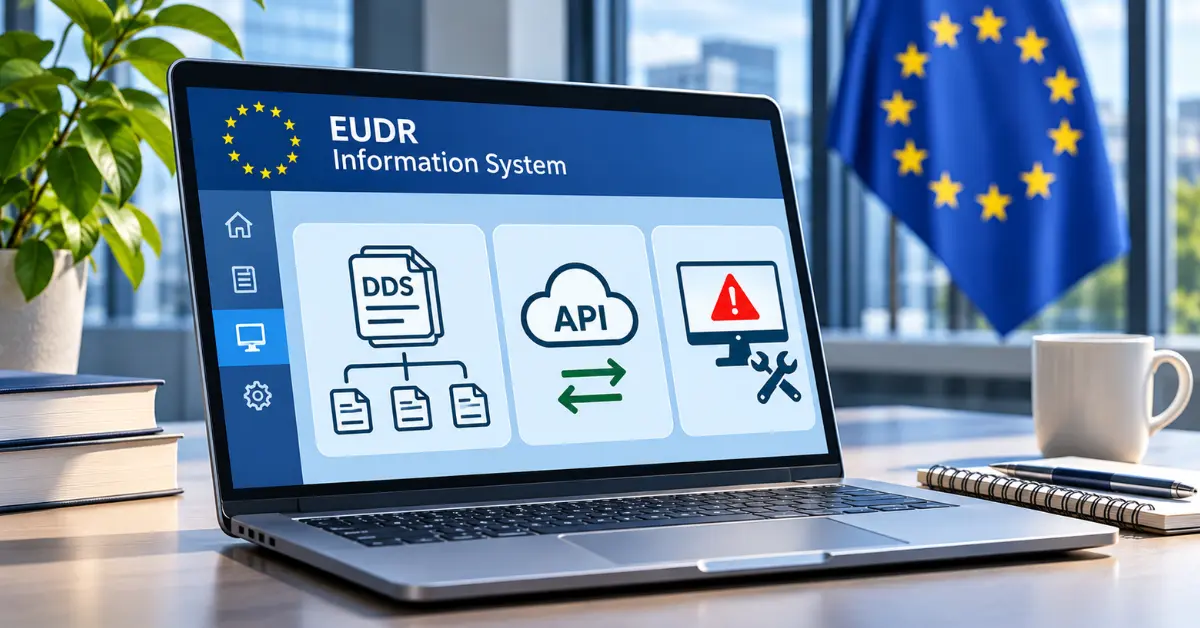
The November 2026 EUDR Information System updates introduces grouping of up to 1,000 DDS or Simplified Declaration members, declaration versioning, API and verification improvements, and expanded operator management. A separate Commission contingency arrangement allows designated identifiers only when an unplanned system outage exceeds 60 minutes and the official Public Status Page confirms that contingency measures are active. Due diligence and record-keeping obligations continue during an outage.
Key Takeaways
The November 2026 EUDR Information System updates signal an important shift: businesses must prepare not only for submitting Due Diligence Statements (DDS), but also for managing declarations, API integrations and system availability throughout their compliance workflows.
Five areas deserve attention:
1. DDS Grouping Simplifies Declaration Management: Businesses can group previously submitted DDSs or Simplified Declarations by submitting a new declaration that references the original declarations. Once grouped, the individual declarations receive a grouped status and are replaced by the new grouped declaration. Businesses should review their internal reference-management processes before using this functionality.
2. API Integration Requires Active Maintenance: The Information System supports machine-to-machine submissions. The current operator API documentation identifies V4 as the current version, with changes to response handling, reference-number status information and retrieval functionality. ERP and software providers should review the latest API specifications and migration guidance rather than rely on older integrations.
3. System Outage Procedures Need to Be Understood: Under the updated implementing rules, the Commission must publish information on system availability and contingency arrangements. For an unplanned outage exceeding 60 minutes, the arrangements must include digital notifications and contingency reference numbers or declaration identifiers where normal submission is not possible.
4. Production and Acceptance Environments Are Different: The Production server is used for legally valid submissions, while the Acceptance server is intended for training and testing. Registration in one environment does not automatically provide access to the other. Businesses should test integrations in the appropriate environment before relying on them for live submissions.
5. Compliance Systems Must Go Beyond DDS Submission: Grouping, API integration, reference tracking and contingency handling all depend on reliable supplier, product, geolocation and shipment information. Businesses need connected systems that can maintain these records and support retrieval when required.
Download our eBook
Assess your EUDR readiness, uncover data gaps, and take proactive steps towards stronger compliance.
The European Union Deforestation Regulation (EUDR) is moving into an operational phase. Businesses need more than supplier information and deforestation-risk assessments: they need reliable processes for preparing Due Diligence Statements (DDS), managing Simplified Declarations (SD), checking upstream references and maintaining records when the EU Information System is unavailable.
Two European Commission publications dated November 2026 provide important operational guidance. The EUDR Information System Release Notes cover versions 8.2.1 and 8.2.2. The Contingency Arrangement for Unplanned Unavailability explains how users may proceed when an unplanned outage lasts more than 60 minutes. Together, they highlight the importance of digital workflow controls and operational resilience.
Explore our blog to understand the EU Information System, its role in EUDR compliance and how businesses can prepare for digital due diligence submissions.
DDS and Simplified Declaration grouping: up to 1,000 members
Version 8.2.1 allows users to create and submit a Group Head for DDS and SD members through the TRACES user interface or API. A DDS Group Head may contain DDS and/or SD members; an SD Group Head may contain SD members only. Each Group Head receives a dedicated reference number and a visual indicator in search results.
The release notes allow up to 1,000 DDS/SD members in one group submission. Users can search and filter Group Heads, navigate to their members, and view or edit Group Head details. A Group Head can be withdrawn or amended within 72 hours from when its reference number becomes visible.
Once a Group Head is submitted, its members are locked from reuse, amendment or independent customs presentation. Version 8.2.2 adds authority checks for grouped members and prevents members with different activity types from being grouped. Businesses should therefore verify the intended members, activity type and submitting authority before submission.
Version 8.2.1 adds full versioning support for Simplified Declarations across API operations, including submit, update, retrieve, withdraw and lookup. Version numbers appear on generated PDFs and are reflected in the user interface. Businesses should align their internal document controls with the version displayed in TRACES and retain records that explain declaration changes.
The release also expands non-EU operator profile management, including address management and competent-authority activity permissions. Registration includes selectable SME and non-SME downstream operator or trader roles. Micro and small primary operators can create, manage, edit, copy, search and generate PDFs for Simplified Declarations. Review operator profiles, user roles and permissions before relying on delegated or automated workflows.
Explore our blog to understand who can use simplified declarations, what information must still be collected, and how the simplified process differs from standard due diligence.
API improvements and multi-operator authentication
Version 8.2.2 introduces a new V4 API for DDS, SD and verification services, with improved error messages, user-information response headers and updated API documentation. The release also includes fixes to declaration retrieval and verification, plus XSD/GeoJSON validation and complex-country polygon checks.
Version 8.2.1 adds multi-operator API authentication. An API user associated with more than one EUDR operator can specify the operator they are acting for through the BodyIdentity SOAP header, using that operator’s Web Service Identifier. New operator registrations receive a Web Service Identifier automatically.
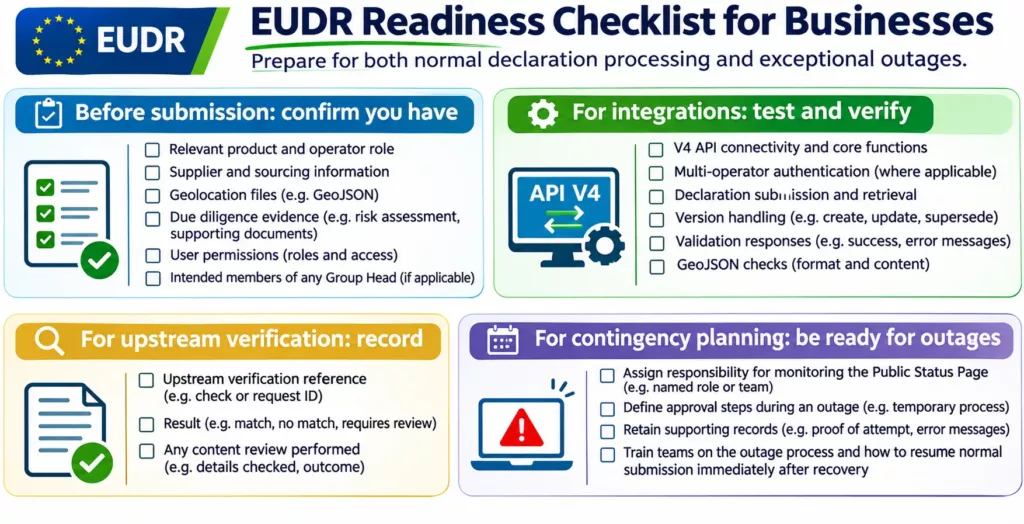
Companies connecting ERP, procurement or compliance platforms to TRACES should review the current API documentation in the TRACES NT Help menu. Integration testing should cover operator identity, permissions, declaration submission and retrieval, validation errors, GeoJSON files and historical versions not just the successful submission scenario.
The release notes introduce verification responses of VALID, NOT VALID or NOT FOUND. They also describe a full declaration content view for non-SME downstream operators, separate from a basic reference-existence check. Access to the content view requires the DDS or SD reference number and verification number.
SME and non-SME downstream operators or traders can verify the validity of upstream Group Heads. For businesses receiving references from suppliers, this creates a reason to formalise upstream verification: check the reference, review the result and, where available and appropriate, inspect the declaration content. Retain the outcome with the related supplier, product and transaction records.
When can the EUDR contingency procedure be used?
The Commission’s Contingency Arrangement is version 1.0 and has an effective date of 30 December 2026. It applies when an unplanned unavailability of the EUDR Information System exceeds 60 minutes and the duration is confirmed on the official Public Status Page. It does not apply to planned maintenance or scheduled updates, even if they last more than an hour.
Before using the contingency procedure, users should rule out local issues such as internet connectivity, browser settings, internal IT restrictions or EU Login credentials. They must then check the Public Status Page. A local access problem, delayed response or API error alone does not establish that the contingency conditions have been met.
Contingency identifiers and operator responsibilities
The Commission establishes two identifiers: the DDS Contingency Reference Number is 00EU0000000000; the Simplified Declaration Contingency Declaration Identifier is S00EU000000000. These are not standard reference numbers generated by a successful TRACES submission.
They may be used only when the confirmed outage exceeds 60 minutes, a DDS or SD could not be submitted for the relevant product, and no standard reference number or declaration identifier has already been issued for that product. The identifiers apply only to transactions taking place during the qualifying unavailability. If a standard identifier already exists, the contingency identifier cannot replace it.
An outage does not waive due diligence. The operator must already have exercised due diligence and gathered the information required under Annex II or Annex III before placing the product on the market or exporting it. The contingency process addresses the inability to submit the declaration and obtain its normal identifier; it is not an exemption from the underlying EUDR requirements.
What records should businesses retain?
Operators using a contingency identifier must record and retain the data required under Annex II or Annex III for the relevant products. The Commission advises keeping a brief explanation of why the DDS or SD could not reasonably have been submitted before the outage, along with evidence that the Information System had been unavailable for more than 60 minutes. A screenshot of the Public Status Page is given as an example.
The contingency identifier may be provided to customs authorities, competent authorities during checks, and downstream operators or traders. Its use in customs declarations is recorded in customs systems, and authorities may request evidence that the conditions for its use were satisfied.
What happens when TRACES is restored?
When the Public Status Page indicates that the Information System is available again, contingency measures cease and users must return to normal submission procedures. Contingency identifiers can no longer be used for new transactions after recovery.
The Commission clarifies that a shipment already placed on the market or exported during a qualifying outage using a contingency identifier does not require a retrospective DDS or SD after recovery. However, subsequent relevant transactions must be covered by a standard DDS or SD, as applicable.
How digital traceability software can support EUDR readiness
TRACES is the EU system for EUDR declarations, but businesses must organise the supplier, sourcing and transaction data that supports those declarations. That information may be spread across spreadsheets, procurement tools, ERP systems, processing records and shipment documentation.
Digital traceability software can connect supplier onboarding, plot-level geolocation, procurement, aggregation, processing, inventory and shipment records. It can support geospatial validation, centralise evidence and maintain an internal history of checks, approvals and declaration references. TraceX EUDR Solutions helps businesses connect these workflows so information is more structured and accessible when preparing for EUDR processes. TraceX does not replace TRACES, determine an operator’s legal responsibilities or guarantee compliance; the responsible business remains accountable for due diligence.
Prepare your EUDR data and workflows
TraceX helps businesses connect supplier onboarding, plot-level geolocation, sourcing, procurement, processing, batch traceability and compliance evidence through digital workflows.
Conclusion: readiness now includes operational resilience
The November 2026 updates make EUDR readiness more operational. Businesses need to manage grouped declarations carefully, track SD versions, verify upstream references, test APIs and understand the strict conditions for using contingency identifiers during an unplanned outage.
The contingency procedure is exceptional, not a workaround for incomplete data or local IT issues. The 60-minute threshold must be confirmed on the Public Status Page, due diligence must already have been completed, supporting information must be retained and normal submissions must resume after recovery. Businesses that connect supplier, geolocation, procurement, processing and shipment data and test these workflows before they are under pressure will be better prepared.
Frequently asked questions
What is the maximum number of members in an EUDR Group Head?
The November 2026 release notes state that a group submission can contain up to 1,000 DDS/SD members.
Can an SD Group Head include DDS members?
No. A DDS Group Head may include DDS and/or SD members, while an SD Group Head may include SD members only.
When can the contingency reference number be used?
Contingency reference number can be used only when an unplanned outage has exceeded 60 minutes and the Public Status Page confirms that contingency measures are permitted.
Does an outage remove the need to complete due diligence?
No. The operator must have completed due diligence and gathered the required information before relying on the contingency procedure.
Is a retrospective DDS required after recovery?
Not for a shipment validly placed on the market or exported during the qualifying outage using the contingency identifier. Later transactions must follow normal procedures.
What verification results are available?
The release notes specify VALID, NOT VALID and NOT FOUND. A separate full-content view is available to non-SME downstream operators under the described access conditions.
Start using TraceX
Transparency, Trust, & Success for your Climate Journey.
We use cookies on our website to give you the most relevant experience by remembering your preferences and repeat visits. By clicking “Accept All”, you consent to the use of ALL the cookies. However, you may visit "Cookie Settings" to provide a controlled consent.
This website uses cookies to improve your experience while you navigate through the website. Out of these, the cookies that are categorized as necessary are stored on your browser as they are essential for the working of basic functionalities of the website. We also use third-party cookies that help us analyze and understand how you use this website. These cookies will be stored in your browser only with your consent. You also have the option to opt-out of these cookies. But opting out of some of these cookies may affect your browsing experience.
Necessary cookies are absolutely essential for the website to function properly. These cookies ensure basic functionalities and security features of the website, anonymously.
Cookie
Duration
Description
cookielawinfo-checkbox-analytics
11 months
This cookie is set by GDPR Cookie Consent plugin. The cookie is used to store the user consent for the cookies in the category "Analytics".
cookielawinfo-checkbox-functional
11 months
The cookie is set by GDPR cookie consent to record the user consent for the cookies in the category "Functional".
cookielawinfo-checkbox-necessary
11 months
This cookie is set by GDPR Cookie Consent plugin. The cookies is used to store the user consent for the cookies in the category "Necessary".
cookielawinfo-checkbox-others
11 months
This cookie is set by GDPR Cookie Consent plugin. The cookie is used to store the user consent for the cookies in the category "Other.
cookielawinfo-checkbox-performance
11 months
This cookie is set by GDPR Cookie Consent plugin. The cookie is used to store the user consent for the cookies in the category "Performance".
viewed_cookie_policy
11 months
The cookie is set by the GDPR Cookie Consent plugin and is used to store whether or not user has consented to the use of cookies. It does not store any personal data.
Functional cookies help to perform certain functionalities like sharing the content of the website on social media platforms, collect feedbacks, and other third-party features.
Performance cookies are used to understand and analyze the key performance indexes of the website which helps in delivering a better user experience for the visitors.
Analytical cookies are used to understand how visitors interact with the website. These cookies help provide information on metrics the number of visitors, bounce rate, traffic source, etc.
Advertisement cookies are used to provide visitors with relevant ads and marketing campaigns. These cookies track visitors across websites and collect information to provide customized ads.