Farm-Level Traceability with SAP and ERP in EUDR: Connect Every Plot to Every Batch
Published
, 9 minute read
Share this article
Quick summary: Farm-level traceability with SAP and ERP in EUDR: link every farm plot to ERP batches and DDS records in 5 steps before the 30 December 2026 deadline.
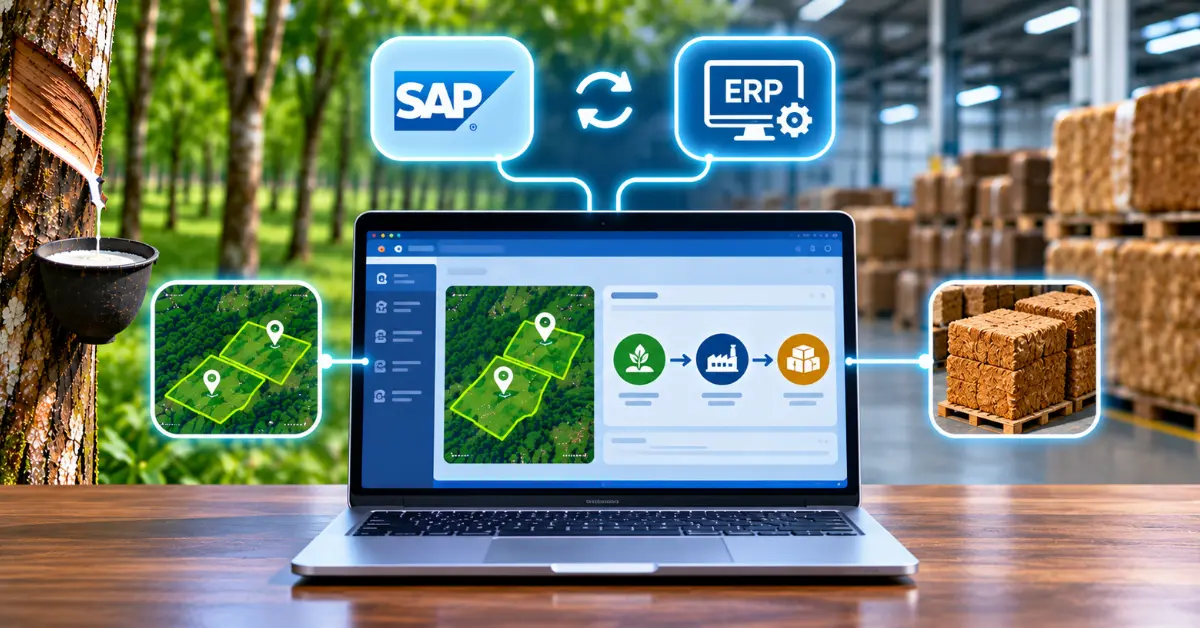
Farm-level traceability with SAP and ERP in EUDR means linking the geolocation of every farm plot that produced a commodity to the purchase orders, goods receipts and batches your ERP already manages, so each shipment carries a valid Due Diligence Statement (DDS) reference. The practical setup keeps plot polygons, farmer records and deforestation checks in a dedicated traceability platform, then passes compliance status and DDS reference numbers into SAP S/4HANA, SAP ECC or another ERP through APIs. Obligations apply from 30 December 2026 for large and medium companies and from 30 June 2027 for most micro and small operators.
Key takeaways
Your ERP knows what you bought and sold. It rarely knows which plot it came from, and EUDR requires both.
Keep farm data (polygons, farmer documents, satellite checks) in a traceability layer and sync only status and IDs into ERP master and transaction data.
Link plots to batches at goods receipt. A batch can draw on many plots, but every plot must be traceable to the DDS.
Block stock and shipments that lack a DDS reference number.
With 30 December 2026 about eight weeks away, your integration should already be in testing.
Most EUDR programmes stall at the same point. The sustainability team holds farm data in spreadsheets or a field app, while procurement, inventory and sales run in SAP. Nobody owns the connection between the two. Yet farm-level traceability with SAP and ERP in EUDR is exactly what turns scattered plot records into evidence a competent authority will accept.
Download our eBook
Assess your EUDR readiness, uncover data gaps, and take proactive steps towards stronger compliance.
Farm-Level Traceability with SAP and ERP in EUDR: What It Means
Farm-level traceability with SAP and ERP in EUDR is an unbroken data link from the farm polygon, to the ERP batch, to the DDS.
What EUDR asks for: proof that each product is deforestation-free and legally produced.
What your ERP holds: suppliers, materials, orders, batches and deliveries.
What is usually missing: the plot-level geolocation that connects the two.
EUDR (Regulation (EU) 2023/1115) covers cattle, cocoa, coffee, oil palm, rubber, soya and wood, plus listed derived products. Operators must show that the land producing these commodities was not deforested after 31 December 2020, that production followed local law, and that a DDS was filed before the goods are placed on the EU market or exported. That proof rests on geolocation: a single point for plots of four hectares or less, and a polygon for larger plots (cattle rules differ). Records must be kept for five years.
In practice, this geolocation has to travel with the commodity through your business systems instead of sitting in a separate file.
Understand when plot coordinates or polygons are required, how to collect and validate farm-level geolocation data, and how to address common challenges in supplier onboarding.
Farm-Level Traceability Gaps in SAP and ERP Systems
ERPs were built for transactions, not for fields, farmers and satellite imagery.
The vendor master records a cooperative or trader, not the 3,000 smallholders behind it.
Standard ERP data models do not store or validate GeoJSON polygons.
Deforestation checks need satellite analysis against the 2020 cutoff, which ERPs do not run.
Farm data is collected in remote areas, often offline, long before a purchase order exists.
SAP now offers EUDR tooling, such as SAP Green Token, and partner connectors exist for S/4HANA purchase-order workflows. These help inside the enterprise. The first mile still has to be captured at the farm, verified and structured before any ERP can use it. Without that first-mile layer, farm-level traceability with SAP and ERP in EUDR stays a goal rather than a working process.
If a batch in your ERP cannot name its plots, it cannot carry a valid DDS.
Discover how ERP, procurement, traceability and compliance platforms can work together to connect supplier data, farm-level geolocation, deforestation risk assessments and Due Diligence Statements.
How to Connect Farm-Level Traceability with SAP and ERP in EUDR: 5 Steps
To set up farm-level traceability with SAP and ERP in EUDR, map the data, capture it at source, assess it outside the ERP, then link and gate every transaction.
Steps 1 and 2 build the data foundation.
Steps 3 to 5 connect it to procurement, inventory and shipping.
EUDR Traceability Step 1: Map Farm Data to ERP Objects
List the ERP objects that must carry EUDR attributes: vendor master, material master, purchase order, goods receipt, batch and outbound delivery. Add fields for EUDR relevance, a traceability ID that points to plot records, a risk status, and the DDS reference and verification numbers. Agree this model with IT before field work scales, because it is the backbone of farm-level traceability with SAP and ERP in EUDR.
EUDR Traceability Step 2: Capture Plot Geolocation at Source
Onboard each farmer through a mobile app that works offline, recording GPS points or walked polygons alongside land tenure and identity documents. Validate every file before it moves on: correct coordinate system (WGS 84), closed polygons, no self-intersections and no duplicate plots across suppliers.
EUDR Traceability Step 3: Assess Risk Outside the ERP
Run satellite deforestation checks against the 31 December 2020 baseline, apply the country risk classification (low, standard or high), and review legality evidence in the traceability platform. Then sync only the outcome, such as cleared, under review or blocked, plus plot IDs into the ERP. This keeps heavy geospatial data out of the ERP core.
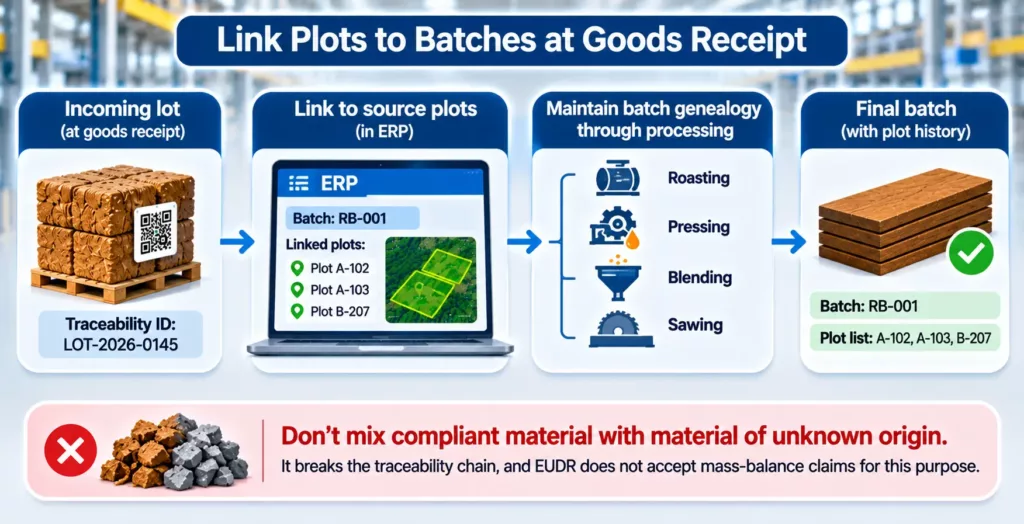
EUDR Traceability Step 4: Link Plots to Batches at Goods Receipt
When a lot arrives, its traceability ID ties the ERP batch to its source plots. Through roasting, pressing, blending or sawing, batch genealogy in the ERP carries that plot list forward. Mixing compliant material with material of unknown origin breaks the chain, since EUDR does not accept mass-balance claims for this purpose.
EUDR Traceability Step 5: Gate Stock and Shipments with DDS References
Set a restricted-use status on EUDR-relevant batches until the DDS is submitted to the EU Information System and its reference and verification numbers flow back into the ERP. Print those numbers on delivery documents and customs declarations, and pass them to downstream customers, who need them for their own records.
Discover how APIs connect your ERP, supplier management, geolocation, traceability and compliance systems to streamline data exchange and reduce manual effort.
Farm-Level Traceability for SAP and ERP Users: The TraceX Cleara AI Approach
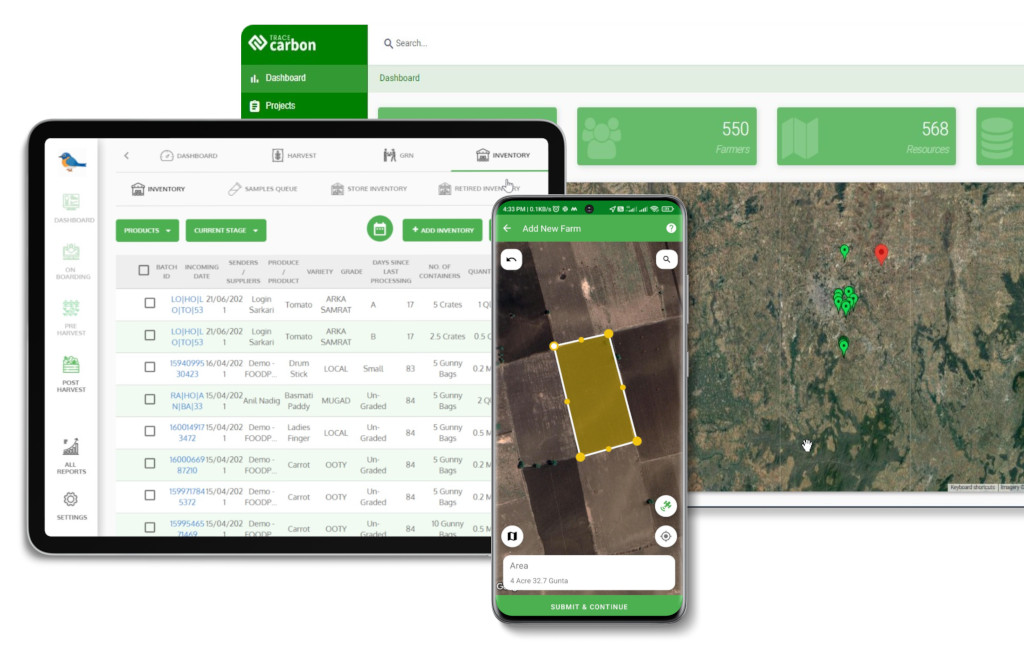
TraceX EUDR Solutions sits between the farm and your ERP. Field teams onboard farmers on an offline mobile app available in 15 languages, capture plot polygons and upload land documents. Cleara AI then validates geolocation against satellite deforestation datasets, scores supplier and plot risk, and generates and submits the DDS to the EU Information System.
For ERP teams, API-based integration with SAP S/4HANA, SAP ECC and non-SAP ERPs pushes plot IDs, risk status and DDS reference numbers into existing master and transaction data, so farm-level traceability with SAP and ERP in EUDR runs inside the workflows your buyers and warehouse staff already use. The platform is GDPR compliant, ISO 27001 certified and SOC 1 and SOC 2 compliant.
Ready to connect your farms to your ERP?
see farm-level traceability with SAP and ERP in EUDR on your own supply chain, or start a 15-day free trial with full platform access, no credit card required.
Farm-Level Traceability with SAP and ERP in EUDR: ERP-Only vs Integrated Platform
ERP-only setups push field work into spreadsheets, while an integrated platform makes farm-level traceability with SAP and ERP in EUDR auditable.
Compare how each model handles plot data, risk checks and DDS submission.
Use the table to brief IT and compliance leads together.
Requirement
ERP-only / manual
Traceability platform + ERP
Plot geolocation
Spreadsheets or attachments, rarely validated
Validated polygons and points linked to farmer IDs
Smallholder onboarding
Supplier-level only
Farmer-level, offline, multilingual
Deforestation check
Outsourced or skipped
Satellite check against the 2020 cutoff
Batch-to-plot link
Manual lookups
Traceability ID on every ERP batch
DDS submission
Copy-paste into the EU Information System
[Generated and submitted via API]
Five-year audit trail
Scattered across files
Single record per batch and plot
Farm-Level Traceability Checklist for SAP and ERP Buyers
Ask these questions before you commit to a platform for farm-level traceability with SAP and ERP in EUDR.
Does it capture polygons offline and validate GeoJSON before sync?
Can it onboard farmers individually, not just suppliers?
Does it check deforestation against the 31 December 2020 cutoff?
Which ERP objects does it update, and through which APIs?
Can it block ERP batches until a DDS reference exists?
Does it submit DDS through the EU Information System API?
Does it hold five years of audit-ready records?
Frequently Asked Questions
Can SAP alone handle farm-level traceability for EUDR?
SAP alone cannot handle farm level traceability. SAP manages procurement, batches and deliveries well, and SAP offers EUDR tooling, but plot capture from smallholders, polygon validation and satellite checks usually sit in a specialised platform that integrates with the ERP.
Do I need a polygon for every farm?
No. Plots of four hectares or less can be recorded as a single geolocation point. Larger plots need a polygon, and cattle follow separate rules.
Do certifications like RSPO or Rainforest Alliance replace plot data?
No. Certifications can support risk mitigation, but they never replace plot-level geolocation, verifiable evidence or the DDS.
Who files the DDS when goods pass through several companies?
The operator that first places the product on the EU market, or exports it, files the DDS. Downstream companies must collect and keep the reference numbers they receive.
When does farm-level traceability with SAP and ERP in EUDR need to be live?
Farm-level traceability with SAP and ERP in EUDR must be live by 30 December 2026 for large and medium companies, and by 30 June 2027 for most micro and small operators. As of November 2026, no further delay has been proposed.
How long does integration take?
Typical TraceX onboarding takes around four weeks, depending on ERP landscape and supplier volume.
Start using TraceX
Transparency, Trust, & Success for your Climate Journey.
We use cookies on our website to give you the most relevant experience by remembering your preferences and repeat visits. By clicking “Accept All”, you consent to the use of ALL the cookies. However, you may visit "Cookie Settings" to provide a controlled consent.
This website uses cookies to improve your experience while you navigate through the website. Out of these, the cookies that are categorized as necessary are stored on your browser as they are essential for the working of basic functionalities of the website. We also use third-party cookies that help us analyze and understand how you use this website. These cookies will be stored in your browser only with your consent. You also have the option to opt-out of these cookies. But opting out of some of these cookies may affect your browsing experience.
Necessary cookies are absolutely essential for the website to function properly. These cookies ensure basic functionalities and security features of the website, anonymously.
Cookie
Duration
Description
cookielawinfo-checkbox-analytics
11 months
This cookie is set by GDPR Cookie Consent plugin. The cookie is used to store the user consent for the cookies in the category "Analytics".
cookielawinfo-checkbox-functional
11 months
The cookie is set by GDPR cookie consent to record the user consent for the cookies in the category "Functional".
cookielawinfo-checkbox-necessary
11 months
This cookie is set by GDPR Cookie Consent plugin. The cookies is used to store the user consent for the cookies in the category "Necessary".
cookielawinfo-checkbox-others
11 months
This cookie is set by GDPR Cookie Consent plugin. The cookie is used to store the user consent for the cookies in the category "Other.
cookielawinfo-checkbox-performance
11 months
This cookie is set by GDPR Cookie Consent plugin. The cookie is used to store the user consent for the cookies in the category "Performance".
viewed_cookie_policy
11 months
The cookie is set by the GDPR Cookie Consent plugin and is used to store whether or not user has consented to the use of cookies. It does not store any personal data.
Functional cookies help to perform certain functionalities like sharing the content of the website on social media platforms, collect feedbacks, and other third-party features.
Performance cookies are used to understand and analyze the key performance indexes of the website which helps in delivering a better user experience for the visitors.
Analytical cookies are used to understand how visitors interact with the website. These cookies help provide information on metrics the number of visitors, bounce rate, traffic source, etc.
Advertisement cookies are used to provide visitors with relevant ads and marketing campaigns. These cookies track visitors across websites and collect information to provide customized ads.
Download the 2026 Traceability Scorecard and Benchmark Your Supply Chain Across 10 Critical Capabilities.
Download our eBook
Don’t Wait for an Audit to Find Your EUDR Gaps
The 2026 Simplification Package changes how HS codes, DDS pass-through and geolocation rules apply to you. Get the free guide and 20-point readiness checklist before enforcement catches you unprepared.