EU Battery Passport Responsibility: Who Is Legally Accountable?
Published
, 8 minute read
Share this article
Quick summary: EU Battery Passport Responsibility explained: learn who is legally accountable, whether outsourcing transfers liability, and how to prepare for February 2027.
EU Battery Passport Responsibility starts with one critical question: Who is legally accountable for creating and maintaining the Battery Passport? The EU Battery Passport is moving from a future compliance concept to an operational requirement. From 18 February 2027, each electric vehicle battery, light means of transport battery, and industrial battery above 2 kWh placed on the EU market or put into service must have a Battery Passport. For manufacturers, importers, OEMs and technology providers, one question is especially important: who is legally responsible for the information in that passport?
The answer matters because implementation can involve several parties. A battery manufacturer may collect information from cell suppliers, work with an OEM, use a software platform, or authorise a third party to create and update the passport. However, these operational arrangements do not automatically transfer the legal responsibility imposed by the Batteries Regulation.
EU Battery Passport Responsibility: Key Takeaways
Legal responsibility stays with the responsible economic operator: The party placing the relevant finished battery on the EU market remains accountable for passport compliance and data accuracy.
Third parties can perform passport tasks: Written authorisation can allow another operator to create or update the Battery Passport.
Outsourcing does not transfer ultimate responsibility: A software provider or consultant can execute processes without becoming the responsible economic operator.
Finished-battery status matters: Responsibility can depend on who completes the finished battery and adds essential components.
Non-EU manufacturers need clear role definitions: They may perform authorised tasks, while Battery Passport registration follows the specific rules for the operator placing the battery on the EU market.
Data governance is central: The real implementation challenge is maintaining accurate, complete and up-to-date data across the battery value chain.
The Battery DPP introduces new expectations around battery data, traceability, sustainability information and digital access across the battery lifecycle.
Our eBook breaks down the key requirements and practical considerations businesses need to understand as they prepare for implementation.
Under Article 77 of Regulation (EU) 2023/1542, the economic operator placing the battery on the EU market is responsible for ensuring that the Battery Passport information is accurate, complete and up to date. The European Commission also states that the obligation to create and maintain the Battery Passport lies with the economic operator placing the finished battery on the market, rather than suppliers of individual cells, components or modules.
This creates a useful distinction between responsibility and execution. The responsible economic operator may use other organisations to perform practical tasks, but legal accountability remains with the party identified by the regulation.
Who Creates the Battery Passport?
The Battery Passport is created and maintained for the finished battery by the responsible economic operator. This does not mean employees must manually enter every data point. The European Commission confirms that another operator can act on behalf of the responsible economic operator under written authorisation.
In practice, this could include a Battery Passport software provider, a cell manufacturer, an OEM, a non-EU manufacturer or another specialist service provider. The important point is that the technology or service provider is performing an authorised function; it does not automatically become the legally responsible party.
Can Battery Passport Management Be Outsourced?
Yes. Outsourcing Battery Passport management is possible when the arrangement is structured correctly. A responsible economic operator may give another operator written authorisation to create or update the Battery Passport on its behalf.
This can be useful because implementation involves data collection, validation, identity management, access controls, lifecycle updates and integration with enterprise systems. A specialised platform can centralise these activities and reduce manual effort.
However, outsourcing should not be treated as outsourcing accountability. Contracts and operating procedures should clearly define who supplies data, who validates it, who updates the passport, who manages corrections, who maintains evidence, and how changes are recorded.
Does Outsourcing Transfer Legal Liability?
No. This is one of the most important points in understanding EU Battery Passport responsibility. The European Commission explicitly states that written authorisation to another operator does not transfer ultimate legal responsibility. The economic operator placing the battery on the EU market remains responsible for compliance and for the data included in the passport.
Therefore, selecting a Battery Passport technology provider should not be viewed simply as purchasing a digital document. The responsible company needs confidence that its underlying supply-chain data is complete, traceable, validated and capable of being kept current throughout the battery lifecycle.
Discover how battery data must evolve across manufacturing, use, reuse, repurposing, remanufacturing, and recycling, and how a connected Battery Passport can help maintain product information and compliance evidence throughout the battery lifecycle.
Can a Non-EU Manufacturer Register the Battery Passport?
The Commission distinguishes between general DPP registration and the specific Battery Passport requirement. A non-EU operator responsible for a DPP can create an account and register a DPP after required verification. For Battery Passports, however, registration must be done by the economic operator that places the battery on the EU market.
This distinction matters for global battery supply chains. A non-EU manufacturer may be authorised to create or update passport information, but that practical role does not by itself make the manufacturer the EU economic operator or transfer ultimate responsibility.
What Happens When a Battery Manufacturer Supplies an EV Manufacturer?
The answer depends on whether the battery is already a complete finished battery when supplied. The European Commission states that if an EU battery manufacturer supplies a complete finished battery to an EU vehicle manufacturer and the vehicle manufacturer merely installs it in the vehicle, the battery manufacturer is responsible for the Battery Passport.
The position can change if the vehicle manufacturer completes the battery. For example, if it adds a Battery Management System or another component essential to the finished battery, responsibility may rest with the vehicle manufacturer. This makes the definition and configuration of the finished battery an important part of determining accountability.
What Data Responsibility Means in Practice
EU Battery Passport responsibility is ultimately a data-governance responsibility. Current Commission guidance brings together 71 data points and identifies which are mandatory, optional, conditional or not required as of February 2027.
Why Battery Passport Responsibility Is a Supply-Chain Challenge
The biggest implementation challenge is rarely the QR code itself. It is connecting reliable data from the battery value chain to the finished battery. Cell, module, material and component information may originate from different suppliers and systems. The responsible economic operator needs a controlled process for collecting, validating, mapping and updating that information.
The Batteries Regulation also requires Battery Passport information to use open standards and an interoperable, machine-readable and structured format. Businesses should therefore avoid building responsibility around isolated spreadsheets or systems that create vendor lock-in.
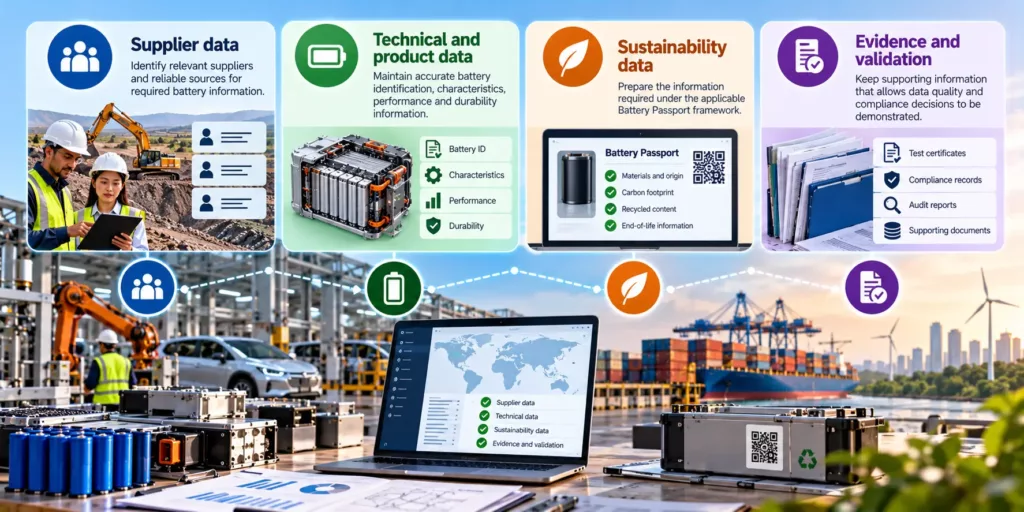
Key data areas include:
Supplier data: Identify relevant suppliers and reliable sources for required battery information.
Technical and product data: Maintain accurate battery identification, characteristics, performance and durability information.
Sustainability data: Prepare the information required under the applicable Battery Passport framework.
Evidence and validation: Keep supporting information that allows data quality and compliance decisions to be demonstrated.
Lifecycle updates: Ensure information remains accurate and up to date as the battery moves through relevant lifecycle stages.
How Businesses Can Prepare for EU Battery Passport Responsibility
Identify the economic operator responsible for each relevant finished battery placed on the EU market.
Map which Battery Passport data comes from internal systems, suppliers, OEMs and other partners.
Define data ownership, validation and approval responsibilities.
Use written authorisations where third parties create or update passport information.
Establish controls for corrections, updates, evidence and audit history.
Connect Battery Passport data with ERP, procurement, product and supply-chain systems where appropriate.
Prepare for the 18 February 2027 mandatory application date and the evolving implementation framework.
Simplify Battery Passport Data Management with TraceX
EU Battery Passport responsibility does not end with creating a QR code or registering a digital record. Businesses need a connected way to manage supplier data, product information, evidence, updates and lifecycle records while keeping responsibility and approvals clearly defined.
TraceX Battery DPP Solutions can help businesses build a structured digital foundation for supply-chain data, connect supplier and product information, manage evidence and create auditable workflows that support emerging EU compliance requirements.
Who is legally responsible for the EU Battery Passport?
The economic operator placing the relevant finished battery on the EU market is responsible for ensuring that the Battery Passport information is accurate, complete and up to date.
Can a third party createtheBattery Passport?
Yes. Another operator may act on behalf of the responsible economic operator under written authorisation.
Does outsourcing Battery Passport management transfer legal responsibility?
No. The European Commission explicitly states that authorisation does not transfer ultimate legal responsibility.
Can a non-EU manufacturer manage Battery Passport information?
Yes, it can perform authorised practical tasks, but the specific Battery Passport registration requirement applies to the economic operator placing the battery on the EU market.
When does the Battery Passport become mandatory?
From 18 February 2027 for each EV battery, LMT battery and industrial battery above 2 kWh that is placed on the EU market or put into service.
Start using TraceX
Transparency, Trust, & Success for your Climate Journey.
We use cookies on our website to give you the most relevant experience by remembering your preferences and repeat visits. By clicking “Accept All”, you consent to the use of ALL the cookies. However, you may visit "Cookie Settings" to provide a controlled consent.
This website uses cookies to improve your experience while you navigate through the website. Out of these, the cookies that are categorized as necessary are stored on your browser as they are essential for the working of basic functionalities of the website. We also use third-party cookies that help us analyze and understand how you use this website. These cookies will be stored in your browser only with your consent. You also have the option to opt-out of these cookies. But opting out of some of these cookies may affect your browsing experience.
Necessary cookies are absolutely essential for the website to function properly. These cookies ensure basic functionalities and security features of the website, anonymously.
Cookie
Duration
Description
cookielawinfo-checkbox-analytics
11 months
This cookie is set by GDPR Cookie Consent plugin. The cookie is used to store the user consent for the cookies in the category "Analytics".
cookielawinfo-checkbox-functional
11 months
The cookie is set by GDPR cookie consent to record the user consent for the cookies in the category "Functional".
cookielawinfo-checkbox-necessary
11 months
This cookie is set by GDPR Cookie Consent plugin. The cookies is used to store the user consent for the cookies in the category "Necessary".
cookielawinfo-checkbox-others
11 months
This cookie is set by GDPR Cookie Consent plugin. The cookie is used to store the user consent for the cookies in the category "Other.
cookielawinfo-checkbox-performance
11 months
This cookie is set by GDPR Cookie Consent plugin. The cookie is used to store the user consent for the cookies in the category "Performance".
viewed_cookie_policy
11 months
The cookie is set by the GDPR Cookie Consent plugin and is used to store whether or not user has consented to the use of cookies. It does not store any personal data.
Functional cookies help to perform certain functionalities like sharing the content of the website on social media platforms, collect feedbacks, and other third-party features.
Performance cookies are used to understand and analyze the key performance indexes of the website which helps in delivering a better user experience for the visitors.
Analytical cookies are used to understand how visitors interact with the website. These cookies help provide information on metrics the number of visitors, bounce rate, traffic source, etc.
Advertisement cookies are used to provide visitors with relevant ads and marketing campaigns. These cookies track visitors across websites and collect information to provide customized ads.
Download the 2026 Traceability Scorecard and Benchmark Your Supply Chain Across 10 Critical Capabilities.
Download our eBook
Don’t Wait for an Audit to Find Your EUDR Gaps
The 2026 Simplification Package changes how HS codes, DDS pass-through and geolocation rules apply to you. Get the free guide and 20-point readiness checklist before enforcement catches you unprepared.