EUDR Timber Compliance in Indonesia: How Exporters Need to Stay EU-Ready
Published
, 8 minute read
Share this article
Quick summary: EUDR timber compliance in Indonesia: what SVLK covers, what it misses, and the 5 steps exporters need before the 30 December 2026 deadline.
EUDR timber compliance in Indonesia means proving that every shipment of wood, plywood, pulp, paper or furniture sold into the EU was legally produced and comes from land that was not deforested or degraded after 31 December 2020. The EU operator files the Due Diligence Statement, but Indonesian suppliers must hand over plot-level geolocation and evidence. SVLK and FLEGT licences cover legality. They do not prove deforestation-free status.
Key takeaways
Deadline: 30 December 2026 for large and medium operators, and for micro and small timber-sector operators already covered by the EU Timber Regulation.
Risk tier: Indonesia is classified as standard risk, so full risk assessment and mitigation apply.
SVLK is half the answer: FLEGT-licensed timber meets the legality test, but geolocation and deforestation checks are still required.
Biggest exposure: plantation conversion (forest degradation), mixed inputs in plywood and furniture, and missing concession polygons.
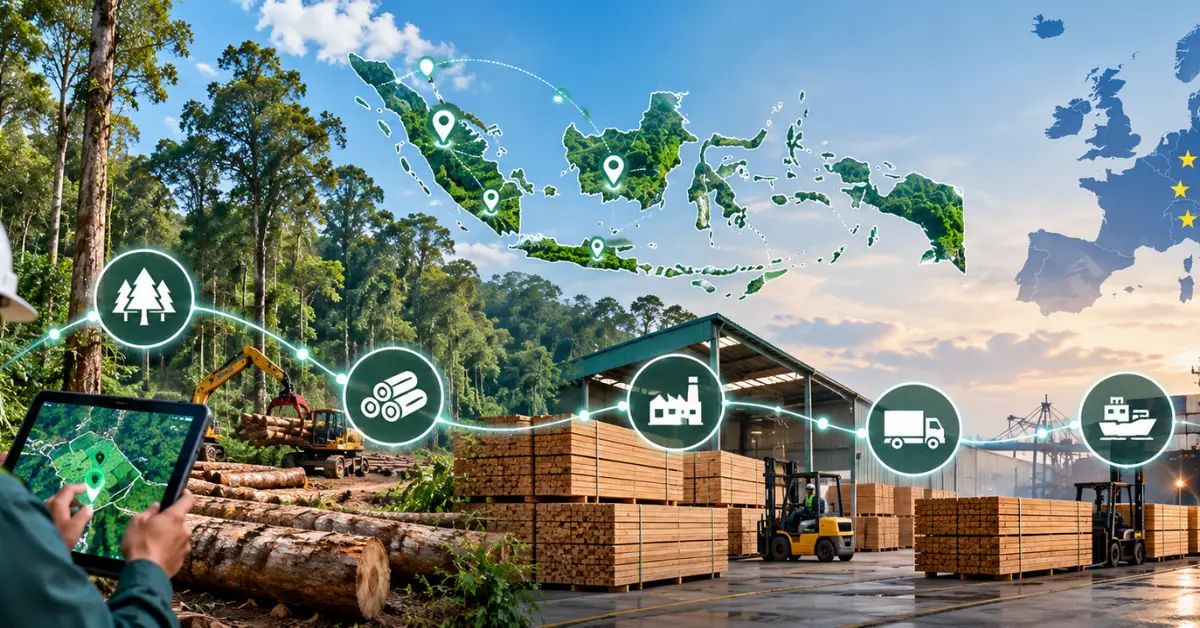
EUDR timber compliance in Indonesia is now a commercial question, not a legal footnote. Indonesia is one of Asia’s largest exporters of plywood, mouldings, furniture, pulp and paper to Europe, and from 30 December 2026 none of that volume can clear EU customs without a Due Diligence Statement backed by traceable data.
The good news: Indonesian exporters already run one of the most mature timber legality systems in the world. The hard part is the data SVLK was never designed to collect. This guide covers what changes, where suppliers usually fail, and the exact steps to close the gap.
EUDR Timber Compliance in Indonesia: What the Regulation Requires
EUDR timber compliance in Indonesia rests on three conditions for every product, with no volume threshold.
Deforestation-free: no deforestation or forest degradation on the harvest land after 31 December 2020.
Legal: produced in line with Indonesian law, including land rights, labour, tax and forestry rules.
Covered by a Due Diligence Statement: submitted to the EU Information System before the goods are placed on the market or exported.
The EU Deforestation Regulation, Regulation (EU) 2023/1115 as amended by Regulation (EU) 2025/2650, places the filing duty on the operator that first places the product on the EU market. In practice that is usually the EU importer, not the Indonesian mill. But the importer cannot file without supplier data, which is why EUDR timber compliance in Indonesia becomes a condition of keeping European contracts.
Discover how Indonesian wood exporters can strengthen supply chain transparency, address compliance gaps, and prepare for EUDR requirements with digital traceability.
Annex I covers wood and most wood-derived goods. For Indonesian exporters that typically includes logs and sawn timber, plywood and veneer, mouldings and flooring, wooden furniture, and pulp and paper. A delegated act adopted in July 2026 refined the list, exempting items such as used and second-hand products, samples and certain packing materials, so confirm each HS code against the final text.
EUDR Indonesia Timber Deadlines and Risk Tier
Large and medium operators must comply from 30 December 2026. Micro and small operators also face that date for timber, because wood was already regulated under the EU Timber Regulation. Indonesia sits in the standard-risk tier, which means national authorities must check at least 3% of relevant operators and no simplified due diligence applies. For most mills, that makes EUDR timber compliance in Indonesia a 2026 project, not a 2027 one.
EUDR Timber Compliance in Indonesia vs SVLK and FLEGT Licensing
SVLK proves legality; the EUDR also demands proof of where and when the wood was grown.
FLEGT-licensed timber is accepted as meeting the EUDR legality requirement.
Plot-level geolocation and the deforestation cut-off check remain mandatory.
The FLEGT licence does not replace the Due Diligence Statement.
Indonesia’s Legality and Sustainability Verification System (SVLK) underpins the country’s FLEGT Voluntary Partnership Agreement with the EU. In August 2026 the EU reaffirmed that FLEGT-licensed Indonesian products satisfy EU legality requirements under the new regime. That gives EUDR timber compliance in Indonesia a head start over many other timber origins.
SVLK answers “was this harvested legally?” The EUDR adds “was this land forested on 31 December 2020, and can you prove exactly where it is?” Treat certifications, including FSC and PEFC, as risk-mitigation evidence that supports your file, never as a substitute for geolocation or the statement itself.
Read our blog to understand how certifications fit into EUDR compliance and what additional steps your business needs to take.
EUDR Timber Compliance in Indonesia: Where Exporters Get Caught
Most EUDR timber compliance in Indonesia failures come from three data gaps, not from illegal logging.
Plantation conversion that counts as forest degradation.
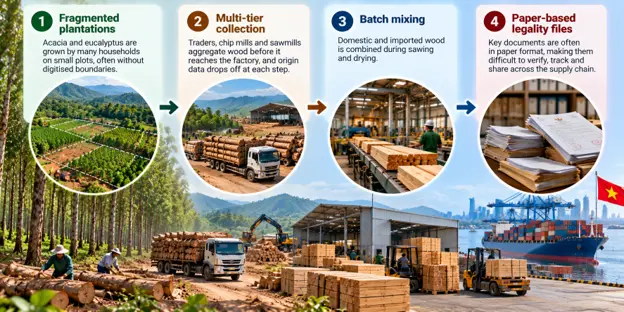
Mixed or unknown-origin inputs in composite products.
Concession and smallholder plots without usable polygons.
Forest Degradation from Plantation Conversion
For wood, the EUDR treats converting primary or naturally regenerating forest into plantation forest as degradation. Industrial plantation (HTI) wood feeding pulp, paper and some plywood lines is the highest-scrutiny category if any compartment was established after the 2020 cut-off.
Mixed Inputs in Plywood and Furniture
One plywood sheet can combine face veneer, core veneer and glue-line material from several forest units. Each source needs geolocation. Mixing a single untraced log batch into a production run can contaminate the whole consignment.
Geolocation for Concessions and Community Forests
Plots above four hectares need polygon boundaries, not single points. Large concessions are usually mapped, but community forests (hutan rakyat) and smallholder woodlots supplying furniture clusters in Java often have only village-level records.
Is your supply chain actually ready?
Move from spreadsheets and fragmented supplier data to a traceable, audit-ready EUDR workflow with TraceX.
EUDR Timber Compliance in Indonesia: 5 Steps to Get Audit-Ready
EUDR timber compliance in Indonesia comes down to five moves made before the EU buyer asks.
Map every harvest plot. Collect GPS coordinates or polygons for each concession block, plantation compartment and smallholder woodlot.
Screen against the 2020 cut-off. Check each polygon against satellite forest-cover data to rule out deforestation and degradation.
Link plots to shipments. Carry plot IDs from log yard to mill to finished batch, so every V-Legal or FLEGT document traces back to land.
Assess and mitigate risk. Score suppliers on country, supply-chain complexity and mixing risk; request extra evidence or audits where risk is not negligible.
Package data for your EU operator. Deliver geolocation, production dates and legality evidence in a format the importer can attach to its Due Diligence Statement.
How TraceX supports Indonesian timber exporters
Manual spreadsheets break down once a mill sources from hundreds of plots. TraceX EUDR Solutions turns EUDR timber compliance in Indonesia into a repeatable workflow:
Captures plot polygons through an offline-first mobile app built for remote field teams.
Validates each plot against JRC and Hansen satellite datasets for post-2020 forest loss.
Extracts legality evidence, including SVLK and FLEGT documents, from supplier files using AI document parsing.
Generates Due Diligence Statement data packages ready for submission to the EU Information System.
Ready to close your geolocation gap?
See how Indonesian mills and EU importers map plots and build Due Diligence Statement data in one workflow.
Indonesian Timber EUDR Compliance: Manual Process vs TraceX
Requirement
Manual process
TraceX
Plot geolocation
Field GPS readings in spreadsheets, often incomplete
Mobile polygon capture with validation
Deforestation check
Ad hoc map comparisons
Automated satellite screening vs. 31 Dec 2020
Legality evidence
SVLK files stored in email and folders
AI parsing and linking to each plot
Batch traceability
Paper trails that break at the mill
Plot-to-shipment chain of custody
DDS readiness
Weeks of data cleaning per buyer
Export-ready data packages
EUDR Timber Software Evaluation Checklist
Before choosing a platform for EUDR timber compliance in Indonesia, confirm it can:
Store polygons, not just points, for plots above four hectares.
Screen plots against recognised satellite datasets and the 2020 cut-off.
Handle multi-source inputs for plywood and furniture batches.
Attach SVLK, FLEGT and certification evidence to specific plots.
Work offline for field data collection in remote forest areas.
Export data in a format your EU operator can file directly.
Frequently Asked Questions
Does an SVLK or FLEGT licence make Indonesian timber EUDR compliant?
No. A FLEGT licence satisfies the legality requirement, but EUDR timber compliance in Indonesia also needs plot-level geolocation, a deforestation-free check against 31 December 2020 and a Due Diligence Statement.
Who submits the Due Diligence Statement for Indonesian timber?
The operator that first places the product on the EU market, usually the EU importer. Indonesian exporters supply the geolocation and evidence the statement relies on.
When does EUDR apply to Indonesian timber?
From 30 December 2026 for large and medium operators, and also for micro and small operators in the timber sector already covered by the EU Timber Regulation.
What risk category is Indonesia under the EUDR?
Indonesia is currently classified as standard risk, so full risk assessment and mitigation apply. The Commission planned a classification review in 2026, so check the latest list.
What are the penalties for non-compliance?
Member states set penalties, which can include confiscation of goods, exclusion from public contracts and fines of up to at least 4% of the operator’s total annual EU turnover.
Start using TraceX
Transparency, Trust, & Success for your Climate Journey.
We use cookies on our website to give you the most relevant experience by remembering your preferences and repeat visits. By clicking “Accept All”, you consent to the use of ALL the cookies. However, you may visit "Cookie Settings" to provide a controlled consent.
This website uses cookies to improve your experience while you navigate through the website. Out of these, the cookies that are categorized as necessary are stored on your browser as they are essential for the working of basic functionalities of the website. We also use third-party cookies that help us analyze and understand how you use this website. These cookies will be stored in your browser only with your consent. You also have the option to opt-out of these cookies. But opting out of some of these cookies may affect your browsing experience.
Necessary cookies are absolutely essential for the website to function properly. These cookies ensure basic functionalities and security features of the website, anonymously.
Cookie
Duration
Description
cookielawinfo-checkbox-analytics
11 months
This cookie is set by GDPR Cookie Consent plugin. The cookie is used to store the user consent for the cookies in the category "Analytics".
cookielawinfo-checkbox-functional
11 months
The cookie is set by GDPR cookie consent to record the user consent for the cookies in the category "Functional".
cookielawinfo-checkbox-necessary
11 months
This cookie is set by GDPR Cookie Consent plugin. The cookies is used to store the user consent for the cookies in the category "Necessary".
cookielawinfo-checkbox-others
11 months
This cookie is set by GDPR Cookie Consent plugin. The cookie is used to store the user consent for the cookies in the category "Other.
cookielawinfo-checkbox-performance
11 months
This cookie is set by GDPR Cookie Consent plugin. The cookie is used to store the user consent for the cookies in the category "Performance".
viewed_cookie_policy
11 months
The cookie is set by the GDPR Cookie Consent plugin and is used to store whether or not user has consented to the use of cookies. It does not store any personal data.
Functional cookies help to perform certain functionalities like sharing the content of the website on social media platforms, collect feedbacks, and other third-party features.
Performance cookies are used to understand and analyze the key performance indexes of the website which helps in delivering a better user experience for the visitors.
Analytical cookies are used to understand how visitors interact with the website. These cookies help provide information on metrics the number of visitors, bounce rate, traffic source, etc.
Advertisement cookies are used to provide visitors with relevant ads and marketing campaigns. These cookies track visitors across websites and collect information to provide customized ads.
Download the 2026 Traceability Scorecard and Benchmark Your Supply Chain Across 10 Critical Capabilities.
Download our eBook
Don’t Wait for an Audit to Find Your EUDR Gaps
The 2026 Simplification Package changes how HS codes, DDS pass-through and geolocation rules apply to you. Get the free guide and 20-point readiness checklist before enforcement catches you unprepared.