EUDR Timber Compliance in Vietnam: What Exporters Must Prove
Published
, 8 minute read
Share this article
Quick summary: EUDR timber compliance in Vietnam starts 30 Dec 2026. See what low-risk status covers, how to trace imported wood, and what evidence EU buyers will ask for.
EUDR timber compliance in Vietnam means proving that every wood product shipped to the EU was legally harvested on land not deforested after 31 December 2020, backed by plot-level geolocation. Vietnam is rated low risk, so EU operators can use simplified due diligence, but that relief ends where imported logs from standard-risk countries enter the mill. The rules apply from 30 December 2026.
KEY TAKEAWAYS
Application date is 30 December 2026 for large and medium operators, and for micro and small operators in the timber sector.
Vietnam has been low risk since May 2025: no mandatory risk assessment for Vietnamese-grown wood, but geolocation is still required.
Imported timber from Laos, Cambodia, Africa or elsewhere needs its own origin evidence. Mixing it with domestic wood can trigger full due diligence.
The EU importer files the Due Diligence Statement. The Vietnamese exporter supplies the evidence behind it.
FSC certification and VNTLAS legality documents help, but neither replaces geolocation or the DDS.
EUDR timber compliance in Vietnam has moved from a policy debate to a sales requirement. Vietnam exported a record US$17.2 billion of wood and wood products in 2025, and although the EU takes only about 5 per cent of that directly, EU buyers set the traceability bar that other markets now follow. From 30 December 2026, any furniture, panel, pellet or paper product made from wood that reaches the EU must be covered by due diligence that ties it back to the plot where the tree was felled.
In plain terms, EUDR timber compliance in Vietnam is the work of collecting origin, legality and geolocation evidence for wood products so that the EU operator can file a Due Diligence Statement (DDS) showing the product is deforestation-free and legal.
Is your supply chain actually ready?
Move from spreadsheets and fragmented supplier data to a traceable, audit-ready EUDR workflow with TraceX.
EUDR Timber Compliance in Vietnam: What the Regulation Requires
The EUDR sets three tests that every wood product entering the EU must pass:
Deforestation-free: no deforestation on the harvest plot after 31 December 2020.
Legal: harvested in line with Vietnamese law on land use, forestry, tax, labour and trade.
Documented: covered by a DDS that includes geolocation of every harvest plot.
EUDR Timber Products from Vietnam That Are in Scope
Coverage follows the EUDR Annex I product list. For Vietnam, that means sawn wood, plywood, MDF, wood chips and pellets, wooden furniture, and pulp and paper. Printed products such as books and newspapers were removed by the December 2025 amendment, while fibre-based packaging stays in scope. If your factory ships acacia dining sets or eucalyptus pellets to Europe, you are part of the chain.
EUDR Due Diligence Roles: Who Files What
The EU company that first places the product on the market is the operator and files the DDS in the EU Information System. Vietnamese exporters are not directly regulated, yet EUDR timber compliance in Vietnam still lands on their desk, because buyers will write the evidence requirements into contracts: plot coordinates (polygons for plots over 4 hectares), species, quantities, harvest dates, supplier details and legality documents.
From verifying forest origins and collecting legality documents to assessing deforestation risks, timber businesses face complex EUDR compliance challenges. Discover how digital traceability can help strengthen supplier transparency, organise evidence, and support more efficient due diligence.
EUDR Timber Compliance in Vietnam Under Low-Risk Status
Vietnam’s low-risk rating reduces paperwork, but it does not remove the evidence requirement.
The European Commission classified Vietnam as low risk in May 2025.
Operators can apply simplified due diligence to wood grown in Vietnam.
Authorities check around 1 per cent of operators sourcing from low-risk countries.
Simplified Due Diligence: What It Removes and What It Keeps
Simplified due diligence removes the formal risk assessment and risk mitigation steps. It keeps everything else: information collection, geolocation, the DDS and five years of records. If an operator learns of a credible risk, such as circumvention or mixing with wood of unknown origin, full due diligence applies again.
Vietnam Timber Imports: Where Low-Risk Status Stops
This is the part of EUDR timber compliance in Vietnam most exporters underestimate. Vietnamese mills process large volumes of imported logs and sawn wood from Laos, Cambodia, Africa, Papua New Guinea, the US and Europe. Under the EUDR, the country of production is where the tree was harvested, not where it was cut into a chair. Wood from a standard-risk country needs a full risk assessment even after processing in Binh Duong or Quy Nhon.
Vietnam’s low-risk rating covers wood grown in Vietnam, not every product finished in Vietnam.
Learn how businesses can use country risk information alongside supplier data, plot-level geolocation, and deforestation evidence to strengthen their due diligence approach.
Timber has a tighter timeline than other commodities because it was already regulated under the EU Timber Regulation (EUTR).
30 December 2026: large and medium operators, plus micro and small operators in the timber sector.
30 June 2027: micro and small operators outside the timber sector.
EUTR transition: EUTR-covered products made before 29 June 2023 and placed on the market before 30 December 2026 stay under the EUTR until 31 December 2029.
Penalties: fines of at least 4 per cent of the operator’s EU turnover, confiscation of goods and exclusion from public contracts.
The Commission’s May 2026 review confirmed there will be no further postponement, so EUDR timber compliance in Vietnam should be treated as a fixed 2026 deadline.
EUDR Timber Compliance Challenges in Vietnam’s Wood Supply Chain
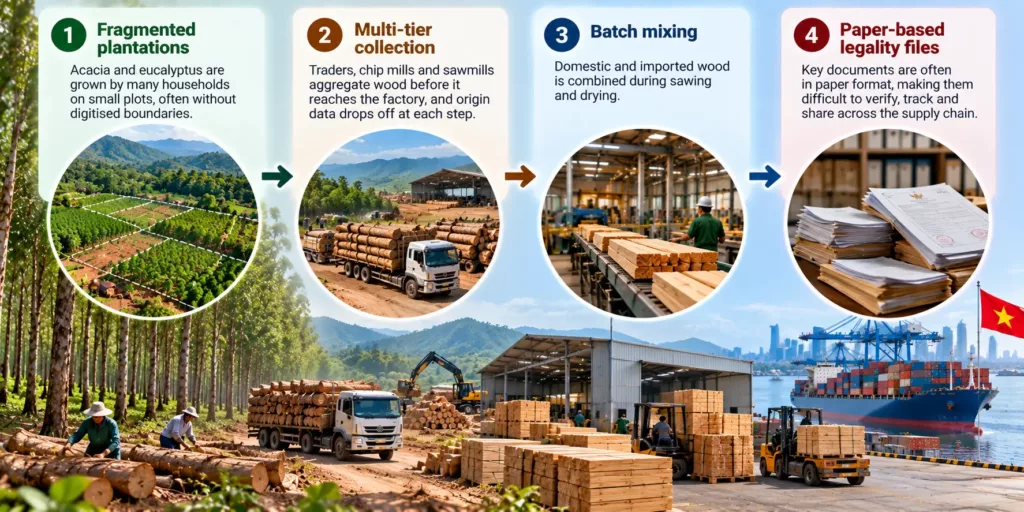
Most gaps in EUDR timber compliance in Vietnam come from how wood actually moves:
Fragmented plantations: acacia and eucalyptus are grown by many households on small plots, often without digitised boundaries.
Multi-tier collection: traders, chip mills and sawmills aggregate wood before it reaches the factory, and origin data drops off at each step.
Batch mixing: domestic and imported wood is combined during sawing and drying.
Paper-based legality files: documents built for VNTLAS and EUTR rarely include coordinates.
Vietnam has announced plans to complete provincial forest-boundary maps during 2026, which will help verification. But the map is only useful if your suppliers’ plots are captured in a format the EU buyer can check.
Not sure where your supply chain stands?
Book a 30-minute EUDR gap review with the TraceX team and get a clear view of your Vietnam timber data gaps.
EUDR Timber Compliance in Vietnam: Manual Process vs. Platform
The difference shows up at the moment an EU buyer asks for evidence on a specific shipment.
Requirement
Manual process
TraceX
Plot geolocation
GPS points in spreadsheets, often incomplete
Polygons captured in the field and validated
Imported timber origin
Supplier declarations, rarely verified
Origin and country risk tracked per lot
Batch traceability
Lost when wood is mixed at the mill
Linked from plot to finished product
Deforestation check
Manual review of maps, if done at all
Automated satellite screening
Hand-off to EU buyer
Emailed folders per shipment
Structured DDS data pack
Five-year audit trail
Scattered across inboxes
Central, searchable record
EUDR Timber Compliance Software Checklist for Vietnamese Exporters
Use these questions when comparing tools:
Can it capture polygons offline in remote plantation areas?
Does it screen plots against recognised post-2020 deforestation datasets?
Can it separate Vietnamese-grown wood from imported wood by lot?
Does it flag inputs from standard-risk or high-risk countries?
Can it store legality documents alongside geolocation data?
Does it produce data your EU buyer can use in the DDS?
Will it hold records for at least five years?
Frequently Asked Questions
Does Vietnam’s low-risk status mean the EUDR doesn’t apply?
No. Low risk only removes the formal risk assessment and mitigation steps. EUDR timber compliance in Vietnam still requires geolocation, legality evidence and a DDS for every shipment.
Do Vietnamese exporters submit the Due Diligence Statement?
No. The EU operator that first places the product on the market submits it. Exporters supply the plot, species and legality data the operator needs.
Does FSC certification or VNTLAS satisfy the EUDR?
Neither replaces the DDS or plot-level geolocation. Certification and VNTLAS documents support legality checks, but EUDR timber compliance in Vietnam still depends on verifiable origin evidence.
What about imported timber processed in Vietnam?
It is assessed against the country where it was harvested. Wood from a standard-risk country needs full due diligence, even after processing in Vietnam.
When does the EUDR apply to small timber businesses?
Micro and small operators in the timber sector apply from 30 December 2026, the same date as larger companies. The June 2027 date applies only to other sectors.
Start using TraceX
Transparency, Trust, & Success for your Climate Journey.
We use cookies on our website to give you the most relevant experience by remembering your preferences and repeat visits. By clicking “Accept All”, you consent to the use of ALL the cookies. However, you may visit "Cookie Settings" to provide a controlled consent.
This website uses cookies to improve your experience while you navigate through the website. Out of these, the cookies that are categorized as necessary are stored on your browser as they are essential for the working of basic functionalities of the website. We also use third-party cookies that help us analyze and understand how you use this website. These cookies will be stored in your browser only with your consent. You also have the option to opt-out of these cookies. But opting out of some of these cookies may affect your browsing experience.
Necessary cookies are absolutely essential for the website to function properly. These cookies ensure basic functionalities and security features of the website, anonymously.
Cookie
Duration
Description
cookielawinfo-checkbox-analytics
11 months
This cookie is set by GDPR Cookie Consent plugin. The cookie is used to store the user consent for the cookies in the category "Analytics".
cookielawinfo-checkbox-functional
11 months
The cookie is set by GDPR cookie consent to record the user consent for the cookies in the category "Functional".
cookielawinfo-checkbox-necessary
11 months
This cookie is set by GDPR Cookie Consent plugin. The cookies is used to store the user consent for the cookies in the category "Necessary".
cookielawinfo-checkbox-others
11 months
This cookie is set by GDPR Cookie Consent plugin. The cookie is used to store the user consent for the cookies in the category "Other.
cookielawinfo-checkbox-performance
11 months
This cookie is set by GDPR Cookie Consent plugin. The cookie is used to store the user consent for the cookies in the category "Performance".
viewed_cookie_policy
11 months
The cookie is set by the GDPR Cookie Consent plugin and is used to store whether or not user has consented to the use of cookies. It does not store any personal data.
Functional cookies help to perform certain functionalities like sharing the content of the website on social media platforms, collect feedbacks, and other third-party features.
Performance cookies are used to understand and analyze the key performance indexes of the website which helps in delivering a better user experience for the visitors.
Analytical cookies are used to understand how visitors interact with the website. These cookies help provide information on metrics the number of visitors, bounce rate, traffic source, etc.
Advertisement cookies are used to provide visitors with relevant ads and marketing campaigns. These cookies track visitors across websites and collect information to provide customized ads.
Download the 2026 Traceability Scorecard and Benchmark Your Supply Chain Across 10 Critical Capabilities.
Download our eBook
Don’t Wait for an Audit to Find Your EUDR Gaps
The 2026 Simplification Package changes how HS codes, DDS pass-through and geolocation rules apply to you. Get the free guide and 20-point readiness checklist before enforcement catches you unprepared.