EUDR Coffee Compliance in India: What Growers and Exporters Must Prove
Published
, 7 minute read
Share this article
Quick summary: EUDR coffee compliance in India: what growers, curing works and exporters must prove before 30 December 2026, plus the 2027 instant coffee deadline.
EUDR coffee compliance in India means proving that every lot of Indian coffee sold into the EU was grown on land not deforested after 31 December 2020, was produced legally under Indian law, and can be traced to plot-level geolocation. The EU importer files the due diligence statement (DDS), but Indian growers, curing works and exporters must supply the evidence behind it. Large and medium EU operators must comply from 30 December 2026.
Key takeaways
Deadline: 30 December 2026 for large and medium EU operators, 30 June 2027 for micro and small ones. The Commission confirmed in May 2026 that there will be no further delay.
Low risk is not exempt: India is classified low risk, which means simplified due diligence and fewer checks, not a waiver.
Plot data is mandatory: a GPS point for plots up to 4 hectares, a polygon for anything larger.
Instant coffee is next: soluble coffee (CN 2101 11 00) comes into scope from 30 December 2027.
Certificates help, but do not replace the DDS or plot geolocation.
Europe is the largest destination for Indian coffee, with Italy, Germany and Belgium among the top buyers. That makes EUDR coffee compliance in India a market-access question rather than a paperwork task. With the application date less than three months away, many EU buyers are already asking exporters in Kodagu, Chikkamagaluru and Wayanad for plot coordinates before they confirm contracts.
Is your supply chain actually ready?
Move from spreadsheets and fragmented supplier data to a traceable, audit-ready EUDR workflow with TraceX.
EUDR Coffee Compliance in India: Who Is Responsible for What
The EU importer files, but the evidence starts on Indian estates.
EU operator: files the DDS in the EU Information System
Indian exporter: compiles lot-level traceability and legality evidence
Curing works and traders: keep plot-to-lot links intact
Growers: provide plot geolocation and land documents
Under Regulation (EU) 2025/2650, the duty to submit a DDS sits with the operator that first places coffee on the EU market, while downstream operators and traders follow a simplified regime. For EUDR coffee compliance in India, this means most Indian exporters will not file in the EU system themselves unless they have an EU entity. They are, however, the only party that can produce the farm data the importer must reference.
Your EU buyer files, you supply the proof. Without your data, the buyer cannot legally place your coffee on the EU market.
Discover how TraceX helps coffee exporters improve farm-level visibility, verify plot geolocation, assess deforestation risks, and maintain reliable supplier records for EU market requirements.
EUDR Coffee Compliance in India Starts at the Plot
Four things must hold for every lot that ships to the EU.
Geolocation for every plot: a point up to 4 hectares, a polygon above
No deforestation after 31 December 2020
Legal production under Indian law
An unbroken chain from plot to shipped lot
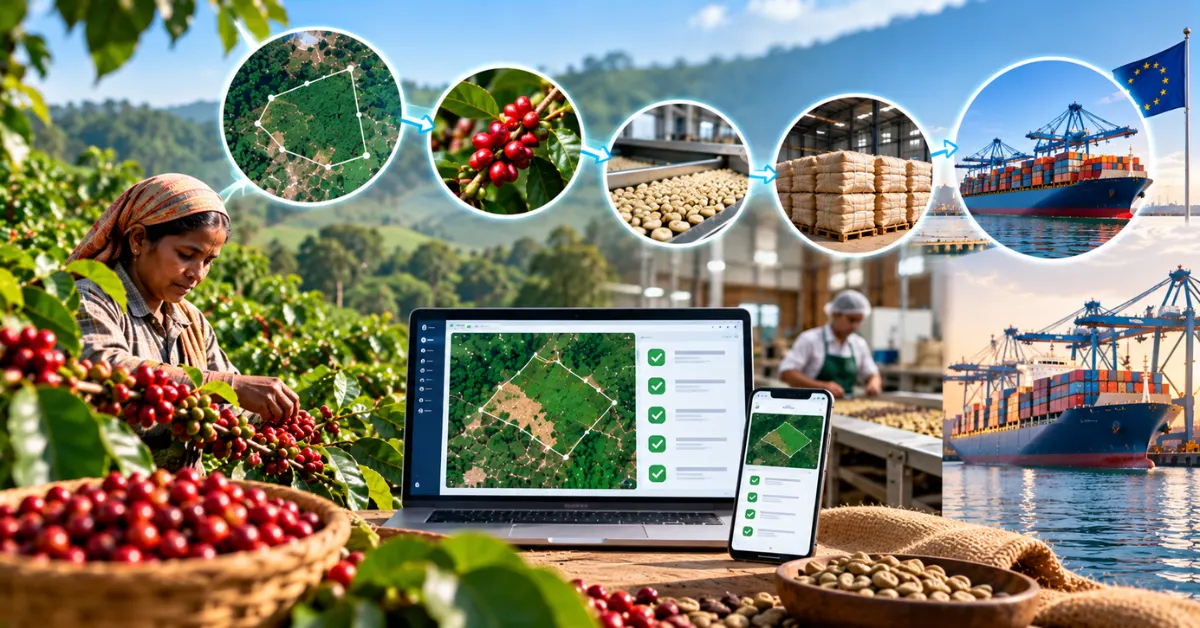
The hardest part of EUDR coffee compliance in India is not the filing. It is keeping plot data attached to coffee as it moves from estate to pulper, curing works, trader and port. A trader who buys cherry from dozens of growers and records only a total weight has already broken the trail.
India Coffee App Registration for EU-Bound Growers
The Coffee Board of India has asked growers supplying the EU to register on the India Coffee App using RTC land records with Aadhaar authentication, and to geo-tag their estates. Estates larger than 10 acres must upload polygon boundaries, and EU-bound growers are expected to register by December 2026. Registration supports EUDR coffee compliance in India, but exporters still need to link those records to specific lots and shipments.
Legality Evidence for Indian Coffee
Legality covers land tenure, environmental and labour rules, and tax and trade law where the coffee was grown. Keep land records, licences and supplier declarations per plot, and refresh them every season.
EUDR Coffee Rules for India: What Low-Risk Status Changes
A low-risk rating lightens the audit load, nothing more.
Simplified due diligence for EU operators sourcing from India
About 1% of relevant operators checked each year
No waiver of geolocation, legality proof or the DDS
Commission Implementing Regulation (EU) 2025/1093 classifies India as low risk. For EUDR coffee compliance in India, this lets EU operators skip the full risk assessment and mitigation steps unless they learn of a risk, and authorities check roughly 1% of operators sourcing from low-risk countries. It does not remove the duty to collect plot geolocation, confirm legality and file a DDS.
Certification works the same way. Rainforest Alliance, Fairtrade or organic certificates strengthen supplier assurance, but no certificate replaces plot geolocation or the DDS.
Understand how the EU’s country risk classification affects deforestation due diligence, risk assessment, and compliance obligations for businesses sourcing regulated commodities.
EUDR Coffee Compliance in India for Instant Coffee and Re-Exports
The scope widened in 2026, and it hits India’s soluble and re-export trade.
Soluble coffee (CN 2101 11 00) in scope from 30 December 2027
Re-exported coffee needs geolocation from the country of production
Blended lots need plot data for every origin in the blend
India exports large volumes of instant coffee and re-exports processed coffee made from imported beans. Delegated Regulation (EU) 2026/2102 added soluble coffee, extracts, essences and concentrates to Annex I from 30 December 2027. That extends EUDR coffee compliance in India to soluble manufacturers, who must trace every input bean to its plot, including beans imported from Vietnam, Uganda or Brazil.
How TraceX fits in
TraceX EUDR Solutions connects grower onboarding, offline polygon capture, satellite deforestation checks against the 31 December 2020 cut-off, and lot-level traceability through curing and export. Exporters can share DDS-ready data packages with EU buyers or push them to the EU Information System via API. The result: EUDR coffee compliance in India becomes a repeatable workflow instead of a seasonal scramble.
EUDR Coffee Compliance in India: Manual vs Platform
Spreadsheets break exactly where Indian coffee changes hands.
Plot data capture and validation
Deforestation and legality checks
Lot traceability and buyer handover
Task
Manual (spreadsheets, email)
Platform (TraceX)
Plot geolocation
GPS readings typed in, formats vary, polygons often missing
Mobile point and polygon capture with validation on entry
Deforestation check
Ad hoc satellite map review, if any
Automated checks against the 2020 cut-off
Plot-to-lot link
Lost at aggregation and curing
Lot IDs carry plot references through processing
Legality documents
Scattered across email and paper files
Stored per plot with renewal alerts
DDS handover
EU buyer re-keys data
Structured data package or API
Manual methods can work for one estate. They rarely survive a season of buying from hundreds of growers, which is where EUDR coffee compliance in India usually fails.
EUDR Coffee Compliance in India: Next Steps
Start at the plot and keep the data intact to the port.
Map growers and plots this season
Lock in legality documents per plot
Agree a data handover format with each EU buyer
EUDR coffee compliance in India rewards exporters who move first. Give your EU buyers DDS-ready data before 30 December 2026, and plan soluble coffee for 2027 now.
Captures points and polygons, and validates GeoJSON before export
Works offline in estate areas with weak connectivity
Runs deforestation checks against the 31 December 2020 cut-off
Preserves plot-to-lot links through curing, blending and re-export
Stores land records and legality documents per plot
Exports data in the format your EU buyer’s DDS needs
Covers soluble coffee inputs ahead of 30 December 2027
Use this list to compare vendors and to brief EU buyers on how you will meet EUDR coffee compliance in India this season.
Frequently Asked Questions
Does EUDR apply to Indian coffee exporters?
Yes, indirectly. Coffee (HS 0901) is an EUDR commodity. The EU importer files the DDS, but it needs plot geolocation and legality evidence from Indian exporters.
When does EUDR coffee compliance in India become mandatory?
From 30 December 2026 for coffee placed on the EU market by large and medium operators, and 30 June 2027 for micro and small operators. Instant coffee follows from 30 December 2027.
Is India high risk under EUDR?
No. India is classified low risk, which simplifies due diligence but keeps the geolocation, legality and DDS requirements.
Is Rainforest Alliance certification enough?
No. Certification supports risk mitigation, but EU operators still need plot geolocation and a filed DDS.
Do small Indian growers need polygons?
Plots up to 4 hectares can use a single GPS point. Larger plots need a polygon, and the Coffee Board asks estates above 10 acres to upload boundaries.
Start using TraceX
Transparency, Trust, & Success for your Climate Journey.
We use cookies on our website to give you the most relevant experience by remembering your preferences and repeat visits. By clicking “Accept All”, you consent to the use of ALL the cookies. However, you may visit "Cookie Settings" to provide a controlled consent.
This website uses cookies to improve your experience while you navigate through the website. Out of these, the cookies that are categorized as necessary are stored on your browser as they are essential for the working of basic functionalities of the website. We also use third-party cookies that help us analyze and understand how you use this website. These cookies will be stored in your browser only with your consent. You also have the option to opt-out of these cookies. But opting out of some of these cookies may affect your browsing experience.
Necessary cookies are absolutely essential for the website to function properly. These cookies ensure basic functionalities and security features of the website, anonymously.
Cookie
Duration
Description
cookielawinfo-checkbox-analytics
11 months
This cookie is set by GDPR Cookie Consent plugin. The cookie is used to store the user consent for the cookies in the category "Analytics".
cookielawinfo-checkbox-functional
11 months
The cookie is set by GDPR cookie consent to record the user consent for the cookies in the category "Functional".
cookielawinfo-checkbox-necessary
11 months
This cookie is set by GDPR Cookie Consent plugin. The cookies is used to store the user consent for the cookies in the category "Necessary".
cookielawinfo-checkbox-others
11 months
This cookie is set by GDPR Cookie Consent plugin. The cookie is used to store the user consent for the cookies in the category "Other.
cookielawinfo-checkbox-performance
11 months
This cookie is set by GDPR Cookie Consent plugin. The cookie is used to store the user consent for the cookies in the category "Performance".
viewed_cookie_policy
11 months
The cookie is set by the GDPR Cookie Consent plugin and is used to store whether or not user has consented to the use of cookies. It does not store any personal data.
Functional cookies help to perform certain functionalities like sharing the content of the website on social media platforms, collect feedbacks, and other third-party features.
Performance cookies are used to understand and analyze the key performance indexes of the website which helps in delivering a better user experience for the visitors.
Analytical cookies are used to understand how visitors interact with the website. These cookies help provide information on metrics the number of visitors, bounce rate, traffic source, etc.
Advertisement cookies are used to provide visitors with relevant ads and marketing campaigns. These cookies track visitors across websites and collect information to provide customized ads.
Download the 2026 Traceability Scorecard and Benchmark Your Supply Chain Across 10 Critical Capabilities.
Download our eBook
Don’t Wait for an Audit to Find Your EUDR Gaps
The 2026 Simplification Package changes how HS codes, DDS pass-through and geolocation rules apply to you. Get the free guide and 20-point readiness checklist before enforcement catches you unprepared.