EUDR Rubber Compliance in India: How Exporters Stay EU-Ready
Published
, 8 minute read
Share this article
Quick summary: EUDR rubber compliance in India explained: 30 Dec 2026 deadline, plot geolocation, Rubber Board BSNR and DDS-ready data your EU buyers need. Start now.
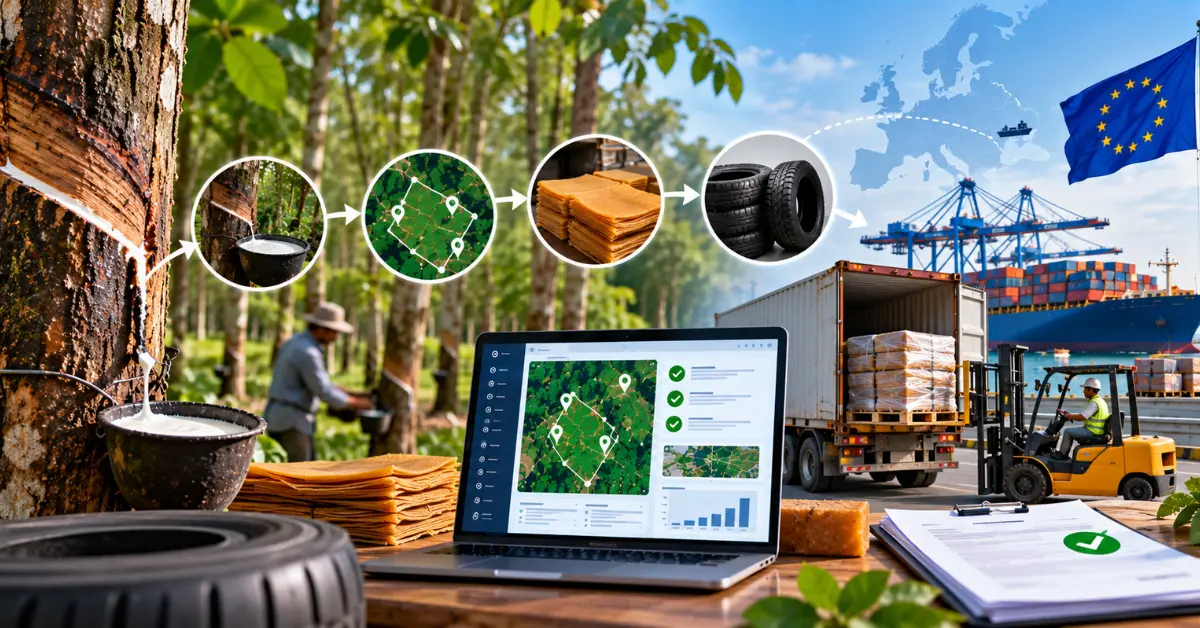
EUDR rubber compliance in India means giving EU buyers proof that natural rubber and rubber products were grown on land not deforested after 31 December 2020, were produced legally, and can be traced to the exact plot. The rules apply from 30 December 2026 for large and medium operators and from 30 June 2027 for micro and small operators.
EUDR rubber compliance in India is now a condition of selling natural rubber, tyres, gloves and moulded parts into Europe. In plain terms, EUDR rubber compliance in India is the evidence package your EU buyer needs before it can file a Due Diligence Statement (DDS) and release your consignment.
Most Indian exporters will not file that statement themselves. But from 30 December 2026, the quality of their plot and lot data decides whether a shipment moves or waits.
Key takeaways
Natural rubber (HS 4001) and products made from it, such as tyres, gloves, belts and moulded parts, are in scope. Synthetic rubber is not, unless natural rubber is blended in.
Only the EU operator that first places a product on the market files the DDS. Indian exporters supply the data behind it.
India was classified low risk in May 2025. That simplifies due diligence but still requires geolocation and legality evidence.
Smallholder-heavy sourcing makes plot mapping and lot segregation the hardest part of EUDR rubber compliance in India.
The Rubber Board BSNR portal and a traceability platform work best together to produce DDS-ready data.
Is your supply chain actually ready?
Move from spreadsheets and fragmented supplier data to a traceable, audit-ready EUDR workflow with TraceX.
Deforestation-free: no deforestation or forest degradation on the plot after 31 December 2020.
Legal: produced under Indian law on land use rights, labour, environmental protection, tax and human rights.
Traceable: covered by a DDS backed by geolocation of every plot, a single point for plots up to 4 hectares and a polygon above that.
That makes EUDR rubber compliance in India a data problem before it is a paperwork problem. Certifications such as PEFC or FSC can support risk mitigation, but they never replace the DDS, plot geolocation or verifiable evidence.
EUDR Rubber Scope: Which Products Are Covered
Annex I covers natural rubber (HS 4001) and derived products, including compounded rubber, new pneumatic tyres (HS 4011), inner tubes, conveyor belts, gloves and other articles of vulcanised rubber. Synthetic rubber (HS 4002) is outside scope unless blended with natural rubber, in which case the natural rubber share must be compliant.
EUDR Rubber Due Diligence: Who Files the DDS
Since the December 2025 amendment, only the operator that first places a product on the EU market submits a DDS in the EU Information System (TRACES). Downstream operators and traders do not resubmit. When an Indian tyre maker ships to a German distributor, the distributor is usually that first operator. The exporter’s job is to hand over complete plot and lot data it can stand behind.
EUDR Rubber Compliance in India Deadlines: 2026 and 2027
The current dates come from the December 2025 amendment, and the Commission has said the text will not be reopened.
30 December 2026: large and medium operators and traders.
30 June 2027: micro and small operators handling non-timber products, which includes rubber.
Today: EU buyers are already asking Indian suppliers for plot data so they can test their systems early.
Treat December 2026 as the date your data must already be clean, not the date to start collecting it. Buyers will favour suppliers who make EUDR rubber compliance in India easy for them.
Discover the key EUDR requirements, compliance challenges, and steps Indian rubber exporters need to understand before exporting to the EU.
EUDR Rubber Compliance in India: Why Smallholder Supply Chains Make It Hard
India’s rubber supply chain was built for volume and price, not plot-level traceability.
Fragmented origin: most natural rubber comes from small holdings across Kerala, Tamil Nadu, Karnataka and the Northeast, many without digital maps.
Multi-tier aggregation: latex and sheets pass through dealers, societies and processors before reaching an exporter or tyre plant.
Mixing risk: one unmapped lot blended into a compliant batch can break the evidence chain for the whole consignment.
Spreadsheet workflows: coordinates, land records and invoices sit in separate files, so nobody can quickly prove the link from plot to shipment.
Today most exporters answer buyer questionnaires with supplier declarations and Excel sheets. Under EUDR rubber compliance in India, that creates a forced tradeoff: slow every shipment to chase data by hand, or accept the risk of a rejected DDS, a held consignment or a lost buyer.
EUDR Rubber Risk: Why India’s Low-Risk Status Is Not a Shortcut
In May 2025 the Commission classified India as low risk. That allows simplified due diligence and a 1% inspection rate for operators. It does not remove the duty to collect geolocation and legality information, and any sign of mixing with unknown or higher-risk origin triggers full risk assessment. A low-risk label helps your buyer. It does not prove your lot.
Discover how the EU Deforestation Regulation (EUDR) impacts smallholder farmers, the key challenges they face, and how businesses can support them in building transparent, deforestation-free supply chains.
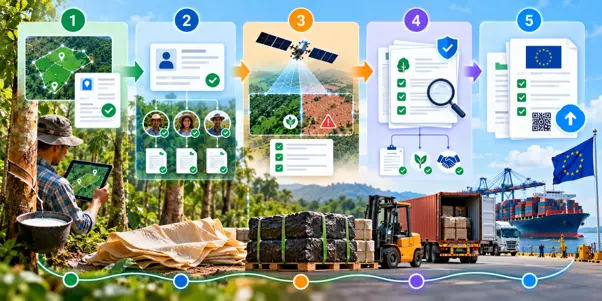
EUDR Rubber Compliance in India: A 5-Step Readiness Plan
These five steps move an exporter from questionnaire mode to DDS-ready data.
Map tiers, capture plots, collect legality proof, segregate lots and package data for buyers.
Map your sourcing tiers. List every dealer, society, processor and estate behind each product line and HS code.
Capture plot geolocation. Collect GPS points or polygons for every holding and check them against satellite data for the post-2020 period. Use the Rubber Board’s BSNR portal where your suppliers are already registered.
Collect legality evidence. Link land records, plantation registration, labour and tax documents to each plot.
Segregate and link lots. Record every transfer from plot to processor to shipment so compliant rubber never mixes with unverified rubber.
Package data for your EU buyer. Share geolocation, risk results and lot links in the format your buyer’s DDS workflow expects, and keep records for five years.
Pilot on one product line, then scale. It is the fastest route to EUDR rubber compliance in India without stalling exports.
How TraceX supports Indian rubber exporters
TraceX EUDR Solutions is built for smallholder-heavy commodities such as natural rubber. Offline mobile plot mapping for field agents and dealers; polygon validation against JRC and Hansen satellite datasets; agentic AI that extracts land and KYC documents from supplier emails; lot-level segregation and mass-balance tracking; DDS-ready exports with TRACES API integration.
The result: scattered dealer data becomes evidence your EU buyer can file with confidence, and EUDR rubber compliance in India stops slowing every shipment.
EUDR Rubber Compliance in India: Manual Process vs Traceability Platform
The comparison shows where manual workflows break under EUDR.
Manual methods depend on supplier declarations that buyers cannot verify.
A platform links plot, lot and shipment data in one record.
Requirement
Manual (spreadsheets, declarations)
Platform
Plot geolocation
Collected ad hoc, often missing or unvalidated
Points and polygons captured offline, validated on entry
Deforestation check
Rarely done before shipment
Automatic check against post-2020 satellite data
Legality documents
Scattered across email and folders
Linked to each plot and supplier record
Lot segregation
Hard to prove once rubber is mixed
Lot-level chain of custody and mass balance
Buyer DDS handover
Rebuilt for every questionnaire
DDS-ready export in buyer format
Five-year records
At risk when staff change
Central audit trail
See how TraceX turns dealer data into DDS-ready evidence for your EU buyers.
EUDR Rubber Compliance in India: Software Buyer Checklist
Ask these questions before choosing EUDR rubber compliance software.
Does it map smallholder plots offline, as both points and polygons?
Does it check plots against recognised satellite datasets for the 31 December 2020 cutoff?
Can it trace rubber through dealers, societies and processors, not just direct suppliers?
Does it track segregation and mass balance at lot level?
Can it import data from the Rubber Board BSNR portal or your ERP?
Does it export DDS-ready data in the format your EU buyers use?
Does it keep audit records for at least five years?
EUDR Rubber Compliance in India: What to Do This Quarter
Use the months before December 2026 to fix data, not paperwork.
Ask your top EU buyers exactly which data fields their DDS workflow needs.
Map plots for your highest-volume product line first.
Choose a platform that closes the gap between dealers and buyers.
Exporters who start now will treat EUDR rubber compliance in India as a sales advantage rather than a shipping risk.
Frequently Asked Questions
Does EUDR apply to Indian natural rubber exporters?
Yes, indirectly. EUDR rubber compliance in India applies to any natural rubber or in-scope rubber product sold into the EU. The EU operator files the DDS, but it relies on the exporter’s plot and lot data.
When does EUDR apply to rubber?
From 30 December 2026 for large and medium operators and traders, and from 30 June 2027 for micro and small operators.
Is synthetic rubber covered by EUDR?
No. Synthetic rubber is outside scope unless it is blended with natural rubber, in which case the natural rubber share must be compliant.
Does a Rubber Board or PEFC certificate make rubber EUDR compliant?
No. Certificates and the BSNR portal support EUDR rubber compliance in India, but the DDS still needs plot geolocation, deforestation checks and legality evidence for each lot.
What does India’s low-risk classification change?
It allows simplified due diligence and fewer inspections for EU operators. Geolocation and legality information are still mandatory.
What happens if a rubber shipment is not compliant?
The product cannot be placed on the EU market. Operators face penalties that can reach at least 4% of EU annual turnover, plus confiscation. Exporters usually lose the buyer.
Start using TraceX
Transparency, Trust, & Success for your Climate Journey.
We use cookies on our website to give you the most relevant experience by remembering your preferences and repeat visits. By clicking “Accept All”, you consent to the use of ALL the cookies. However, you may visit "Cookie Settings" to provide a controlled consent.
This website uses cookies to improve your experience while you navigate through the website. Out of these, the cookies that are categorized as necessary are stored on your browser as they are essential for the working of basic functionalities of the website. We also use third-party cookies that help us analyze and understand how you use this website. These cookies will be stored in your browser only with your consent. You also have the option to opt-out of these cookies. But opting out of some of these cookies may affect your browsing experience.
Necessary cookies are absolutely essential for the website to function properly. These cookies ensure basic functionalities and security features of the website, anonymously.
Cookie
Duration
Description
cookielawinfo-checkbox-analytics
11 months
This cookie is set by GDPR Cookie Consent plugin. The cookie is used to store the user consent for the cookies in the category "Analytics".
cookielawinfo-checkbox-functional
11 months
The cookie is set by GDPR cookie consent to record the user consent for the cookies in the category "Functional".
cookielawinfo-checkbox-necessary
11 months
This cookie is set by GDPR Cookie Consent plugin. The cookies is used to store the user consent for the cookies in the category "Necessary".
cookielawinfo-checkbox-others
11 months
This cookie is set by GDPR Cookie Consent plugin. The cookie is used to store the user consent for the cookies in the category "Other.
cookielawinfo-checkbox-performance
11 months
This cookie is set by GDPR Cookie Consent plugin. The cookie is used to store the user consent for the cookies in the category "Performance".
viewed_cookie_policy
11 months
The cookie is set by the GDPR Cookie Consent plugin and is used to store whether or not user has consented to the use of cookies. It does not store any personal data.
Functional cookies help to perform certain functionalities like sharing the content of the website on social media platforms, collect feedbacks, and other third-party features.
Performance cookies are used to understand and analyze the key performance indexes of the website which helps in delivering a better user experience for the visitors.
Analytical cookies are used to understand how visitors interact with the website. These cookies help provide information on metrics the number of visitors, bounce rate, traffic source, etc.
Advertisement cookies are used to provide visitors with relevant ads and marketing campaigns. These cookies track visitors across websites and collect information to provide customized ads.
Download the 2026 Traceability Scorecard and Benchmark Your Supply Chain Across 10 Critical Capabilities.
Download our eBook
Don’t Wait for an Audit to Find Your EUDR Gaps
The 2026 Simplification Package changes how HS codes, DDS pass-through and geolocation rules apply to you. Get the free guide and 20-point readiness checklist before enforcement catches you unprepared.