PPWR Packaging Inventory: How to Build One That Passes Compliance Review
Published
, 13 minute read
Share this article
Quick summary: A PPWR packaging inventory is a structured, SKU-level record of every packaging format a company places on the market tracking material, weight, recyclability, recycled content, and country of sale so producers can calculate PRO fees accurately and respond to compliance audits under the EU’s Packaging and Packaging Waste Regulation. PPWR packaging inventory work usually starts the same […]
A PPWR packaging inventory is a structured, SKU-level record of every packaging format a company places on the market tracking material, weight, recyclability, recycled content, and country of sale so producers can calculate PRO fees accurately and respond to compliance audits under the EU’s Packaging and Packaging Waste Regulation.
PPWR packaging inventory work usually starts the same way: someone gets asked for a fee estimate or an audit-ready data export, and realizes the company has no single source of truth for what packaging it actually puts on the market. Product data lives in one system, packaging specs live in a supplier email thread, and nobody has recalculated recycled content since the last redesign.
This guide walks through what belongs in a proper packaging inventory, a step-by-step process for building one, and since most people researching this are close to a build-or-buy decision the criteria worth weighing before you commit engineering time or budget to a tool. As with any compliance topic, treat regulatory dates and thresholds mentioned here as directional and confirm specifics with your PRO or legal counsel before acting.
PPWR Phase 1 Hits 12 August – Are You Ready?
With enforcement approaching fast, guesswork is expensive. See how TraceX helps you get audit-ready before the deadline, not after.
A PPWR packaging inventory is the data foundation behind accurate PRO fee calculations and audit-ready reporting.
At minimum, track material type, weight, recyclability, recycled content percentage, and country of sale for every packaging format.
Building one in-house works for small, stable catalogs; multi-country or fast-changing SKU lists usually justify dedicated tooling.
Buyers evaluating a tool should weigh data model flexibility, PRO/ERP integration, multi-country support, and audit trail quality.
This guide is educational, not legal advice confirm your exact required fields with your PRO or counsel.
PPWR Packaging Inventory: What It Is and Why You Need One
A PPWR packaging inventory is a centralized record of every packaging component your business places on the EU market. It captures essential information such as packaging type, material composition, weight, supplier details, product-to-packaging relationships, and supporting compliance documents. This inventory serves as the foundation for technical documentation, EPR reporting, Declarations of Conformity, and demonstrating compliance with the Packaging and Packaging Waste Regulation (PPWR).
Who Needs a PPWR Packaging Inventory?
Any business that places packaged products on the EU market should maintain a packaging inventory. This includes:
Packaging manufacturers
Brand owners
Importers
Producers
Consumer goods manufacturers
Retailers with private-label products
A well-maintained inventory enables these businesses to accurately classify packaging, collect supplier documentation, and respond efficiently to regulatory audits and customer requests.
How Is It Different from an ERP or Bill of Materials (BOM)?
An ERP manages operational data such as procurement, inventory, and production, while a Bill of Materials (BOM) lists the components required to manufacture a product. Neither is designed to capture the detailed packaging compliance information required under PPWR.
A PPWR packaging inventory goes beyond operational records by linking packaging components to products, suppliers, material composition, packaging weights, recycled content, technical documentation, and compliance evidence. It creates a single, audit-ready source of truth specifically for managing packaging compliance.
PPWR compliance starts with preparation, not paperwork.
The core data fields every SKU-level record needs to support fee calculation and reporting.
Material and Format Data
Every packaging component needs a material classification plastic resin type, paper/board grade, glass, metal, or composite plus a format description (bottle, pouch, corrugated case, blister pack). PROs use this to bucket packaging into the fee categories their eco-modulation model scores against, so vague descriptions like ‘mixed plastic’ create downstream fee-calculation headaches.
Weight and Unit Data
Fees are frequently calculated per unit weight, so your inventory needs an accurate weight per packaging component, not just per finished product. If a product ships with a box, an inner tray, and a poly bag, each needs its own weight entry lumping them together under-reports some materials and over-reports others.
Recyclability and Recycled Content Data
This is the field most inventories get wrong, because it changes whenever a supplier swaps material sourcing. Track both a recyclability classification (recyclable, not currently recyclable, recyclable with limitations) and a recycled content percentage, and revisit both whenever packaging specs change not just at your annual review.
Country and Volume Data
Because obligations and fee schedules vary by member state, your inventory needs to track which countries each packaging format is sold into, along with unit volumes per market. This is the field that determines which PRO registrations apply and how fees split across markets miss it, and multi-country fee estimates will be wrong by construction.
Supplier and Traceability Data
It’s easy to treat material and weight fields as static facts, but they’re really claims made by a supplier at a point in time. Recording which supplier provided a given packaging component, and when the spec was last confirmed, turns a vague ‘is this still accurate?’ question into a quick lookup. This becomes especially valuable when a supplier changes resin sourcing or a recycled-content claim needs to be re-verified you know immediately which SKUs are affected instead of re-auditing the entire catalog.
Understanding PPWR requirements is the first step toward compliance.
Why Most Packaging Inventories Fail Compliance Reviews
Many businesses already maintain some form of packaging inventory, but these records are often created for procurement or production not regulatory compliance. As a result, they frequently lack the detailed, accurate, and traceable information needed to demonstrate PPWR compliance during audits or market surveillance.
Common gaps include:
Missing packaging components – Not all primary, secondary, or transport packaging is captured, leaving an incomplete compliance record.
Incorrect packaging weights – Outdated or estimated weights can result in inaccurate EPR reporting and fee calculations.
No product-to-packaging SKU mapping – Without linking packaging to the products it contains, it’s difficult to trace packaging throughout the supply chain.
Missing supplier data – Incomplete supplier declarations and technical documentation make it challenging to verify compliance claims.
No version control – Packaging specifications change over time, and without version tracking, businesses risk using outdated compliance information.
Data spread across ERP, PLM, and Excel – When packaging data is stored across multiple systems, maintaining consistency, accuracy, and audit readiness becomes increasingly difficult.
If you can’t prove what’s in your packaging, you can’t prove compliance. A PPWR-compliant packaging inventory isn’t just a list of packaging materials it’s the evidence that supports your technical documentation, Declaration of Conformity, EPR reporting, and overall regulatory compliance.
How to Build a PPWR Packaging Inventory Step by Step
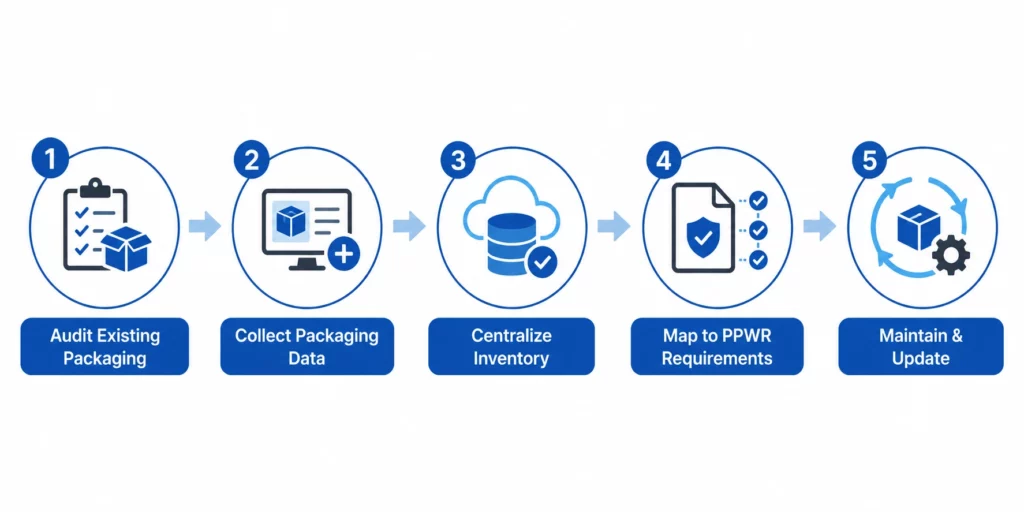
A five-step process that turns scattered packaging data into one maintained system of record.
Step 1: Audit Every SKU and Packaging Format
Start with a full list of active SKUs and the packaging components tied to each one primary packaging, secondary packaging, and any shipping materials that count under your PRO’s scope. It’s common to discover packaging formats nobody remembers approving; this is the point to catch them.
Step 2: Collect Material, Weight, and Recycling Data
Pull spec sheets from suppliers, weigh sample units where documentation is missing or outdated, and confirm recycled content claims rather than assuming last year’s numbers still hold. This step is almost always the slowest part of the build budget for it accordingly.
Step 3: Centralize the Data in One System of Record
Whether it’s a well-structured spreadsheet or a dedicated tool, the goal is one authoritative file not a packaging tab in procurement’s sheet and a separate one in sustainability’s sheet. Assign clear field ownership so updates don’t silently diverge between versions.
Step 4: Map Fields to Your PRO’s Reporting Format
Every PRO expects data in a specific structure field names, units, category codes. Map your internal inventory fields to that format once, and you can export on demand instead of manually reformatting every reporting cycle.
Step 5: Maintain It on a Set Cadence
Packaging specs change more often than most compliance calendars assume new suppliers, redesigns, format switches. Set a recurring review (quarterly is a reasonable default) rather than only updating the inventory when a report or audit forces it.
PPWR Packaging Inventory: Build In-House vs. Buy a Tool
This is usually the real decision buyers are weighing. A spreadsheet-based PPWR packaging inventory works fine for a small, stable catalog selling into one or two markets. It starts to break down once you’re managing dozens of SKUs, frequent packaging changes, or reporting across several member states.
There’s no universally right answer here the honest framing is that a spreadsheet is a starting point everyone should try first, and a dedicated tool is what you upgrade to once the spreadsheet’s maintenance cost starts outweighing its low sticker price. Watch for the tell-tale signs: version conflicts between teams, fee estimates that don’t match what your PRO actually invoices, or nobody being fully sure which tab is current.
Factor
In-House Spreadsheet
Dedicated Tool
Setup effort
Low start today
Higher onboarding and data migration
Scales with SKU count
Poorly past ~50-100 SKUs
Built for large, changing catalogs
Multi-country reporting
Manual reformatting per PRO
Often has built-in export mappings
Audit trail
Depends on version discipline
Usually automatic change history
Ongoing cost
Low direct cost, high labor cost
Subscription cost, lower labor cost
Everything You Need to Understand PPWR — in One Guide
Skip the scattered articles and regulatory PDFs. Our handbook breaks down PPWR obligations, timelines, and requirements into one clear resource.
Why a Packaging Inventory Is More Than a Compliance Exercise
A PPWR packaging inventory is more than a regulatory requirement it’s the foundation for managing packaging data across your business. When maintained accurately, it supports multiple compliance, operational, and sustainability initiatives beyond PPWR.
Technical Documentation
A packaging inventory provides the core data needed to build technical documentation, including material composition, packaging specifications, weights, and supporting supplier evidence.
Technical documentation is the evidence behind PPWR compliance.
The Declaration of Conformity relies on accurate packaging information and supporting documentation. A centralized inventory ensures the evidence behind every declaration is complete, consistent, and easy to retrieve.
Supplier Collaboration
A packaging inventory helps standardize the information collected from suppliers, making it easier to gather material declarations, recyclability certificates, and other compliance documents while reducing manual follow-ups.
Packaging Optimization
With complete visibility into packaging materials and specifications, businesses can identify opportunities to reduce material usage, improve recyclability, increase recycled content, and optimize packaging designs.
EPR Reporting
Packaging inventories provide the material and weight data required for Extended Producer Responsibility (EPR) reporting, helping businesses submit accurate reports and calculate applicable producer fees.
Eco-Modulation
Many EPR schemes apply eco-modulated fees based on packaging recyclability and material choices. A well-maintained inventory provides the data needed to assess packaging performance and support more accurate fee calculations.
Sustainability Reporting
Beyond regulatory compliance, packaging inventory data supports ESG and sustainability reporting by providing insights into material usage, recycled content, packaging reduction initiatives, and circularity goals across the organization.
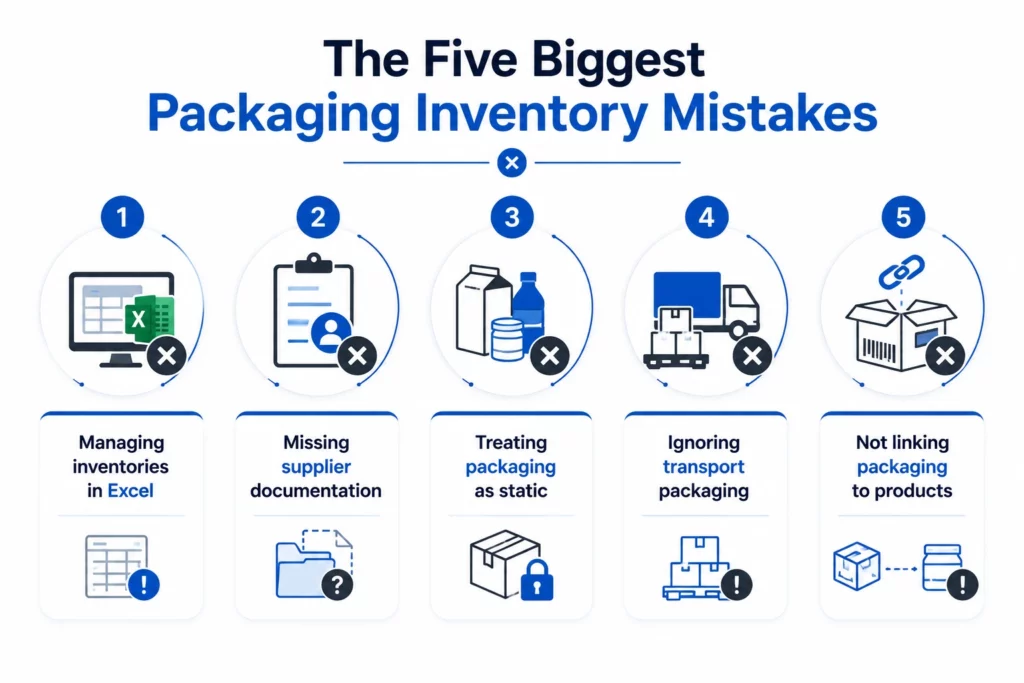
Common Mistakes When Building a PPWR Packaging Inventory
Tracking products instead of packaging components, which hides multi-material breakdowns
Recording recycled content once and never revisiting it after a supplier change
Keeping parallel spreadsheets across teams that quietly drift out of sync
Skipping secondary and shipping packaging that’s still in scope for reporting
Treating the inventory as a one-time project instead of an ongoing maintenance task
Most of these mistakes are invisible until a fee estimate looks wrong or an audit asks a question the inventory can’t answer. Building maintenance into the process from day one is far cheaper than reconstructing two years of packaging history under deadline pressure. If you only fix one thing from this list, fix the parallel-spreadsheet problem first it’s the root cause behind most of the others, since teams working from different versions will eventually disagree about which numbers are current.
How TraceX Helps Build a PPWR-Ready Packaging Inventory
Managing a PPWR packaging inventory manually across spreadsheets, ERP systems, PLM platforms, and shared drives can quickly become complex as packaging portfolios grow. TraceX PPWR Solutions provides a centralized, AI-powered platform that helps businesses build and maintain a complete, audit-ready packaging inventory from a single source of truth.
Centralized Packaging Inventory
Consolidate all packaging components, materials, weights, and specifications into a unified repository, making packaging data easier to manage, update, and retrieve.
Product-to-Packaging SKU Mapping
Link every packaging component to the products it contains, enabling complete traceability across SKUs and supporting accurate compliance reporting.
Supplier Document Collection
Automate the collection of supplier declarations, recyclability certificates, recycled content certifications, and other compliance documents through structured supplier collaboration workflows.
Packaging Specifications Management
Maintain standardized packaging specifications, including dimensions, materials, packaging hierarchy, and design information, with complete visibility across your portfolio.
Material Composition Tracking
Capture and manage detailed material composition data for every packaging component to support packaging classification, recyclability assessments, and technical documentation.
Packaging Version Control
Track packaging revisions and specification changes over time, ensuring compliance teams always work with the latest approved packaging data and supporting documents.
Technical Documentation Management
Organize packaging specifications, supplier evidence, certificates, and supporting records in one place to simplify the preparation and maintenance of PPWR technical documentation.
Declaration of Conformity (DoC) Support
Maintain the evidence required to support packaging Declarations of Conformity by linking documentation directly to the relevant packaging components and products.
Audit-Ready Compliance Records
Create a complete digital audit trail with centralized records, document history, version control, and supplier evidence, enabling faster responses to customer requests and regulatory inspections.
TraceX PPWR Solutions transforms fragmented packaging data into a connected, audit-ready compliance platform helping businesses centralize packaging inventories, streamline supplier collaboration, and simplify PPWR compliance before the August 2026 deadline.
Not sure where to start with PPWR?
Book a free PPWR consultation with our experts to assess your packaging data, identify compliance gaps, and build a roadmap to August 2026 readiness.
How detailed does a PPWR packaging inventory need to be?
At minimum, track material, weight, recyclability, recycled content percentage, and country of sale for every packaging component not just the finished product. Some PROs request additional fields, so confirm the exact list with yours before finalizing your data model.
Can I manage a PPWR packaging inventory in a spreadsheet?
Yes, for a small and relatively stable catalog. Spreadsheets tend to break down once you’re tracking dozens of SKUs, frequent packaging changes, or reporting across multiple member states at that point, dedicated tooling usually pays for itself in saved labor.
Who should own the packaging inventory internally?
It varies, but packaging engineering or sustainability/compliance teams most commonly own it, with procurement supplying supplier-level data. What matters more than the specific owner is that there’s one owner, not several parallel versions.
How often should a PPWR packaging inventory be updated?
A quarterly review is a reasonable default for most companies, with ad hoc updates whenever a packaging format or supplier changes. Waiting until a report or audit forces an update usually means reconstructing data under time pressure.
Does the packaging inventory replace my PRO relationship?
No it’s the data input that makes your PRO relationship work smoothly. The PRO still handles registration, fee collection, and submission to authorities; your inventory is what makes those numbers accurate and quick to produce.
What’s the biggest risk of skipping a formal packaging inventory?
Inaccurate fee estimates and slow audit responses are the most immediate risks, but the bigger long-term cost is losing institutional knowledge when the one person who remembers a packaging spec leaves, an undocumented inventory leaves with them.
Start using TraceX
Transparency, Trust, & Success for your Climate Journey.
We use cookies on our website to give you the most relevant experience by remembering your preferences and repeat visits. By clicking “Accept All”, you consent to the use of ALL the cookies. However, you may visit "Cookie Settings" to provide a controlled consent.
This website uses cookies to improve your experience while you navigate through the website. Out of these, the cookies that are categorized as necessary are stored on your browser as they are essential for the working of basic functionalities of the website. We also use third-party cookies that help us analyze and understand how you use this website. These cookies will be stored in your browser only with your consent. You also have the option to opt-out of these cookies. But opting out of some of these cookies may affect your browsing experience.
Necessary cookies are absolutely essential for the website to function properly. These cookies ensure basic functionalities and security features of the website, anonymously.
Cookie
Duration
Description
cookielawinfo-checkbox-analytics
11 months
This cookie is set by GDPR Cookie Consent plugin. The cookie is used to store the user consent for the cookies in the category "Analytics".
cookielawinfo-checkbox-functional
11 months
The cookie is set by GDPR cookie consent to record the user consent for the cookies in the category "Functional".
cookielawinfo-checkbox-necessary
11 months
This cookie is set by GDPR Cookie Consent plugin. The cookies is used to store the user consent for the cookies in the category "Necessary".
cookielawinfo-checkbox-others
11 months
This cookie is set by GDPR Cookie Consent plugin. The cookie is used to store the user consent for the cookies in the category "Other.
cookielawinfo-checkbox-performance
11 months
This cookie is set by GDPR Cookie Consent plugin. The cookie is used to store the user consent for the cookies in the category "Performance".
viewed_cookie_policy
11 months
The cookie is set by the GDPR Cookie Consent plugin and is used to store whether or not user has consented to the use of cookies. It does not store any personal data.
Functional cookies help to perform certain functionalities like sharing the content of the website on social media platforms, collect feedbacks, and other third-party features.
Performance cookies are used to understand and analyze the key performance indexes of the website which helps in delivering a better user experience for the visitors.
Analytical cookies are used to understand how visitors interact with the website. These cookies help provide information on metrics the number of visitors, bounce rate, traffic source, etc.
Advertisement cookies are used to provide visitors with relevant ads and marketing campaigns. These cookies track visitors across websites and collect information to provide customized ads.
Download the 2026 Traceability Scorecard and Benchmark Your Supply Chain Across 10 Critical Capabilities.
Download our eBook
Don’t Wait for an Audit to Find Your EUDR Gaps
The 2026 Simplification Package changes how HS codes, DDS pass-through and geolocation rules apply to you. Get the free guide and 20-point readiness checklist before enforcement catches you unprepared.