Supplier Data Collection in EUDR for the Paper and Pulp Supply Chain in Italy
Published
, 18 minute read
Share this article
Quick summary: Supplier Data Collection in EUDR for the Paper & Pulp Supply Chain in Italy: understand legal responsibilities, mandatory supplier data, key compliance risks, and how Italian paper manufacturers, converters, and importers can meet EUDR requirements without disrupting production or EU market access.
Supplier Data Collection in EUDR for paper and pulp in Italy has become a critical compliance priority for the country’s packaging manufacturers, paper producers, converters, and publishing industries. While Italy is not the EU’s largest import gateway, it is one of Europe’s leading manufacturing and processing economies with strong demand for wood-based inputs.
Italy plays a central role in transforming imported and domestically sourced wood into:
Paper and packaging materials
Cartonboard and corrugated packaging
Tissue and hygiene products
Printed materials (books, labels, magazines)
Industrial and specialty paper products
Because of this downstream manufacturing strength, Italian companies are often operators placing paper and pulp-derived products on the EU market—making EUDR compliance legally binding at the point of manufacturing, conversion, or commercialization.
For Italian manufacturers, EUDR compliance is not limited to import documentation—it requires end-to-end supply chain transparency from forest to finished product.
Read the complete EUDR guide to clearly understand your obligations, mandatory supplier data, and due diligence steps for paper and pulp.
What Is EUDR and How Does It Apply to the Paper & Pulp Supply Chain in Italy?
The EU Deforestation Regulation (EUDR) requires that wood, paper, pulp, and derived products placed on the EU market must be:
Importers and distributors placing paper products on the EU market
Industrial users of pulp-based inputs
Italy’s paper and pulp supply chain is highly import-dependent, sourcing from:
Scandinavia (Finland, Sweden)
Eastern Europe and Baltic countries
Brazil and Latin America
Indonesia and Southeast Asia
Even when pulp or timber enters the EU through other countries, Italian companies placing finished products on the market may still qualify as operators under EUDR.
Compliance responsibility cannot be outsourced even when sourcing is managed by traders, mills, or intermediaries.
What EUDR Requires for Paper & Pulp in Italy
Italian companies placing paper, pulp, or wood-derived goods on the EU market must:
Prove that materials are not linked to deforestation after 31 December 2020
Demonstrate compliance with local forestry and land-use laws in origin countries
Submit a Due Diligence Statement (DDS) before market placement
Failure to comply can result in:
Blocked product commercialization
Financial penalties (up to at least 4% of EU turnover)
Confiscation of goods
Public enforcement notices
Reputational damage especially in consumer-facing sectors
For Italy’s packaging, fashion, publishing, and luxury goods industries where sustainability is closely tied to brand value non-compliance carries both legal and commercial risk.
Data Requirements: Why Paper & Pulp Compliance in Italy Is Supply-Chain Deep
Italy’s challenge lies in upstream forest visibility combined with complex conversion processes.
Manufacturers must collect and validate supplier-level data originating from diverse forestry ecosystems:
Brazil
Indonesia
Finland and Sweden
Baltic countries
Eastern Europe
Required data includes:
Polygon-level geolocation of forest plots
Country and region of harvest
Tree species and harvesting timelines
Volume traceability linking raw material to production batches
Risk assessment documentation
Risk mitigation evidence where necessary
For Italian converters and manufacturers sourcing from multiple suppliers and mills, fiber mixing and transformation significantly increase traceability complexity.
No verified geolocation data = no compliant finished product.
Why Italy Faces Unique EUDR Exposure
Italy’s risk profile differs from both Germany and the Netherlands.
Increasing ESG scrutiny from EU buyers and global markets
Unlike pure import hubs or heavy industrial manufacturers:
Italy’s risk is embedded in transformation, conversion, and brand-facing supply chains.
This means:
Compliance must be preserved through processing, not just verified at entry or origin.
The Strategic Reality for Italian Paper & Pulp Companies
For Italian paper manufacturers, converters, and packaging firms, supplier data collection under EUDR is not just a compliance requirement.
It is a business-critical function that protects market access and brand reputation.
Key priorities include:
Digitizing supplier onboarding across global sourcing networks
Mapping forest plots at polygon level
Implementing risk-based sourcing frameworks
Ensuring batch-level traceability through conversion processes
Maintaining audit-ready documentation across supply chains
Because Italy operates in high-value, consumer-facing industries, compliance failures can quickly translate into:
Lost contracts
Brand damage
Retail and export disruptions
In the Italian Paper & Pulp Supply Chain, Compliance Begins in the Forest and Must Survive Conversion
For Italian companies, EUDR compliance requires:
Upstream data transparency
Structured risk assessment workflows
Cross-border supplier coordination
Integration between procurement, production, sustainability, and compliance teams
Supplier data collection is no longer administrative.
It is strategic risk management that protects both market access and brand integrity.
What Happens if Supplier Data Is Missing or Unverifiable in Italy?
If supplier data for paper and pulp is incomplete, inconsistent, or unverifiable, the consequences under the EU Deforestation Regulation (EUDR) are immediate and commercially significant for Italian operators.
Finished paper, packaging, and converted products may be blocked from being placed on the EU market
Packaging materials and printed goods may be halted before distribution
Authorities can impose financial penalties and corrective measures
Companies may face intensified regulatory audits
Retailers, brands, and FMCG buyers may reject deliveries due to missing or invalid Due Diligence Statement (DDS) references
Production and conversion schedules may be disrupted due to non-compliant raw material inputs
In Italy, where paper and pulp feed directly into packaging, publishing, food, and luxury supply chains, a single missing forest polygon, unverifiable geolocation coordinate, or incomplete supplier record can halt commercialization of finished goods.
Unlike port-based disruption, Italy’s exposure is embedded in conversion, value addition, and brand-facing supply chains. If wood-based inputs are non-compliant, the finished packaging or product cannot legally enter the EU market.
For Italy’s packaging and consumer goods ecosystem, compliance failures do not remain isolated they can cascade across converters, brands, retailers, and export markets.
Read our blog on Supplier Data Management for EUDR to learn how Dutch cocoa companies can standardize supplier data, validate geolocation, and remain audit-ready without disrupting imports or processing operations.
Explore our guide on Supplier Assessment under EUDR to see how to score cocoa suppliers by deforestation risk, data quality, and traceability before shipments arrive at Dutch ports or contracts are finalized.
Who Must Collect Supplier Data Under EUDR in Italy?
Under EUDR, any company in Italy that places paper, pulp, or wood-derived products on the EU market must ensure supplier data is complete, verifiable, and linked to a valid DDS reference even if that data originates upstream.
Below is a role-by-role breakdown for the Italian paper and pulp supply chain.
Paper Manufacturers and Converters Placing Products on the EU Market
Italy hosts a strong network of paper manufacturers and converters. When these companies place paper or packaging products on the EU market using pulp or timber inputs, they may qualify as operators under EUDR especially when importing directly or first commercializing the product.
Responsibilities include:
Ensuring forest-level polygon geolocation exists
Verifying deforestation-free status post-31 December 2020
Conducting documented risk assessments
Submitting a Due Diligence Statement (DDS) where applicable
Preserving traceability from raw fiber to finished product
Because pulp and paper are transformed during conversion, traceability systems must preserve upstream compliance evidence throughout processing.
Transformation increases compliance complexity it does not remove responsibility.
Pulp Processors and Industrial Paper Product Manufacturers
Italian manufacturers using pulp in:
Packaging and carton board products
Tissue and hygiene products
Printed materials and labels
Industrial and specialty paper
may become operators if they import directly or place products on the EU market for the first time.
In these cases, companies must ensure:
Fiber volumes are traceable to mapped forest polygons
Risk assessments are completed and documented
DDS submissions are properly filed before commercialization
Failure to validate upstream supplier data can prevent finished goods from being legally marketed.
Paper & Pulp Importers Based in Italy
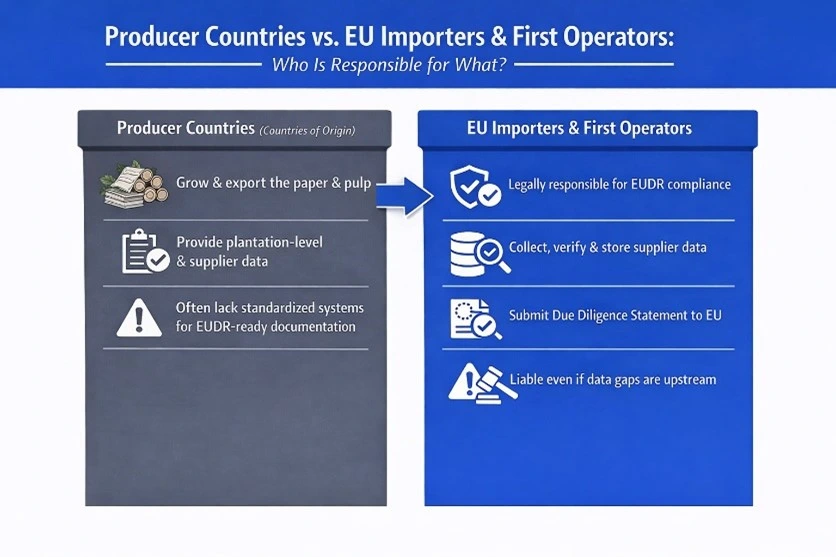
If an Italian company imports pulp, timber, or paper directly from origin countries under its own name, it becomes a first operator under EUDR.
This includes responsibility to:
Collect supplier and forest data
Validate geolocation and deforestation status
Conduct structured risk assessment
Submit DDS prior to placing products on the EU market
Even if suppliers provide documentation, legal liability remains with the Italian importer.
Traders and Distributors
Italian traders and distributors play a critical role in supply chain movement.
If you import directly:
You are a first operator and must collect, verify, and submit DDS documentation.
If you trade products already placed on the EU market:
You are a downstream operator but must still:
Verify that a valid DDS reference exists
Maintain traceability to the original compliant batch
Retain supplier and transaction records
Pass DDS references to buyers
Trading paper or pulp products without a valid DDS reference exposes companies to audit risk and commercial disruption.
Downstream Operators and Brand-Facing Supply Chain Players
Companies purchasing paper and pulp-derived goods within Italy especially in packaging, food, and luxury sectors may qualify as downstream operators.
They are not required to file a new DDS if:
A valid DDS already exists
The product remains unchanged
Traceability is preserved
However, they must still:
Verify DDS references
Maintain documentation for audits
Ensure compliance evidence is retained
If the DDS is missing or unverifiable, downstream companies may face shipment rejection, contractual disputes, or regulatory exposure.
Key Clarification: Legal Responsibility vs. Operational Exposure in Italy
This distinction is critical in Italy’s conversion-heavy paper and pulp sector.
Legal Responsibility
Lies with the first operator placing paper, pulp, or wood-derived products on the EU market
Includes liability for incorrect or misleading supplier data
Operational Exposure
Affects manufacturers, converters, packaging companies, and brand owners
Even when not filing DDS, they depend on upstream supplier data integrity
Missing or weak data can halt product commercialization and exports
In Italy: You may not be the original importer but if you place the finished product on the market, compliance exposure sits with you.
Mandatory Supplier Data Required for Paper & Pulp Under EUDR in Italy
For paper, pulp, and wood-derived products placed on the EU market by Italian companies, the following supplier data is non-negotiable:
Polygon-level geolocation of forest plots
Country and region of harvest
Tree species and production details
Harvest timelines
Volume traceability linking raw material to specific forest areas or batches
Risk assessment documentation
Risk mitigation evidence where required
If even one of these elements is missing or unverifiable, the Due Diligence Statement may be invalid preventing lawful commercialization of paper and pulp-derived products.
Compliance Pillar
Key Data Points Required
Critical “Why” for Audits
1. Fiber Origin & Species ID
• Common & Latin Names (e.g., Eucalyptus globulus) • Virgin vs. Recycled Content % • Country of Harvest • Supplier EORI Number
Mixed-fiber paper is a “high-risk” composite. Auditors look for Species Mapping to ensure that high-conservation value (HCV) wood hasn’t been “laundered” into a mix of commodity pulp.
2. Geolocation & Plot-Level Proof
• GeoJSON Polygons (Mandatory >4ha) • GPS Center Points (Allowed <4ha) • Digital Product Passport (DPP) Link • Satellite Baseline (Post-2020)
Unlike seasonal crops, timber has long cycles. Auditors use High-Res Satellite imagery to check for “Forest Degradation”—specifically, the conversion of primary forests into monoculture plantations after the 2020 cutoff.
3. Mass Balance & Segregation
• Air-Dried Ton (ADT) Metrics • Mill Processing Yield Ratios • Silo/Batch ID Segregation • Inbound Log vs. Outbound Pulp Logs
Pulp mills often “commingle” logs from hundreds of sources. EUDR strictly forbids mixing compliant and non-compliant fiber. If your mill’s output exceeds the ADT capacity of your verified polygons, the entire batch is flagged as illegal.
In the wood industry, “Legality” includes Customary Rights. Auditors verify that timber wasn’t harvested in violation of indigenous land claims or without local community consent, even if a government permit was issued.
Common Supplier Data Gaps in Italian Paper & Pulp Supply Chains
Even the most sophisticated paper manufacturers, converters, packaging companies, and publishers in Italy are encountering EUDR compliance challenges because global forestry supply chains were never designed for plot-level regulatory verification especially across fragmented and multi-tier sourcing networks.
In practice, most Due Diligence Statement (DDS) failures affecting paper and pulp in Italian supply chains can be traced back to recurring supplier data weaknesses.
Fragmented Forestry Sourcing and Multi-Tier Supply Chains
Wood and pulp used in Italy often originate from:
Multiple international forest regions
A mix of large forestry operations and smaller holdings
Independent harvesting contractors
Complex multi-tier supplier networks
Aggregated fiber flows across mills and distributors
Common issues include:
Inconsistent forest plot identifiers across suppliers
Limited visibility into subcontracted harvesting operations
Fiber mixing across regions, countries, and suppliers
Difficulty linking raw material to specific forest plots
For Italian converters and manufacturers, fragmentation at origin creates upstream data instability that can jeopardize product commercialization.
A single batch of paper or packaging may trace back to multiple forest plots across countries each requiring verified geolocation and legality documentation.
Paper-Based or Legacy Data Systems at Origin
Despite Italy’s advanced manufacturing ecosystem, much forestry data at origin remains:
Paper-based harvesting permits
Manual logging records
Non-standardized supplier documentation
Local spreadsheets maintained by forest operators or mills
Legacy and paper-based systems do not integrate efficiently into Italian procurement, ERP, or compliance workflows creating a disconnect between upstream forestry practices and downstream regulatory requirements.
Inconsistent or Low-Quality Geolocation Data
Common geolocation issues affecting Italian paper and pulp buyers include:
Point coordinates submitted instead of polygon boundaries
Incomplete or partially mapped forest plots
Overlapping or duplicated geospatial data
Coordinates outside recognized forestry zones
Missing or inconsistent harvest timestamps
Consequences:
Satellite verification produces inconclusive or high-risk results
Risk assessments become unreliable
DDS submissions are delayed or rejected
For Italian companies placing packaging and paper products on the EU market, poor geolocation data can halt commercialization especially in export-driven and brand-sensitive sectors.
Polygon-level forest mapping is no longer optional—it is foundational.
Legal & Forestry Documentation Gaps
Supplier documentation frequently arrives:
In local languages without certified translation
With inconsistent naming conventions
Without standardized legal compliance declarations
Using forestry classifications unfamiliar to EU authorities
Under EUDR, unclear legality equals compliance risk even if sourcing practices are responsible.
Italian companies particularly those supplying to high-value consumer markets face increased scrutiny, where documentation quality directly impacts compliance outcomes.
Aggregation and Fiber Mixing That Breaks Traceability
Aggregation is intrinsic to pulp and paper supply chains but it introduces structural compliance risk.
is disrupted, EUDR compliance cannot be demonstrated.
For Italian converters, this risk is amplified because materials are transformed into packaging, labels, and finished goods. Once aggregation occurs, reconstructing upstream traceability becomes significantly more complex.
Traceability must survive conversion not just sourcing.
How Italian Paper & Pulp Companies Can Structure Supplier Data Collection
For companies operating in Italy, EUDR compliance is not about collecting more data it is about collecting validated, conversion-linked, DDS-ready data.
Start by identifying all suppliers linked to products placed on the EU market.
Actions:
Map all wood and pulp inputs used in EU-bound products
Identify direct import suppliers versus intermediaries
Trace fiber flows back to forest origin where possible
Flag high-volume and strategically critical suppliers
Segment suppliers by:
Volume contribution
Country-level deforestation risk
Data maturity
Aggregation and conversion complexity
Prioritization model:
High volume + high deforestation risk → immediate verification
High volume + moderate risk → structured validation
Low volume + high risk → remediation or alternative sourcing
Outcome: Compliance controls are implemented before materials enter conversion—not after products are finalized.
Step 2 – Standardized Data Collection Framework
Unstructured supplier data is a major bottleneck in Italian compliance programs especially across SME-heavy supply chains
Best practices include:
Structured digital questionnaires aligned with DDS requirements
Mandatory forest polygon geolocation submission
Harvest and production timeline capture
Standardized legal compliance declarations
Digital documentation linked to batch-level and product-level traceability
Critical principle: If supplier data does not map directly to DDS requirements, commercialization delays are inevitable.
Italy’s high-value manufacturing sectors demand precision—compliance systems must match that standard.
Step 3 – Validation & Integrated Risk Scoring
Data collection alone does not ensure compliance.
Validation must include:
Geolocation Verification
Polygon completeness and spatial accuracy
Alignment with recognized forestry regions
Satellite-based validation
Deforestation Risk Checks
Compliance with 31 December 2020 cut-off
Land-use history analysis
Proximity to protected or high-risk zones
Supplier Risk Scoring
Data completeness scoring
Geographic risk exposure
Aggregation and conversion complexity
Traceability resilience
High-risk suppliers should be:
Flagged before procurement or production
Assigned remediation timelines
Replaced if mitigation fails
Outcome: DDS rejections are prevented before finished products are placed on the EU market.
How TraceX Helps Italian Paper & Pulp Companies Meet EUDR Supplier Data Requirements
TraceX EUDR Compliance Solutions help Italian paper manufacturers, converters, and packaging companies transition from fragmented upstream data to structured, production-ready compliance.
Digital supplier onboarding captures forest-level data and documentation
Automated risk scoring integrates with procurement workflows
DDS-ready data structures enable seamless submission and audit readiness
ERP integration ensures traceability from raw fiber to finished product
For Italy’s conversion-driven paper sector, TraceX transforms supplier data collection into an integrated compliance system protecting product commercialization and safeguarding EU market access.
Build an EUDR-ready paper and pulp supply chain aligned with Italy’s high-value manufacturing and export standards.
Talk to TraceX experts about automating supplier data collection for paper and pulp under EUDR.
Turning Supplier Data Collection into EUDR Readiness in Italy’s Paper & Pulp Sector
Supplier data collection under EUDR for Italy’s paper and pulp supply chain is no longer an upstream administrative task—it determines whether finished products can be legally commercialized and exported.
Italy’s exposure lies in conversion, brand reputation, and global market positioning.
Companies that digitize supplier onboarding, implement polygon-level geolocation validation, and integrate structured risk assessment into procurement and production will maintain uninterrupted market access.
Those relying on fragmented upstream data will face DDS rejections, production delays, contract risks, and regulatory scrutiny.
In Italy’s paper and pulp sector, mastering supplier data collection is how companies protect brand value, ensure compliance, and remain competitive under EUDR.
Explore our guide on EUDR for Operators and Traders to understand legal responsibility, DDS handover, and what checks you must perform before buying or selling coffee in the EU.
Dive into our practical breakdown of EUDR Due Diligence , including required data, risk assessment steps, and how to avoid delays at customs.
FAQs
What supplier data is mandatory for paper and pulp under EUDR in Italy?
Italian companies placing paper, pulp, or wood-derived products on the EU market must collect: supplier identification (KYC), forest plot-level polygon geolocation, harvesting period, supplied volumes, traceability linking raw material to batches or finished products, and proof of legal harvesting in the country of origin. Without this structured data, a Due Diligence Statement (DDS) cannot be validated, and paper, packaging, or converted products cannot be legally commercialized in the EU.
Do Italian paper manufacturers and converters need forest-level geolocation data?
Yes, if they qualify as first operators or import pulp, timber, or paper directly. Italian companies placing paper, packaging, or converted products on the EU market must ensure verified forest plot-level geolocation data exists and supports deforestation-free sourcing. Even when sourcing through EU suppliers, companies must retain a valid DDS reference and preserve traceability to compliant fiber inputs throughout conversion processes.
Can non-EU pulp or timber suppliers provide EUDR data digitally to Italian companies?
Yes. Suppliers in regions such as Latin America, Southeast Asia, and Northern Europe can submit EUDR-compliant data digitally through structured onboarding platforms, forest-mapping tools, and systems capturing GPS polygon data along with legal documentation. Digital submission improves validation accuracy, reduces geolocation errors, and minimizes DDS rejection risk before products are processed or commercialized in Italy.
How long must supplier data be retained in Italy under EUDR?
Operators in Italy must retain due diligence documentation and supplier data for at least five years. Records must be readily accessible to competent authorities in case of audits, investigations, or regulatory reviews.
What happens if supplier data changes after a DDS is submitted in Italy?
If supplier data changes such as new forest plots, updated geolocation boundaries, ownership changes, or revised harvesting volumes the risk assessment must be updated. Material changes may require submission of a new or revised DDS before affected paper, packaging, or pulp-derived products can be placed on the EU market.
Start using TraceX
Transparency, Trust, & Success for your Climate Journey.
We use cookies on our website to give you the most relevant experience by remembering your preferences and repeat visits. By clicking “Accept All”, you consent to the use of ALL the cookies. However, you may visit "Cookie Settings" to provide a controlled consent.
This website uses cookies to improve your experience while you navigate through the website. Out of these, the cookies that are categorized as necessary are stored on your browser as they are essential for the working of basic functionalities of the website. We also use third-party cookies that help us analyze and understand how you use this website. These cookies will be stored in your browser only with your consent. You also have the option to opt-out of these cookies. But opting out of some of these cookies may affect your browsing experience.
Necessary cookies are absolutely essential for the website to function properly. These cookies ensure basic functionalities and security features of the website, anonymously.
Cookie
Duration
Description
cookielawinfo-checkbox-analytics
11 months
This cookie is set by GDPR Cookie Consent plugin. The cookie is used to store the user consent for the cookies in the category "Analytics".
cookielawinfo-checkbox-functional
11 months
The cookie is set by GDPR cookie consent to record the user consent for the cookies in the category "Functional".
cookielawinfo-checkbox-necessary
11 months
This cookie is set by GDPR Cookie Consent plugin. The cookies is used to store the user consent for the cookies in the category "Necessary".
cookielawinfo-checkbox-others
11 months
This cookie is set by GDPR Cookie Consent plugin. The cookie is used to store the user consent for the cookies in the category "Other.
cookielawinfo-checkbox-performance
11 months
This cookie is set by GDPR Cookie Consent plugin. The cookie is used to store the user consent for the cookies in the category "Performance".
viewed_cookie_policy
11 months
The cookie is set by the GDPR Cookie Consent plugin and is used to store whether or not user has consented to the use of cookies. It does not store any personal data.
Functional cookies help to perform certain functionalities like sharing the content of the website on social media platforms, collect feedbacks, and other third-party features.
Performance cookies are used to understand and analyze the key performance indexes of the website which helps in delivering a better user experience for the visitors.
Analytical cookies are used to understand how visitors interact with the website. These cookies help provide information on metrics the number of visitors, bounce rate, traffic source, etc.
Advertisement cookies are used to provide visitors with relevant ads and marketing campaigns. These cookies track visitors across websites and collect information to provide customized ads.
Download the 2026 Traceability Scorecard and Benchmark Your Supply Chain Across 10 Critical Capabilities.
Download our eBook
Don’t Wait for an Audit to Find Your EUDR Gaps
The 2026 Simplification Package changes how HS codes, DDS pass-through and geolocation rules apply to you. Get the free guide and 20-point readiness checklist before enforcement catches you unprepared.