Quick summary: Explore how Tanzania’s wood exporters can achieve EUDR compliance through digital traceability, geolocation mapping, and blockchain verification. Learn how platforms like TraceX simplify Due Diligence Statement (DDS) creation, ensure deforestation-free sourcing, and future-proof wood exports to the EU market.
EUDR Compliance for Wood Exporters in Tanzania requires exporters to prove that all timber, wood-based panels, pulp, and related products entering the EU are deforestation-free, legally sourced, and traceable to the exact forest plot of origin. Tanzanian exporters must collect geolocation polygons for harvesting areas, verify land-use legality, assess deforestation risk, and maintain a transparent chain of custody from forest to mill to export. A complete Due Diligence Statement (DDS) must be submitted before shipment. Robust digital traceability, legality documentation, and supplier onboarding are essential to ensure continued access to the EU market.
Stay ahead of the 2025 regulation with our expert guide on Due Diligence Statements, traceability workflows, and category-specific obligations for operators, traders, and downstream entities.
Tanzania is a significant regional supplier of timber, wood products, and pulp-based materials, exporting to the EU, India, China, the Middle East, and East African markets. Key export categories include sawn timber, hardwood logs, eucalyptus and pine poles, plywood, veneer sheets, wood charcoal, kraft pulp, and packaging paper. Production is driven by a mix of industrial plantations, village land forest reserves, community-managed forests, and smallholder woodlots across regions such as Iringa, Morogoro, Tanga, Kilimanjaro, Mbeya, and Ruvuma. According to trade data, Tanzania’s wood, pulp, and paper exports are valued at US$120–180 million annually, with strong demand for softwood and hardwood products.
Tanzania’s forestry supply chain, however, is highly decentralized, involving thousands of smallholders, community forest associations, private plantation owners, sawmills, and brokers. This fragmentation complicates traceability, legality verification, and deforestation-risk assessment challenges amplified under the EU Deforestation Regulation (EUDR), which requires plot-level visibility and full legality documentation for all wood and wood-derived products destined for the EU.
Under EUDR, Tanzania’s export products fall under key HS codes such as:
With compliance deadlines set for 30 December 2025 (large/medium operators) and 30 June 2026 (small/micro enterprises), Tanzanian exporters must prepare for stringent requirements. These include capturing geolocation polygons for harvesting areas, proving land-use legality, documenting every step of the chain of custody, and conducting systematic deforestation-risk assessments across supply regions.
To preserve EU market access and strengthen Tanzania’s position as a sustainable forestry producer, exporters must invest in digital traceability platforms, geospatial plantation mapping, blockchain-backed verification, and AI-supported land-use monitoring. These tools will help Tanzania demonstrate deforestation-free, legally sourced wood products, enhancing its credibility and competitiveness in global timber and paper markets.
Want to understand how the EUDR reshapes sourcing, documentation, and traceability for global wood exporters?
What are the Key Challenges Faced by the Tanzanian Wood Export Sector Under the EUDR
1. Fragmented and Decentralized Forestry Supply Chains
Tanzania’s wood sector is highly decentralized, involving:
smallholder woodlots,
village land forest reserves (VLFRs),
community forest associations,
private plantations,
harvesters, brokers, and sawmills.
EUDR requires plot-level geolocation mapping and full traceability yet most harvesting areas are scattered, undocumented, and lack digitized boundaries. Exporters often source from dozens of intermediaries, making end-to-end visibility extremely difficult.
2. Limited Land-Tenure Documentation
A large portion of Tanzania’s forests lie on:
customary village lands,
family-owned plots,
community-managed areas,
non-registered private holdings.
Many landholders lack formal title deeds or Certificates of Customary Rights of Occupancy (CCROs). EUDR requires proof of legal ownership or harvesting rights, but exporters face:
inconsistent documentation,
gaps in local land registries,
multiple layers of village approvals.
This creates major verification challenges.
3. Insufficient Digital Records and Traceability Systems
Most forest operations still run on paper-based systems. Exporters lack:
digital harvesting permits,
electronic transport manifests,
real-time chain-of-custody logs,
centralized supplier databases.
EUDR demands traceability from forest plot → transporter → sawmill → exporter, which is nearly impossible using manual workflows.
4. Complex Multi-Tier Intermediary Networks
Timber often changes hands multiple times before reaching a mill or port. Intermediaries typically do not maintain:
origin information,
harvesting documents,
contractor details,
movement records.
This results in early loss of chain-of-custody integrity contradicting EUDR’s requirement for continuous and unbroken traceability.
Exporters must prove that no deforestation occurred after 31 December 2020 in all sourcing plots. This requires:
satellite monitoring,
GIS mapping,
land-use change analysis,
detection of encroachment into natural forests.
Most exporters and mill operators lack GIS expertise, tools, and data interpretation capacity to perform EUDR-grade monitoring.
6. High Administrative Burden for DDS Preparation
Preparing a Due Diligence Statement (DDS) for every shipment requires:
polygon coordinates of harvesting plots,
legality documents,
risk assessments,
supplier declarations,
transport and processing logs,
chain-of-custody documentation.
For exporters handling large volumes or sourcing from multiple regions, this creates heavy operational pressure and risk of non-compliance.
7. Compliance Costs for Small and Medium Exporters
Meeting EUDR requirements demands investment in:
digital traceability platforms,
geolocation mapping campaigns,
staff training,
supplier onboarding programs,
documentation audits.
For small and mid-sized processors or sawmills, these costs can be prohibitive and may threaten business continuity.
8. Inconsistent Enforcement and Documentation Quality Across Regions
Different districts and village councils issue harvesting permits, movement passes, and approvals. Exporters face:
varying document formats,
inconsistent verification processes,
limited digital record retention,
potential risks of fraud or inaccuracies.
Such irregularities pose challenges in proving legality to EU regulators.
9. High Risk of Shipment Delays or Rejection
Incomplete DDS submissions can trigger:
EU border inspections,
shipment detentions,
rejection or re-export orders,
increased scrutiny on future consignments.
For exporters relying on the EU for stability and pricing, this risk has significant financial implications.
10. Pressure to Restructure Supply Chains Quickly
EUDR enforcement deadlines 30 December 2025 for large/medium operators, 30 June 2026 for small/micro enterprises leave limited time for Tanzania’s wood sector to:
digitize forest inventories,
map thousands of sourcing plots,
standardize documentation,
overhaul procurement systems,
train intermediaries and smallholders.
The transition timeline is demanding for a supply chain still largely informal.
Tanzania’s wood export sector faces serious structural, technical, and compliance-related challenges under the EUDR. Fragmented sourcing systems, lack of digital traceability, land-tenure complexities, intermediary networks, and limited geospatial capacity make compliance difficult without major transformation. Exporters will need digital traceability systems, forest mapping, legality verification, and automated DDS workflows to maintain EU market access and protect Tanzania’s forestry competitiveness.
How TraceX Simplifies EUDR Compliance for Wood Exporters in Tanzania
The EU Deforestation Regulation (EUDR) requires Tanzanian exporters of timber, logs, poles, veneer, fibreboard, pulp, and paper products to prove that all raw materials are legally harvested, deforestation-free, and fully traceable to the exact forest plot of origin. With Tanzania’s forestry sector spanning village land forest reserves (VLFRs), community-managed forests, smallholder woodlots, private timber estates, and multi-tier sawmills, meeting EUDR obligations demands a digital, standardized, and verifiable compliance system. The TraceX EUDR Compliance Platform provides an integrated, AI- and blockchain-enabled solution that automates due diligence, enhances transparency, and ensures seamless EU compliance across Tanzania’s diverse wood supply chains.
End-to-End Digital Traceability
TraceX connects smallholder growers, community forest associations, private plantations, village councils, sawmills, transporters, processors, and exporters into a single traceability network. Every log, pole, plank, veneer sheet, pulp batch, or paper input receives a unique digital ID linked to verified geolocation polygons, harvesting permits, land-rights documents, and chain-of-custody data. This creates a tamper-proof, audit-ready record from forest plot to export port, fully aligned with EUDR traceability requirements.
Automated Data Capture & DDS Generation
With mobile-enabled field tools, village forest managers, plantation supervisors, and sourcing teams can capture plot coordinates, harvesting permits, movement passes, felling records, mill conversion logs, and transport documentation directly at the source. TraceX automatically compiles these into an EUDR-compliant Due Diligence Statement (DDS) for each export shipment, eliminating manual paperwork errors and accelerating EU submission and approval.
Blockchain-Based Proof of Origin
All harvesting, transport, processing, and export events are immutably recorded on the TraceX blockchain ledger, ensuring an incorruptible proof-of-origin trail. This gives EU buyers and regulators verified assurance that Tanzanian timber and pulp products originate from legal, deforestation-free, post-2020 compliant forest plots critical for meeting EUDR enforcement standards.
Smallholder & Community Forest Onboarding
Tanzania’s wood sector relies heavily on smallholder eucalyptus and pine woodlots, community forests, and village-managed reserves. TraceX platform enables rapid onboarding and GPS/polygon mapping of these suppliers across Iringa, Tanga, Morogoro, Ruvuma, Kilimanjaro, Mbeya, and coastal regions. Each supplier profile stores legality documents, land-rights validation, certification data, and production records bringing full visibility to even the smallest contributors in the chain.
AI-Powered Deforestation Risk Monitoring
TraceX platform integrates satellite imagery, forest-loss data, and AI-driven analytics to detect:
illegal harvesting,
encroachment into natural forests,
land-use change,
unapproved clearing near reserves,
post-2020 deforestation signals.
Exporters receive automated risk scores, alerts, and mitigation recommendations, enabling real-time compliance control across vast forest landscapes.
Collaborative Compliance Ecosystem
TraceX platform acts as a centralized, secure compliance hub where village councils, community forest associations, plantation owners, sawmills, transporters, exporters, auditors, and EU importers share verified data through standardized workflows. This reduces administrative burden, strengthens document accuracy, and ensures faster, smoother regulatory reviews under EUDR.
Turning Compliance into Competitive Advantage
With blockchain verification, AI-driven risk intelligence, and automated DDS workflows, TraceX solution transforms EUDR compliance into a strategic market advantage for Tanzanian exporters. Companies can demonstrate traceable, legally verified, deforestation-free sourcing protecting EU market access and elevating Tanzania’s reputation as a trusted supplier of sustainable wood, timber, pulp, and paper products.
Book a Free Demo with TraceX
Digitize your compliance, safeguard EU market access, and future-proof Tanzania’s wood exports with verifiable, transparent, EUDR-ready traceability.
What EUDR Compliance Means for Tanzania’s Wood Exporters
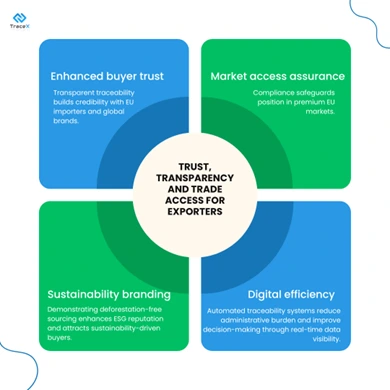
The EU Deforestation Regulation (EUDR) is a pivotal development for Tanzania’s wood sector because it directly determines whether the country’s timber, poles, veneer, pulp, and paper products can continue accessing one of the world’s most valuable and sustainability-focused markets. As the EU tightens environmental and legality requirements across all forest-risk commodities, Tanzanian exporters must demonstrate transparent, traceable, and deforestation-free sourcing to maintain credibility and competitiveness.
Protecting Access to a High-Value, Growing EU Market
The EU is a key importer of East African hardwoods, softwood poles, fibreboard, and kraft pulp. Under EUDR, any shipment lacking plot-level geolocation, legality verification, or risk assessment may face:
shipment delays or detentions,
rejection at EU entry points,
increased regulatory scrutiny,
or complete loss of market access.
Compliance ensures Tanzanian exporters retain access to premium buyers and stable long-term contracts.
Strengthening Tanzania’s Reputation as a Sustainable Forestry Producer
The global wood market is moving toward verified sustainable sourcing, and EUDR compliance helps Tanzania position itself as a responsible origin. This enhances:
brand reputation,
buyer confidence,
ESG alignment,
and eligibility for sustainability-linked procurement programs.
Exporters who can prove deforestation-free supply chains gain a powerful competitive edge.
Modernizing Tanzania’s Forestry Governance and Supply Chains
EUDR pushes the sector to modernize by requiring:
geolocation mapping of forest plots,
blockchain or digital chain-of-custody systems,
standardized legal documentation,
improved village and community forest governance.
This strengthens national forest management, reduces illegal harvesting, and improves long-term sector sustainability.
Ensuring Legality and Transparency Across Fragmented Supply Networks
Tanzania’s forestry supply chain spans:
village land forest reserves (VLFRs),
community forest associations (CFAs),
smallholder woodlots,
private plantations,
multi-tier sawmills and brokers.
EUDR compels exporters to verify legality and trace wood across every transaction, reducing risks associated with:
undocumented harvesting,
informal intermediaries,
inconsistent record-keeping.
This improves both domestic regulatory compliance and international trust.
Reducing Deforestation Risk and Enhancing Environmental Stewardship
EUDR prohibits sourcing from land deforested after 31 December 2020. This encourages:
better land-use planning,
conservation of natural forests,
sustainable plantation expansion,
adoption of satellite-based monitoring.
Such practices support Tanzania’s national climate goals and forest-conservation priorities.
Ensuring Long-Term Stability and Export Resilience
Global buyers increasingly demand transparency and sustainability. EUDR compliance helps exporters:
secure multi-year supply agreements,
reduce risk of shipment disruptions,
avoid penalties or market exclusion,
stay ahead of future sustainability regulations.
Compliance today ensures the sector remains resilient and future-ready.
Unlocking Premium Pricing and Differentiated Market Opportunities
EUDR-aligned exporters can tap into:
premium markets,
sustainability-focused buyers,
green procurement programs,
and potential price premiums for verified deforestation-free wood.
This offers tangible economic benefits to exporters, sawmills, and forest-owning communities.
EUDR compliance matters for Tanzania’s wood exporters because it safeguards access to the EU market, strengthens global reputation, modernizes supply chains, and promotes long-term sustainability. By embracing traceability, legality verification, and digital compliance systems, Tanzania can position itself as a leading supplier of deforestation-free, responsibly managed, and fully traceable wood products driving growth, resilience, and competitive advantage.
Future-Proofing Tanzania’s Wood Sector Through EUDR-Ready Compliance
EUDR Compliance for Wood Exporters in Tanzania is essential for maintaining seamless access to the EU’s high-value timber, pulp, and paper markets. By adopting digital traceability, geolocation mapping, legality verification, and automated DDS workflows, Tanzanian exporters can meet stringent EU requirements while strengthening transparency across community forests, village reserves, and private plantations. Embracing EUDR not only protects current export channels but also positions Tanzania as a credible supplier of sustainable, legally verified, deforestation-free wood products enhancing competitiveness, market trust, and long-term sector resilience.
What is EUDR compliance for Tanzania’s wood exporters?
EUDR compliance requires Tanzanian exporters to prove that all wood products are deforestation-free, legally sourced, and traceable to their plantation of origin before entering the EU market.
Why is EUDR compliance important for Tanzania’s wood industry?
The EU is a major destination for Tanzania’s wood exports. Compliance ensures continued market access, strengthens buyer trust, and positions exporters as sustainability leaders in the global value chain.
What are the key requirements for Tanzanian exporters?
Tanzanian exporters must map supply chains to the farm level, capture geolocation coordinates (GeoJSON), verify legal sourcing, and submit a Due Diligence Statement (DDS) via the EU portal before shipment.
What challenges do Tanzania wood exporters face with EUDR?
Common challenges include fragmented smallholder networks, limited digital infrastructure, manual documentation, and lack of standardized traceability frameworks across the value chain.
What are the long-term benefits of EUDR compliance for Tanzanian exporters?
Beyond meeting EU regulations, compliance drives supply chain transparency, builds brand credibility, enhances ESG performance, and opens access to premium global markets demanding sustainable wood for the Tanzanian exporters.
Start using TraceX
Transparency, Trust, & Success for your Climate Journey.
We use cookies on our website to give you the most relevant experience by remembering your preferences and repeat visits. By clicking “Accept All”, you consent to the use of ALL the cookies. However, you may visit "Cookie Settings" to provide a controlled consent.
This website uses cookies to improve your experience while you navigate through the website. Out of these, the cookies that are categorized as necessary are stored on your browser as they are essential for the working of basic functionalities of the website. We also use third-party cookies that help us analyze and understand how you use this website. These cookies will be stored in your browser only with your consent. You also have the option to opt-out of these cookies. But opting out of some of these cookies may affect your browsing experience.
Necessary cookies are absolutely essential for the website to function properly. These cookies ensure basic functionalities and security features of the website, anonymously.
Cookie
Duration
Description
cookielawinfo-checkbox-analytics
11 months
This cookie is set by GDPR Cookie Consent plugin. The cookie is used to store the user consent for the cookies in the category "Analytics".
cookielawinfo-checkbox-functional
11 months
The cookie is set by GDPR cookie consent to record the user consent for the cookies in the category "Functional".
cookielawinfo-checkbox-necessary
11 months
This cookie is set by GDPR Cookie Consent plugin. The cookies is used to store the user consent for the cookies in the category "Necessary".
cookielawinfo-checkbox-others
11 months
This cookie is set by GDPR Cookie Consent plugin. The cookie is used to store the user consent for the cookies in the category "Other.
cookielawinfo-checkbox-performance
11 months
This cookie is set by GDPR Cookie Consent plugin. The cookie is used to store the user consent for the cookies in the category "Performance".
viewed_cookie_policy
11 months
The cookie is set by the GDPR Cookie Consent plugin and is used to store whether or not user has consented to the use of cookies. It does not store any personal data.
Functional cookies help to perform certain functionalities like sharing the content of the website on social media platforms, collect feedbacks, and other third-party features.
Performance cookies are used to understand and analyze the key performance indexes of the website which helps in delivering a better user experience for the visitors.
Analytical cookies are used to understand how visitors interact with the website. These cookies help provide information on metrics the number of visitors, bounce rate, traffic source, etc.
Advertisement cookies are used to provide visitors with relevant ads and marketing campaigns. These cookies track visitors across websites and collect information to provide customized ads.
Download the 2026 Traceability Scorecard and Benchmark Your Supply Chain Across 10 Critical Capabilities.
Download our eBook
Don’t Wait for an Audit to Find Your EUDR Gaps
The 2026 Simplification Package changes how HS codes, DDS pass-through and geolocation rules apply to you. Get the free guide and 20-point readiness checklist before enforcement catches you unprepared.