EUDR DDS for Chocolate Supply Chain in Switzerland
Published
, 7 minute read
Share this article
Quick summary: TraceX helps chocolate companies in Switzerland meet EU Deforestation Regulation requirements with automated DDS generation, cocoa traceability, and deforestation risk verification for EU market access.
EUDR Due Diligence Statements (DDS) for chocolate supply chains in Switzerland are critical to ensuring that all cocoa used in chocolate products is deforestation-free and legally sourced under the EU Deforestation Regulation.
Although Switzerland is not part of the EU, its chocolate industry is deeply integrated with European markets. Swiss chocolate exporters must align with EUDR requirements to maintain uninterrupted access to EU markets.
With enforcement timelines approaching, importers, processors, and manufacturers must implement farm-level traceability, supplier data validation, and DDS workflows to ensure compliance.
Stay ahead of the regulation with our expert guide on Due Diligence Statements, traceability workflows, and category-specific obligations for operators, traders, and downstream entities. Download the EUDR Handbook Now
The EUDR Landscape for Chocolate in Switzerland
Switzerland is globally renowned for its premium chocolate industry, with a strong focus on quality, exports, and sustainability.
Switzerland imported about $332 million of chocolate and other cocoa-containing food preparations in 2023, making it the 26th-largest chocolate importer globally. The main sources were Germany, Italy, France, the Netherlands, and Belgium.
Import snapshot
2023 import value: about $331–332 million
Year-on-year growth: about 13.9% versus 2022.
Share of total Swiss imports: about 0.09%.
Largest supplier: Germany at about $163 million.
Supplier mix
The import structure is led by nearby European producers, with Germany far ahead of the rest. Italy and France are the next biggest sources, followed by the Netherlands and Belgium. This pattern fits Switzerland’s role as both a chocolate consumer and a major chocolate-processing hub.
Consumption context
Imported chocolate still matters in Switzerland: imported chocolate made up about 40% of the domestic market in 2024, even though Swiss-made chocolate remained dominant overall. Switzerland also imports cocoa beans heavily, with imports reaching 63,800 tonnes in 2024, reflecting its manufacturing base.
Market Overview:
Switzerland is a major exporter of high-quality chocolate products
Strong reliance on imported cocoa for domestic processing
Premium positioning in global markets
Key Cocoa Sourcing Regions:
Côte d’Ivoire
Ghana
Nigeria
These regions are critical to global cocoa supply but are also associated with deforestation risks linked to agricultural expansion.
What Are the Challenges Facing Swiss Chocolate Companies
Swiss chocolate manufacturers and exporters face several challenges:
Multi-Origin Sourcing Complexity
Cocoa sourced globally with varying data standards
Supplier fragmentation across regions
Manual DDS Preparation
Reliance on spreadsheets and manual workflows
Risk of delays and errors
Limited Farm-Level Traceability
Aggregation reduces visibility into farm-level origins
Difficulty linking products to individual farms
Complex Supplier Documentation
Multi-tier supply chains with inconsistent formats
Challenges in verifying authenticity
High Compliance Risk
Risk of shipment rejection in EU markets
Potential loss of export competitiveness
For Swiss companies:
Compliance is essential to maintaining premium brand positioning and EU market access
How TraceX Simplifies EUDR DDS for Chocolate
TraceX EUDR Solutions enables Swiss chocolate companies to achieve end-to-end traceability and compliance:
Automated DDS Creation
Auto-generated DDS aligned with EU systems
Faster and error-free submissions
Blockchain-Based Traceability
Immutable records linking cocoa to chocolate products
Tamper-proof proof of origin
Farm-Level Visibility
Digital onboarding of farmers
GPS-based polygon mapping of cocoa farms
Risk Assessment Dashboards
Real-time deforestation risk scoring
Supplier monitoring
AI-Powered Monitoring
Satellite-based deforestation detection
Continuous risk tracking
This enables Swiss companies to maintain high-quality standards while ensuring regulatory compliance
Turning Compliance into Competitive Advantage in Switzerland’s Chocolate Industry
EUDR compliance is redefining the chocolate industry in Switzerland.
Companies that:
Digitize traceability
Validate supplier data
Automate DDS workflows
Will gain:
Stronger EU market access
Enhanced brand credibility
Reduced compliance risk
Those that fail to adapt risk:
Export disruptions
Financial losses
Reputational damage
Ensure your Swiss chocolate supply chain is EUDR-ready.
Discover how TraceX enables traceability, compliance, and seamless DDS workflows. Start a free trial
For Switzerland home to some of the world’s most iconic premium chocolate brands compliance with the EU Deforestation Regulation is more than a legal requirement; it is a strategic imperative shaping the future of chocolate sourcing and global market access.
While Switzerland is not part of the EU, its chocolate industry is deeply export-oriented, with the EU being a critical market. This makes EUDR compliance essential for maintaining uninterrupted trade flows and premium brand positioning.
By adopting digital traceability and transparency platforms, Swiss chocolate companies can unlock significant long-term value:
Building Consumer Trust Through Verified Chocolate Products
Consumers globally expect transparency around the origin of chocolate products. Verified “deforestation-free” and ethically sourced labels allow Swiss brands to reinforce their premium quality and sustainability leadership.
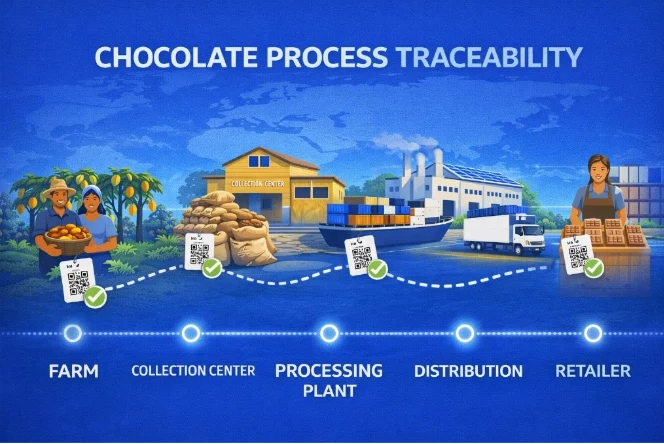
Digital traceability ensures every cocoa input used in chocolate can be traced back to its source enabling complete visibility from farm to finished product.
Meeting ESG and Certification Benchmarks
Traceability systems simplify compliance with ESG goals and certifications such as:
Fairtrade
Rainforest Alliance
Organic
Automated reporting and verified sustainability data help Swiss chocolate companies meet the expectations of international buyers, regulators, and sustainability-conscious consumers.
Data-Driven Sourcing and Risk Management
Swiss chocolate companies gain access to:
Real-time supplier performance insights
Deforestation risk alerts
Carbon footprint tracking
This enables informed sourcing decisions, proactive risk mitigation, and reduced exposure to compliance failures especially for exports into EU markets.
Ultimately, aligning with EUDR strengthens Switzerland’s position as a global leader in premium, ethical, and traceable chocolate production.
Toward a Sustainable and Compliant Chocolate Future
As EUDR enforcement timelines approach, Swiss chocolate companies face a critical opportunity to move from operational complexity to strategic transformation.
By embracing:
Digital traceability
Blockchain-backed data integrity
AI-driven compliance workflows
The industry can transition from fragmented systems to a fully transparent and verifiable cocoa supply chain.
Platforms like Tracex Technologies enable chocolate manufacturers and exporters to convert complex sourcing networks into data-driven, audit-ready ecosystems.
The outcome is not just compliance but:
Seamless EU market access
Stronger global brand credibility
Long-term sustainability leadership
For Switzerland’s chocolate industry, EUDR is not just a regulatory hurdle—it is an opportunity to reinforce its leadership in premium, traceable, and sustainable chocolate globally.
Unpack the biggest hurdles faced by importers under EUDR and how technology can turn compliance into a competitive edge. Read blog on Challenges for EU Importers
FAQs
What is the EU Deforestation Regulation (EUDR)?
The EU Deforestation Regulation (EUDR) is designed to prevent deforestation-linked commodities like cocoa from entering the EU market. It requires full supply chain traceability and submission of Due Diligence Statements (DDS).
What is a Due Diligence Statement (DDS) under EUDR?
A DDS is a formal declaration confirming that cocoa used in chocolate exported from Switzerland to the EU is deforestation-free and legally sourced. It must include farm-level geolocation data and risk assessment documentation.
Do Swiss chocolate companies need to comply with EUDR?
Yes. While Switzerland is not part of the EU, any chocolate exported to EU markets must comply with EUDR requirements, including traceability and DDS submission.
What challenges do Swiss chocolate companies face with EUDR DDS generation?
Common challenges include: • Collecting farm-level traceability data across global cocoa supply chains • Verifying deforestation-free sourcing • Managing smallholder-driven supply chains • Integrating supplier data into centralized systems • Preparing DDS documentation manually
How does TraceX help automate EUDR DDS generation?
TraceX digitizes the process by mapping cocoa farms, verifying deforestation risks using satellite data, and auto-generating DDS reports ready for submission.
Start using TraceX
Transparency, Trust, & Success for your Climate Journey.
We use cookies on our website to give you the most relevant experience by remembering your preferences and repeat visits. By clicking “Accept All”, you consent to the use of ALL the cookies. However, you may visit "Cookie Settings" to provide a controlled consent.
This website uses cookies to improve your experience while you navigate through the website. Out of these, the cookies that are categorized as necessary are stored on your browser as they are essential for the working of basic functionalities of the website. We also use third-party cookies that help us analyze and understand how you use this website. These cookies will be stored in your browser only with your consent. You also have the option to opt-out of these cookies. But opting out of some of these cookies may affect your browsing experience.
Necessary cookies are absolutely essential for the website to function properly. These cookies ensure basic functionalities and security features of the website, anonymously.
Cookie
Duration
Description
cookielawinfo-checkbox-analytics
11 months
This cookie is set by GDPR Cookie Consent plugin. The cookie is used to store the user consent for the cookies in the category "Analytics".
cookielawinfo-checkbox-functional
11 months
The cookie is set by GDPR cookie consent to record the user consent for the cookies in the category "Functional".
cookielawinfo-checkbox-necessary
11 months
This cookie is set by GDPR Cookie Consent plugin. The cookies is used to store the user consent for the cookies in the category "Necessary".
cookielawinfo-checkbox-others
11 months
This cookie is set by GDPR Cookie Consent plugin. The cookie is used to store the user consent for the cookies in the category "Other.
cookielawinfo-checkbox-performance
11 months
This cookie is set by GDPR Cookie Consent plugin. The cookie is used to store the user consent for the cookies in the category "Performance".
viewed_cookie_policy
11 months
The cookie is set by the GDPR Cookie Consent plugin and is used to store whether or not user has consented to the use of cookies. It does not store any personal data.
Functional cookies help to perform certain functionalities like sharing the content of the website on social media platforms, collect feedbacks, and other third-party features.
Performance cookies are used to understand and analyze the key performance indexes of the website which helps in delivering a better user experience for the visitors.
Analytical cookies are used to understand how visitors interact with the website. These cookies help provide information on metrics the number of visitors, bounce rate, traffic source, etc.
Advertisement cookies are used to provide visitors with relevant ads and marketing campaigns. These cookies track visitors across websites and collect information to provide customized ads.
Download the 2026 Traceability Scorecard and Benchmark Your Supply Chain Across 10 Critical Capabilities.
Download our eBook
Don’t Wait for an Audit to Find Your EUDR Gaps
The 2026 Simplification Package changes how HS codes, DDS pass-through and geolocation rules apply to you. Get the free guide and 20-point readiness checklist before enforcement catches you unprepared.