Quick summary: Regulation (EU) 2023/1115, commonly called the EU Deforestation Regulation, applies directly to cocoa, one of Indonesia’s important agricultural commodities within its diversified export economy. Entering into force on June 29, 2023, with compliance deadlines starting December 30, 2024, the regulation identifies cocoa as one of seven commodities linked to deforestation risk, alongside cattle, coffee, palm […]
Regulation (EU) 2023/1115, commonly called the EU Deforestation Regulation, applies directly to cocoa, one of Indonesia’s important agricultural commodities within its diversified export economy. Entering into force on June 29, 2023, with compliance deadlines starting December 30, 2024, the regulation identifies cocoa as one of seven commodities linked to deforestation risk, alongside cattle, coffee, palm oil, rubber, soya, and wood.
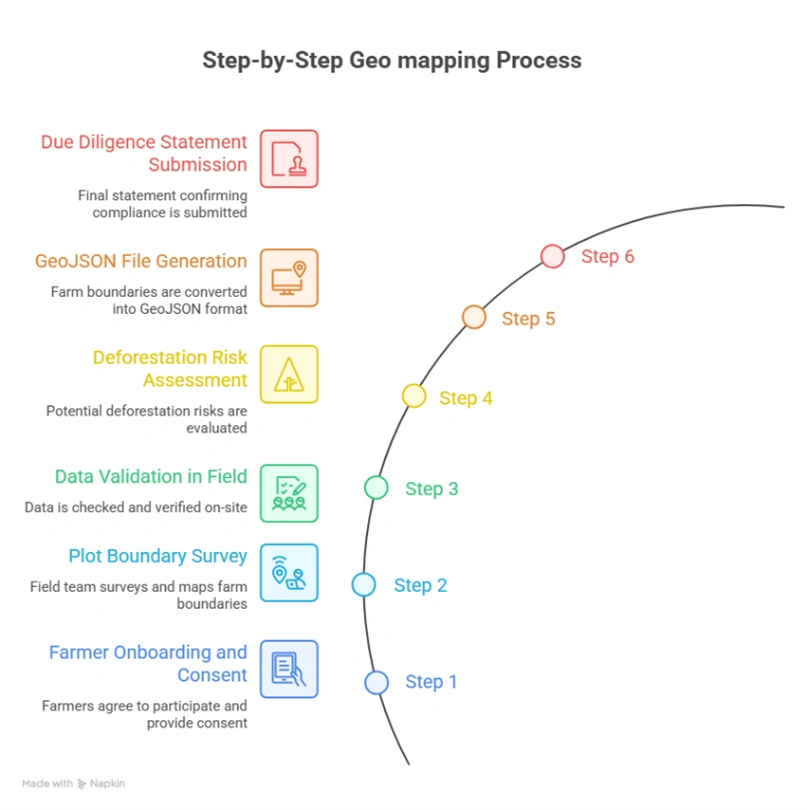
Geo mapping for cocoa exporters in Indonesia is becoming a critical capability, enabling accurate data capture, validation, and compliance at scale. This guide walks through each element of that process.
EUDR Deadlines Are Near
Start Your Free Trial Before Your Cocoa Exports Are Blocked
What the EU Deforestation Regulation Requires for Cocoa Exporters
Core Legal Obligations
Operators and traders placing cocoa or cocoa-derived products on the EU market must demonstrate three essential conditions before any shipment is accepted:
No deforestation: Cocoa must not originate from land that was deforested or degraded after December 31, 2020. This is particularly relevant in Indonesia, where cocoa cultivation often overlaps with forest-adjacent regions and mixed agroforestry systems.
Legal compliance: Production must comply with all applicable national laws in Indonesia, including land-use rights, environmental regulations, and labor laws.
Due diligence: A due diligence statement must be completed and submitted through the EU information system, confirming that risks have been assessed and mitigated across the supply chain.
The Geolocation Mandate
Article 9 of EUDR makes geolocation mandatory for cocoa supply chains. Because cocoa is a land-based commodity, exporters must provide precise geographic data for every plot where cocoa is grown.
Key data requirements include:
GPS polygon mapping: Exact boundary coordinates of each cocoa farm must be captured as polygons (not just single GPS points), accurately outlining the production area.
Plot-level traceability: Each mapped plot must be uniquely linked to the cocoa being exported, ensuring full traceability from farm to shipment.
Coordinate accuracy: Geolocation data must meet strict accuracy thresholds, typically within a few meters, requiring reliable GPS-enabled devices or satellite-based tools.
Timestamped production data: Coordinates must correspond to the actual production period to confirm compliance with the December 31, 2020 deforestation cutoff.
Data submission format: All geolocation data must be uploaded into the EU’s due diligence system in the required standardized format.
For Indonesia’s cocoa sector characterized by smallholder farmers, decentralized production systems, and strong involvement of cooperatives and intermediaries building scalable geo-mapping capabilities is essential. Accurate GPS polygon data collection, validation, and integration into traceability systems will form the foundation of EUDR compliance and ensure continued access to the EU market.
Coordinate type
GPS polygons (lat/long pairs forming a closed boundary)
Accuracy standard
Parcel-level, sufficient to verify against satellite forest-cover data
Cut-off date
December 31, 2020 (forest cover must be intact at this date)
Format requirement
GeoJSON or compatible geospatial format
Linked documentation
Due diligence statement referencing coordinates
Submission system
EU TRACES / dedicated EUDR IT platform
Indonesia Cocoa Exports
Indonesia’s cocoa export story is shifting from a raw-bean model toward more processed and value-added exports, even as domestic bean supply remains constrained. In 2023, Indonesia exported US$1.2 billion of cocoa and cocoa preparations, while trade data for cocoa beans alone show US$46.9 million in exports and 14.45 million kg shipped in 2023.
Data Snapshot
Indonesia is still a major cocoa producer, but output has been under pressure for years, with one recent estimate putting 2023 cocoa bean production at around 650,612 tons after several years of decline from earlier highs. At the farm level, the sector is dominated by smallholders, and more than 1.5 million farmers are involved in cocoa, which makes quality consistency and traceability difficult but also creates room for productivity gains. The country imported US$304.41 million worth of cocoa and cocoa products in January 2025 alone to feed domestic processing and export activity, showing that Indonesia is increasingly reliant on imported raw cocoa to support its industrial base.
Market Insights
The strongest pattern is that Indonesia is becoming more important as a cocoa processing hub than as a pure bean exporter. Historical trade data show that processed cocoa exports expanded sharply after export taxes encouraged more domestic grinding and semi-processed exports, with cocoa butter, powder, paste, and chocolate becoming the main export categories. That structure still matters today because it gives Indonesia more value capture than raw bean exports, even though the country’s declining plantation productivity limits upstream supply.
Indicator
Time Period
Value / Quantity
Cocoa Bean Production (Estimate)
2023
650,612 Tons
Total Cocoa & Cocoa Preparations Exports
2023
US$1.20 Billion
Cocoa Bean Exports (Volume)
2023
14.45 Million kg
Cocoa Bean Exports (Value)
2023
US$46.90 Million
Cocoa Imports (Total Value)
January 2025
US$304.41 Million
The sector’s next growth phase depends less on planting new area and more on rehabilitating farms, improving yields, and securing traceable supply. Global cocoa consumption is expected to keep rising, and ethical sourcing requirements are becoming more important, which gives Indonesian cocoa a chance to upgrade into premium, sustainable, and origin-specific markets. But if production keeps falling, Indonesia will likely remain a net importer of raw cocoa even while it exports more processed cocoa products.
Indonesia matters because it already has processing scale, export experience, and a huge smallholder base that could support a stronger quality-led cocoa economy. The opportunity is to move from commodity blending toward differentiated cocoa powder, butter, nibs, and craft chocolate with better traceability and stronger farmer incomes. The main risk is that weak farm profitability keeps pushing farmers into other crops, which would tighten supply further and reduce the country’s long-term export potential.
GeoJSON Errors Can Delay EU Shipments
Verify farm boundaries, fix formatting issues, and ensure your data is ready for DDS submission.
Why Geolocation (GPS Polygons) Is Mandatory for Indonesia’s Cocoa Supply Chain
Under the EU Deforestation Regulation, GPS polygon mapping is not a procedural formality it is the technical foundation that enables verification of deforestation-free cocoa. For exporters in Indonesia, where cocoa is predominantly cultivated by smallholder farmers across dispersed islands and agroforestry systems, precise geolocation is essential to prove compliance and maintain access to EU markets.
The Satellite Verification Pipeline
EU authorities and third-party verifiers rely on satellite monitoring systems such as the Copernicus Programme, European Space Agency’s Sentinel missions, and Global Forest Watch to detect deforestation at the plot level. This verification process only works when exact farm boundaries are provided.
The verification logic for Indonesia’s cocoa supply chain operates as follows:
Step 1 — Exporter submits GPS polygon coordinates for each cocoa farm supplying the shipment.
Step 2 — Coordinates are overlaid onto historical satellite imagery dating back to December 31, 2020.
Step 3 — Forest cover analysis determines whether the land was forested on or before the cutoff date.
Step 4 — Change detection algorithms identify any deforestation events within the polygon after the cutoff.
Step 5 — Compliance decision: If deforestation is detected, the cocoa shipment is flagged and may be denied entry into the EU market.
Why Points Are Not Enough
Older traceability systems in Indonesia’s cocoa sector may rely on single GPS points (centroids) to represent farms. EUDR explicitly requires polygons instead, for several critical reasons:
Inaccurate representation of farm boundaries: Cocoa farms in Indonesia are often irregular, intercropped, and spread across multiple plots. A single point cannot capture this complexity.
Risk of misclassification: Adjacent plots may differ in compliance status. A centroid could fall on compliant land while parts of the farm overlap deforested or protected areas.
Incompatibility with satellite analytics: Forest monitoring systems require area-based analysis to measure canopy cover and detect land-use change accurately.
Scalable aggregation: Polygon data enables exporters to consolidate sourcing from thousands of smallholder farms while maintaining traceability and auditability.
Regulatory Note
For cocoa plots smaller than 4 hectares, EUDR technical guidance allows a minimum of four coordinate pairs forming a closed polygon. Larger plots must reflect the true and accurate shape of farm boundaries.
Using simplified shapes such as square bounding boxes for irregular cocoa farms is considered non-compliant, as it can misrepresent land use and lead to incorrect deforestation assessments.
Indonesia’s cocoa supply chain large, decentralized, and smallholder-driven—faces structural and operational complexities that make EUDR compliance particularly demanding.
Fragmented Smallholder Landscape
A significant share of Indonesia’s cocoa production comes from smallholder farmers, many cultivating plots under 1–3 hectares across regions such as Sulawesi, Sumatra, and Papua. Key challenges include:
Limited formal land documentation: Many farmers lack digitized or formally registered land titles, complicating verification.
Highly fragmented plots: Farmers may manage multiple dispersed plots, often intercropped with other crops.
Low digital literacy: GPS mapping and digital tools often require trained field teams for data collection.
Multi-layered sourcing networks: Cocoa beans pass through collectors, cooperatives, and traders before reaching exporters, increasing traceability gaps.
Geographic and Infrastructure Barriers
Archipelagic geography: Cocoa farms are spread across islands, making large-scale mapping logistically complex.
Agroforestry systems: Cocoa is often grown under shade trees, affecting GNSS signal accuracy.
Remote access: Many farms are located in rural or forest-adjacent areas with limited infrastructure.
Connectivity limitations: Inconsistent mobile coverage impacts real-time data validation and syncing.
Boundary ambiguity: Informal land divisions can result in overlapping or unclear farm boundaries.
Complete the Due Diligence Statement (DDS), referencing relevant HS codes (e.g., 1801 for cocoa beans).
Submit through the EU system (e.g., TRACES NT or the EUDR platform).
Retain all records for at least 5 years, as required under Article 10 of the EU Deforestation Regulation.
Enabling Scalable Compliance
Geo-mapping for cocoa exporters in Indonesia can be streamlined through digital platforms that integrate GPS polygon capture, automated validation, satellite verification, and compliance reporting helping exporters meet EUDR requirements while improving transparency and long-term supply chain resilience.
Geo mapping for cocoa exporters in Indonesia becomes significantly more efficient with EUDR solutions from TraceX, enabling accurate GPS polygon capture, real-time validation, and end-to-end compliance management across large-scale, geographically dispersed, and smallholder-driven cocoa supply chains.
Common Errors in GeoJSON / Polygon Mapping
Data quality failures at the polygon level are the single most common reason EUDR submissions are flagged for review or rejected. Field teams and data managers should be trained to identify and fix the following errors:
Error Type
Description
Impact
Fix
Self-Intersection
Polygon boundary crosses itself, creating a ‘bowtie’ shape. Occurs when field agent reverses direction while walking.
Latitude and longitude values transposed (lat first, instead of GeoJSON spec’s lon first).
Plot placed in wrong hemisphere or ocean; immediate deforestation false-alarm.
Validate first coordinate: Vietnam lon ≈ 102–109°E; lat ≈ 8–23°N.
Spike Artefacts
One or more vertices are outliers caused by GNSS signal bounce under canopy.
Polygon area inflated; boundary bleeds into adjacent plots.
Remove outlier points; apply Douglas-Peucker simplification at 1m tolerance.
Duplicate Polygons
Same farm submitted twice with different farmer_id due to aggregator duplication.
Inflated area records; compliance review flags double-counting.
Spatial deduplication using PostGIS ST_Equals or Turf.js booleanEqual.
Overly Simplified Polygon
Only 3 or 4 vertices used for complex, irregularly shaped plots.
True boundary not captured; adjacent deforested land may be excluded or included.
Minimum 6–8 vertices for plots with non-linear edges; re-survey if needed.
Conclusion
For cocoa exporters in Indonesia, compliance with the EU Deforestation Regulation is not just a documentation requirement it represents a fundamental transformation of the supply chain. At the center of this shift is GPS polygon mapping, which creates a verifiable link between each cocoa plot, its land-use history, and the beans entering the European market.
The challenges are significant: highly fragmented smallholder systems, geographically dispersed farms across multiple islands such as Sulawesi and Sumatra, and the complexity of collecting accurate geospatial data in remote and forest-adjacent regions. Yet the path forward is clear. Exporters that invest early in scalable geo-mapping infrastructure combining mobile data collection, GIS-based validation, deforestation risk screening, and seamless integration with EU compliance systems will not only meet regulatory requirements but also gain a long-term competitive advantage.
The deadline is approaching. Geolocation is the foundation. Build it right.
What is geo mapping for cocoa exporters in Indonesia?
Geo mapping for cocoa exporters in Indonesia involves capturing GPS polygon coordinates of cocoa farms to verify origin, ensure traceability, and comply with EUDR deforestation-free requirements.
Why is geo mapping important for EUDR compliance in cocoa supply chains?
Geo mapping is mandatory under the EUDR because it enables authorities to verify that cocoa is not sourced from land deforested after December 31, 2020.
What data is required for geo mapping cocoa farms in Indonesia?
Exporters must collect:
GPS polygon coordinates of each farm plot
Farmer identity and supplier or cooperative details
Cocoa production data (e.g., variety, intercropping systems)
Harvest and production location information
What are common challenges in geo mapping cocoa supply chains?
Key challenges include:
Smallholder fragmentation and geographically dispersed farms
Inconsistent or inaccurate GPS data collection
GeoJSON formatting and data standardization issues
Difficulty validating deforestation risk across remote and forest-adjacent regions
Digital solutions help address these challenges through automated validation, satellite-based risk analysis, and end-to-end traceability systems.
Start using TraceX
Transparency, Trust, & Success for your Climate Journey.
We use cookies on our website to give you the most relevant experience by remembering your preferences and repeat visits. By clicking “Accept All”, you consent to the use of ALL the cookies. However, you may visit "Cookie Settings" to provide a controlled consent.
This website uses cookies to improve your experience while you navigate through the website. Out of these, the cookies that are categorized as necessary are stored on your browser as they are essential for the working of basic functionalities of the website. We also use third-party cookies that help us analyze and understand how you use this website. These cookies will be stored in your browser only with your consent. You also have the option to opt-out of these cookies. But opting out of some of these cookies may affect your browsing experience.
Necessary cookies are absolutely essential for the website to function properly. These cookies ensure basic functionalities and security features of the website, anonymously.
Cookie
Duration
Description
cookielawinfo-checkbox-analytics
11 months
This cookie is set by GDPR Cookie Consent plugin. The cookie is used to store the user consent for the cookies in the category "Analytics".
cookielawinfo-checkbox-functional
11 months
The cookie is set by GDPR cookie consent to record the user consent for the cookies in the category "Functional".
cookielawinfo-checkbox-necessary
11 months
This cookie is set by GDPR Cookie Consent plugin. The cookies is used to store the user consent for the cookies in the category "Necessary".
cookielawinfo-checkbox-others
11 months
This cookie is set by GDPR Cookie Consent plugin. The cookie is used to store the user consent for the cookies in the category "Other.
cookielawinfo-checkbox-performance
11 months
This cookie is set by GDPR Cookie Consent plugin. The cookie is used to store the user consent for the cookies in the category "Performance".
viewed_cookie_policy
11 months
The cookie is set by the GDPR Cookie Consent plugin and is used to store whether or not user has consented to the use of cookies. It does not store any personal data.
Functional cookies help to perform certain functionalities like sharing the content of the website on social media platforms, collect feedbacks, and other third-party features.
Performance cookies are used to understand and analyze the key performance indexes of the website which helps in delivering a better user experience for the visitors.
Analytical cookies are used to understand how visitors interact with the website. These cookies help provide information on metrics the number of visitors, bounce rate, traffic source, etc.
Advertisement cookies are used to provide visitors with relevant ads and marketing campaigns. These cookies track visitors across websites and collect information to provide customized ads.
Download the 2026 Traceability Scorecard and Benchmark Your Supply Chain Across 10 Critical Capabilities.
Download our eBook
Don’t Wait for an Audit to Find Your EUDR Gaps
The 2026 Simplification Package changes how HS codes, DDS pass-through and geolocation rules apply to you. Get the free guide and 20-point readiness checklist before enforcement catches you unprepared.