Supplier Engagement in PPWR Compliance: How to Collect Conformity Data Before August 2026
Published
, 8 minute read
Share this article
Quick summary: PPWR compliance will depend less on packaging design and more on supplier data readiness. This article explains how companies can collect supplier-issued Declarations of Conformity, substance data, recycled-content evidence, and technical documentation before the August 2026 deadline, while reducing audit risk and avoiding shipment delays.
Supplier engagement in PPWR is the real PPWR bottleneck not the regulation itself. Under the EU Packaging and Packaging Waste Regulation (PPWR), the manufacturer issues a Declaration of Conformity (DoC) for each packaging type, and importers and brand owners must collect and retain it. That means PPWR compliance is won or lost in your supplier relationships. From August 12, 2026, packaging without a valid DoC cannot legally be placed on the EU market and there is no grace period for stock already produced
If you can’t get the data out of your suppliers, you can’t ship.
Here’s the uncomfortable part. Most companies already meet the physical packaging requirements. The gap is proving it pulling verified test results, recycler certificates, and full material breakdowns from every supplier in the chain. That is a supplier-engagement problem dressed up as a regulatory one.
Replace Manual Compliance Work with One Platform
No more rebuilding technical dossiers by hand or tracking versions in email. Watch how TraceX automates packaging documentation and Declarations of Conformity end to end.
Key Takeaways PPWR (Regulation (EU) 2025/40) makes August 12, 2026 a single, unified deadline: every packaging type on the EU market needs a supplier-issued Declaration of Conformity, with no grace period for existing stock. The hard part isn’t the rules it’s the data. Most teams can’t collect verified substance results, recycler certificates, and DoCs from hundreds of suppliers using spreadsheets. Centralized supplier engagement is the deciding factor (European Commission, 2025).
Why does PPWR shift the burden onto your suppliers?
EU packaging waste hit 177.8 kg per person in 2023, and PPWR moves the financial and operational responsibility for it directly onto producers. Because PPWR is a regulation, not a directive the same rules apply in all 27 member states on the same day, with no national transposition. You can no longer manage packaging compliance market by market.
EU packaging waste per capita and the PPWR response
Waste per capita 2023
177.8 kg
Member states affected
All 27, same day
DoC grace period
0 days
Source: Eurostat/JRC (2023); European Commission, Regulation (EU) 2025/40 (2025).
PPWR (Regulation (EU) 2025/40) applies from August 12, 2026 across all 27 EU member states simultaneously, with no national transposition and no grace period for existing stock. Market surveillance authorities can demand full technical documentation within 10 days, making verified supplier data not packaging design the primary compliance risk (European Commission, 2025).
Preparing for PPWR? Learn how companies can manage packaging data, supplier information, and technical documentation requirements in our blog,
What are the challenges in Supplier engagement in PPWR
Roughly speaking, most teams stall on the same four things: fragmented data, missing supplier information, no validation process, and records that go stale within a quarter. For agri-food exporters, FMCG brands, and processors working with hundreds of suppliers across fragmented geographies, these aren’t edge cases they’re the default state.
Below are the buyer-side challenges we see most often, mapped to who feels them.
ICP / Persona
PPWR challenge they feel
What breaks first
Compliance / Trade Ops Manager
Collecting DoCs and test data from dozens-to-hundreds of packaging suppliers
Manual email chasing; no audit trail
Procurement / Sourcing Lead
No visibility into which suppliers can actually produce a valid DoC
Shipments blocked at the border
Sustainability / ESG Head
Proving recycled content and substance limits with verified, not assumed, data
Greenwashing exposure; failed audits
Private-label brand owner
Becoming the ‘manufacturer’ under Article 21 without realizing it
Legal liability lands on the brand
That last row matters more than people expect. If your brand or name appears on the packaging, the compliance obligation sits with you not your supplier .Many retailers and own-label importers hold manufacturer duties they never signed up for.
Building technical documentation is just the first step. Explore our blog, Conformity Assessment in PPWR: What Businesses Need to Know, to understand how declarations, supporting evidence, and conformity assessment processes come together to demonstrate packaging compliance
See it on your own supply chain TraceX digitizes supplier onboarding geotagged plots, certifications, and compliance documents so DoC and substance data lands in one verifiable place instead of an inbox.
What jobs are buyers actually hiring a solution to do?
When a procurement or compliance lead evaluates PPWR tooling, they’re not buying ‘software’ they’re hiring it to make four jobs disappear before the deadline. Roughly 8 in 10 organizations are still early in PPWR preparation and lack the infrastructure to support it
The core Jobs-To-Be-Done
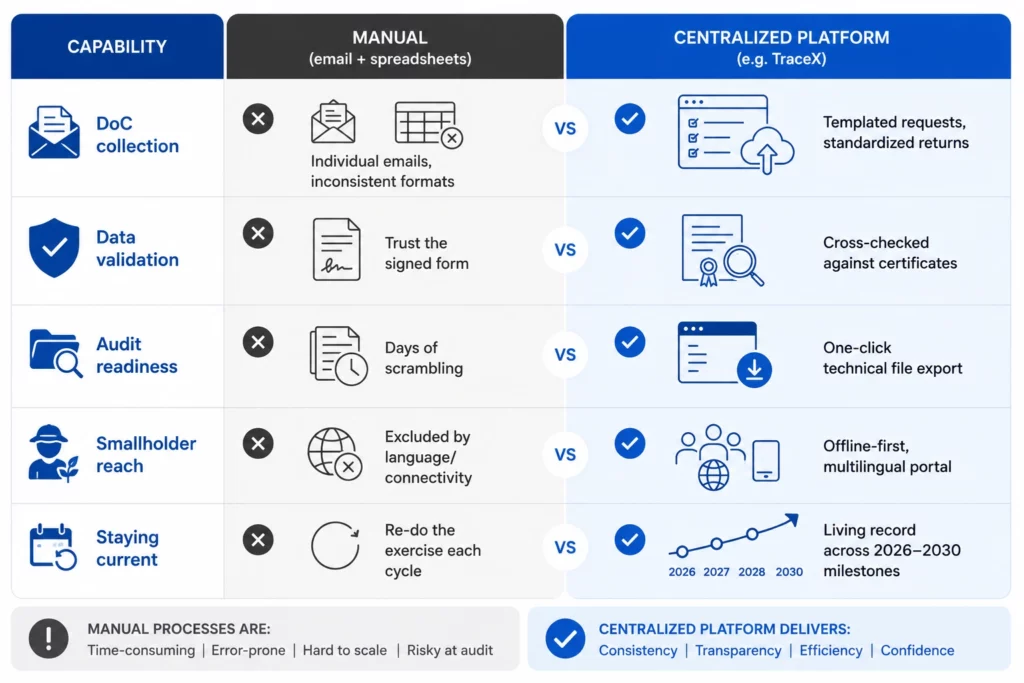
Collect at scale. “Get a valid DoC and supporting test data from every packaging supplier without 400 individual emails.”
Verify, don’t assume. “Replace assumed material data with recycler certificates and substance results I can defend in an audit.”
Stay audit-ready. “Produce full technical documentation within the 10-day window if a market surveillance authority asks.”
Keep it current. “Maintain accurate records as suppliers, SKUs, and 2028/2030 obligations change not a one-time snapshot.”
Around 80% of organizations remain in the early stages of PPWR preparation and have not built the data infrastructure to collect, validate, and maintain supplier compliance information at scale. The result is reliance on assumptions instead of verified data, increasing audit exposure
How do you engage suppliers for PPWR
A workable mid-sized-brand sequence runs PFAS testing and supplier questionnaires in Q2 2026, signed DoCs for every SKU in Q3 2026, then recyclability and recycled-content roadmaps into 2027. The principle is simple: map first, request second, verify third, monitor continuously.
Step-by-step supplier engagement
Map suppliers to packaging types. A supplier providing three packaging formats owes three separate DoCs. Build the matrix before you send a single request.
Send a structured request, not a freeform email. Supply a DoC template (Annex VIII model) plus a substance and recycled-content questionnaire so suppliers return consistent, comparable data.
Validate against evidence. Cross-check claims against recycler certificates and test reports don’t accept a signed form at face value.
Store with an audit trail. Keep DoCs and technical files retrievable on demand, owner and deadline flagged per SKU.
Re-engage on a schedule. Layer in 2028 labeling and 2030 recyclability/recycled-content obligations as they approach.
PPWR readiness starts with understanding what is required—and when. Explore our blog, PPWR Requirements: What Businesses Need to Know, for a practical guide to the obligations, timelines, and documentation that will shape packaging compliance in the years ahead
Example: a spice exporter onboarding 600 smallholder-linked suppliers
Consider an India-based spice exporter shipping to EU buyers. Its packaging spans pouches, cartons, and transport boxes from multiple converters. Chasing DoCs by email across 600+ supplier relationships many with language and connectivity barriers is where compliance programs quietly fail.
With a multilingual, offline-first supplier portal, field agents and suppliers upload documents directly, geotagged and timestamped. The exporter moves from ‘we think we’re covered’ to a defensible, queryable record the difference between clearing customs and watching a container sit.
This is exactly the gap TraceX was built to close: digital supplier onboarding with document capture, certification tracking, and audit-ready export, designed for fragmented supplier bases in India, Africa, and Southeast Asia.
Manual supplier outreach vs. a centralized engagement platform
The deciding variable isn’t whether your packaging complies it’s whether you can prove it across hundreds of suppliers, fast. Companies relying on spreadsheets and email default to assumptions, which raises error rates and weakens defensibility under scrutiny
What’s coming after August 2026?
August 2026 is the headline, but obligations roll out in waves: harmonized material labelling from August 2028, reusable-packaging QR labels from February 2029, and recyclability grades plus minimum recycled content from January 2030 .Each wave demands more supplier data, not less.
Teams that build a durable supplier-engagement system now rather than a one-time DoC scramble won’t have to rebuild it for every milestone. The same data carrier also interoperates with Digital Product Passport infrastructure under ESPR, so the work compounds.
How does TraceX help with PPWR supplier engagement?
TraceX PPWR Solutions provides digital supplier onboarding, document and certification capture, and audit-ready export in one platform with offline-first, multilingual portals for fragmented supplier bases. It centralizes DoC and substance data so teams replace assumptions with verified, retrievable records
The bottom line
PPWR compliance is a supplier-data problem. The rules are mostly familiar; proving them across your supplier base is the hard part.
August 12, 2026 is a hard, unified, no-grace deadline. Every packaging type needs a supplier-issued DoC.
Manual outreach doesn’t scale. Hundreds of suppliers, multiple formats, and a 10-day audit window break spreadsheets.
Centralized engagement future-proofs you through the 2028 and 2030 milestones.
Find Out Which PPWR Rules Apply to Your Packaging
Recyclability, recycled content, labelling, DoCs — the handbook helps you identify what’s relevant to your products so you focus on what matters.
Who issues the Declaration of Conformity under PPWR?
The packaging manufacturer issues and signs the DoC for each packaging type, confirming compliance with Articles 5–12 of Regulation (EU) 2025/40. Importers and brand owners must collect and retain it. If your brand appears on the packaging, you become the manufacturer and must issue it yourself
When is the PPWR supplier-data deadline?
PPWR entered into force on February 11, 2025, but the first hard deadline is August 12, 2026. From that date every packaging type on the EU market needs a valid DoC, with no grace period for existing stock. Supplier data collection must be operational before then
What happens if a supplier can’t provide a DoC?
Packaging without a valid DoC cannot legally be placed on the EU market from August 12, 2026. Market surveillance authorities can request full technical documentation within 10 days. A non-responsive supplier effectively blocks that SKU, making early supplier engagement critical
How many DoCs does each supplier need to provide?
One per packaging type, not one per supplier. A supplier providing three distinct formats owes three separate DoCs. Mapping suppliers to packaging types is the essential first step before sending requests
Start using TraceX
Transparency, Trust, & Success for your Climate Journey.
We use cookies on our website to give you the most relevant experience by remembering your preferences and repeat visits. By clicking “Accept All”, you consent to the use of ALL the cookies. However, you may visit "Cookie Settings" to provide a controlled consent.
This website uses cookies to improve your experience while you navigate through the website. Out of these, the cookies that are categorized as necessary are stored on your browser as they are essential for the working of basic functionalities of the website. We also use third-party cookies that help us analyze and understand how you use this website. These cookies will be stored in your browser only with your consent. You also have the option to opt-out of these cookies. But opting out of some of these cookies may affect your browsing experience.
Necessary cookies are absolutely essential for the website to function properly. These cookies ensure basic functionalities and security features of the website, anonymously.
Cookie
Duration
Description
cookielawinfo-checkbox-analytics
11 months
This cookie is set by GDPR Cookie Consent plugin. The cookie is used to store the user consent for the cookies in the category "Analytics".
cookielawinfo-checkbox-functional
11 months
The cookie is set by GDPR cookie consent to record the user consent for the cookies in the category "Functional".
cookielawinfo-checkbox-necessary
11 months
This cookie is set by GDPR Cookie Consent plugin. The cookies is used to store the user consent for the cookies in the category "Necessary".
cookielawinfo-checkbox-others
11 months
This cookie is set by GDPR Cookie Consent plugin. The cookie is used to store the user consent for the cookies in the category "Other.
cookielawinfo-checkbox-performance
11 months
This cookie is set by GDPR Cookie Consent plugin. The cookie is used to store the user consent for the cookies in the category "Performance".
viewed_cookie_policy
11 months
The cookie is set by the GDPR Cookie Consent plugin and is used to store whether or not user has consented to the use of cookies. It does not store any personal data.
Functional cookies help to perform certain functionalities like sharing the content of the website on social media platforms, collect feedbacks, and other third-party features.
Performance cookies are used to understand and analyze the key performance indexes of the website which helps in delivering a better user experience for the visitors.
Analytical cookies are used to understand how visitors interact with the website. These cookies help provide information on metrics the number of visitors, bounce rate, traffic source, etc.
Advertisement cookies are used to provide visitors with relevant ads and marketing campaigns. These cookies track visitors across websites and collect information to provide customized ads.
Download the 2026 Traceability Scorecard and Benchmark Your Supply Chain Across 10 Critical Capabilities.
Download our eBook
Don’t Wait for an Audit to Find Your EUDR Gaps
The 2026 Simplification Package changes how HS codes, DDS pass-through and geolocation rules apply to you. Get the free guide and 20-point readiness checklist before enforcement catches you unprepared.