Biochar Carbon Credits Market: A Comprehensive Buyer’s Guide
Published
, 17 minute read
Share this article
Quick summary: Biochar Carbon Credits Market explained: learn how biochar carbon credits are generated, verified, traded, and monetized, who benefits from biochar projects, key market standards, buyer considerations, and the role of traceability and dMRV in ensuring credit integrity.
A Comprehensive Buyer’s Guide to Understanding How They Work and Who Benefits
The biochar carbon credits market is experiencing unprecedented growth, with global market value reaching USD 235 million in 2024 and projected to grow at a CAGR of 27.4% to reach USD 2.14 billion by 2033. Biochar carbon removal credits represent one of the most tangible and scalable climate solutions available today, offering corporations, ESG funds, and climate-focused investors a high-integrity pathway to achieve net-zero targets. This comprehensive guide explores the mechanics of biochar carbon credits, verification standards, pricing dynamics, and strategic opportunities for buyers.
89% of 2025 biochar carbon credits are already committed to offtake agreements, signaling extreme scarcity and strong demand momentum from Fortune 500 companies.
Key Takeaways
Biochar carbon credits are engineered, permanent carbon removal, locking CO₂ in stable form for 100+ years.
Current market: $235M (2024), growing at 27.4% CAGR to $2.14B (2033). 89% of 2025 credits already committed.
Average price: $164/tonne (2025), up 25% since 2023. Puro.earth credits command 15–25% premiums; Gold Standard 10–20% over Verra.
Top buyers: Microsoft (1.24M tonnes), Google, JPMorgan Chase, Swiss Re, BCG. Concentration creates market fragility.
Rigorous MRV and standard selection (Puro.earth, Verra VM0044, Gold Standard, CSI) are critical for credit integrity.
Buyer strategy: Diversify across standards, project types, and geographies. Verify delivery track records via public registries. Demand third-party MRV documentation. Consider 5–15% allocation until market matures.
Outlook: Market expected to reach $1.35B by 2030 as supply expands and buyer base diversifies. Early uncertainty (2026–2027) presents opportunity for disciplined, long-term investors.
What Are Biochar Carbon Credits? A Primer
Biochar is a carbon-rich material produced through the pyrolysis of biomass a process that heats organic material (agricultural residues, forest waste, forestry byproducts) in the absence of oxygen. Unlike traditional burning, pyrolysis preserves carbon in a stable form that can persist in soil for hundreds to thousands of years.
One biochar carbon credit (1 BCR) represents one tonne of CO₂ equivalent permanently sequestered. When biochar is produced and applied to soil, the locked-in carbon is prevented from entering the atmosphere, creating a measurable and verifiable climate benefit.
Why Biochar Stands Out
Permanence: Carbon locked in biochar can remain stable for 100+ years, making it one of the most durable carbon removal approaches.
Co-benefits: Improves soil health, increases crop yields, enhances water retention, and provides valuable agricultural income to farmers.
Scalability: Can be deployed globally using agricultural and forestry waste, unlike many carbon removal technologies.
Cost-Effectiveness: Current pricing ($164/tonne in 2025) is competitive compared to nature-based or direct air capture solutions.
Measurability: Robust MRV (Monitoring, Reporting, Verification) protocols enable transparent tracking from production to retirement.
Discover how biochar interacts with soil ecosystems, the science behind its benefits, and why it is becoming an important tool in climate-smart agriculture and land restoration strategies.
The Biochar Carbon Credit Market: Key Statistics & Trends
Metric
2024 Value
2033 Projection
Market Size (Global Biochar Credits)
$235 million
$2.14 billion
CAGR
—
27.4%
Contracted Volume (since 2022)
—
3.0+ million tonnes
Delivered (H1 2025)
—
683,000 tonnes (22% delivery ratio)
2025 Credits Committed
89%
(up from 62% in March)
Regional Market Dynamics
North America: USD 82 million in 2024, growing at 25.8% CAGR. Driven by regulatory support, corporate net-zero commitments, and strong participation from Fortune 500 companies (Microsoft, Google, JPMorgan Chase).
Europe: USD 68 million in 2024. Leadership in climate policy, sustainable agriculture initiatives, and the recent EU Carbon Removals & Carbon Farming (CRCF) Regulation formally recognizing biochar as a permanent carbon removal solution.
Emerging Markets: India, Southeast Asia, and Latin America showing strong growth potential due to abundant biomass resources and agricultural focus. Samunnati’s Carbon Incubator Facility in India (launched Sept 2024) exemplifies expansion into smallholder farmer participation.
Supply & Demand Imbalance
The biochar market is experiencing extreme supply constraints. As of Q2 2025, 89% of 2025 credits are already committed up from 62% in March 2025. Even 2026 credits are 40% locked into offtake agreements, with buyers racing to secure supply over a year in advance. This scarcity is driving 8% quarter-over-quarter price increases and 10–20% premiums for operational projects with proven delivery track records.
Pricing Trends
Year
Price/Tonne (USD)
Change
2023
$131
Baseline
2024
$145 (est.)
+11%
2025 (H1)
$164
+25% YoY
The 25% price increase from 2023 to 2025 reflects growing demand and constrained supply. Standards like Puro.earth command the highest prices due to methodological rigor, while Verra credits trade at a discount. Gold Standard biochar credits often trade 10–20% higher than Verra due to integrated SDG impact assessments, appealing to ESG-focused buyers.
Explore the science behind biochar, its role in regenerative agriculture, potential carbon-market benefits, and how it can contribute to more sustainable and resilient food systems.
Verification Standards: Puro.earth, Verra, Gold Standard & Beyond
The integrity of biochar carbon credits depends entirely on the standard and methodology used. Independent verification by accredited Validation & Verification Bodies (VVBs) ensures that claims are scientifically sound, methodologically rigorous, and free from double-counting.
On February 3, 2026, the European Commission formally adopted biochar carbon removal under the CRCF Regulation, officially categorizing BCR as a permanent carbon removal methodology eligible for compliance-ready, high-integrity credits.
Standard
Rigor
Cost/Timeline
Focus Area
Puro.earth
Highest
$50k–$100k; 12–15 months
Permanence & engineered removal
Verra VM0044
High
$30k–$70k; 12–18 months
Lifecycle accounting & global scale
Gold Standard
High
$50k–$100k; 12–15 months
SDG alignment & social impact
CSI
Medium
$15k–$30k; 6–12 months
Artisanal & smallholder projects
Choosing the Right Standard for Your Goals
For maximum market liquidity & pricing: Puro.earth BCR credits are the most actively traded and typically achieve the highest valuations due to market demand and methodological rigor.
For global scale & smallholder inclusion: Verra VM0044 is the most adopted standard, offering lower costs and broader applicability across diverse project types and geographies.
For ESG & SDG alignment: Gold Standard integrates comprehensive SDG impact assessments, making credits attractive to corporations with strong social responsibility mandates.
For artisanal & emerging market producers: Carbon Standards International (CSI) specializes in small-scale biochar methodologies, enabling producers in the Global South to participate.
Learn how leading carbon standards evaluate projects, the differences between major certification frameworks, and what organizations should consider when assessing carbon credits for sustainability and net-zero strategies.
MRV in Biochar: Monitoring, Reporting, Verification Explained
MRV is the backbone of biochar carbon credit credibility. It ensures that credits represent real, measurable, and permanent carbon removal not greenwashing.
The MRV Process
Phase
What It Means
Key Actors
Timeline
Monitoring
Continuous collection of project data: feedstock inputs, biochar yields, energy consumption, soil application records. Digital MRV platforms increasingly used.
Project operators, IoT sensors, ERP systems
Ongoing
Reporting
Compilation of monitoring data into formal monitoring reports submitted to standard body. Includes emissions calculations, permanence claims, and co-product allocations.
Project developers, dMRV platforms
Annual or per-batch
Verification
Independent third-party auditor (Validation & Verification Body) reviews all data and confirms methodology compliance. Issues verification statement.
Accredited VVB (appointed by standard body)
3–6 months after reporting
Issuance
Standard body issues tradeable carbon credits (VCUs, CORCs) to project account in public registry. 1 credit = 1 tonne CO₂e.
Standard body (Verra, Puro.earth, etc.)
Upon approval
Digital MRV systems (dMRV) are increasingly adopted, integrating IoT sensors, ERP systems, and automated data collection from suppliers. Platforms like Carbonfuture provide standardized digital infrastructure supporting verification across multiple standards (Puro.earth, Verra, Isometric, CSI, CAR).
Discover how dMRV helps automate data collection, improve transparency, reduce reporting burdens, and create audit-ready sustainability records across complex supply chains.
Pyrolysis parameters: Temperature, residence time, energy inputs, and gas/oil co-products capture.
Biochar stability testing: H/Corg ratio, recalcitrance tests, and durability assessment. Puro.earth requires H/Corg <0.7 for soil-applied biochar.
Lifecycle emissions: Full accounting of production, transport, application, and use-phase emissions to calculate net carbon removal.
Application & persistence: Documentation of soil application, monitoring for biochar persistence, and long-term permanence tracking.
Credible methodologies from standards like Puro.earth, Verra VM0044, Isometric, and CAR include explicit guidance on co-product allocation and stack emissions monitoring. Projects unable to provide third-party verification of these metrics are not investment-grade.
Biochar Carbon Credit Pricing: What Drives the Market
Current Market Price (H1 2025): $164/tonne
This represents a 25% increase from $131/tonne in 2023, driven by supply scarcity, growing corporate demand, and improving market integrity.
Factors Influencing Biochar Credit Pricing
Verification Standard: Puro.earth commands 15–25% premiums over Verra due to higher methodological rigor. Gold Standard biochar credits trade 10–20% above Verra.
Operational Track Record: Projects with proven delivery history earn 10–20% premiums. Early-stage projects trade at discounts due to execution risk.
Supply Constraints: Limited certified supply has driven Q2-to-Q3 2025 price increases of 8%, with continued tightening projected.
Co-benefits & SDG Alignment: Credits from projects with documented social impact, farmer income benefits, or biodiversity co-benefits command premiums.
Buyer Concentration Risk: Prices remain susceptible to shifts if major buyers (Microsoft, Google, JPMorgan) reduce purchases, exposing market fragility.
Price Outlook
Experts project biochar credit valuations to reach $250–$300/tonne by 2030 as supply expands and standardization deepens. However, price stability remains dependent on broadening the buyer base beyond the current oligopoly of Fortune 500 companies and expanding into mid-market and SME segments.
Learn how voluntary carbon markets work, the key stakeholders involved, evolving integrity standards, and what businesses need to evaluate before investing in carbon-credit programs.
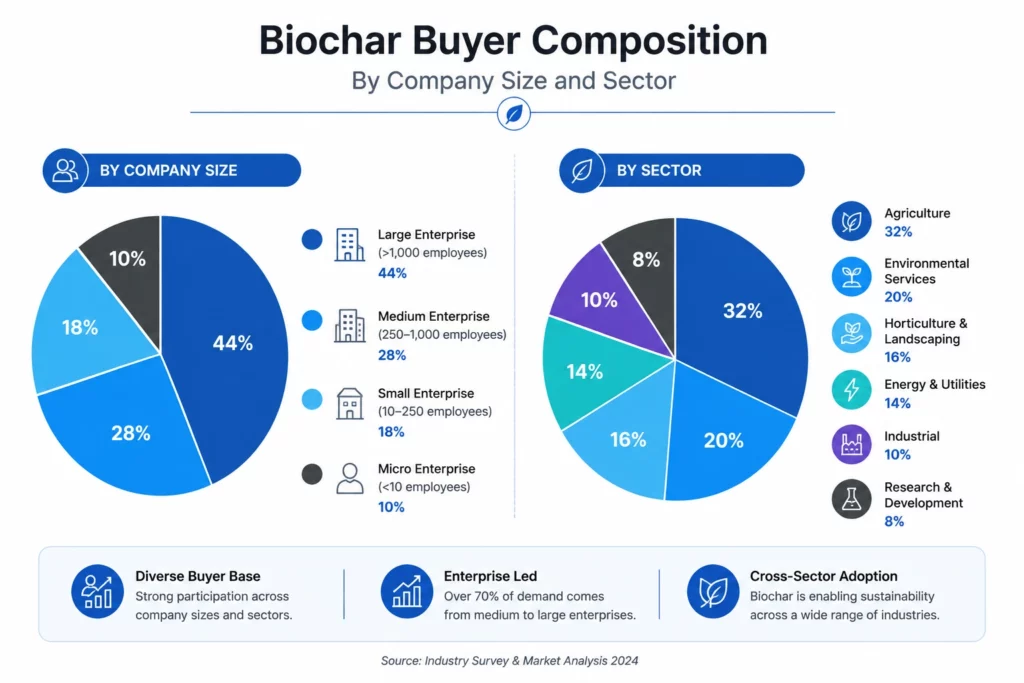
Despite rapid market growth, biochar credit purchases remain highly concentrated. A handful of Fortune 500 companies account for the majority of procurement:
Company
Sector
Contracted Volume
Status
Microsoft
Technology
1.24M tonnes (Q2 2025)
Active major buyer
Google
Technology
500k+ tonnes (est.)
Active buyer
JPMorgan Chase
Financial Services
250k+ tonnes (est.)
Active buyer
Swiss Re
Insurance
200k+ tonnes (est.)
Active buyer
BCG
Professional Services
100k+ tonnes (est.)
Active buyer
This concentration creates a paradox: strong demand that drives price increases, but fragile market structure susceptible to disruption if even one major buyer reduces commitments.
Why These Companies Buy Biochar Credits
Net-Zero Commitments: Fortune 500 companies have publicly committed to carbon neutrality by 2030–2050, requiring reliable, durable carbon removal solutions.
Permanence & Integrity: Biochar’s 100+ year durability reduces reputational risk compared to temporary natural carbon offsets.
Regulatory Compliance: EU CRCF and emerging compliance markets are creating demand for compliance-ready biochar credits.
Marketing & Brand Differentiation: Biochar projects often carry compelling agricultural sustainability narratives, appealing to B2C messaging.
Emerging Buyer Segments
Market developers are actively working to expand beyond the oligopoly:
Mid-Market Corporates (250–1,000 employees): Growing segment seeking carbon neutrality at lower cost than mega-corporations can negotiate. Biochar’s $164 price point is attractive vs. direct air capture ($200–$600) or nature-based credits ($50–$200 with permanence concerns).
ESG-Focused Asset Managers: BlackRock, Vanguard, State Street allocating billions to carbon removal portfolios. Biochar offers higher integrity than legacy nature-based offsets.
Climate-Focused Venture Capital: Breakthrough Energy, Lowercarbon Capital, and similar funds purchasing biochar credits for portfolio companies.
Individual & Small Business Buyers: Emerging trend of SMEs and high-net-worth individuals purchasing biochar credits for carbon neutrality. Brokers report rising push to reach ‘smaller buyers’ as diversification strategy.
For corporations and asset managers considering biochar carbon credit investments, several critical challenges and decision factors warrant attention:
Challenge 1: Supply Fragmentation & Delivery Risk
Limited operational projects: Many biochar developers are still in validation or early production phases. Of 3M+ tonnes contracted since 2022, only 683k tonnes have been delivered (22%).
Project delays: Certification backlogs and production ramp-up challenges have created multi-year delivery gaps. Early 2025 data showed Q1-Q2 retirement volumes flat year-over-year despite surging contracts.
Mitigation: Use public registries (Puro.earth, Verra, Isometric, CAR) to verify historical issuance, delivery, and retirement track records. Prioritize projects with 2–3 years of proven deliveries.
Challenge 2: Market Concentration & Buyer Risk
Oligopolistic structure: Microsoft, Google, JPMorgan, Swiss Re, and a handful of others drive >70% of demand. If any major buyer withdraws, prices could fall 20–40%.
Market fragility: Weak sentiment in Q3 2025, despite price stability, hints at demand uncertainty. Many developers are rethinking strategy toward diversified revenue (biochar-as-soil-amendment) rather than credit-dependent models.
Mitigation: Diversify purchases across multiple projects, standards, and geographies. Allocate only 5–15% of carbon removal budget to biochar until buyer base broadens.
Challenge 3: Standard & Methodology Variability
Different rigor = different risk: Puro.earth’s strict H/Corg <0.7 permanence threshold is more conservative than Verra’s broader allowances. CSI’s artisanal methodologies carry different risk profiles than industrial-scale operations.
MRV gaps: Not all projects use digital MRV or provide transparent emissions monitoring. Projects unable to show LCA (Lifecycle Assessment) data or emissions monitoring plans are not investment-grade.
Mitigation: Insist on third-party verification from credible standards. Require projects to share independent LCA reports and emissions monitoring plans. Prioritize digital MRV platforms for transparency.
Biochar pyrolysis produces energy co-products (syngas, biochar oil). Credits must account for allocation: if syngas replaces fossil fuels, who gets credit—the biochar producer or the energy buyer?
Stack emissions risk: If production energy comes from fossil sources, lifecycle emissions may be higher than marketed. Projects must provide transparent energy source documentation.
Mitigation: Require projects to follow ICVCM-approved co-product allocation methods (Puro.earth, Verra VM0044, Isometric all specify methodologies). Demand stack emissions data and energy source documentation.
Challenge 5: Permanence & Long-Term Monitoring
Biochar durability claims: 100+ year claims are based on lab tests, not centuries of field observation. Standards like Puro.earth and Isometric are more conservative, while Verra has broader allowances.
Reversibility risk: Biochar in soil can be remobilized by soil disturbance, erosion, or extreme weather. Insurance mechanisms and long-term monitoring are still emerging.
Mitigation: Favor projects with conservative permanence thresholds (H/Corg <0.7). Include long-term monitoring clauses in offtake agreements. Consider permanence insurance or buffer accounts when available.
Challenge 6: Farmer Economics & Additionality
Smallholder sustainability: In emerging markets, farmers may abandon biochar adoption if carbon credit prices collapse or if soil amendment benefits don’t offset labor costs.
Additionality risk: Credits only have value if the activity wouldn’t have happened anyway. Careful baseline-setting is critical but difficult to verify.
Mitigation: Prioritize projects in regions where biochar adoption is low and agricultural incomes are modest, increasing likelihood of true additionality. Support projects with explicit farmer benefit-sharing agreements.
Feedstock Traceability – Track biomass feedstock sources, supplier information, origin locations, and sustainability attributes to establish transparent chain-of-custody records.
Digital Data Collection – Capture production data, pyrolysis parameters, feedstock volumes, biochar yields, and field application records through standardized digital workflows.
Carbon Accounting & Monitoring – Support the measurement of carbon sequestration, emissions reductions, and project performance using verifiable datasets aligned with carbon-market methodologies.
Verification-Ready Documentation – Centralize operational records, laboratory test results, monitoring reports, and supporting evidence required for third-party validation and verification.
Project Reporting & Compliance – Streamline reporting for carbon registries, certification programs, sustainability disclosures, and climate-finance initiatives.
AI-Powered Data Integrity Checks – Identify data gaps, inconsistencies, and missing records early, improving confidence in project outcomes and reducing verification risks.
By creating a transparent, traceable, and verifiable digital audit trail, TraceX dMRV helps biochar developers improve project credibility, simplify carbon-credit issuance processes, and demonstrate measurable climate impact with greater confidence.
Biochar vs. Nature-Based and Other Carbon Credits: A Comparison
Attribute
Biochar
Nature-Based
Direct Air Capture
Price ($/tonne)
$164
$50–$200
$200–$600
Permanence
100+ years
20–100 years (risk)
Permanent (geological)
Co-benefits
Soil health, crop yield, farmer income
Biodiversity, water, ecosystem
Minimal
Scalability
High (abundant biomass)
Limited (land constraint)
Limited (capital, energy)
Time to Impact
1–2 years
10–20 years
Immediate
Biochar’s advantage lies in permanence, cost, and scalability. Unlike nature-based offsets (reforestation, REDD+), biochar carbon is engineered to be stable for 100+ years. At $164/tonne, biochar is cheaper than direct air capture ($200–$600/tonne) while offering faster deployment than afforestation (which requires 10–20 years to mature). However, biochar depends on consistent biomass supply and operates at smaller scale than forest carbon programs.
Explore how Nature-Based Solutions work, their role in climate mitigation and adaptation, and why businesses, governments, and investors are increasingly integrating nature into their sustainability strategies.
The Buyer’s Decision Framework: 7-Step Procurement Strategy
Step
Action Items
1
Define Procurement Goals Determine budget allocation for biochar (recommend 5–15% of total carbon removal budget). Set permanence requirements (100+ years preferred). Identify ESG/SDG priorities (e.g., farmer income, biodiversity co-benefits).
2
Select Verification Standard Choose standard based on goals: Puro.earth for highest rigor, Verra VM0044 for scale, Gold Standard for SDG alignment, CSI for smallholder projects. Budget $30k– $100k for certification costs and 12–18 month timeline.
3
Verify Delivery Track Record Use public registries (Puro.earth, Verra, Isometric, CAR) to check project history: How many credits issued? How many retired? Delivery delays? Prioritize projects with 2+ years of proven deliveries and 70%+ delivery-to-contracted ratio.
4
Demand MRV Documentation Request third-party verified Lifecycle Assessment (LCA), feedstock traceability docs, pyrolysis monitoring data, H/Corg stability testing, and emissions accounting. If project uses digital MRV, verify platform credibility and transparency.
5
Diversify Portfolio Spread purchases across 5–10 projects, multiple standards (Puro/Verra/Gold Standard), geographies (North America, Europe, Emerging Markets), and project scales (industrial vs. smallholder). Limits concentration and execution risk.
6
Structure Offtake Agreements Negotiate 3–5 year contracts locking in pricing and delivery timelines. Include performance penalties for delays. Specify permanence insurance or buffer accounts. Consider price escalation clauses to share in future price upside as market matures.
7
Monitor & Report Track portfolio performance against net-zero targets. Monitor for delivery delays, price volatility, and standard changes. Publish transparent ESG reporting on carbon removal, permanence, and co-benefits. Engage with market participants on buyer-base diversification.
By following this framework, buyers can navigate the complexities of biochar credit procurement while managing risk and maximizing impact integrity.
Is Biochar Right for Your Portfolio?
Biochar carbon credits represent a compelling climate solution for corporates and asset managers seeking durable, cost-effective carbon removal. The market is growing at 27.4% CAGR, driven by Fortune 500 demand and emerging compliance frameworks like the EU CRCF.
However, extreme supply scarcity, buyer concentration, and methodological variability create meaningful risks. Successful biochar procurement requires careful standard selection, rigorous MRV due diligence, and diversified project portfolio strategy.
For buyers comfortable with emerging-market risk and able to lock in multi-year offtake agreements, biochar offers a rare opportunity: engineered carbon removal with agricultural co-benefits, proven third-party verification, and institutional-grade permanence. For conservative buyers seeking maximum certainty, delayed purchasing until supply normalizes (2027+) and buyer base broadens may be prudent.
The next 18 months will be decisive for biochar market trajectory. Early adopters with strong due diligence discipline will position themselves advantageously as the market matures.
Frequently Asked Questions (FAQ’s)
What are biochar carbon credits?
Biochar carbon credits are carbon removal credits generated when biomass is converted into stable biochar through pyrolysis and applied to soils or other approved end uses. Because biochar can store carbon for hundreds to thousands of years, the resulting carbon sequestration can be quantified, verified, and issued as tradable carbon credits under approved methodologies.
Who buys biochar carbon credits?
Biochar carbon credits are typically purchased by:
Corporations pursuing net-zero goals
Companies seeking high-quality carbon removals
Sustainability-focused investors
Climate-tech funds
Voluntary carbon market participants
Demand is growing because biochar credits are often viewed as durable carbon removals with measurable climate benefits and relatively low reversal risk compared to some nature-based projects.
How are biochar carbon credits verified?
Biochar projects must undergo rigorous monitoring, reporting, and verification processes before credits are issued.
Verification generally includes:
Feedstock traceability
Production monitoring
Biochar quality testing
Carbon-content analysis
Project documentation reviews
Third-party validation and verification
Many projects also use digital MRV (dMRV) systems to improve data quality, transparency, and audit readiness.
What factors influence the value of biochar carbon credits?
Several factors affect biochar credit pricing, including:
Carbon removal permanence
Feedstock sustainability
Project location
Verification standard used
Data transparency and traceability
Credit demand and market conditions
Co-benefits such as soil health improvements and waste reduction
Projects with strong traceability and robust verification frameworks often command premium pricing.
Why is traceability important in biochar carbon markets?
Traceability helps demonstrate that feedstocks are sourced responsibly, production processes are properly documented, and carbon-removal claims can be verified.
Strong traceability systems support:
Carbon-credit integrity
Regulatory compliance
Third-party verification
Buyer confidence
Reduced fraud and double-counting risks
As voluntary carbon markets mature, transparent data, digital MRV systems, and end-to-end traceability are becoming increasingly important for project credibility and long-term market acceptance.
Start using TraceX
Transparency, Trust, & Success for your Climate Journey.
We use cookies on our website to give you the most relevant experience by remembering your preferences and repeat visits. By clicking “Accept All”, you consent to the use of ALL the cookies. However, you may visit "Cookie Settings" to provide a controlled consent.
This website uses cookies to improve your experience while you navigate through the website. Out of these, the cookies that are categorized as necessary are stored on your browser as they are essential for the working of basic functionalities of the website. We also use third-party cookies that help us analyze and understand how you use this website. These cookies will be stored in your browser only with your consent. You also have the option to opt-out of these cookies. But opting out of some of these cookies may affect your browsing experience.
Necessary cookies are absolutely essential for the website to function properly. These cookies ensure basic functionalities and security features of the website, anonymously.
Cookie
Duration
Description
cookielawinfo-checkbox-analytics
11 months
This cookie is set by GDPR Cookie Consent plugin. The cookie is used to store the user consent for the cookies in the category "Analytics".
cookielawinfo-checkbox-functional
11 months
The cookie is set by GDPR cookie consent to record the user consent for the cookies in the category "Functional".
cookielawinfo-checkbox-necessary
11 months
This cookie is set by GDPR Cookie Consent plugin. The cookies is used to store the user consent for the cookies in the category "Necessary".
cookielawinfo-checkbox-others
11 months
This cookie is set by GDPR Cookie Consent plugin. The cookie is used to store the user consent for the cookies in the category "Other.
cookielawinfo-checkbox-performance
11 months
This cookie is set by GDPR Cookie Consent plugin. The cookie is used to store the user consent for the cookies in the category "Performance".
viewed_cookie_policy
11 months
The cookie is set by the GDPR Cookie Consent plugin and is used to store whether or not user has consented to the use of cookies. It does not store any personal data.
Functional cookies help to perform certain functionalities like sharing the content of the website on social media platforms, collect feedbacks, and other third-party features.
Performance cookies are used to understand and analyze the key performance indexes of the website which helps in delivering a better user experience for the visitors.
Analytical cookies are used to understand how visitors interact with the website. These cookies help provide information on metrics the number of visitors, bounce rate, traffic source, etc.
Advertisement cookies are used to provide visitors with relevant ads and marketing campaigns. These cookies track visitors across websites and collect information to provide customized ads.
Download the 2026 Traceability Scorecard and Benchmark Your Supply Chain Across 10 Critical Capabilities.
Download our eBook
Don’t Wait for an Audit to Find Your EUDR Gaps
The 2026 Simplification Package changes how HS codes, DDS pass-through and geolocation rules apply to you. Get the free guide and 20-point readiness checklist before enforcement catches you unprepared.