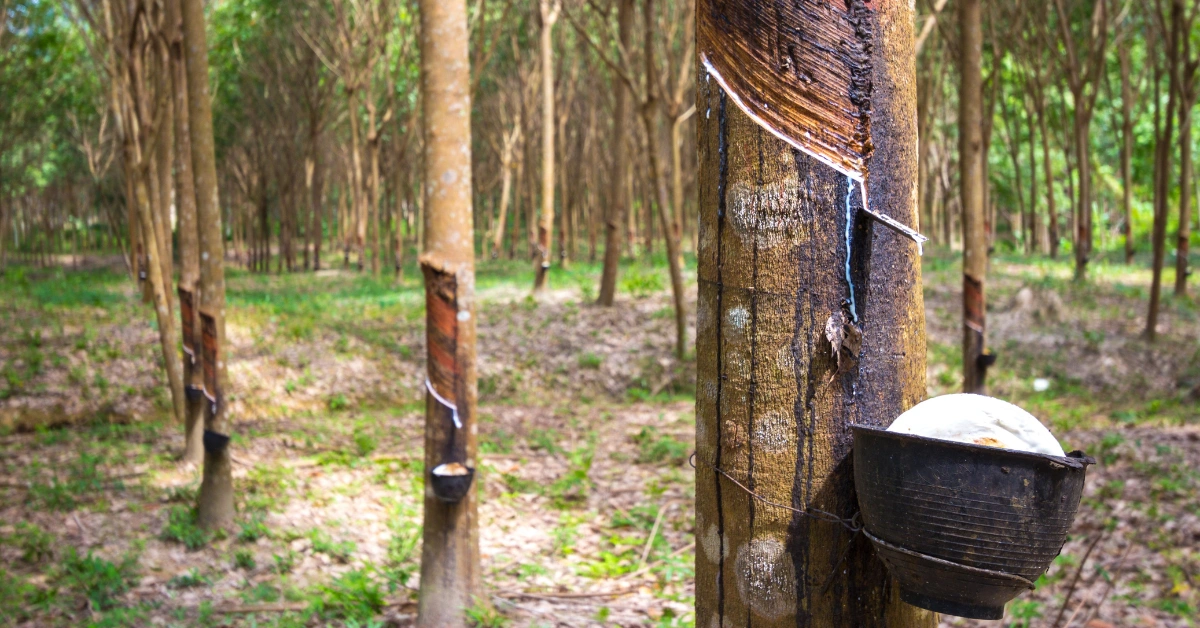
Quick summary: Learn how geo mapping for rubber exporters in Indonesia enables EUDR compliance through GPS polygon mapping, traceability, and accurate supply chain data validation.
The EU Deforestation Regulation (EUDR), effective December 30, 2024, requires that all rubber and rubber-derived products entering the EU market be provably deforestation-free.
At the core of this requirement lies precise geolocation: GPS polygon mapping of every plot of land where the commodity was produced.
Geo mapping for rubber exporters in Indonesia is rapidly becoming a mission-critical capability, especially given the country’s highly fragmented, smallholder-driven supply chains. It enables accurate data capture, validation, and compliance at scale ensuring continued access to EU markets.
This guide walks through each element of that process.
Struggling with EUDR DDS? Automate Compliance & Submit Error-Free—Start Free
Eliminate manual errors and delays. Generate audit-ready DDS with automated traceability, risk checks, and EU-ready submissions—try it free.
What the EU Deforestation Regulation Requires for Rubber Exporters in Indonesia
Regulation (EU) 2023/1115, commonly referred to as the EU Deforestation Regulation (EUDR), entered into force on June 29, 2023, with mandatory compliance deadlines beginning in late 2024.
It targets seven high-deforestation commodities: Rubber, Cattle, Cocoa, Coffee, Palm oil, Soya, and Wood.
As one of the world’s largest rubber producers, Indonesia is under increasing scrutiny to ensure that its exports meet strict traceability and deforestation-free requirements.
Core Legal Obligations
Operators and traders placing Indonesian rubber on the EU market must demonstrate three key conditions before export:
No Deforestation: Rubber must not be sourced from land deforested after December 31, 2020.
Legal Compliance: Production must comply with all relevant Indonesian laws, including land-use and tenure rights, environmental regulations, and labor and social compliance.
Due Diligence: A formal due diligence statement must be submitted through the EU information system, supported by verifiable and auditable data.
The Geolocation Mandate
Article 9 of the EU Deforestation Regulation (EUDR) makes geolocation mandatory and non-negotiable.
For land-based commodities like rubber, exporters must provide precise geographic coordinates in the form of GPS polygons for every plot of land where the rubber was produced.
This requirement is particularly significant in Indonesia due to: large volumes of rubber sourced from smallholder farms, multi-layered supply chains with intermediaries, and limited historical availability of structured farm-level data.
Key Geolocation Requirements
Requirement
Specification
Coordinate type
GPS polygons (lat/long pairs forming a closed boundary)
Accuracy standard
Parcel-level, sufficient to verify against satellite forest-cover data
Cut-off date
December 31, 2020 (forest cover must be intact at this date)
Format requirement
GeoJSON or compatible geospatial format
Linked documentation
Due diligence statement referencing coordinates
Submission system
EU TRACES / dedicated EUDR IT platform
Indonesia Rubber Exports
Indonesia remains one of the world’s largest rubber exporters. In the first seven months of 2025, Indonesia exported 968,000 tons of natural rubber, up 8% year on year, and total natural rubber plus mixed-rubber exports reached 999,000 tons, up 10% year on year.
Indonesia exported about US$3.14 billion of rubber in 2024, ranking second globally by export value. For 2023, technically specified natural rubber (TSNR) exports totaled US$3.05 billion with 1.79 billion kg volume.
Indicator
Data
Rubber exports, 2024 (Value)
US$2.98 Billion
Natural rubber exports, Jan–Jul 2025
968,000 tons
Natural + mixed rubber exports, Jan–Jul 2025
999,000 tons
TSNR (SIR) exports, 2023 (Value)
US$3.05 Billion
TSNR export quantity, 2023
1.79 Billion kg
Market Insights and What Matters Now
Indonesia’s export mix is highly exposed to Asian demand, especially China. The country’s rubber sector is structurally shaped by smallholders, who account for around 80% of output, making traceability and productivity central to competitiveness. Around 75–80% of natural rubber production is exported, so global pricing and external demand have an outsized effect on farm incomes.
The main trend is that Indonesia is exporting more volume, but value growth is constrained by price pressure, product mix, and concentration in a few destination markets. Compliance and traceability are increasingly important as EU deforestation rules and buyer sustainability requirements reward verifiable sourcing.
GeoJSON Errors Can Delay EU Shipments Verify farm boundaries, fix formatting issues, and ensure your data is ready for DDS submission.
Why Geolocation (GPS Polygons) Is Mandatory for Indonesian Rubber Exporters
Under the EU Deforestation Regulation (EUDR), GPS polygon data is the technical foundation of deforestation verification.
For Indonesia’s rubber sector where supply chains are fragmented across thousands of smallholder farms, precise geolocation is the only way to prove compliance at scale.
How the Verification Process Works
Step 1 — Data Submission: Indonesian exporters submit GPS polygon coordinates for each rubber-producing plot.
Step 2 — Satellite Overlay: Polygons are mapped against historical satellite imagery dated December 31, 2020 (EUDR cutoff).
Step 3 — Forest Cover Analysis: Algorithms determine whether the land within the polygon was forested before the cutoff date.
Step 4 — Deforestation Detection: Any forest loss within the polygon after the cutoff triggers a compliance risk flag.
Step 5 — Enforcement: Shipments linked to non-compliant plots can be rejected or blocked from entering the EU market.
Why GPS Points Are Not Enough
In Indonesia, where rubber farms are often irregular in shape, split across multiple small plots, and located near forest boundaries, using a single GPS point is insufficient and non-compliant.
Polygons are required because: a single point cannot represent complex or fragmented farm boundaries, it cannot distinguish between adjacent compliant and deforested land, satellite systems require area-based analysis not just location points, and polygon data enables accurate aggregation across thousands of smallholders.
Challenges in Indonesia Rubber Sourcing
Indonesia’s rubber supply chain presents significant structural, geographic, and traceability challenges. Over 80% of production comes from smallholder farmers with millions of plots spread across Sumatra, Kalimantan, and Sulawesi.
Fragmented Smallholder Landscape
Limited formal land documentation: Many farmers lack fully registered land titles, especially in remote areas
Highly fragmented plots: Farmers often manage multiple small, scattered parcels without consolidated records
Low digital literacy: Most smallholders are unable to self-map or manage geolocation data digitally
Complex aggregation chains: Rubber typically passes through 3–6 intermediaries before reaching processors
Geographic and Infrastructure Barriers
Major rubber-producing regions face logistical constraints: dense canopy interference (rubber trees 15–25 m height reduce GNSS signal accuracy), limited connectivity in many farm areas, seasonal accessibility issues during heavy rains, and frequent land-use conflicts between smallholder land, forest zones, and concession areas.
Supply Chain Traceability Gaps
Indonesia’s rubber supply chain relies on informal networks making it difficult to link rubber batches to specific farm plots, validate deforestation-free claims, and maintain auditable records for EUDR compliance.
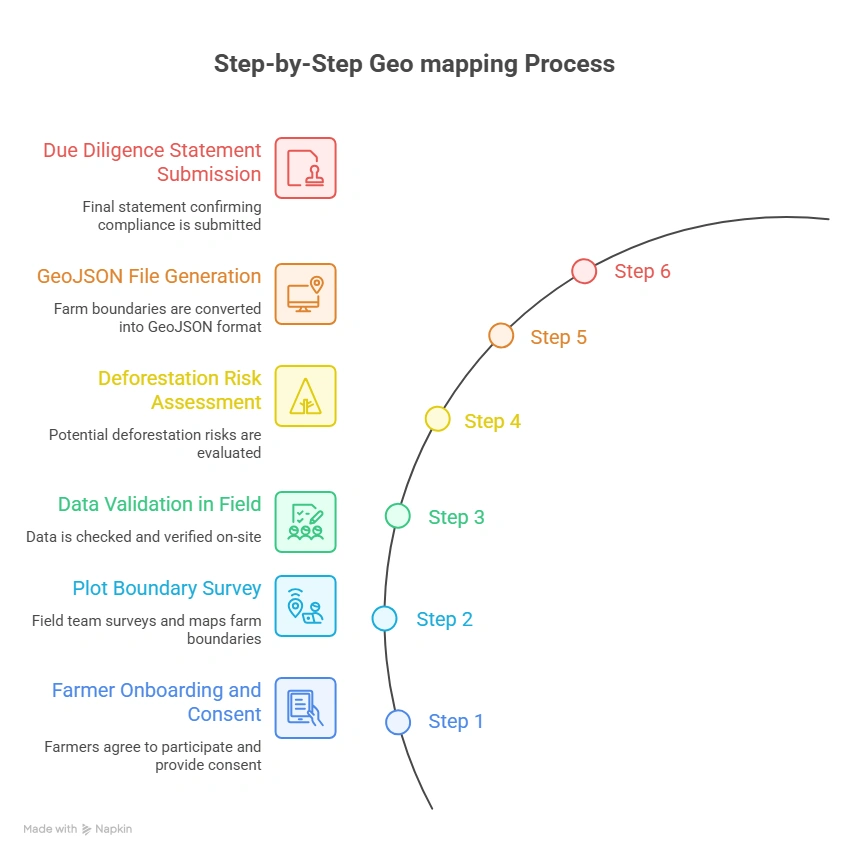
Step-by-Step Geo-mapping Process for Indonesia Rubber
Below is a field-tested workflow designed for Indonesia’s rubber ecosystem, balancing compliance with on-ground realities.
Step 1: Farmer Onboarding and Consent
Register farmer identity (KTP – national ID, family card, land documents if available)
Obtain written consent for GPS data collection and EU submission
Verify land-use rights via village (desa) records or local authorities/cooperatives
Explain EUDR requirements in Bahasa Indonesia and local dialects
Append first coordinate to end of ring or use auto-close
Wrong CRS
Coordinates recorded in wrong projection instead of WGS 84
Coordinates displaced by hundreds of meters
Reproject to EPSG:4326 using QGIS or GeoPandas
Reversed Winding Order
Exterior ring wound clockwise instead of counter-clockwise
Some parsers treat interior as exterior; area inversion
Reverse coordinate array; use QGIS ‘Rewind Polygons’ tool
Coordinate Swap
Latitude and longitude transposed
Plot placed in wrong hemisphere; deforestation false-alarm
Validate first coordinate: Indonesia lon ≈ 95–141°E; lat ≈ 6°S–5°N
Spike Artefacts
Outlier vertices from GNSS signal bounce under canopy
Polygon area inflated; boundary bleeds into adjacent plots
Remove outliers; apply Douglas-Peucker simplification at 1m tolerance
Duplicate Polygons
Same farm submitted twice with different farmer_id
Inflated area records; compliance review flags double-counting
Spatial deduplication using PostGIS ST_Equals or Turf.js
Overly Simplified Polygon
Only 3–4 vertices used for complex, irregular plots
True boundary not captured; adjacent deforested land excluded/included
Minimum 6–8 vertices for non-linear edges; re-survey if needed
Conclusion
For Indonesia’s rubber exporters, compliance with the EU Deforestation Regulation (EUDR) is not just a regulatory requirement it represents a fundamental transformation of the supply chain.
At the center of this transformation is GPS polygon-based geolocation, which creates a verifiable link between the farm plot, its deforestation history, and the rubber entering the EU market.
Indonesia’s challenges are substantial: smallholder dominance, fragmented landholdings, and inconsistent land documentation all make compliance more complex.
But the pathway forward is clear. Exporters that invest early in robust geo mapping systems combining mobile data collection, spatial data validation, deforestation risk screening, and digital compliance workflows will not only meet EUDR requirements but also gain a long-term competitive advantage in global markets.
The clock is running. Geolocation is the foundation. Build it right.
What is Geo-mapping for Rubber Exporters in Indonesia?
Geo mapping for rubber exporters in Indonesia involves capturing GPS polygon coordinates of rubber farms to verify origin and ensure compliance with deforestation-free requirements under the EU Deforestation Regulation (EUDR).
Why is Geo-mapping Important for EUDR Compliance in Indonesia?
Geo mapping is mandatory under EUDR because it enables authorities to verify that rubber is not sourced from land deforested after December 31, 2020, using satellite-based analysis.
What Data is Required for Geo-mapping Rubber Farms in Indonesia?
Exporters must collect: GPS polygon coordinates of farm plots, farmer identity and supplier details, land-use and ownership information (where available), crop and production data, and harvest and sourcing location details.
How do Indonesian Rubber Exporters Capture Geolocation Data for EUDR?
Geolocation data is typically captured using mobile mapping applications, GPS-enabled smartphones or GNSS devices, GeoJSON or KML file uploads, and field agents or cooperatives supported by digital traceability platforms.
What are Common Challenges in Geo-mapping Indonesia’s Rubber Supply Chain?
Key challenges include highly fragmented smallholder farms, limited access to accurate land records, inconsistent or low-quality GPS data, complex aggregation networks, and difficulty validating deforestation risk. Digital solutions help address these through automated validation, risk analysis, and scalable traceability systems.
Start using TraceX
Transparency, Trust, & Success for your Climate Journey.
We use cookies on our website to give you the most relevant experience by remembering your preferences and repeat visits. By clicking “Accept All”, you consent to the use of ALL the cookies. However, you may visit "Cookie Settings" to provide a controlled consent.
This website uses cookies to improve your experience while you navigate through the website. Out of these, the cookies that are categorized as necessary are stored on your browser as they are essential for the working of basic functionalities of the website. We also use third-party cookies that help us analyze and understand how you use this website. These cookies will be stored in your browser only with your consent. You also have the option to opt-out of these cookies. But opting out of some of these cookies may affect your browsing experience.
Necessary cookies are absolutely essential for the website to function properly. These cookies ensure basic functionalities and security features of the website, anonymously.
Cookie
Duration
Description
cookielawinfo-checkbox-analytics
11 months
This cookie is set by GDPR Cookie Consent plugin. The cookie is used to store the user consent for the cookies in the category "Analytics".
cookielawinfo-checkbox-functional
11 months
The cookie is set by GDPR cookie consent to record the user consent for the cookies in the category "Functional".
cookielawinfo-checkbox-necessary
11 months
This cookie is set by GDPR Cookie Consent plugin. The cookies is used to store the user consent for the cookies in the category "Necessary".
cookielawinfo-checkbox-others
11 months
This cookie is set by GDPR Cookie Consent plugin. The cookie is used to store the user consent for the cookies in the category "Other.
cookielawinfo-checkbox-performance
11 months
This cookie is set by GDPR Cookie Consent plugin. The cookie is used to store the user consent for the cookies in the category "Performance".
viewed_cookie_policy
11 months
The cookie is set by the GDPR Cookie Consent plugin and is used to store whether or not user has consented to the use of cookies. It does not store any personal data.
Functional cookies help to perform certain functionalities like sharing the content of the website on social media platforms, collect feedbacks, and other third-party features.
Performance cookies are used to understand and analyze the key performance indexes of the website which helps in delivering a better user experience for the visitors.
Analytical cookies are used to understand how visitors interact with the website. These cookies help provide information on metrics the number of visitors, bounce rate, traffic source, etc.
Advertisement cookies are used to provide visitors with relevant ads and marketing campaigns. These cookies track visitors across websites and collect information to provide customized ads.
Download the 2026 Traceability Scorecard and Benchmark Your Supply Chain Across 10 Critical Capabilities.
Download our eBook
Don’t Wait for an Audit to Find Your EUDR Gaps
The 2026 Simplification Package changes how HS codes, DDS pass-through and geolocation rules apply to you. Get the free guide and 20-point readiness checklist before enforcement catches you unprepared.