The Role of an Authorised Representative Under the EUDR
Published
, 10 minute read
Share this article
Quick summary: An Authorised Representative under the EUDR can submit your DDS in TRACES but never absorbs your legal duty. Here's when to appoint one, when to skip it, and how to stay audit-ready.
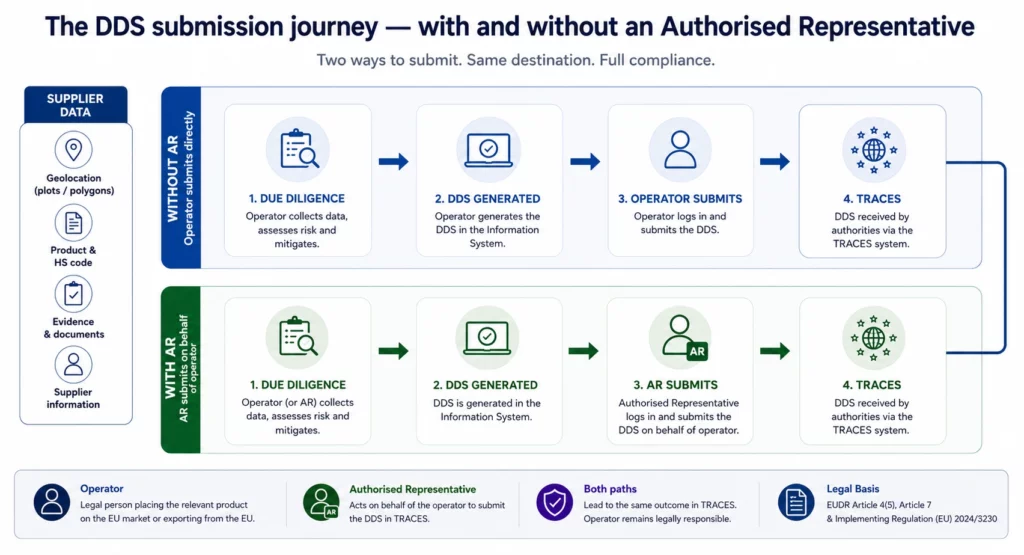
An Authorised Representative under the EUDR is an EU-based person or entity formally mandated by an operator or large trader to submit Due Diligence Statements (DDS) in the EU TRACES system on their behalf. Appointment is voluntary in most cases, the role is purely administrative, and full legal responsibility for compliance traceability, geolocation, risk assessment, mitigation, and record-keeping always stays with the operator.
Roughly 7,000 commodities and derivative products fall under the EUDR scope, and every shipment placed on the EU market must be backed by a Due Diligence Statement filed in TRACES. With enforcement now set for 30 December 2026 for large and medium operators and 30 June 2027 for small and micro operators, compliance teams are scrambling to figure out one specific question: do we appoint an Authorised Representative, or do we file the DDS ourselves?
It’s a fair question and the answer matters more than most teams realise. Get it right, and you delegate paperwork while keeping control. Get it wrong, and you create a false sense of security that collapses the moment a Member State competent authority asks for evidence.
Key Takeaways
• Definition: An EU-based representative mandated in writing to submit DDS in TRACES on behalf of an operator or large trader (EUDR Article 6). • Not a legal shield: The operator keeps every due diligence obligation data collection, risk analysis, mitigation, five-year record retention. • When it helps: Groups with multiple EU entities, exporters submitting thousands of DDSs, and microenterprises/natural persons under Article 6(3). • What you still need: A defensible due diligence system that produces the data your AR submits which is exactly what TraceX automates.
What is an Authorised Representative Under the EUDR?
An Authorised Representative is any natural or legal person residing in the European Union who has been formally mandated, in writing, to submit a Due Diligence Statement on behalf of an EUDR operator or large trader through the EU’s TRACES Information System (EUDR Article 6(1)). Their role is narrow: they file DDS records. They do not perform due diligence, gather farm-level data, or carry legal liability for the products.
Think of an Authorised Representative as a notary, not a partner. They press the submit button. They don’t verify the substance of what’s being submitted. That distinction shows up in every Member State enforcement guideline and in the wording of Article 6 itself.
Where the Role Comes From in the EUDR Text
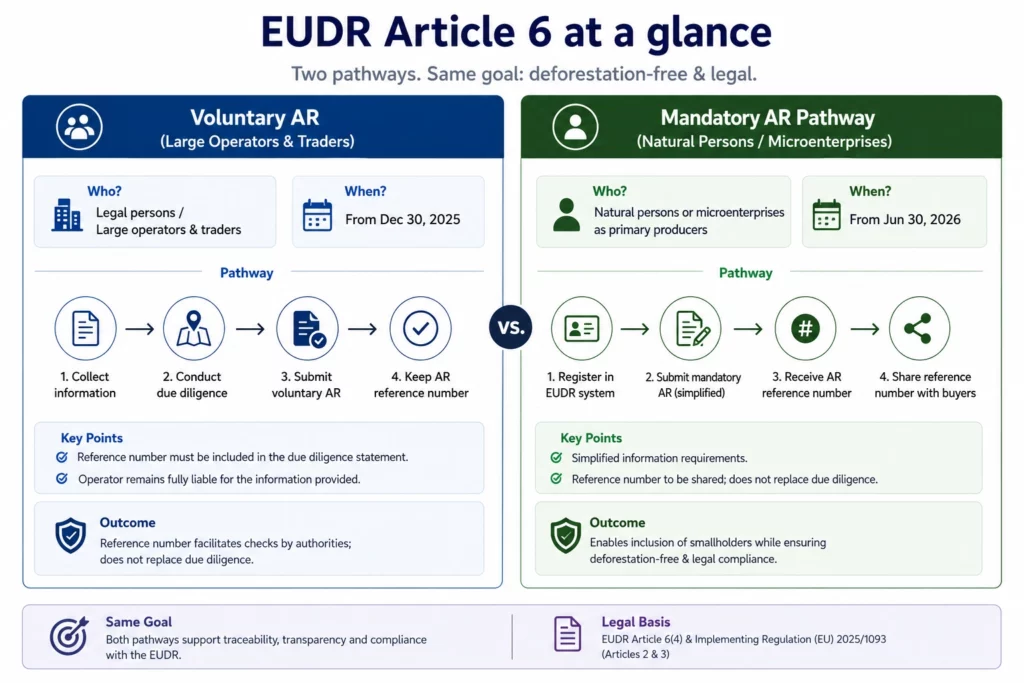
Article 6(1) of Regulation (EU) 2023/1115 gives operators and large traders the option to appoint an Authorised Representative. Article 6(3) creates a separate, narrower pathway: when the upstream party is a natural person or microenterprise, the next downstream operator must act as the AR if they want to place the products on the EU market a clause with significant implications for smallholder-sourced supply chains.
When Does Appointing an Authorised Representative Make Sense?
Appointing an AR makes sense when DDS submission becomes a bottleneck not when due diligence does. Three scenarios consistently come up across exporter conversations:
Scenario 1: Multi-Entity Corporate Groups
A multinational with separate legal entities across Germany, Spain, the Netherlands, and Italy can nominate its EU headquarters as the Authorised Representative for all subsidiary entities. Each operating entity still performs its own due diligence, but DDS submissions flow through a single AR account in TRACES.
Example: A global cocoa processor with five EU manufacturing sites consolidates DDS filing into one Belgian holding company. The compliance team in Brussels submits on behalf of all five, while each site retains responsibility for its own traceability records.
Scenario 2: High-Volume DDS Submissions
Operators handling tens of thousands of shipments annually think coffee, palm oil, soy, and timber traders often outsource DDS submission to a specialised service provider.
Example: An Indian coffee exporter shipping 4,000 lots a year into Hamburg and Antwerp may appoint an EU-based consultancy as its AR. The exporter still runs deforestation checks, geolocation validation, and supplier KYC. The AR handles only the TRACES workflow.
Scenario 3: Microenterprises and Natural Persons (Article 6(3))
This scenario is different from the first two. Under Article 6(3), if the operator is a natural person or microenterprise, they may mandate the next operator in the supply chain provided that next party is not also a natural person or microenterprise to submit the DDS for them. In effect, the downstream operator must act as AR if they want the products on the market. The microenterprise keeps legal responsibility and must supply the underlying data.
Article 6(3) is often misread as a smallholder exemption. It is not. It is a routing mechanism. The smallholder still owes the data; only the submission shifts.
What Can and Cannot an Authorised Representative Do?
Every EUDR engagement we have seen runs into the same misconception: that an Authorised Representative absorbs liability or accelerates compliance. Neither is true. The table below resolves the confusion in one place.
Activity
Who is responsible?
Submitting DDS in TRACES
Authorised Representative (under written mandate)
Collecting GPS / polygon geolocation data
Operator (legal duty)
Verifying deforestation-free status against 31 Dec 2020 cut-off
Operator (legal duty)
Conducting risk assessment for each consignment
Operator (legal duty)
Designing and applying risk mitigation measures
Operator (legal duty)
Retaining records for 5 years
Operator (legal duty)
Responding to Member State competent authority audits
Operator (legal duty)
Holding ultimate legal liability
Operator (always)
Still trying to map your EUDR responsibilities?
TraceX has a free EUDR readiness scorecard that benchmarks your data, geolocation coverage, and DDS workflow in under 10 minutes.
How Do You Formally Appoint an Authorised Representative?
Two steps. Both have to be done in this order, and both create an audit trail Member State competent authorities will look for.
Step 1: Register Both Parties in TRACES
The operator registers in the EU’s TRACES Information System under the role ‘EUDR Operator’ (or ‘EUDR Trader’, for large traders). The Authorised Representative separately registers under the role ‘EUDR Authorised Representative.’ Once linked, the AR can submit DDS records that remain attached to the operator’s account, not their own a deliberate design choice to keep accountability with the responsible party.
Step 2: Issue a Written Mandate
The mandate is a formal document that names the AR, defines the scope of authority (only DDS submission), and is signed by both parties. The EUDR does not prescribe a fixed template, but the mandate must be available on request from competent authorities and may need to be translated into the official EU language of the Member State where the DDS is submitted.
Several organisations publish free templates Preferred by Nature’s Due Diligence Toolkit being the most widely referenced. For Article 6(3) cases involving microenterprises or natural persons, a separate notification form is usually required.
When You Should Not Appoint an Authorised Representative
If the goal is to reduce legal exposure, an AR will not deliver. Article 6 makes the operator’s liability inseparable from the products placed on the market. We have seen three failure patterns:
Liability misread — A trader assumes that handing DDS submission to a consultant transfers risk. The Member State authority disagrees. Fines, shipment seizures, and exclusion from public procurement still hit the operator.
Data control loss — An AR with deeper access than necessary becomes a second copy of the operator’s supply chain data, raising commercial confidentiality and data protection issues.
False simplicity — The operator treats DDS submission as the bottleneck, when the real constraint is upstream traceability. The AR submits faster, but the data they submit is still incomplete.
In all three cases, the AR is doing exactly what the regulation allows but the operator has built a strategy around the wrong constraint.
Where Does TraceX Fit in the AR Conversation?
An Authorised Representative submits whatever you give them. If your DDS is built on incomplete polygon data, missing land tenure documentation, or unverified supplier declarations, the AR submits the gap to TRACES and the liability still travels back to you.
TraceX exists to make sure the data the AR submits is defensible. Our Regulatory Compliance Platform generates DDS records automatically from primary supplier data, validates geolocation against the JRC and Hansen satellite datasets, and runs continuous risk scoring against deforestation alerts. The platform integrates directly with TRACES via API, so whether you submit yourself or through an AR, the workflow stays the same.
Practical example: Commodity exporters use TraceX to consolidate thousands of smallholder GPS plots, auto-extract KYC and land tenure from supplier emails using agentic AI, and export audit-ready DDS in PDF, XML, or TRACES-native formats. Whether their EU subsidiary acts as the AR, an external consultancy does, or they submit directly the underlying compliance evidence is identical.
Make sure the DDS your AR submits is one you can defend
TraceX automates DDS generation, polygon validation against JRC and Hansen datasets, and direct TRACES submission used by companies. Book a 30-minute walkthrough and we’ll show you exactly where your current process leaks risk
No. The Authorised Representative provisions in Article 6 are unchanged by the November/December 2025 amendments. What changed: the application date moved to 30 December 2026 for large and medium operators and 30 June 2027 for small and micro operators. The European Commission’s May 2026 simplification review confirmed those dates will not slip again, and reaffirmed that authorised representatives including cooperatives acting on behalf of smallholders remain a valid pathway for DDS submission.
The takeaway: the deferred timeline is a preparation window, not a reprieve. Operators that wait until late 2026 to decide whether to appoint an AR will be deciding under deadline pressure. Operators that build their underlying due diligence system now can make the AR choice on its merits.
Is an Authorised Representative Mandatory Under the EUDR?
In most cases, no. Article 6(1) makes appointment voluntary for operators and large traders. The one exception is Article 6(3): when the operator is a natural person or microenterprise, the next downstream operator must act as the AR if they want to place those products on the EU market. The operator keeps full legal responsibility either way.
Does an Authorised Representative Take on Legal Liability for EUDR Compliance?
No. The Authorised Representative’s role is administrative — limited to submitting the Due Diligence Statement in TRACES. The operator retains every other obligation: data collection, risk assessment, risk mitigation, geolocation accuracy, and five-year record retention. Member State authorities pursue the operator, not the AR, for non-compliance.
Can a Non-EU Company Appoint an Authorised Representative?
Only if the AR is a natural or legal person residing in the European Union. Non-EU operators cannot appoint an AR based outside the EU. In practice, exporters from India, Brazil, Indonesia, or West Africa often appoint EU subsidiaries, EU-based importers, or specialised compliance firms with an EU office.
How is a Written Mandate for an Authorised Representative Issued?
The mandate is a written document signed by the operator and the AR. The EUDR does not require a fixed template, but the mandate must clearly identify both parties, state the scope (DDS submission only), and be available on request from competent authorities. Translations into the relevant Member State’s official language may be required.
Can the Same Authorised Representative Act for Multiple Operators?
Yes. There is no limit in EUDR Article 6 on how many operators an Authorised Representative may serve. Service providers and consultancies routinely act for dozens or hundreds of operators each with a separate written mandate and a separate link in TRACES.
Start using TraceX
Transparency, Trust, & Success for your Climate Journey.
We use cookies on our website to give you the most relevant experience by remembering your preferences and repeat visits. By clicking “Accept All”, you consent to the use of ALL the cookies. However, you may visit "Cookie Settings" to provide a controlled consent.
This website uses cookies to improve your experience while you navigate through the website. Out of these, the cookies that are categorized as necessary are stored on your browser as they are essential for the working of basic functionalities of the website. We also use third-party cookies that help us analyze and understand how you use this website. These cookies will be stored in your browser only with your consent. You also have the option to opt-out of these cookies. But opting out of some of these cookies may affect your browsing experience.
Necessary cookies are absolutely essential for the website to function properly. These cookies ensure basic functionalities and security features of the website, anonymously.
Cookie
Duration
Description
cookielawinfo-checkbox-analytics
11 months
This cookie is set by GDPR Cookie Consent plugin. The cookie is used to store the user consent for the cookies in the category "Analytics".
cookielawinfo-checkbox-functional
11 months
The cookie is set by GDPR cookie consent to record the user consent for the cookies in the category "Functional".
cookielawinfo-checkbox-necessary
11 months
This cookie is set by GDPR Cookie Consent plugin. The cookies is used to store the user consent for the cookies in the category "Necessary".
cookielawinfo-checkbox-others
11 months
This cookie is set by GDPR Cookie Consent plugin. The cookie is used to store the user consent for the cookies in the category "Other.
cookielawinfo-checkbox-performance
11 months
This cookie is set by GDPR Cookie Consent plugin. The cookie is used to store the user consent for the cookies in the category "Performance".
viewed_cookie_policy
11 months
The cookie is set by the GDPR Cookie Consent plugin and is used to store whether or not user has consented to the use of cookies. It does not store any personal data.
Functional cookies help to perform certain functionalities like sharing the content of the website on social media platforms, collect feedbacks, and other third-party features.
Performance cookies are used to understand and analyze the key performance indexes of the website which helps in delivering a better user experience for the visitors.
Analytical cookies are used to understand how visitors interact with the website. These cookies help provide information on metrics the number of visitors, bounce rate, traffic source, etc.
Advertisement cookies are used to provide visitors with relevant ads and marketing campaigns. These cookies track visitors across websites and collect information to provide customized ads.
Download the 2026 Traceability Scorecard and Benchmark Your Supply Chain Across 10 Critical Capabilities.
Download our eBook
Don’t Wait for an Audit to Find Your EUDR Gaps
The 2026 Simplification Package changes how HS codes, DDS pass-through and geolocation rules apply to you. Get the free guide and 20-point readiness checklist before enforcement catches you unprepared.