Quick summary: Explore how digital traceability is transforming the coffee supply chain in Uganda. Learn how blockchain, geolocation, and digital onboarding enhance transparency, enable EUDR compliance, empower farmers, and build sustainable, globally trusted coffee exports.
Traceability for Coffee Supply Chain in Uganda is becoming essential as global markets demand verifiable, deforestation-free, and ethically sourced products. Uganda, Africa’s second-largest coffee exporter, faces challenges in mapping smallholder farms and tracking beans through informal trade networks. Implementing digital traceability solutions enables end-to-end visibility from farm to export, ensuring compliance with the EU Deforestation Regulation (EUDR)and other due diligence laws. Through blockchain, GPS mapping, and real-time data capture, Uganda’s coffee sector can enhance transparency, strengthen market access, and build global trust in its sustainable, high-quality coffee exports.
Ready to build a traceable, compliant, and globally competitive coffee value chain in Uganda?
Your step-by-step guide to digitizing sourcing, meeting EUDR requirements, and empowering farmers through transparency.
The Ugandan Coffee Landscape – An Emerging Opportunity
Uganda stands as one of Africa’s most promising coffee producers, with a unique position in the global market. The country is the continent’s second-largest coffee exporter after Ethiopia, contributing significantly to both rural livelihoods and national GDP. Coffee accounts for nearly 20–30% of Uganda’s agricultural export earnings, with an estimated 1.7 million smallholder farmers relying on it as their main source of income.
Uganda’s strength lies in its dual coffee production system Robusta, native to the Lake Victoria Basin, and Arabica, grown in the highlands of Mount Elgon, Rwenzori, and West Nile regions. This diversity provides both volume and quality differentiation, catering to various market segments, from specialty roasters to industrial buyers. Uganda exports over 6 million 60-kg bags annually, primarily to the EU, UK, and U.S. markets, while domestic consumption is rising due to a burgeoning urban coffee culture. The Uganda Coffee Development Authority (UCDA) has set an ambitious target to increase exports to 20 million bags by 2030, emphasizing value addition, branding, and sustainability as key drivers of growth.
The European Union is Uganda’s largest market, accounting for two-thirds of exports. Italy, Germany, Belgium, and Spain are top buyers. Exports to the US, Morocco, India, China, and intra-Africa have also grown, reflecting Uganda’s quality improvements and market diversification.
The backbone of Uganda’s coffee industry is its network of smallholder farmers and cooperatives, often cultivating less than two hectares of land. However, limited access to digital tools, financing, and formal documentation creates visibility challenges across the supply chain making traceability a crucial next step toward modernization.
As international buyers tighten sustainability and deforestation-free sourcing requirements under frameworks like the EUDR, Uganda faces both a challenge and an opportunity. By embracing digital traceability platforms, blockchain verification, and satellite mapping, Uganda can strengthen compliance, unlock premium markets, and build a global reputation for transparent, responsibly sourced coffee.
In short, Uganda’s coffee landscape is at a pivotal transition point where tradition meets technology. With the right investments in traceability and supply chain digitization, Uganda can move beyond being a volume exporter to becoming a trusted origin for sustainable, traceable, and high-quality coffee.
Discover how blockchain is revolutionizing food traceability, ensuring every bean’s journey is transparent, tamper-proof, and trusted.
With over 1.7 million smallholder farmers and a complex network of cooperatives, brokers, and aggregators, Uganda’s coffee supply chain is heavily fragmented. This fragmentation makes it difficult to map each producer, monitor bean batches, and establish a continuous traceability framework from farm to export.
2. Limited Digital Infrastructure & Data Capture
Many farmer groups and collection networks rely on paper-based systems or informal record-keeping. The lack of digital tools, GPS mapping of farms, and consistent data collection hampers the ability to provide verifiable origin data required by regulations like the EU Deforestation Regulation (EUDR).
3. Geolocation & Land-Legality Verification Gaps
To meet deforestation-free sourcing standards, exporters need precise geolocation of farms and verification of land legality. Uganda faces challenges here: land tenure can be informal, and farm boundaries may not be registered or documented, making compliance difficult.
4. Opaque Middlemen Networks
Coffee often passes through multiple intermediaries—local buyers, aggregators, exporters—before reaching the market. These layers reduce transparency, obscure origin, and complicate traceability efforts
5. Regulatory & Market Access Risks
With the upcoming EUDR compliance deadlines, Ugandan coffee exporters risk losing market access if traceability systems aren’t up to standard. The cost of compliance may squeeze margins for farmers and exporters alike
6. Low Incentivization & Capacity Constraints
Many smallholder farmers lack incentives to adopt traceability because the benefits (price premiums, market access) are not yet widely realised. They also face capacity constraints limited training, digital literacy, access to tech that slow adoption of traceability systems.
Addressing these gaps through digital traceability, cooperative strengthening, farm-level mapping, and stakeholder alignment will be essential for Uganda’s coffee sector to meet compliance requirements, unlock premium markets, and establish itself as a transparent, sustainable coffee origin.
How TraceX Can Help Strengthen Coffee Traceability in Uganda
Digital traceability platforms from TraceX can play a transformative role in modernizing Uganda’s coffee supply chain by creating transparency, accountability, and compliance readiness across all stages of production and export. Leveraging blockchain, AI analytics, and mobile-first data capture, TraceX enables end-to-end visibility from smallholder farms to international markets.
End-to-End Visibility from Farm to Port
TraceX connects every actor farmers, cooperatives, aggregators, processors, exporters, and regulators within one digital network. Each coffee lot is assigned a unique digital ID, allowing full traceability from cultivation to export. This “farm-to-port” view ensures verified origin, prevents mixing of unregistered beans, and enhances Uganda’s reputation for ethical sourcing.
Digital Onboarding for Smallholders and Cooperatives
Through mobile onboarding tools, TraceX allows even remote smallholders to be GPS-mapped, registered, and verified. Farmer profiles include ownership details, sustainability certifications, and production data. This inclusion builds trust, supports compliance with EUDR, and gives small farmers visibility in global value chains.
Real-Time Data Capture and Automated DDS Generation
TraceX automates compliance processes under frameworks like the EU Deforestation Regulation (EUDR). Data on farm geolocation, harvest quantity, and supplier verification are captured in real time, with Due Diligence Statements (DDS) auto-generated for each export batch. This ensures faster audits, less manual work, and full alignment with EU market standards.
Blockchain-Based Proof of Origin and ESG Compliance
Each transaction from cherry collection to milling and export is stored on an immutable blockchain ledger, offering tamper-proof verification of coffee origin. This builds buyer confidence, strengthens ESG transparency, and provides evidence of deforestation-free sourcing.
By adopting TraceX, Uganda’s coffee exporters can enhance supply chain visibility, meet international due diligence regulations, and position Ugandan coffee as a transparent, traceable, and sustainable global origin.
Discover how TraceX can help Uganda build a deforestation-free, digitally verifiable, and market-ready coffee supply chain.
Traceability is not just a compliance tool for Uganda’s coffee industry it is a strategic enabler for competitiveness, sustainability, and long-term growth. As the global coffee market shifts toward transparency and deforestation-free sourcing, Uganda’s ability to prove the origin, quality, and integrity of every coffee bean has become a decisive factor for trade success.
Ensuring Market Access and Regulatory Compliance
The EU Deforestation Regulation (EUDR), the UK Environment Act, and similar frameworks now require verifiable proof of origin and legality for agricultural exports. Uganda, as a major coffee supplier to Europe, must demonstrate that its coffee is deforestation-free and traceable back to the farm. Without robust traceability, exporters risk losing access to lucrative EU and UK markets making digital compliance essential to safeguard trade continuity.
Strengthening Credibility with Global Buyers
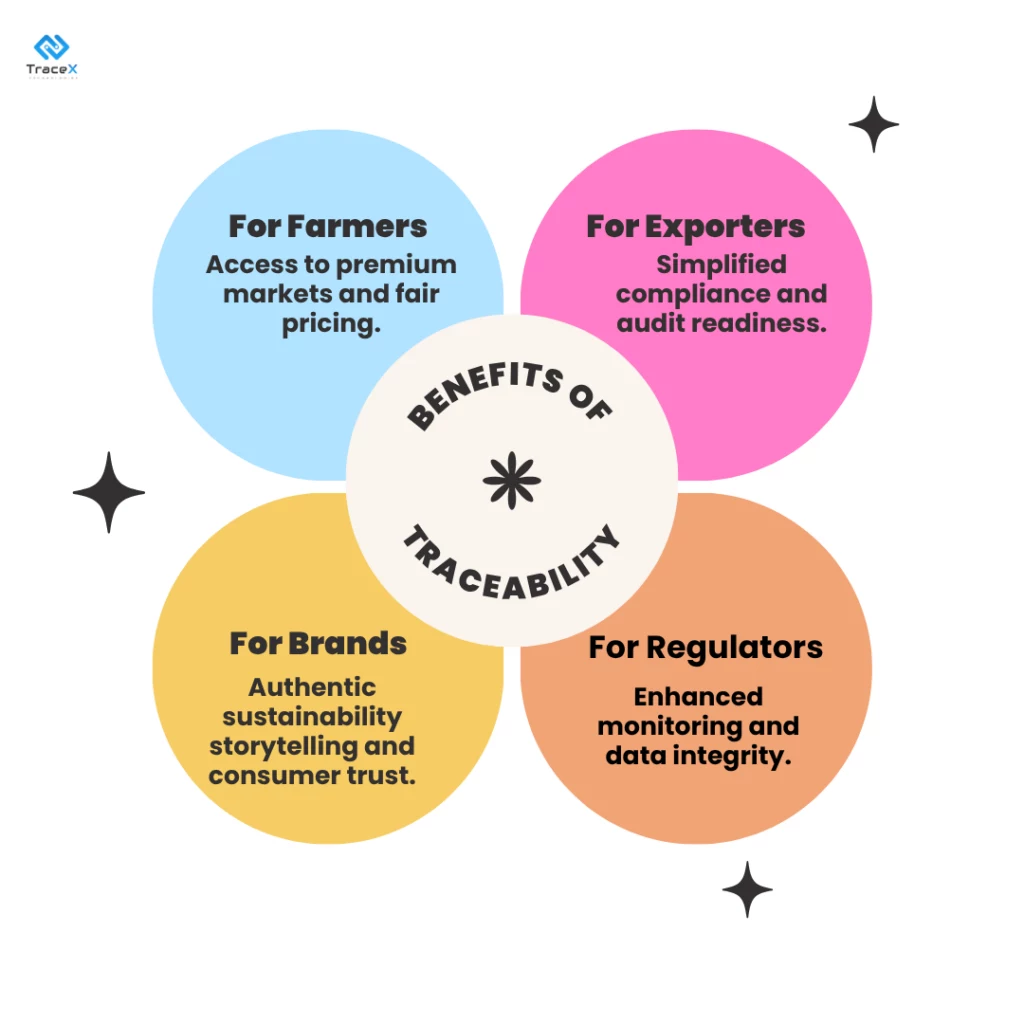
International roasters, importers, and retailers increasingly demand transparent sourcing and data-backed claims. Traceability provides authenticated information about farm location, production practices, and sustainability certifications. This builds buyer confidence, differentiates Ugandan coffee in global markets, and enhances its reputation as an origin of ethical and high-quality beans.
Empowering Farmers through Data Visibility
Traceability transforms smallholder participation by making them visible contributors in the global value chain. Digitally registered farmers gain recognition, access to training, and better market linkages. Verified data allows them to negotiate fairer pricing and participate in sustainability programs, improving livelihoods while promoting regenerative farming practices.
Enabling ESG Reporting and Brand Transparency
For exporters and roasters, traceability systems generate structured, verifiable data that supports ESG (Environmental, Social, and Governance) disclosures. Companies can report on deforestation-free sourcing, ethical labor practices, and supply-chain emissions with credibility—strengthening brand reputation and compliance with investor-driven sustainability mandates.
Unlocking Premium and Specialty Market Opportunities
In a market increasingly driven by “bean-to-cup transparency,” verified traceability opens access to specialty buyers who reward origin integrity with premium prices. Ugandan coffee, known for its rich flavor and dual Arabica-Robusta profile, can leverage traceability to elevate its global market position and secure value-based partnerships with conscious brands.
Enhancing Supply Chain Efficiency and Risk Management
Traceability enables real-time monitoring of production, logistics, and supplier performance. Exporters can identify inefficiencies, prevent fraud, and respond swiftly to quality or compliance risks. This operational visibility not only reduces costs but also strengthens Uganda’s resilience against climate and market shocks.
In essence, traceability is the key to transforming Uganda’s coffee sector from volume-driven to value-driven. By embedding digital transparency across the supply chain, Uganda can ensure sustainability, compliance, and trust positioning its coffee as a benchmark for traceable excellence in the global market.
Traceability for Coffee Supply Chain in Uganda
The future of Uganda’s coffee sector depends on its ability to trace, verify, and prove the integrity of every bean from smallholder farms to international markets. As global buyers demand transparency and regulations like the EU Deforestation Regulation (EUDR) take effect, traceability is no longer optional it’s a strategic necessity.
By adopting digital traceability platforms such as TraceX, Uganda can build a supply chain that is transparent, compliant, and inclusive. Empowering farmers with digital tools, automating compliance for exporters, and creating verifiable blockchain-backed proof of origin will not only protect market access but also enhance Uganda’s global reputation as a sustainable and responsible coffee origin.
In doing so, Uganda can transform traceability from a compliance burden into a competitive advantage driving long-term growth, ethical trade, and shared value across its coffee ecosystem.
Traceability isn’t just about compliance—it’s about preserving legacy, enabling growth, and future-proofing Ethiopian coffee for generations to come.
What is traceability in the Uganda coffee supply chain?
Traceability refers to the ability to track coffee from its origin farm or cooperative through processing, export, and final sale. It ensures transparency, legal sourcing, and compliance with sustainability and deforestation-free regulations.
Why is traceability important for Uganda coffee exporters?
It builds credibility with global buyers, enables compliance with the EU Deforestation Regulation (EUDR), and positions Uganda competitively in international markets. Verified traceability also opens access to premium and sustainable trade segments.
What are the key challenges to achieving coffee traceability in Uganda?
Challenges include fragmented smallholder networks, lack of digital tools, manual record-keeping, and limited geospatial mapping. Many cooperatives and exporters lack systems for tracking origin and verifying supplier data.
How can digital traceability platforms like TraceX help Uganda coffee producers?
TraceX automates data capture, supplier onboarding, and Due Diligence Statement (DDS) creation. Its blockchain-enabled system provides tamper-proof proof of origin, enabling exporters to meet compliance and sustainability goals efficiently.
What global regulations make traceability mandatory for coffee?
The EU Deforestation Regulation (EUDR), the UK Environment Act, and emerging US import standards require traceability to verify that coffee is deforestation-free and legally sourced before entering their markets.
How can Uganda coffee companies start implementing traceability?
They can begin by mapping their supply chain, digitizing farmer records, capturing GPS farm data, and adopting traceability software to integrate supplier, processing, and export information for compliance and transparency.
Start using TraceX
Transparency, Trust, & Success for your Climate Journey.
We use cookies on our website to give you the most relevant experience by remembering your preferences and repeat visits. By clicking “Accept All”, you consent to the use of ALL the cookies. However, you may visit "Cookie Settings" to provide a controlled consent.
This website uses cookies to improve your experience while you navigate through the website. Out of these, the cookies that are categorized as necessary are stored on your browser as they are essential for the working of basic functionalities of the website. We also use third-party cookies that help us analyze and understand how you use this website. These cookies will be stored in your browser only with your consent. You also have the option to opt-out of these cookies. But opting out of some of these cookies may affect your browsing experience.
Necessary cookies are absolutely essential for the website to function properly. These cookies ensure basic functionalities and security features of the website, anonymously.
Cookie
Duration
Description
cookielawinfo-checkbox-analytics
11 months
This cookie is set by GDPR Cookie Consent plugin. The cookie is used to store the user consent for the cookies in the category "Analytics".
cookielawinfo-checkbox-functional
11 months
The cookie is set by GDPR cookie consent to record the user consent for the cookies in the category "Functional".
cookielawinfo-checkbox-necessary
11 months
This cookie is set by GDPR Cookie Consent plugin. The cookies is used to store the user consent for the cookies in the category "Necessary".
cookielawinfo-checkbox-others
11 months
This cookie is set by GDPR Cookie Consent plugin. The cookie is used to store the user consent for the cookies in the category "Other.
cookielawinfo-checkbox-performance
11 months
This cookie is set by GDPR Cookie Consent plugin. The cookie is used to store the user consent for the cookies in the category "Performance".
viewed_cookie_policy
11 months
The cookie is set by the GDPR Cookie Consent plugin and is used to store whether or not user has consented to the use of cookies. It does not store any personal data.
Functional cookies help to perform certain functionalities like sharing the content of the website on social media platforms, collect feedbacks, and other third-party features.
Performance cookies are used to understand and analyze the key performance indexes of the website which helps in delivering a better user experience for the visitors.
Analytical cookies are used to understand how visitors interact with the website. These cookies help provide information on metrics the number of visitors, bounce rate, traffic source, etc.
Advertisement cookies are used to provide visitors with relevant ads and marketing campaigns. These cookies track visitors across websites and collect information to provide customized ads.
Download the 2026 Traceability Scorecard and Benchmark Your Supply Chain Across 10 Critical Capabilities.
Download our eBook
Don’t Wait for an Audit to Find Your EUDR Gaps
The 2026 Simplification Package changes how HS codes, DDS pass-through and geolocation rules apply to you. Get the free guide and 20-point readiness checklist before enforcement catches you unprepared.