Procurement in Agriculture: Sourcing That Holds Up in the Field
Published
, 8 minute read
Share this article
Quick summary: Procurement in agriculture fails at the field, not the office. See how offline-first, grade-based sourcing captures traceable data at every purchase.
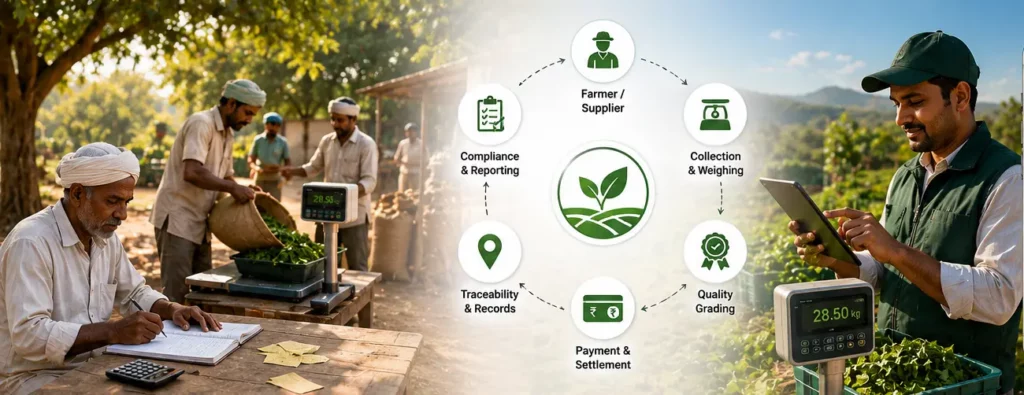
Procurement in agriculture is the process of sourcing raw produce and farm inputs negotiating price, checking quality, weighing, paying farmers, and recording every transaction across a fragmented and often remote supply base. Unlike office procurement, procurement in agriculture succeeds or fails at the collection point, where grade, price, and traceable data have to be captured accurately, frequently offline.
Key takeaways
Procurement in agriculture spans price negotiation, grading, weighing, payment, and traceability far more than raising a purchase order.
The biggest failure point is the field, not the back office: low connectivity, variable grades, and fragile farmer trust.
Generic ERP procurement tools were never built for grade-based pricing or purchasing in remote villages.
A field-ready platform captures traceable procurement data at the point of purchase, feeding compliance evidence automatically.
VST used TraceX to bring farmer management, procurement, grading, weighment and payments into a connected digital workflow replacing fragmented manual processes with real-time, traceable procurement data.
Want to see what this could look like for your procurement operations? and explore how you can digitize procurement from farm gate to factory.
Why procurement in agriculture is harder than office procurement
Procurement in agriculture rarely looks like a clean purchase order. A procurement manager sourcing grain, coffee, or cotton is dealing with thousands of smallholders, produce whose value shifts with moisture and grade, prices that swing week to week, and collection points in villages with patchy internet. Every purchase means weighing, grading, agreeing a price, paying the farmer, and increasingly recording where the produce came from. That combination makes procurement in agriculture one of the most operationally complex sourcing jobs in any industry.
When any link in that chain breaks a mis-graded lot, a late payment, a missing origin record the cost is immediate. Farmers lose trust, quality slips, and buyers downstream lose confidence in what they are receiving.
A leading tobacco company needed to manage farmers, farmlands, field teams and procurement in one connected system. With TraceX, they adopted flexible Single-Stage and Two-Stage procurement workflows to accommodate different grading, pricing and buyer requirementswhile improving procurement accuracy and traceability.
Read the case study to see how TraceX digitized procurement and built a stronger foundation for end-to-end tobacco traceability.
The hidden cost of manual procurement in agriculture
Most agribusinesses still run procurement in agriculture on paper slips, spreadsheets, and memory. A field agent scribbles weights in a notebook, prices are calculated by hand, payment happens days later, and the traceability record if it exists at all is reconstructed after the fact. This manual approach to procurement in agriculture leaks money and trust at every step: over-payment from grading errors, disputes over weights, delayed farmer payments, and no reliable link between a batch and its source.
It also makes compliance painful. When a buyer or regulator asks for proof of origin for EUDR-covered commodities such as coffee or cocoa, for example teams scramble to assemble records that were never captured cleanly at the point of purchase
Read our blog on Challenges in Agricultural Procurement to understand the key bottlenecks procurement teams faceand how digital procurement, real-time data and traceability can help build a more efficient and transparent sourcing process.
How a Farm management platform fixes procurement in agriculture
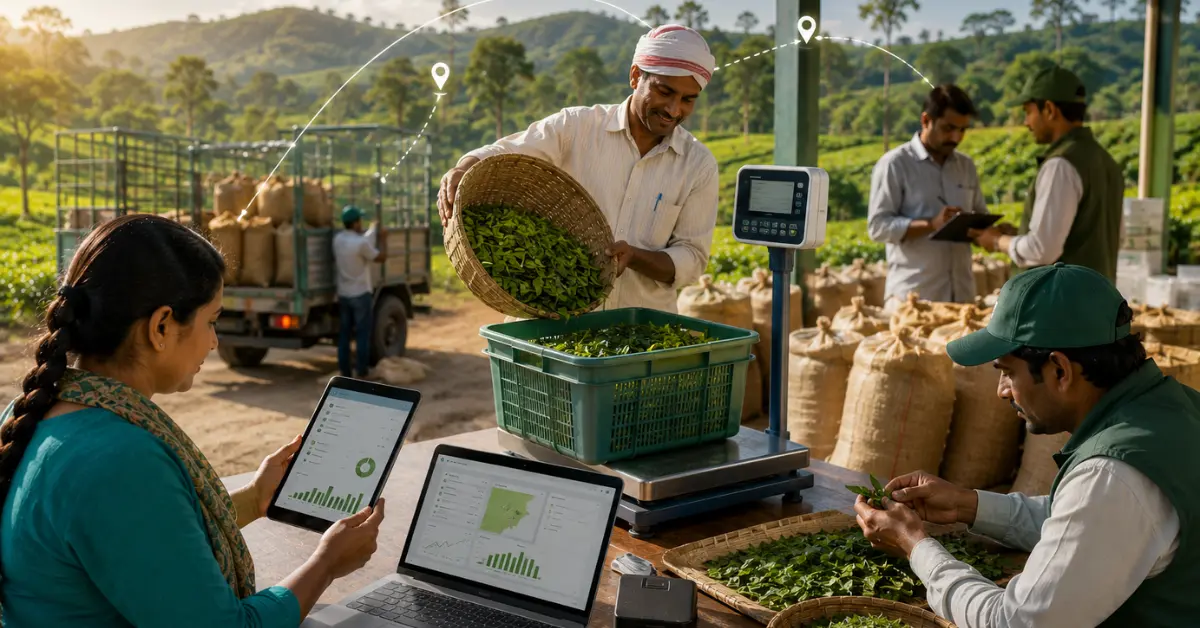
This is where a digital platform reshapes procurement in agriculture. TraceX Farm Digitization Platform with a Procurement solution captures each transaction at the point of purchase supplier identity, grade, weight, agreed price, and location on a mobile app that works offline and syncs when connectivity returns. Grade-based pricing is applied automatically, digital receipts and SMS notifications go straight to the farmer, and every purchase generates a traceable record linked to its batch and supplier.
Because the data is captured once, at source, procurement in agriculture stops being a reconciliation exercise. The same record that pays the farmer also feeds quality tracking and compliance documentation, giving teams a single source of truth from field to shipment instead of three disconnected systems stitched together before an audit.
The benefits of digital procurement in agriculture
Digitising procurement in agriculture pays back quickly. Procurement cycles speed up even in remote villages, grading and weighing disputes fall because the numbers are transparent, and farmer payments become faster and fairer which directly strengthens supplier loyalty. Finance teams get accurate procurement costs in real time instead of month-end guesswork, and sustainability teams inherit the traceability data they would otherwise spend seasons chasing.
For agribusinesses under pressure to prove responsible sourcing, well-run procurement in agriculture becomes the foundation for compliance: the origin evidence is already in the system, ready for retailers, certification schemes, or regulators, rather than rebuilt from scratch each time it is requested.
Procurement in agriculture is won at the weighbridge, not in the ERP. The teams that struggle are the ones who treat field purchasing as data entry to be cleaned up later. Capture the transaction correctly once grade, weight, price, origin and procurement, quality, payments, and compliance all run off the same record.
Procurement in agriculture: manual / generic ERP vs. a field-ready platform
How the two common operating models compare on the things that actually break in the field:
Dimension
Manual / generic ERP
Field-ready platform (TraceX)
Point of data capture
Back-office, re-keyed later
At the point of purchase
Grade-based pricing
Manual, error-prone
Applied automatically
Low / no connectivity
Fails without internet
Offline-first, syncs later
Farmer payments
Delayed, often disputed
Fast, transparent (SMS + receipt)
Traceability / origin
Reconstructed after the fact
Captured per batch and supplier
Compliance readiness
Scramble before audits
Origin evidence already in system
TraceX’s Procurement Module digitizes the entire agricultural procurement process, connecting farmers, farms, field teams, procurement teams and buyers in one platform. It enables businesses to plan and execute procurement through single-stage or two-stage workflows, capture farmer and farm details, record quantities, grades, prices and quality information at procurement, and maintain digital records of transactions and payments. The module provides visibility from farm-gate procurement to warehouse/factory, while linking procurement data with traceability records for each batch or lot. By replacing fragmented spreadsheets and manual records with structured, real-time data, TraceX helps procurement teams improve operational efficiency, transparency, farmer management, quality control and end-to-end traceability across large and complex agricultural supply chains.
See how TraceX’s Procurement Planning module captures grade, price, and origin at every purchase even offline.
How to evaluate a procurement in agriculture solution
Use this checklist when comparing platforms or upgrading how your team runs procurement in agriculture:
Does it capture procurement data at the point of purchase, not back-office re-entry?
Does it work offline in low-connectivity field and village locations?
Does it support grade-based and market-linked pricing?
Does it generate farmer receipts and payment notifications automatically?
Does it link every purchase to a batch, supplier, and origin?
Does it flex to single- and two-stage procurement models across crop types?
Does it feed traceability and compliance evidence (e.g., EUDR for covered commodities) from the same record?
Frequently Asked Questions
What is procurement in agriculture?
Procurement in agriculture is the sourcing of raw produce and farm inputs including price negotiation, quality grading, weighing, farmer payment, and record-keeping across a typically fragmented and rural supply base. Done well, it ensures fair pricing for farmers and a reliable, traceable supply for buyers.
Why is procurement in agriculture more complex than other procurement?
Because value depends on variable factors like grade and moisture, prices fluctuate constantly, suppliers are numerous and dispersed, and much of the buying happens at remote collection points with poor connectivity. Every purchase also increasingly needs a traceability record, which office procurement rarely demands.
What are the main challenges in procurement in agriculture?
The recurring ones are price volatility, inconsistent product quality, fragmented supplier networks, grading and weighing disputes, delayed farmer payments, and the difficulty of maintaining traceability and compliance across a scattered supply base.
How does technology improve procurement in agriculture?
Digital platforms capture each transaction at the point of purchase, apply grade-based pricing automatically, notify farmers of payments, and generate a traceable record for every batch. This removes manual re-entry, reduces disputes, and turns procurement data into ready-made compliance evidence.
What is grade-based pricing in agricultural procurement?
Grade-based pricing sets the price of a lot according to measured quality parameters rather than a flat rate. Applied automatically at purchase, it makes payouts fairer and more transparent for farmers and protects buyers from over-paying for lower-grade produce.
Can procurement in agriculture support EUDR or other compliance?
Yes when procurement is digital, the origin and transaction data needed for schemes and regulations is captured at source. For EUDR-covered commodities (such as coffee, cocoa, or wood), that origin evidence is already in the system; note that tea and cotton are not EUDR commodities.
How does a farm management platform help procurement in agriculture?
A platform such as TraceX captures grade, weight, price, and origin at the point of purchase, works offline, and links every transaction to its supplier and batch so procurement, payments, quality, and compliance all run from one source of truth
Start using TraceX
Transparency, Trust, & Success for your Climate Journey.
We use cookies on our website to give you the most relevant experience by remembering your preferences and repeat visits. By clicking “Accept All”, you consent to the use of ALL the cookies. However, you may visit "Cookie Settings" to provide a controlled consent.
This website uses cookies to improve your experience while you navigate through the website. Out of these, the cookies that are categorized as necessary are stored on your browser as they are essential for the working of basic functionalities of the website. We also use third-party cookies that help us analyze and understand how you use this website. These cookies will be stored in your browser only with your consent. You also have the option to opt-out of these cookies. But opting out of some of these cookies may affect your browsing experience.
Necessary cookies are absolutely essential for the website to function properly. These cookies ensure basic functionalities and security features of the website, anonymously.
Cookie
Duration
Description
cookielawinfo-checkbox-analytics
11 months
This cookie is set by GDPR Cookie Consent plugin. The cookie is used to store the user consent for the cookies in the category "Analytics".
cookielawinfo-checkbox-functional
11 months
The cookie is set by GDPR cookie consent to record the user consent for the cookies in the category "Functional".
cookielawinfo-checkbox-necessary
11 months
This cookie is set by GDPR Cookie Consent plugin. The cookies is used to store the user consent for the cookies in the category "Necessary".
cookielawinfo-checkbox-others
11 months
This cookie is set by GDPR Cookie Consent plugin. The cookie is used to store the user consent for the cookies in the category "Other.
cookielawinfo-checkbox-performance
11 months
This cookie is set by GDPR Cookie Consent plugin. The cookie is used to store the user consent for the cookies in the category "Performance".
viewed_cookie_policy
11 months
The cookie is set by the GDPR Cookie Consent plugin and is used to store whether or not user has consented to the use of cookies. It does not store any personal data.
Functional cookies help to perform certain functionalities like sharing the content of the website on social media platforms, collect feedbacks, and other third-party features.
Performance cookies are used to understand and analyze the key performance indexes of the website which helps in delivering a better user experience for the visitors.
Analytical cookies are used to understand how visitors interact with the website. These cookies help provide information on metrics the number of visitors, bounce rate, traffic source, etc.
Advertisement cookies are used to provide visitors with relevant ads and marketing campaigns. These cookies track visitors across websites and collect information to provide customized ads.
Download the 2026 Traceability Scorecard and Benchmark Your Supply Chain Across 10 Critical Capabilities.
Download our eBook
Don’t Wait for an Audit to Find Your EUDR Gaps
The 2026 Simplification Package changes how HS codes, DDS pass-through and geolocation rules apply to you. Get the free guide and 20-point readiness checklist before enforcement catches you unprepared.