Country Benchmarking in EUDR: How the 2025 Risk Tiers Decide Your Due-Diligence Workload
Published
, 10 minute read
Share this article
Quick summary: Discover how country benchmarking in EUDR risk assessment helps businesses identify high-risk regions for deforestation and implement effective compliance strategies to meet the EU Deforestation Regulation (EUDR) requirements.
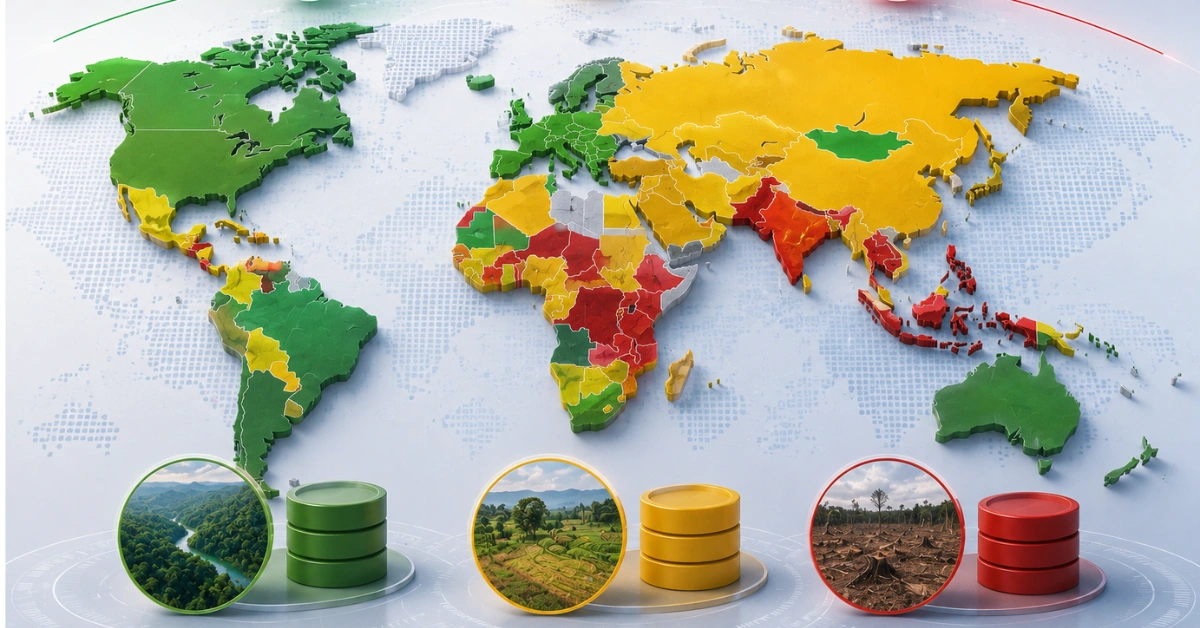
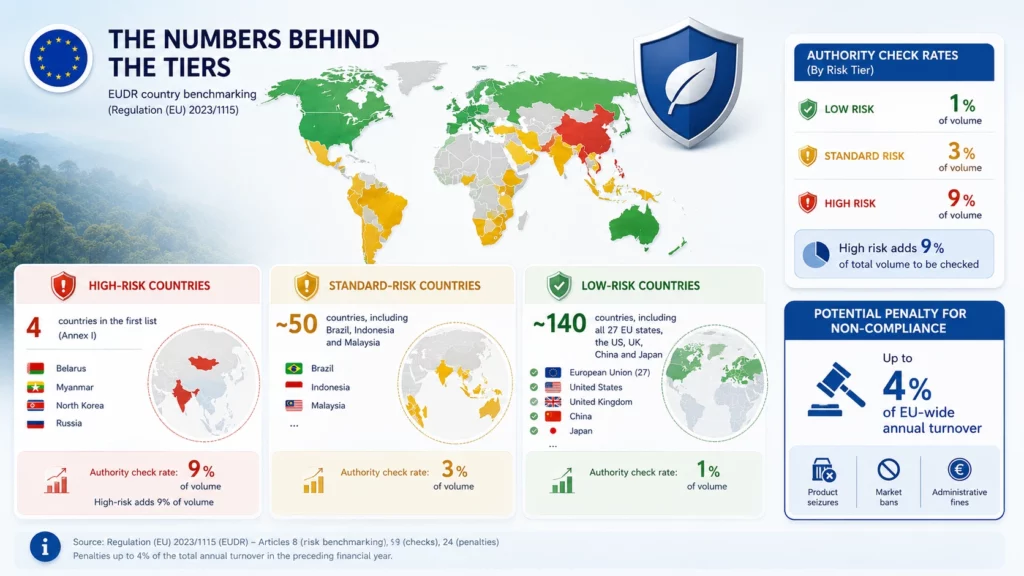
Country benchmarking in EUDR is the European Commission’s system for classifying every country of production as low, standard, or high risk for deforestation under the EU Deforestation Regulation (Regulation (EU) 2023/1115, Article 29). The tier sets how much due diligence you perform and how often authorities check your shipments: 1% of operators for low-risk origins, 3% for standard-risk, and 9% (plus 9% of product volume) for high-risk. The first official list took effect on 22 May 2025 under Commission Implementing Regulation (EU) 2025/1093, naming four high-risk countries (Belarus, Myanmar, North Korea, Russia), around 50 standard-risk countries, and roughly 140 low-risk countries. Crucially, benchmarking does not remove the core obligation: every operator must still file a Due Diligence Statement and provide plot-level geolocation, whatever the tier.
Key takeaways
Country benchmarking in EUDR places each origin country into one of three tiers low, standard, or high risk and that tier sets both your documentation burden and your audit rate.
The first list is live: published 22 May 2025 via Commission Implementing Regulation (EU) 2025/1093. Four high-risk countries, ~50 standard, ~140 low.
Tiers ≠ exemptions. Even low-risk origins require a Due Diligence Statement (DDS) and geolocation. Low risk only unlocks simplified due diligence you skip full risk assessment and mitigation, not the DDS.
Check rates scale with tier: 1% (low) / 3% (standard) / 9% + 9% of volume (high).
The list is dynamic. A first review was scheduled for 2026 on updated FAO data a country can move tiers, so classification must be monitored continuously, not checked once.
Certifications (RSPO, FSC) support risk mitigation but do not replace geolocation, the DDS, or plot-level evidence in any tier.
What Country Benchmarking in EUDR Actually Means
Country benchmarking in EUDR is the three-tier system the European Commission uses to rank each country or region within a country by its risk of producing commodities linked to deforestation and forest degradation. Introduced under Article 29 of the EU Deforestation Regulation (Regulation (EU) 2023/1115), it exists to do one practical thing: match the intensity of due diligence to the actual deforestation risk of where you source.
In plain terms: benchmarking is a filter on your supply chain. Source from a high-risk origin and you inherit intensive checks, more documentation, and higher rejection risk. Source from a low-risk origin and you qualify for simplified due diligence. But and this is the point most 2024-era explainers miss no tier removes the baseline obligation to file a Due Diligence Statement and provide plot-level geolocation.
The Three EUDR Risk Tiers, Explained
Each origin country sits in exactly one tier. The tier does three things at once it labels the origin, sets your workload, and sets your audit odds:
A label per origin — every country is benchmarked high, standard, or low risk.
A workload setting — the tier decides how much risk assessment and documentation you must perform.
An audit dial — it determines how often competent authorities check your shipments at the border.
EUDR Risk Categories at a Glance
Risk tier
Example origins (first 2025 list)
Your due-diligence obligation
Authority check rate
High risk
Belarus, Myanmar, North Korea, Russia (largely sanctions-driven)
Enhanced due diligence: full risk assessment + mitigation, granular evidence, stricter supplier checks
9% of operators + 9% of volume
Standard risk
Brazil, Indonesia, Malaysia, Côte d’Ivoire, Cameroon, DRC (and any country not otherwise listed)
Full due diligence: assess and mitigate risk; submit DDS
3% of operators
Low risk
All 27 EU states, UK, US, Canada, China, Japan, Australia, South Africa (~140 total)
Simplified due diligence: collect info + DDS; skip full risk assessment/mitigation (but still screen for circumvention/mixing)
1% of operators
Source: Commission Implementing Regulation (EU) 2025/1093, list published 22 May 2025. Standard-risk countries are not individually listed — any country not classified low or high defaults to standard risk. Classifications are dynamic; confirm the current tier on the EC Green Forum before sourcing decisions.
Why Country Benchmarking in EUDR Is Harder Than It Looks
The Pain: Static Checks Against a Moving List
The list changes. A first review was scheduled for 2026 using updated FAO-FRA data. A supplier that is standard risk today can shift, and with it your entire documentation burden. A one-time lookup goes stale.
“Low risk” gets misread as “no work.” Teams assume a low-risk origin means no obligation then discover at the border that a DDS and geolocation were still mandatory, and that they still had to screen for circumvention and mixing with unknown-origin product.
Mixed-origin sourcing multiplies tiers. A single SKU sourced from three countries can span all three tiers at once. Managing that manually spreadsheet by spreadsheet is where compliance quietly breaks.
The result: country benchmarking in EUDR becomes a source of anxiety rather than a planning tool, because the sourcing map and the risk map are maintained separately and drift apart.
How does your sourcing country impact your EUDR obligations?
Understand the EU’s country risk classifications and what they mean for your due diligence and compliance strategy.
How TraceX Turns Country Benchmarking in EUDR Into a Live Signal
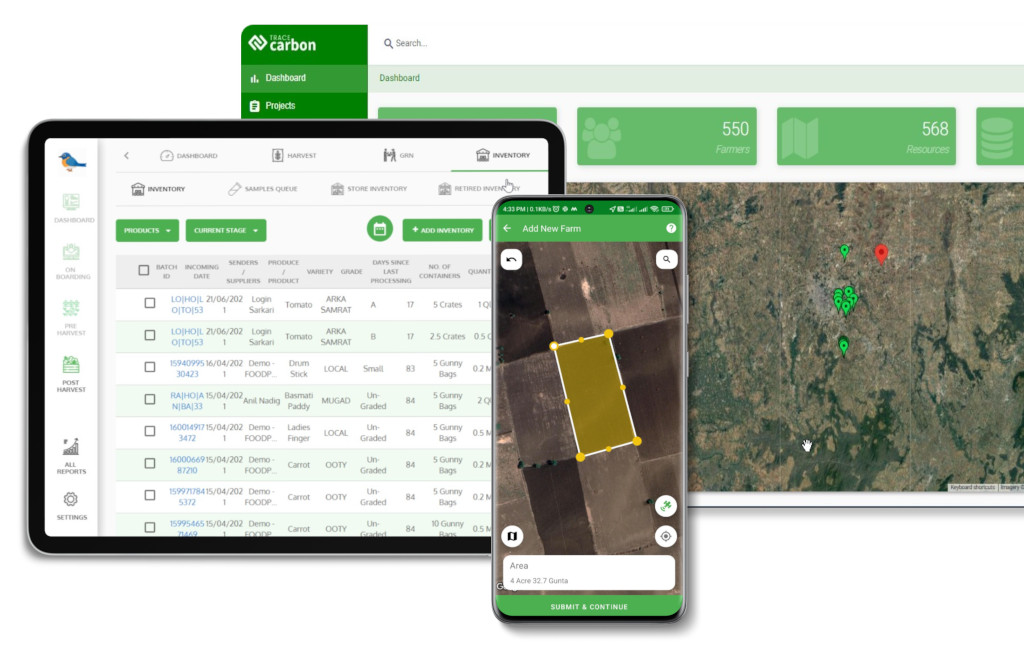
This is where automated traceability changes the equation. Rather than treating benchmarking as an annual lookup, TraceXEUDR Solutions wires the EU country tiers directly into your live supplier and plot data, so the risk map and the sourcing map are the same map.
Capability: Continuous Tier Monitoring
Every supplier origin is matched against the current EU benchmarking classification automatically.
When a country’s tier changes, affected supplier portfolios are flagged for review you react in days, not at the next audit.
Benefit: you stop maintaining a separate, decaying spreadsheet of country tiers. The classification lives next to the shipment it governs.
Capability: Tier-Aware Due Diligence Workflows
Low-risk origins route to the simplified path (collect + DDS), while standard and high-risk origins trigger the full risk-assessment and mitigation workflow.
Plot-level geolocation is captured and validated against satellite deforestation datasets for every origin, regardless of tier — because the DDS requires it regardless of tier.
Benefit: the workload scales itself to the tier, so you don’t over-document low-risk sourcing or under-document high-risk sourcing.
Capability: One-Click, Audit-Ready DDS
Geolocation, risk-assessment outcomes, and certification records are formatted and validated for EU TRACES submission.
Benefit: when a competent authority selects your shipment whether at the 1%, 3%, or 9% check rate the evidence pack is already assembled. [
Does low-risk classification exempt me from EUDR due diligence?
No. Low-risk classification under EUDR country benchmarking unlocks simplified due diligence you collect supply-chain information and still file a Due Diligence Statement, but you are not required to complete the full risk assessment and mitigation steps. You must still provide geolocation and screen for the risk of circumvention or mixing with product from standard- or high-risk origins. Certifications such as RSPO or FSC can support this risk screening but do not replace the DDS or geolocation requirement in any tier.
EUDR Certifications and Country Risk Tiers: What Actually Counts
A common assumption is that a certificate (RSPO for palm oil, FSC for wood) neutralises a standard- or high-risk classification. It does not. Certifications are risk-mitigation support evidence that strengthens a risk assessment not a substitute for geolocation, the DDS, or plot-level deforestation-free proof.
In standard- and high-risk origins, a valid RSPO or FSC certificate helps demonstrate that non-negligible risk has been assessed and mitigated but the plot geolocation and DDS are still mandatory.
In low-risk origins, certification can reinforce your circumvention/mixing screen, but the simplified path already applies.
Bottom line: benchmarking sets the workload; certification helps you satisfy it. Neither replaces traceability to the plot.
Country Benchmarking in EUDR in Practice: A Sourcing Example
Consider an importer sourcing natural rubber across Southeast Asia. Under country benchmarking in EUDR, the origin countries fall into standard risk meaning full due diligence, not the simplified path.
The lesson generalises: the tier tells you how much to prove; a live traceability layer is what lets you prove it at the check rate the tier imposes without rebuilding the evidence pack by hand each time.
Are certifications enough to demonstrate EUDR compliance?
Learn which certifications can support your due diligence and where additional evidence is still required.
Buyer’s Checklist: Evaluating a Country Benchmarking in EUDR Solution
If you’re assessing a compliance platform against country benchmarking in EUDR, run it through this checklist every unchecked box is a shipment risk:
Does it match every origin to the current EU benchmarking list automatically and re-check on updates?
Does it flag suppliers when a country’s risk tier changes?
Does it route low-risk origins to simplified due diligence while still capturing the DDS and geolocation?
Does it enforce full risk assessment and mitigation for standard- and high-risk origins?
Does it handle mixed-origin SKUs that span multiple tiers?
Does it screen low-risk sourcing for circumvention and mixing with unknown-origin product?
Does it treat RSPO/FSC as supporting evidence, not a replacement for geolocation or the DDS?
Does it produce a validated, TRACES-ready DDS package for any check rate (1% / 3% / 9%)?
See Country Benchmarking in EUDR Work on Your Own Supply Chain
Stop tracking country tiers in spreadsheets. See how TraceX matches every origin to the live EUDR benchmarking list, routes due diligence by tier, and assembles a TRACES-ready DDS — on your own suppliers.
It is the European Commission’s system, under Article 29 of Regulation (EU) 2023/1115, that classifies each country of production as low, standard, or high risk for deforestation. The tier determines how much due diligence you perform and how frequently authorities check your shipments.
When was the first EUDR benchmarking list published?
On 22 May 2025, through Commission Implementing Regulation (EU) 2025/1093, published on the Commission’s Green Forum platform. A first review was scheduled for 2026 using updated FAO forest data, so classifications can change.
Which countries are high risk under EUDR?
The first list names four: Belarus, Myanmar, North Korea, and Russia. These designations are driven largely by existing UN or EU sanctions on the relevant commodities rather than deforestation rates alone.
What check rates apply to each risk tier?
Competent authorities must check at least 1% of operators for low-risk origins, 3% for standard-risk, and 9% of operators plus 9% of product volume for high-risk origins.
Does low-risk classification remove my EUDR obligations?
No. Low risk unlocks simplified due diligence you collect information and still file a Due Diligence Statement with geolocation, but you are not required to complete full risk assessment and mitigation. You must still screen for circumvention and mixing.
Do RSPO or FSC certifications override a country’s risk tier?
No. Certifications support your risk assessment and mitigation but do not replace geolocation, the DDS, or plot-level deforestation-free evidence. They help you satisfy the workload the tier sets; they don’t remove it.
How often should I re-check country benchmarking in EUDR?
Continuously. Because the list is reviewed and revised, treat benchmarking as a live signal tied to each supplier origin rather than a one-time lookup a tier change can alter your entire documentation burden.
Start using TraceX
Transparency, Trust, & Success for your Climate Journey.
We use cookies on our website to give you the most relevant experience by remembering your preferences and repeat visits. By clicking “Accept All”, you consent to the use of ALL the cookies. However, you may visit "Cookie Settings" to provide a controlled consent.
This website uses cookies to improve your experience while you navigate through the website. Out of these, the cookies that are categorized as necessary are stored on your browser as they are essential for the working of basic functionalities of the website. We also use third-party cookies that help us analyze and understand how you use this website. These cookies will be stored in your browser only with your consent. You also have the option to opt-out of these cookies. But opting out of some of these cookies may affect your browsing experience.
Necessary cookies are absolutely essential for the website to function properly. These cookies ensure basic functionalities and security features of the website, anonymously.
Cookie
Duration
Description
cookielawinfo-checkbox-analytics
11 months
This cookie is set by GDPR Cookie Consent plugin. The cookie is used to store the user consent for the cookies in the category "Analytics".
cookielawinfo-checkbox-functional
11 months
The cookie is set by GDPR cookie consent to record the user consent for the cookies in the category "Functional".
cookielawinfo-checkbox-necessary
11 months
This cookie is set by GDPR Cookie Consent plugin. The cookies is used to store the user consent for the cookies in the category "Necessary".
cookielawinfo-checkbox-others
11 months
This cookie is set by GDPR Cookie Consent plugin. The cookie is used to store the user consent for the cookies in the category "Other.
cookielawinfo-checkbox-performance
11 months
This cookie is set by GDPR Cookie Consent plugin. The cookie is used to store the user consent for the cookies in the category "Performance".
viewed_cookie_policy
11 months
The cookie is set by the GDPR Cookie Consent plugin and is used to store whether or not user has consented to the use of cookies. It does not store any personal data.
Functional cookies help to perform certain functionalities like sharing the content of the website on social media platforms, collect feedbacks, and other third-party features.
Performance cookies are used to understand and analyze the key performance indexes of the website which helps in delivering a better user experience for the visitors.
Analytical cookies are used to understand how visitors interact with the website. These cookies help provide information on metrics the number of visitors, bounce rate, traffic source, etc.
Advertisement cookies are used to provide visitors with relevant ads and marketing campaigns. These cookies track visitors across websites and collect information to provide customized ads.
Download the 2026 Traceability Scorecard and Benchmark Your Supply Chain Across 10 Critical Capabilities.
Download our eBook
Don’t Wait for an Audit to Find Your EUDR Gaps
The 2026 Simplification Package changes how HS codes, DDS pass-through and geolocation rules apply to you. Get the free guide and 20-point readiness checklist before enforcement catches you unprepared.