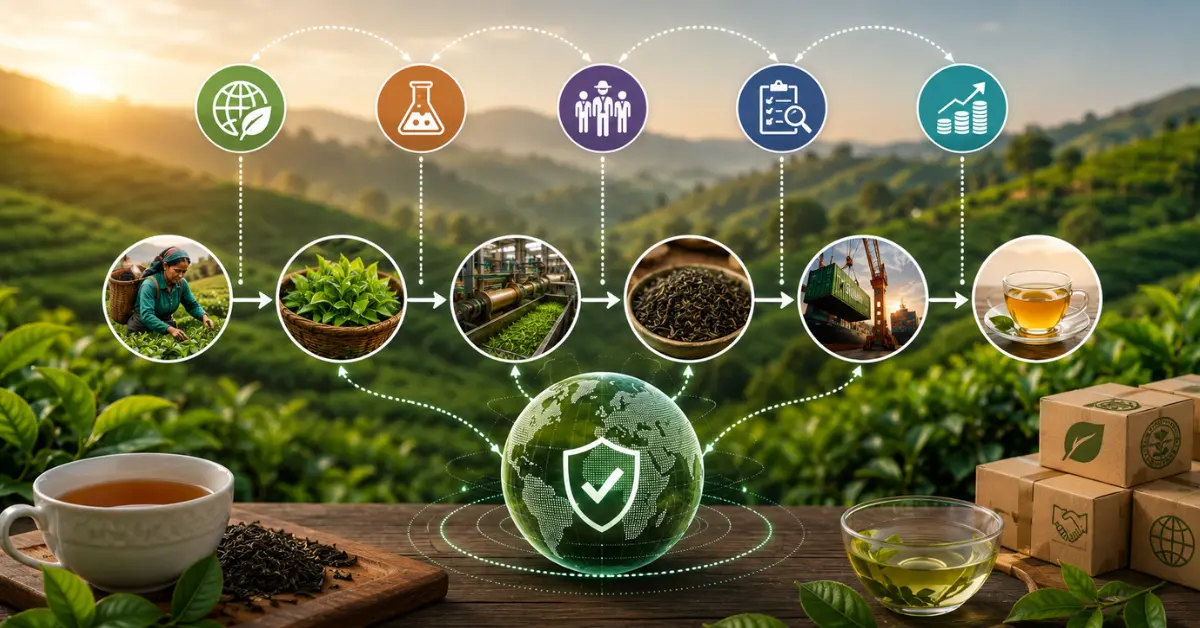
Tea Sustainability Challenges: Turning Supply Risk Into a Sourcing Advantage
Published
, 8 minute read
Share this article
Quick summary: Tea sustainability challenges climate, pesticide MRLs, labour and traceability are supply risks on your desk. See how tea buyers turn them into an advantage.
Tea sustainability challenges are the environmental, social and compliance risks that threaten a reliable, marketable supply of tea chiefly climate volatility, pesticide and EU maximum residue limit (MRL) exposure, labour and human-rights conditions, fragmented traceability, and the rising cost of certification. For a tea buyer they are not abstract industry issues; each one is a direct threat to supply continuity, EU market access, or your own ESG reporting. The common root cause is a lack of farm-level visibility and that is exactly what makes them solvable.
Key takeaways
The biggest tea sustainability challenges climate, pesticides/MRLs, labour, traceability and certification cost all land on the buyer as supply risk.
Tea is not covered by EUDR, but EU pesticide MRLs, CSDDD due diligence and CSRD reporting still shape what buyers must prove.
An MRL breach is discovered at the EU border unless you can trace it to a garden and lot before shipment.
Certifications like Rainforest Alliance and Fairtrade support sustainability but don’t give you lot-level farm data on their own.
Every tea sustainability challenge shares one root cause no visibility to the farm which is why digitising origin data turns risk into advantage.
Ready to Build an End-to-End Traceable Supply Chain?
See how TraceX helps you digitize sourcing, track products from origin to destination, and simplify regulatory compliance with complete supply chain visibility.
The Tea Sustainability Challenges That Actually Reach the Buyer
Tea sustainability challenges get written up as producer problems, but the risk flows downstream to whoever is buying, blending and selling the tea. Here are the five that show up in procurement, each with what it really costs a buyer.
Build More Sustainable Agribusiness Supply ChainsDiscover how sustainable sourcing helps agribusinesses improve traceability, strengthen supplier relationships, reduce risk, and meet growing sustainability and regulatory expectations.
Tea is unusually sensitive to temperature and rainfall, so shifting monsoons and drought translate straight into yield and quality swings. In Kenya, reporting has linked severe droughts to tea yield losses of around 30% in bad years. For a blender relying on a fixed origin profile, that is a supply-continuity and price risk and the one you feel first.
2. Pesticides and EU maximum residue limits
This is the tea sustainability challenge with the sharpest commercial edge. EU MRLs under Regulation (EC) No 396/2005 apply equally to imported tea, and as active substances are banned in the EU their limits are being lowered toward the limit of detection. A blender importing Assam or a Chinese green tea can face a border alert on a residue like acetamiprid and if you can’t trace which garden and lot it came from, you lose the whole consignment, not just the problem batch.
3. Labour conditions and human-rights due diligence
Tea is labour-intensive, with a large share of the workforce being women on estates and smallholdings. Fair wages and safe conditions are the social core of tea sustainability challenges and under the CSDDD, large buyers must now identify and address human-rights risks in their value chains, pushing those duties down to their tea suppliers. A UK brand asked by a retailer to evidence estate labour practices needs data, not assurances.
4. Fragmented traceability
Tea moves through smallholders, estates, factories, brokers and auctions before it reaches a buyer, and each hop erases origin detail. That fragmentation is what makes the other tea sustainability challenges so hard to act on: you can’t manage an MRL, labour or climate risk in a garden you can’t even identify. Traceability isn’t a nice-to-have here it’s the precondition for everything else.
Gain Complete Visibility Across the Tea Supply ChainDiscover how digital traceability helps tea producers, exporters, and brands improve transparency, strengthen supplier collaboration, and meet evolving sustainability and regulatory expectations.
Schemes such as Rainforest Alliance and Fairtrade add real value and help here, but they carry cost and, on their own, don’t hand a buyer lot-level farm data. A brand can run a fully certified line and still be unable to answer “which farms, what practices, which season” when a customer or auditor asks. Certification supports the story; it doesn’t replace the underlying evidence.
Strip these five apart and they share one root cause: no visibility to the farm. You can’t manage a residue you can’t trace, protect a livelihood you can’t see, or report on a supply base you can’t map. Treat tea sustainability challenges as a single data-visibility problem captured once at origin and each risk becomes something you can price, pre-empt and prove, rather than absorb at the border.
Tackling Tea Sustainability Challenges: Manual vs. a Connected Platform
Most tea buyers start with spreadsheets, broker assurances and certificate PDFs. That works until a border alert or an audit. Here’s how the manual approach compares with a connected traceability platform across the same risks.
How to Evaluate a Solution for Tea Sustainability Challenges
If you’re comparing tools to get on top of tea sustainability challenges, score each option against this buyer checklist before you book a demo:
Does it capture garden- and lot-level origin, including from smallholders and estates?
Can it flag MRL and pesticide risk before shipment, not after a border alert?
Does it hold labour and certification evidence as living records against each source?
Will the same data feed CSDDD due diligence and CSRD reporting without a rebuild?
How quickly can you trace a problem lot back to its garden — minutes or weeks?
How TraceX Helps Buyers Meet Tea Sustainability Challenges
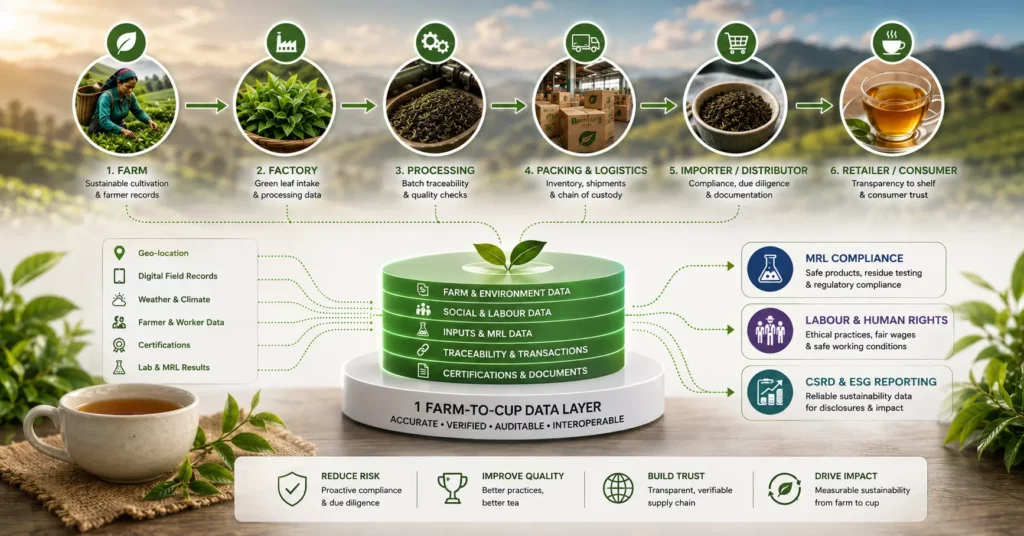
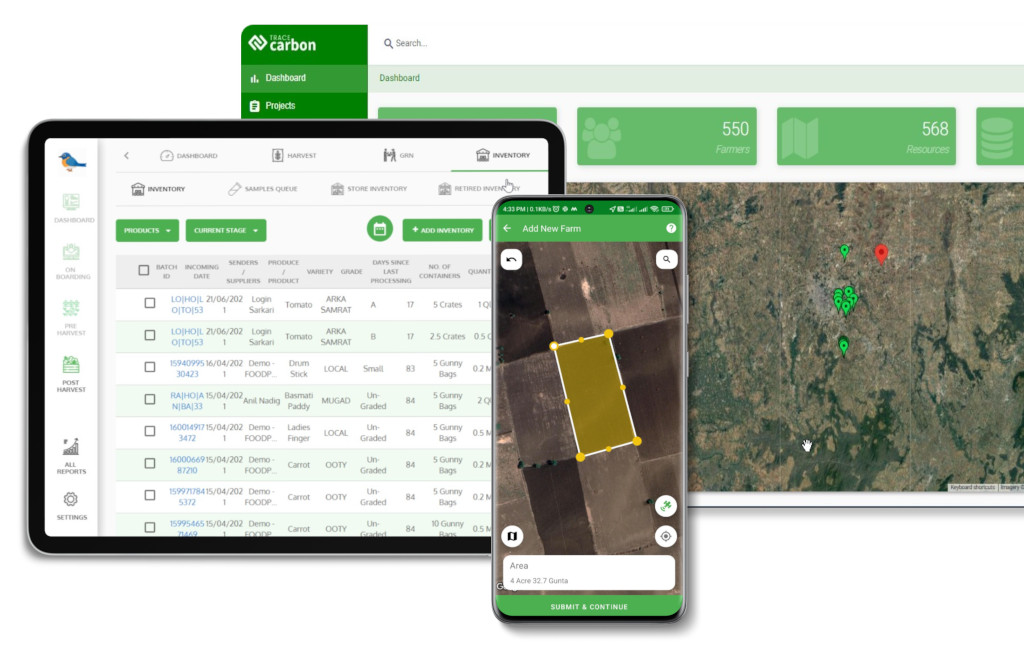
TraceX gives tea buyers and sustainability teams one platform to capture origin data, manage supplier and certification evidence, and turn the tea sustainability challenges above into decisions they can defend. Its blockchain-backed traceability records each batch’s journey from garden to cup, so origin, farming practices and certifications are verifiable rather than assumed. Mobile data capture reaches smallholders and estates, closing the visibility gap that drives MRL, labour and climate risk. Because it sits on one data layer, the same records extend to CSDDD due diligence and CSRD reporting so buyers meet compliance and continuity from a single source of truth.
Turn tea sustainability challenges into a sourcing advantage.
See how TraceX gives tea buyers farm-to-cup visibility to pre-empt MRL, labour and climate risk and report with confidence.
The main tea sustainability challenges are climate volatility and yield loss, pesticide use and EU MRL exposure, labour and human-rights conditions, fragmented traceability from farm to cup, and the cost and credibility of certification all of which reach the buyer as supply, market-access or reporting risk.
Does EUDR apply to tea?
No. Tea is not one of the seven EUDR commodities (cattle, cocoa, coffee, oil palm, rubber, soya and wood). Tea buyers are instead shaped by EU pesticide MRLs, CSDDD human-rights due diligence and CSRD reporting, plus voluntary deforestation-free commitments.
Why are EU MRLs such a big tea sustainability challenge?
EU maximum residue limits under Regulation (EC) No 396/2005 apply to all tea sold in the EU, imported or not, and are tightening as substances are banned. A single residue breach can trigger a border rejection of an entire consignment, which is why traceability to the garden matters.
How does climate change affect tea sustainability?
Tea is highly sensitive to temperature and rainfall, so drought and erratic monsoons cut yields and alter quality. Reporting has linked severe drought in Kenya to yield losses of roughly 30% in bad years, creating direct supply-continuity and price risk for buyers.
Do Rainforest Alliance or Fairtrade certifications solve these challenges?
They help, but they don’t replace lot-level farm data. Certification adds assurance and market value, yet a buyer can be fully certified and still unable to trace a specific garden, practice or season so certification supports, rather than substitutes for, traceability.
What data do buyers need to manage tea sustainability challenges?
At minimum: garden- and lot-level origin, pesticide and MRL status, labour and certification evidence per source, and a traceable chain of custody from farm to cup all retrievable quickly enough to act before a shipment or an audit.
How do I start improving tea sustainability in my supply chain?
Map your highest-risk origins first, digitise origin and supplier data in one place, and choose a platform that flags MRL and labour risk early while remaining reusable for CSDDD and CSRD reporting.
Start using TraceX
Transparency, Trust, & Success for your Climate Journey.
We use cookies on our website to give you the most relevant experience by remembering your preferences and repeat visits. By clicking “Accept All”, you consent to the use of ALL the cookies. However, you may visit "Cookie Settings" to provide a controlled consent.
This website uses cookies to improve your experience while you navigate through the website. Out of these, the cookies that are categorized as necessary are stored on your browser as they are essential for the working of basic functionalities of the website. We also use third-party cookies that help us analyze and understand how you use this website. These cookies will be stored in your browser only with your consent. You also have the option to opt-out of these cookies. But opting out of some of these cookies may affect your browsing experience.
Necessary cookies are absolutely essential for the website to function properly. These cookies ensure basic functionalities and security features of the website, anonymously.
Cookie
Duration
Description
cookielawinfo-checkbox-analytics
11 months
This cookie is set by GDPR Cookie Consent plugin. The cookie is used to store the user consent for the cookies in the category "Analytics".
cookielawinfo-checkbox-functional
11 months
The cookie is set by GDPR cookie consent to record the user consent for the cookies in the category "Functional".
cookielawinfo-checkbox-necessary
11 months
This cookie is set by GDPR Cookie Consent plugin. The cookies is used to store the user consent for the cookies in the category "Necessary".
cookielawinfo-checkbox-others
11 months
This cookie is set by GDPR Cookie Consent plugin. The cookie is used to store the user consent for the cookies in the category "Other.
cookielawinfo-checkbox-performance
11 months
This cookie is set by GDPR Cookie Consent plugin. The cookie is used to store the user consent for the cookies in the category "Performance".
viewed_cookie_policy
11 months
The cookie is set by the GDPR Cookie Consent plugin and is used to store whether or not user has consented to the use of cookies. It does not store any personal data.
Functional cookies help to perform certain functionalities like sharing the content of the website on social media platforms, collect feedbacks, and other third-party features.
Performance cookies are used to understand and analyze the key performance indexes of the website which helps in delivering a better user experience for the visitors.
Analytical cookies are used to understand how visitors interact with the website. These cookies help provide information on metrics the number of visitors, bounce rate, traffic source, etc.
Advertisement cookies are used to provide visitors with relevant ads and marketing campaigns. These cookies track visitors across websites and collect information to provide customized ads.
Download the 2026 Traceability Scorecard and Benchmark Your Supply Chain Across 10 Critical Capabilities.
Download our eBook
Don’t Wait for an Audit to Find Your EUDR Gaps
The 2026 Simplification Package changes how HS codes, DDS pass-through and geolocation rules apply to you. Get the free guide and 20-point readiness checklist before enforcement catches you unprepared.