Farm Digitization in Philippines: A Buyer’s Guide for Agribusinesses
Published
, 7 minute read
Share this article
Quick summary: Farm digitization in Philippines helps agribusinesses cut post-harvest losses, prove sustainability, and reach export markets. See how to evaluate and adopt it.
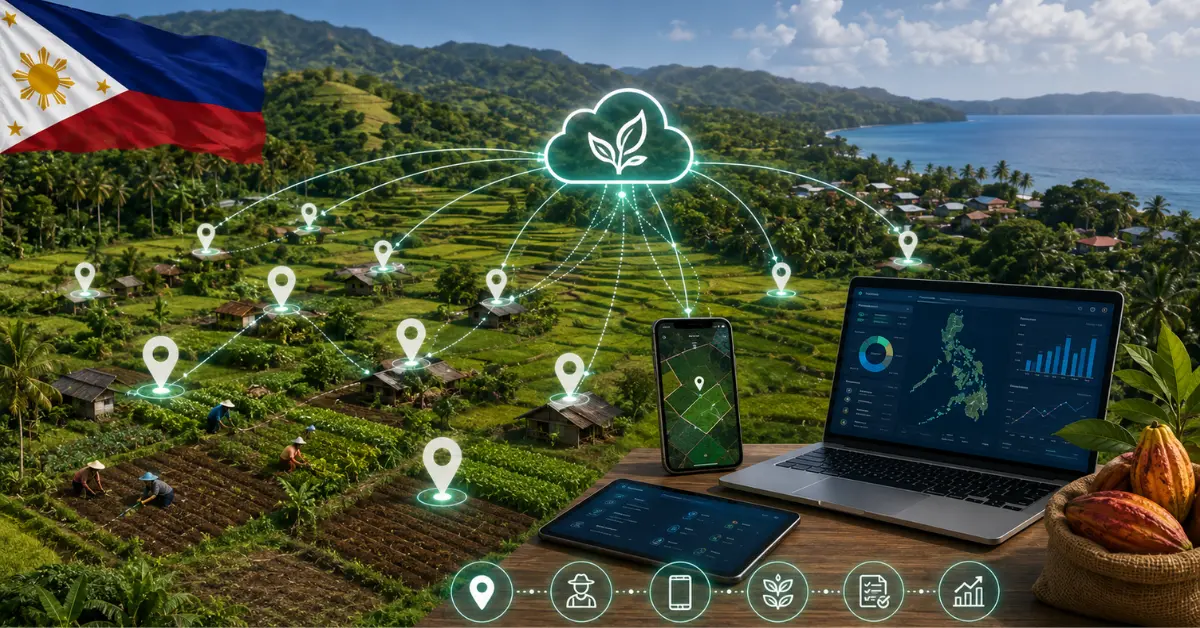
Farm digitization in Philippines is the shift from paper records and spreadsheets to a connected digital platform that captures farm, crop, and supply-chain data in real time. For agribusinesses sourcing from smallholders, it replaces guesswork with plot-level data geo-tagged farms, digital crop records, input usage, and harvest declarations so you can cut post-harvest losses, prove sustainability to buyers, and open export markets that demand traceability.
Key takeaways
Filipino agriculture faces land fragmentation, weak post-harvest infrastructure, climate volatility, and limited market access all data problems a digital platform can address.
Post-harvest losses among major Philippine commodities run 10–50%; better visibility directly protects income.
Farm digitization means geo-tagged farmer records, real-time crop and input data, weather-based risk alerts, and farm-to-buyer traceability in one system.
Buyers increasingly require verifiable, plot-level sustainability data digitization is how you supply it and command premium prices.
The right platform is mobile-first, works offline in rural areas, and is simple enough for field teams and farmers to actually use.
TraceX helps agribusinesses build connected digital farm and traceability workflows, giving teams greater visibility from the field to the supply chain.
Ready to explore farm digitization for your business in the Philippines?
To see how the platform can fit your operations and help you move from fragmented farm data to a connected digital workflow.
What farm digitization in Philippines actually means
Farm digitization in Philippines means moving farm operations off paper and onto a connected digital platform online tools that capture, store, and analyse data across cultivation, resources, and market access. In plain terms, it replaces scattered notebooks, WhatsApp messages, and spreadsheets with a single source of truth: geo-tagged farms, digital crop cycles, input records, and harvest data that anyone in your team can see in real time.
For an agribusiness or cooperative sourcing from many small, fragmented plots, that shift is the difference between reacting late and deciding early. Instead of chasing field reports at the end of a season, you get a live, structured view of your entire supplier network which is exactly what farm digitization in Philippines is built to deliver.
Why farm digitization in Philippines matters now
Philippine agriculture is a pillar of the economy, yet it carries deep structural challenges and each one is, underneath, a data problem. Based on 2021 Philippine Statistics Authority figures, poverty incidence among farmers and fishers sat near 30%, roughly double the national average of 18.1%. Farm digitization in Philippines does not fix poverty on its own, but it attacks the operational causes of lost income.
Post-harvest losses. Losses across major commodities range from 10–50% because of weak processing and storage visibility. Digital records flag spoilage risk and improve harvest planning before produce is lost.
Climate volatility. Unpredictable weather causes crop losses. Weather-linked alerts let farmers adjust planting, irrigation, and harvest schedules ahead of extreme events.
Limited market access. A concentrated market favours large buyers. Verifiable farm data connects smallholders directly to buyers who pay for traceable, sustainable produce.
Put together, these pressures explain why farm digitization in Philippines has moved from a nice-to-have to a competitive necessity for any organisation that sources at scale.
Want to understand how regenerative farming can help build more resilient and sustainable agriculture in the Philippines?
What farm digitization in Philippines looks like in practice
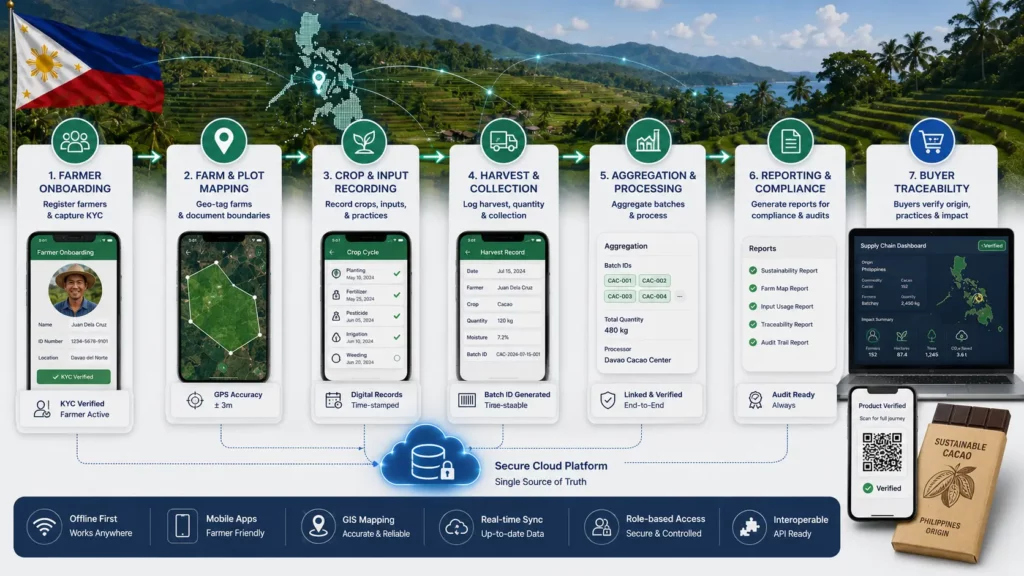
A capable platform for farm digitization in Philippines pulls several functions into one workflow rather than leaving them in separate apps:
Digital farmer and plot records. Onboard farmers, geo-tag their land, and maintain a centralised, mappable database of every plot you source from.
Precision data and crop monitoring. Capture soil, input, and crop-health data so decisions on water, fertiliser, and pest control are driven by field conditions, not habit.
Together, these functions are what separate real farm digitization in Philippines from a single-purpose farm app the data flows into one place instead of a dozen.
Weather and risk alerts. Feed forecasts into planning to reduce weather-related crop loss.
Farm-to-buyer traceability. Track crop cycles, input usage, and harvest declarations end to end, so you can prove origin and quality to buyers.
Example scenario. A cooperative aggregating rice and coffee from hundreds of smallholders onboards each farmer once, geo-tags every plot, and logs crop cycles through a mobile app that works offline. At harvest, declarations roll up automatically into a buyer-ready record no end-of-season spreadsheet scramble. When an EU or export buyer asks for plot-level sustainability evidence, the cooperative exports it in minutes instead of weeks. That is farm digitization in Philippines turning fragmented paperwork into a saleable asset.
Want to understand how the Philippines can build a more sustainable and resilient rice sector?
Signs your operation is ready for farm digitization in Philippines
Farm digitization in Philippines pays off fastest when these signals are present use them to judge your own readiness before you evaluate vendors:
You source from many smallholders and cannot see plot-level data in one place.
Buyers or export markets are starting to ask for traceability or sustainability evidence you cannot yet produce.
Post-harvest losses or side-selling are eroding margins you cannot fully explain.
Your team rebuilds the same reports by hand every season from field notes and spreadsheets.
Adoption is not frictionless rural connectivity, digital literacy, cost, and tool interoperability are real barriers. The platforms that succeed are mobile-first, offline-capable, genuinely easy for field staff and farmers to use, and able to integrate with the systems you already run. Prioritise those traits over feature count. Weigh the barriers honestly, because farm digitization in Philippines only returns value when field teams and farmers use the tool day to day.
We see farm digitization in Philippines as first-mile data infrastructure, not just an app. The TraceX Farm Management platform digitises farm operations onboarding farmers, geo-tagging plots, and tracking crop cycles and connects that first-mile data to traceability, compliance, and buyer reporting. The goal is simple: give agribusinesses one audit-ready view of their supplier network so field teams and farmers can actually use it, and so the data you capture becomes evidence you can sell on. Certifications and buyer scorecards support this, but they do not replace your own plot-level farm records.
Farm digitization in Philippines: manual approach vs the TraceX platform
Where the two approaches diverge on the work that actually consumes field and back-office time:
Task
Manual (paper + spreadsheets)
TraceX platform
Farmer & plot records
Scattered notebooks, no geo-tagging
Centralised, geo-tagged database
Crop & input data
Logged late, often estimated
Real-time, field-level capture
Post-harvest visibility
Losses spotted after the fact
Early risk flags on spoilage
Buyer traceability
Rebuilt by hand per request
Exported farm-to-buyer on demand
Sustainability evidence
Hard to prove, hard to defend
Audit-ready, plot-level records
Talk to TraceX to map your first-mile data gaps
See how farm digitization in Philippines can cut losses, prove sustainability, and open new markets for your supplier network.
Farm digitization in Philippines: buyer’s evaluation checklist
Score any platform against these before you commit:
Mobile-first and offline-capable for low-connectivity rural areas.
Farmer onboarding with geo-tagging and plot-level mapping.
Real-time crop, input, and harvest data capture.
Weather and risk alerts built into planning.
Farm-to-buyer traceability and export-ready reporting.
Simple enough for field staff and farmers to adopt without heavy training.
Integrates with your existing ERP, procurement, and reporting systems.
Local-language support and on-the-ground onboarding help.
frequently asked questions
What is farm digitization in Philippines?
It is the move from paper and spreadsheets to a connected digital platform that captures farm, crop, and supply-chain data in real time geo-tagged farms, digital crop records, input tracking, and harvest data in one system.
Who benefits most from farm digitization?
Agribusinesses, cooperatives, and food brands that source from many smallholders and need plot-level visibility, traceability, and sustainability evidence to serve demanding buyers and export markets.
Does farm digitization work in areas with poor internet?
The best platforms are mobile-first and offline-capable, syncing data when a connection is available essential for rural Philippine conditions.
How does digitization reduce post-harvest losses?
Real-time crop and harvest data improves planning and flags spoilage risk early, so produce is moved, stored, or sold before it is lost.
Can farm digitization help with export and buyer compliance?
Yes. Plot-level, traceable records let you prove origin, quality, and sustainability on demand increasingly a condition of access to premium and export markets.
What are the main adoption barriers?
Rural connectivity, digital literacy, cost, and interoperability between tools. Choosing an easy-to-use, offline-ready, integrable platform reduces all four.
How is farm digitization different from farm management software?
Farm management software is one part of it. Full farm digitization connects those records to traceability, compliance, and buyer reporting, turning field data into a business asset rather than a filing task.
Start using TraceX
Transparency, Trust, & Success for your Climate Journey.
We use cookies on our website to give you the most relevant experience by remembering your preferences and repeat visits. By clicking “Accept All”, you consent to the use of ALL the cookies. However, you may visit "Cookie Settings" to provide a controlled consent.
This website uses cookies to improve your experience while you navigate through the website. Out of these, the cookies that are categorized as necessary are stored on your browser as they are essential for the working of basic functionalities of the website. We also use third-party cookies that help us analyze and understand how you use this website. These cookies will be stored in your browser only with your consent. You also have the option to opt-out of these cookies. But opting out of some of these cookies may affect your browsing experience.
Necessary cookies are absolutely essential for the website to function properly. These cookies ensure basic functionalities and security features of the website, anonymously.
Cookie
Duration
Description
cookielawinfo-checkbox-analytics
11 months
This cookie is set by GDPR Cookie Consent plugin. The cookie is used to store the user consent for the cookies in the category "Analytics".
cookielawinfo-checkbox-functional
11 months
The cookie is set by GDPR cookie consent to record the user consent for the cookies in the category "Functional".
cookielawinfo-checkbox-necessary
11 months
This cookie is set by GDPR Cookie Consent plugin. The cookies is used to store the user consent for the cookies in the category "Necessary".
cookielawinfo-checkbox-others
11 months
This cookie is set by GDPR Cookie Consent plugin. The cookie is used to store the user consent for the cookies in the category "Other.
cookielawinfo-checkbox-performance
11 months
This cookie is set by GDPR Cookie Consent plugin. The cookie is used to store the user consent for the cookies in the category "Performance".
viewed_cookie_policy
11 months
The cookie is set by the GDPR Cookie Consent plugin and is used to store whether or not user has consented to the use of cookies. It does not store any personal data.
Functional cookies help to perform certain functionalities like sharing the content of the website on social media platforms, collect feedbacks, and other third-party features.
Performance cookies are used to understand and analyze the key performance indexes of the website which helps in delivering a better user experience for the visitors.
Analytical cookies are used to understand how visitors interact with the website. These cookies help provide information on metrics the number of visitors, bounce rate, traffic source, etc.
Advertisement cookies are used to provide visitors with relevant ads and marketing campaigns. These cookies track visitors across websites and collect information to provide customized ads.
Download the 2026 Traceability Scorecard and Benchmark Your Supply Chain Across 10 Critical Capabilities.
Download our eBook
Don’t Wait for an Audit to Find Your EUDR Gaps
The 2026 Simplification Package changes how HS codes, DDS pass-through and geolocation rules apply to you. Get the free guide and 20-point readiness checklist before enforcement catches you unprepared.