Quick summary: Embark on a journey through the lush landscapes of agroforestry in the coffee value chain. Uncover how this sustainable farming practice harmonizes with nature, fosters resilience, and positively impacts coffee yields. Explore the symbiotic relationship between trees and coffee plants, promoting biodiversity and mitigating climate change effects. Delve into the blog for insights into agroforestry's role in crafting a greener and more sustainable coffee industry.
Agroforestry in coffee value chain is the practice of growing coffee alongside integrated trees and shrubs shade canopy, timber, and fruit species rather than in open monoculture. It buffers coffee against climate extremes, improves soil and biodiversity, sequesters carbon, and adds farmer income. But because coffee is an EUDR commodity, agroforestry carries a hidden data catch: the tree canopy can obscure plot boundaries from satellite mapping, so its triple payoff climate resilience, carbon revenue, and EUDR-provable sourcing only materialises when each plot is geolocated and monitored.
Agroforestry in coffee value chain has usually been sold as a feel-good sustainability story: plant some shade trees, help the birds, tell a nicer origin story. That framing badly undersells it and misses the catch. For coffee, agroforestry is closer to an insurance policy against an existential threat, and, at the same time, it quietly changes what a coffee business has to prove to a satellite. Both things are true, and both are business-critical in 2026.
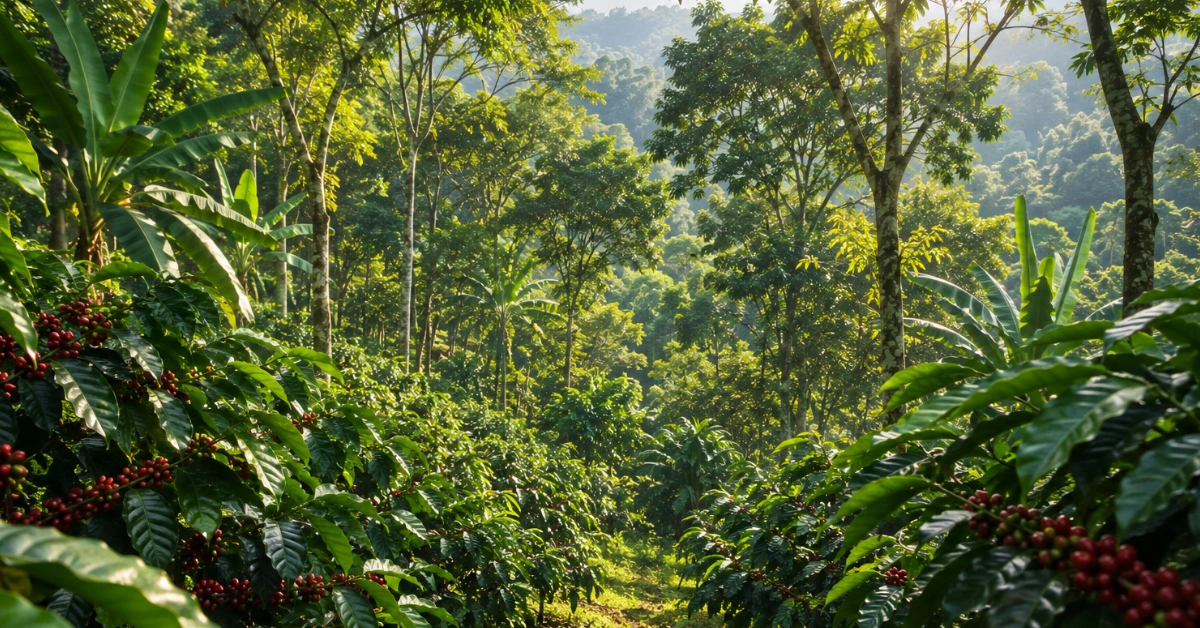
In plain terms, agroforestry in coffee value chain means cultivating coffee within a deliberately designed system of trees and shrubs rather than as an exposed monocrop. The trees deliver shade, microclimate, biodiversity, and income. This guide covers those benefits then turns to the part the usual coverage skips: what the trees demand back in data.
Key takeaways
Agroforestry in coffee value chain integrates shade and companion trees to build climate resilience, biodiversity, soil health, and farmer income.
It is coffee’s insurance against climate-driven yield collapse a survival strategy, not just a sustainability one.
The catch: tree canopy can complicate the plot-level geolocation and polygon mapping EUDR requires for coffee.
The triple payoff resilience, carbon credits, and EUDR proof only pays when every agroforestry plot is mapped and monitored.
Building resilient coffee landscapes requires more than planting trees it demands farm-level visibility, traceability, and measurable sustainability outcomes.
Why Agroforestry in Coffee Value Chain Is Climate Insurance
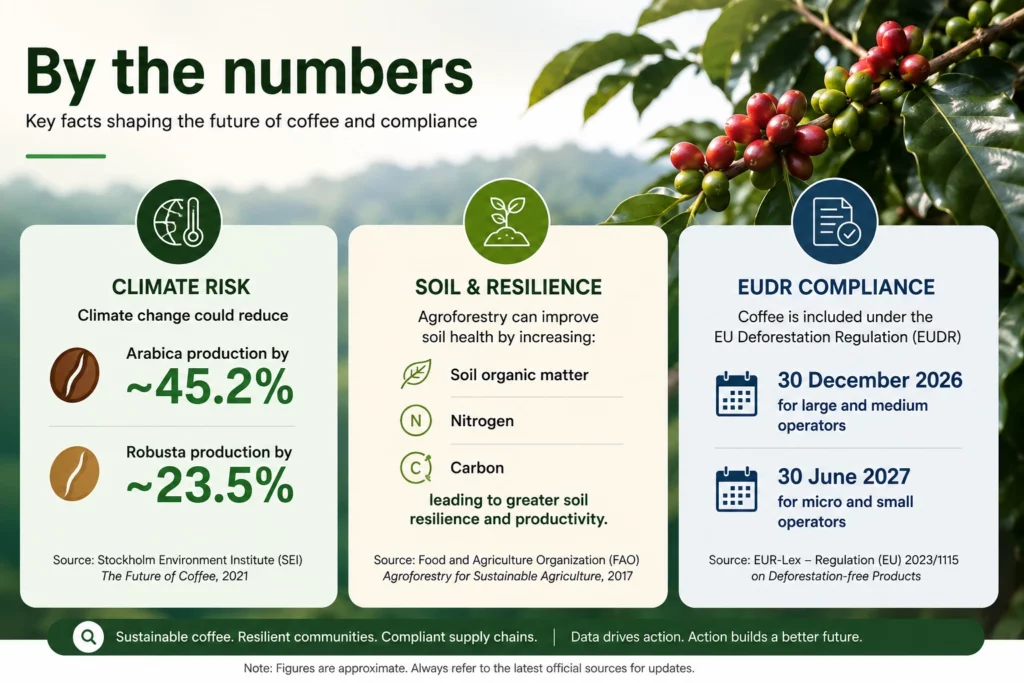
Coffee is acutely climate-sensitive, and the outlook is stark. An analysis by the Stockholm Environment Institute suggests climate change could cut global Arabica production by around 45.2% and Robusta by 23.5%. Against that, agroforestry is not decoration it is defence. Shade trees moderate temperature and humidity, protect delicate coffee plants from heat and erratic rain, improve water retention, and per FAO raise soil organic matter, nitrogen, and carbon, increasing the resilience of the whole system. Diverse tree species add pest control, pollination, and supplementary income from timber or fruit. For a grower facing yield collapse, agroforestry in coffee value chain is survival economics, not decoration.
The Hidden Catch of Agroforestry in Coffee Value Chain: The Canopy Problem
Here is the reframe no one puts on the label. Coffee is one of the seven EUDR commodities, so from 30 December 2026 (large and medium operators; 30 June 2027 for micro and small) coffee sold into the EU must carry plot-level geolocation and a filed due diligence statement proving it is deforestation-free. The awkward truth is that a dense agroforestry canopy the very thing making the coffee sustainable can make a plot harder to delineate by satellite. Tree-integrated systems can read to a monitoring algorithm as forest, or as forest change, blurring the polygon boundary EUDR wants crisp.
So agroforestry in coffee value chain sits squarely on a paradox: it is simultaneously the best answer to coffee’s climate risk and a complication for its deforestation-free proof. The resolution is not fewer trees it is better data. Certifications such as Rainforest Alliance help with sustainability, but the same rule holds: they do not replace EUDR geolocation, plot-level evidence, or a DDS.
The Triple Payoff of Agroforestry in Coffee Value Chain and Its Data Price
Mapped and monitored, agroforestry pays a coffee business three ways at once. Each return, though, has a data prerequisite:
Payoff
What the trees deliver
The data it requires
Climate resilience
Shade, moisture, stable yield
Plot records + practice tracking
Carbon revenue
Sequestration → credits
Tree geolocation + growth (dMRV)
EUDR-provable sourcing
Deforestation-free origin
Polygon geolocation + DDS
Premium & trust
Bean-to-cup story
Traceable plot-level provenance
Barriers to Agroforestry in Coffee Value Chain 2014 and How to Clear Them
Adoption still lags for practical reasons: the payoff is long-term while costs are upfront, farmers need training, and technical support is thin. The proven levers are farmer education that highlights long-term gains, financial incentives or subsidies for adoption, community engagement, and visible case studies. Increasingly, a fifth lever matters most giving farmers the digital tools that make agroforestry in coffee value chain provable, letting them monitor trees and turn their agroforestry into a bankable, provable asset.
How TraceX Makes Agroforestry in Coffee Value Chain Pay
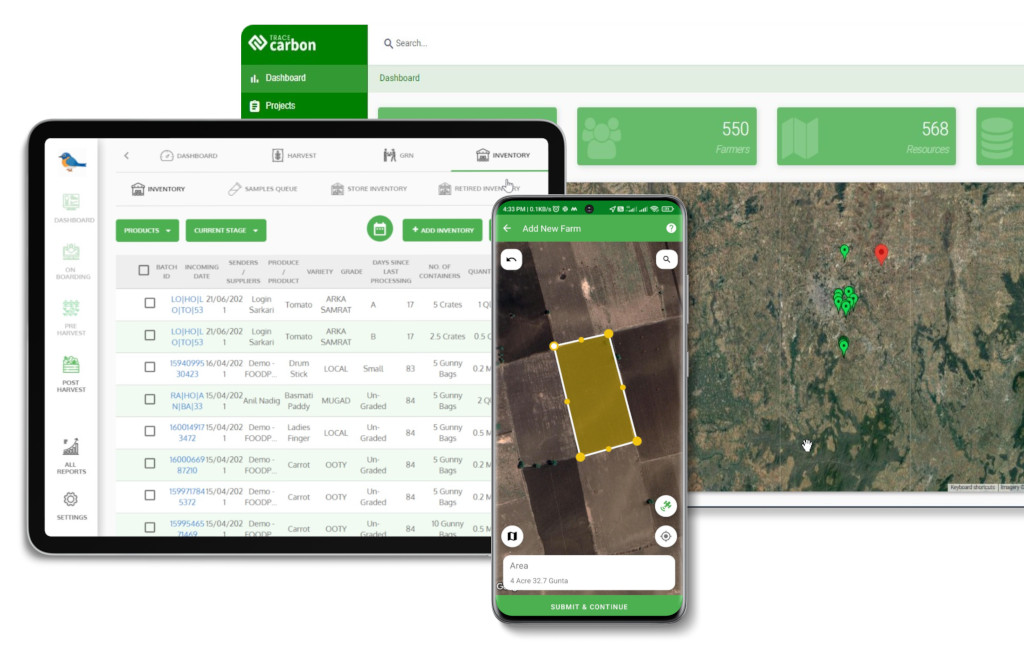
The pain is now specific: agroforestry’s returns are locked behind data the canopy makes harder to capture. The capability that answers it pairs an EUDR compliance platform with agroforestry dMRV: precise polygon geolocation that delineates coffee plots even under canopy, satellite deforestation checks against the 2020 cut-off, tree-level monitoring for carbon sequestration, and auto-generated due diligence statements. The benefit is the full triple payoff realised resilient supply, carbon credits, and EUDR-proof sourcing from one plot-level record.
Discover How Climate-Resilient Coffee Farming Is Transforming India’s Coffee Landscape
See how a leading global commodity company partnered with TraceX to build a climate-resilient coffee production landscape across Karnataka and Kerala through sustainable farming practices, digital traceability, and farmer engagement.
This is also where transparency becomes a brand asset: plot-level data powers a credible bean-to-cup story that sustainable coffee buyers and regulators both accept.
Make your shade trees pay
See how TraceX maps agroforestry coffee under canopy turning trees into carbon credits and EUDR-proof sourcing from one plot record.
Buyer’s Checklist: Proving Agroforestry in Your Coffee Value Chain
If you source or grow shade-grown coffee, confirm you can:
Delineate plot polygons accurately even under dense tree canopy
Prove no deforestation on that land after 31 December 2020
Monitor tree growth for carbon-credit measurement (dMRV)
Generate and file a due diligence statement for EUDR
Track agroforestry practices at farmer level for resilience claims
Treat certifications as a complement to not a substitute for geolocation and DDS
Frequently Asked Questions (FAQ’s)
What is agroforestry in coffee value chain?
Growing coffee within a system of integrated trees and shrubs shade, timber, and fruit species rather than as an open monocrop, to build resilience, biodiversity, soil health, and farmer income.
How does agroforestry help coffee cope with climate change?
Shade trees moderate temperature and humidity, protect plants from heat and erratic rainfall, improve water and soil retention, and sequester carbon buffering coffee against the yield losses climate change is projected to cause.
Does agroforestry make EUDR compliance harder for coffee?
It can. A dense canopy can blur plot boundaries for satellite mapping, so agroforestry coffee needs precise polygon geolocation and monitoring to produce the deforestation-free proof and due diligence statement EUDR requires.
Can agroforestry coffee earn carbon credits?
Yes tree sequestration can generate agroforestry carbon credits, but only with tree-level geolocation and digital MRV to measure and verify the carbon.
We use cookies on our website to give you the most relevant experience by remembering your preferences and repeat visits. By clicking “Accept All”, you consent to the use of ALL the cookies. However, you may visit "Cookie Settings" to provide a controlled consent.
This website uses cookies to improve your experience while you navigate through the website. Out of these, the cookies that are categorized as necessary are stored on your browser as they are essential for the working of basic functionalities of the website. We also use third-party cookies that help us analyze and understand how you use this website. These cookies will be stored in your browser only with your consent. You also have the option to opt-out of these cookies. But opting out of some of these cookies may affect your browsing experience.
Necessary cookies are absolutely essential for the website to function properly. These cookies ensure basic functionalities and security features of the website, anonymously.
Cookie
Duration
Description
cookielawinfo-checkbox-analytics
11 months
This cookie is set by GDPR Cookie Consent plugin. The cookie is used to store the user consent for the cookies in the category "Analytics".
cookielawinfo-checkbox-functional
11 months
The cookie is set by GDPR cookie consent to record the user consent for the cookies in the category "Functional".
cookielawinfo-checkbox-necessary
11 months
This cookie is set by GDPR Cookie Consent plugin. The cookies is used to store the user consent for the cookies in the category "Necessary".
cookielawinfo-checkbox-others
11 months
This cookie is set by GDPR Cookie Consent plugin. The cookie is used to store the user consent for the cookies in the category "Other.
cookielawinfo-checkbox-performance
11 months
This cookie is set by GDPR Cookie Consent plugin. The cookie is used to store the user consent for the cookies in the category "Performance".
viewed_cookie_policy
11 months
The cookie is set by the GDPR Cookie Consent plugin and is used to store whether or not user has consented to the use of cookies. It does not store any personal data.
Functional cookies help to perform certain functionalities like sharing the content of the website on social media platforms, collect feedbacks, and other third-party features.
Performance cookies are used to understand and analyze the key performance indexes of the website which helps in delivering a better user experience for the visitors.
Analytical cookies are used to understand how visitors interact with the website. These cookies help provide information on metrics the number of visitors, bounce rate, traffic source, etc.
Advertisement cookies are used to provide visitors with relevant ads and marketing campaigns. These cookies track visitors across websites and collect information to provide customized ads.
Download the 2026 Traceability Scorecard and Benchmark Your Supply Chain Across 10 Critical Capabilities.
Download our eBook
Don’t Wait for an Audit to Find Your EUDR Gaps
The 2026 Simplification Package changes how HS codes, DDS pass-through and geolocation rules apply to you. Get the free guide and 20-point readiness checklist before enforcement catches you unprepared.