SDGs in Agriculture: The 7 Questions Every Agri Leader Is Asking
Published
, 8 minute read
Share this article
Quick summary: SDGs in agriculture explained — which goals matter, why they’re hard to meet, and how farms prove real progress. The 7 questions leaders ask, answered.
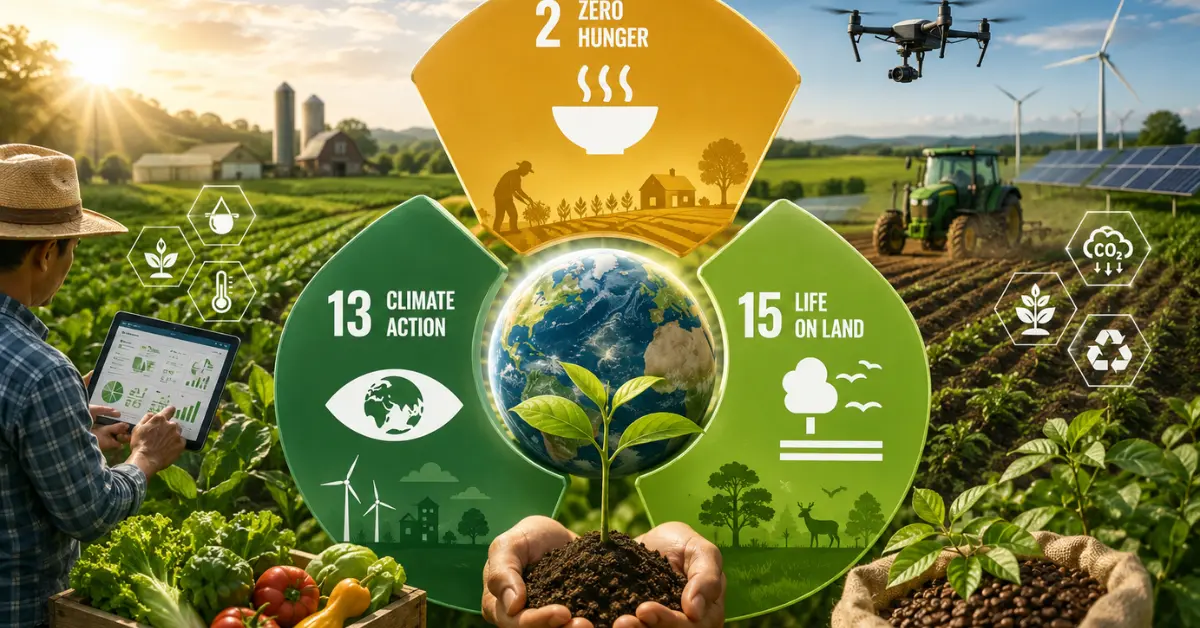
SDGs in agriculture are the UN Sustainable Development Goals applied to farming and food systems using agriculture to end hunger, fight climate change and protect ecosystems by 2030. Agriculture touches most of the 17 goals, but three sit at its core: SDG 2 (Zero Hunger), SDG 13 (Climate Action) and SDG 15 (Life on Land). The hard part isn’t agreeing they matter it’s operationalising and proving progress across a fragmented supply chain. This guide answers the seven questions agri leaders ask when turning SDGs in agriculture from a pledge into verifiable practice.
Key takeaways
SDGs in agriculture apply the UN’s 17 goals (adopted 2015, target 2030) to farming and food systems.
Three goals are central: SDG 2 (Zero Hunger), SDG 13 (Climate Action) and SDG 15 (Life on Land) with SDG 1, 3, 5, 6 and 12 close behind.
Agriculture is both a driver of and a solution to climate change, making SDG 13 pivotal.
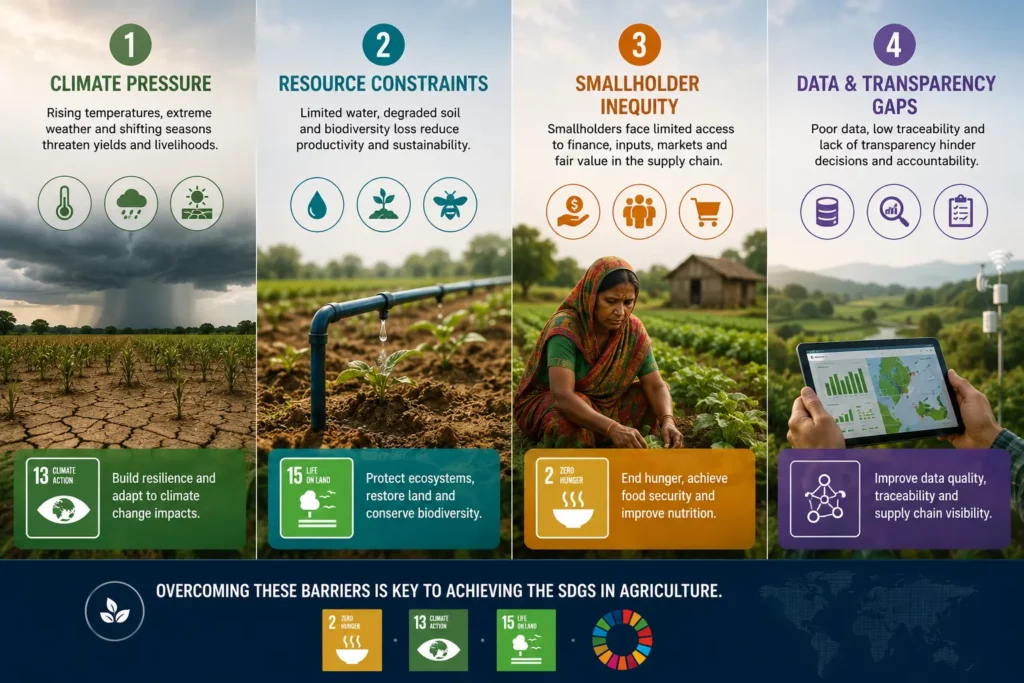
The barriers are climate volatility, resource inefficiency, smallholder inequity and weak data not lack of intent.
Climate-smart and regenerative practices plus fair-trade market access move multiple goals at once.
Technology traceability, blockchain, dMRV is what turns SDG claims into verifiable, audit-ready proof.
Ready to Turn Sustainability Goals Into Action?
Connect with TraceX experts to explore solutions for sustainable sourcing, traceability, carbon management, ESG, certifications and regulatory compliance across your supply chain.
SDGs in agriculture are the UN Sustainable Development Goals applied to farming using food systems to end hunger, protect the climate and restore ecosystems.
The 17 Sustainable Development Goals were adopted by UN member states in 2015 as a shared blueprint for people and planet by 2030. Agriculture is the unifying thread that runs through most of them because it shapes food security, rural livelihoods and the health of land and water at once. That is why SDGs in agriculture are less a separate programme than a lens: align farming practice with the goals, and you address hunger, poverty and climate in the same move.
How Can Businesses Turn the SDGs Into Measurable Action?Explore how technology, traceability and sustainable supply-chain practices can help businesses align their operations with the UN Sustainable Development Goals (SDGs) and track meaningful progress.
SDGs in agriculture matter because they align profitability with regulatory compliance, market access and consumer trust not just ethics.
For agribusinesses, the goals have moved from CSR to commercial necessity. Buyers, regulators and investors now ask for evidence of ethical, low-impact sourcing, and rules like the EUDR and ESG reporting frameworks make that evidence mandatory. Aligning with SDGs in agriculture protects market access, differentiates a brand on transparency, and de-risks a supply chain against climate and reputational shocks while the underlying practices often cut cost and waste too.
Are You Keeping Up With the Growing Sustainability Landscape?Understand how sustainability frameworks, standards and regulations shape business requirements—and how organisations can turn them into measurable, traceable action across the supply chain.
What are the biggest challenges to achieving SDGs in agriculture?
The biggest barriers are climate volatility, resource inefficiency, smallholder inequity and weak data not a lack of good intentions.
Climate change — droughts, floods and erratic seasons disrupt yields and force costly adaptation.
Resource inefficiency — water overuse and soil degradation undermine long-term productivity.
Smallholder inequity — limited access to finance, training, tools and fair markets slows adoption.
Weak data and traceability — without verifiable farm-level data, progress can’t be measured, proven or funded.
How can agriculture help achieve the SDGs?
Agriculture advances the SDGs through climate-smart and regenerative practices, fairer market access, and digital traceability.
Practical levers move several goals at once. Climate-smart agriculture precision inputs, crop diversification, carbon farming lifts SDG 2 and SDG 13 together. Regenerative methods like cover cropping and agroforestry restore soil and biodiversity for SDG 15. Fair-trade pricing and direct market linkages raise smallholder incomes for SDG 1, while responsible water management supports SDG 6. Meeting the SDGs in agriculture, in other words, is less about a single fix than about stacking practices that reinforce one another.
Can Agriculture Grow While Adapting to Climate Change?Discover how climate-smart agriculture can help improve farm resilience, optimise resources and support sustainable productivity while reducing environmental impact.
How does technology accelerate SDGs in agriculture?
Technology accelerates SDGs in agriculture by turning sustainability claims into verifiable, real-time, audit-ready data.
Digital traceability — tracks food farm-to-fork, improving safety, recalls and smallholder market visibility.
Blockchain — makes records immutable, so organic, fair-trade and deforestation-free claims can be verified, not just asserted.
Satellite + IoT — monitor crop health, water and soil in real time to optimise resource use.
Digital MRV — measures, reports and verifies carbon and nature outcomes so climate progress is fundable.
Is Your Supply Chain Ready for Digital Traceability?Discover how digital traceability systems can connect suppliers, products, batches and supply-chain events to improve visibility, compliance and operational control.
How do businesses prove SDG progress in agriculture?
Businesses prove SDG progress in agriculture with verifiable farm-level data traceability, certifications and digital MRV not self-declarations.
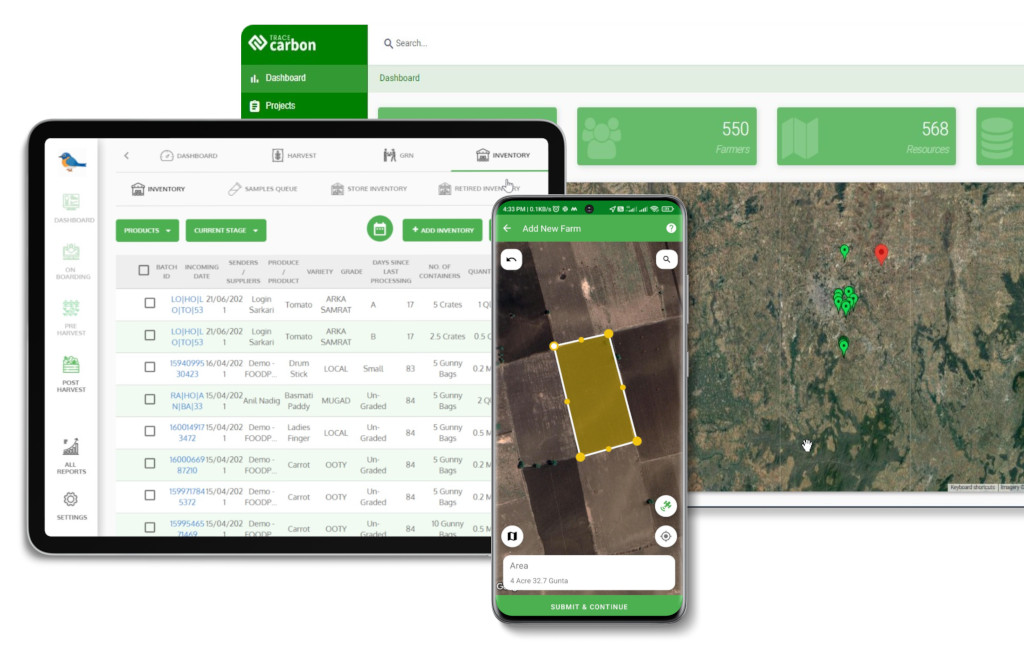
Regulators, buyers and investors increasingly want proof, not promises. The TraceX sustainability platform helps agribusinesses operationalise SDGs in agriculture by digitising farms, tracking practices, verifying certifications and reporting carbon on a blockchain-backed record, so a claim of “regenerative” or “deforestation-free” is backed by data an auditor can trust. That is what turns a sustainability pledge into a defensible, fundable outcome.
See how farm digitisation, traceability and digital MRV turn SDG commitments into verifiable, audit-ready outcomes.
“The SDGs in agriculture won’t be won on intent they’ll be won on evidence. The farms that can prove their impact, plot by plot, are the ones that will keep market access, attract climate finance and earn consumer trust.”
SDGs in agriculture: goals, actions and proof
How core goals map to on-farm action and the evidence buyers now expect.
SDG
On-farm action
How it’s proven
SDG 2 — Zero Hunger
Higher, more nutritious yields; reduced loss
Yield + traceability data
SDG 13 — Climate Action
Carbon farming, precision inputs, resilience
Digital MRV / carbon records
SDG 15 — Life on Land
No deforestation, agroforestry, soil health
Geo-mapping + monitoring
SDG 1 — No Poverty
Fair pricing, direct market access
Farmer payment records
SDG 12 — Responsible Prod.
Certified, transparent sourcing
Verified certifications
Checklist: operationalising SDGs in agriculture
A platform that supports SDG alignment should let you do all seven.
Digitise farms and capture plot-level, geo-tagged data
Map on-farm practices to specific SDG targets (2, 13, 15 and beyond)
Track climate-smart and regenerative practices over time
Verify certifications (organic, fair-trade, deforestation-free) with evidence
Measure, report and verify carbon and nature outcomes (dMRV)
Give smallholders visibility, fair pricing and market linkage
Produce audit-ready reports for EUDR, ESG and buyer requirements
Frequently Asked Questions
What are the key SDGs related to agriculture?
The most relevant SDGs in agriculture are SDG 2 (Zero Hunger), SDG 13 (Climate Action) and SDG 15 (Life on Land) — focused on food security, climate resilience and protecting ecosystems. SDG 1, 3, 5, 6 and 12 are closely linked.
Why is agriculture central to the SDGs?
Agriculture directly shapes food security, rural livelihoods, water use, land health and emissions, so it influences most of the 17 goals at once. Progress in farming ripples across hunger, poverty, climate and biodiversity targets together.
How does agriculture contribute to climate change (SDG 13)?
Farming is a significant source of greenhouse gas emissions through land-use change, livestock and inputs but it is also a powerful sink. Practices like carbon farming and agroforestry can turn agriculture into part of the climate solution.
What is climate-smart agriculture?
Climate-smart agriculture combines practices precision farming, crop diversification, carbon farming that raise productivity, build resilience to climate shocks and cut emissions, advancing SDG 2 and SDG 13 at the same time.
How can technology help achieve SDGs in agriculture?
Technology enables SDGs in agriculture by improving traceability, verifying sustainable practices with data, and enhancing supply-chain transparency through tools like blockchain and digital MRV, so progress can be measured and proven.
What role do businesses play in sustainable agriculture?
Businesses drive change by adopting eco-friendly practices, supporting smallholders with training and fair pricing, and using digital tools to align sourcing with the SDGs turning sustainability into both compliance and competitive advantage.
What is the target year for the SDGs?
The 17 Sustainable Development Goals were adopted in 2015 with a target year of 2030, giving agriculture a defined horizon to scale sustainable, resilient and inclusive practices.
Start using TraceX
Transparency, Trust, & Success for your Climate Journey.
We use cookies on our website to give you the most relevant experience by remembering your preferences and repeat visits. By clicking “Accept All”, you consent to the use of ALL the cookies. However, you may visit "Cookie Settings" to provide a controlled consent.
This website uses cookies to improve your experience while you navigate through the website. Out of these, the cookies that are categorized as necessary are stored on your browser as they are essential for the working of basic functionalities of the website. We also use third-party cookies that help us analyze and understand how you use this website. These cookies will be stored in your browser only with your consent. You also have the option to opt-out of these cookies. But opting out of some of these cookies may affect your browsing experience.
Necessary cookies are absolutely essential for the website to function properly. These cookies ensure basic functionalities and security features of the website, anonymously.
Cookie
Duration
Description
cookielawinfo-checkbox-analytics
11 months
This cookie is set by GDPR Cookie Consent plugin. The cookie is used to store the user consent for the cookies in the category "Analytics".
cookielawinfo-checkbox-functional
11 months
The cookie is set by GDPR cookie consent to record the user consent for the cookies in the category "Functional".
cookielawinfo-checkbox-necessary
11 months
This cookie is set by GDPR Cookie Consent plugin. The cookies is used to store the user consent for the cookies in the category "Necessary".
cookielawinfo-checkbox-others
11 months
This cookie is set by GDPR Cookie Consent plugin. The cookie is used to store the user consent for the cookies in the category "Other.
cookielawinfo-checkbox-performance
11 months
This cookie is set by GDPR Cookie Consent plugin. The cookie is used to store the user consent for the cookies in the category "Performance".
viewed_cookie_policy
11 months
The cookie is set by the GDPR Cookie Consent plugin and is used to store whether or not user has consented to the use of cookies. It does not store any personal data.
Functional cookies help to perform certain functionalities like sharing the content of the website on social media platforms, collect feedbacks, and other third-party features.
Performance cookies are used to understand and analyze the key performance indexes of the website which helps in delivering a better user experience for the visitors.
Analytical cookies are used to understand how visitors interact with the website. These cookies help provide information on metrics the number of visitors, bounce rate, traffic source, etc.
Advertisement cookies are used to provide visitors with relevant ads and marketing campaigns. These cookies track visitors across websites and collect information to provide customized ads.
Download the 2026 Traceability Scorecard and Benchmark Your Supply Chain Across 10 Critical Capabilities.
Download our eBook
Don’t Wait for an Audit to Find Your EUDR Gaps
The 2026 Simplification Package changes how HS codes, DDS pass-through and geolocation rules apply to you. Get the free guide and 20-point readiness checklist before enforcement catches you unprepared.