Digital Product Passports for Textiles: What ESPR Means for Brands
Published
, 14 minute read
Share this article
Quick summary: Digital Product Passports (DPPs) are transforming textile compliance under the EU’s ESPR. Learn what DPPs are, which products are affected, required data, timelines, and how brands can prepare to secure EU market access and strengthen supply chain transparency.
The fashion and textile industry is facing its “regulatory moment.” Gone are the days of voluntary sustainability reports and vague “eco-friendly” tags. As of January 2026, the Ecodesign for Sustainable Products Regulation (ESPR) is no longer a future concept it is the operational reality for every brand selling in the European Union.
At the heart of this shift is the Digital Product Passport (DPP) for Textiles
This isn’t just a QR code; it’s a fundamental restructuring of how product data is captured, stored, and shared. For brands that act now, the DPP is a competitive superpower.
For years, textile brands have relied on self-reported sustainability claims such as recycled content percentages, ethical sourcing statements, or carbon labels often supported by periodic supplier declarations or certifications. Under the ESPR, this approach is no longer sufficient. Digital Product Passports require verifiable, machine-readable, product-level data that can be audited, updated, and traced across the full lifecycle of each textile product.
Under ESPR, Digital Product Passports will become a regulatory gateway to the EU market. Textile products placed on the EU market without a compliant DPP may face restrictions, delayed customs clearance, or outright exclusion. Beyond regulation, EU buyers, retailers, and marketplaces are expected to use DPP data as a supplier qualification requirement, favouring brands that can provide complete, trusted product information.
In this comprehensive guide, we’ll break down exactly what the ESPR mandates, how the DPP works, and how your brand can turn compliance into a driver for organic growth.
Key Takeaways
The EU’s Ecodesign for Sustainable Products Regulation (ESPR) makes textiles a priority for Digital Product Passports (DPPs), shifting compliance from broad sustainability claims to product-level, verifiable data.
DPPs capture material composition, supplier and multi-tier manufacturing data, sustainability metrics, and regulatory compliance across the full lifecycle.
Early preparation is critical, as Tier-2 and Tier-3 supplier data now determine credibility and market access.
Common compliance gaps manual spreadsheets, inconsistent identifiers, static claims, and disconnected systems can block EU sales.
Digital traceability platforms from TraceXcentralize supplier data, track lifecycle events, automate reporting, and deliver audit-ready DPP outputs, enabling brands to secure compliance, transparency, and competitive advantage.
“Digital Product Passports Explained: From Compliance to Competitive Edge,” and learn how leading brands are using DPPs to secure EU market access, reduce risk, and build trusted, future-ready supply chains.
The EU has identified textiles as one of the most resource-intensive sectors, responsible for significant water consumption, land use, and waste. The ESPR replaces the old Ecodesign Directive, expanding its scope from energy-related products to almost all physical goods starting with apparel and footwear.
For textile products, ESPR goes far beyond energy use to address material composition, durability, reparability, recycled content, chemical safety, and end-of-life recyclability. This shift reflects the EU’s move toward regulating the full environmental footprint of products across their entire lifecycle from fiber sourcing and manufacturing to use and disposal making textiles subject to the same level of scrutiny as traditionally regulated industrial goods.
Key Performance Requirements under ESPR:
Durability: Garments must be designed to last longer. Brands will soon have to disclose “technical lifetime” and resistance to stress.
Repairability: Design must allow for easy repair. The DPP will likely serve as the manual, providing technicians with spare part SKUs and disassembly instructions.
Recycled Content: Minimum thresholds for recycled fibers (like rPET) will become mandatory.
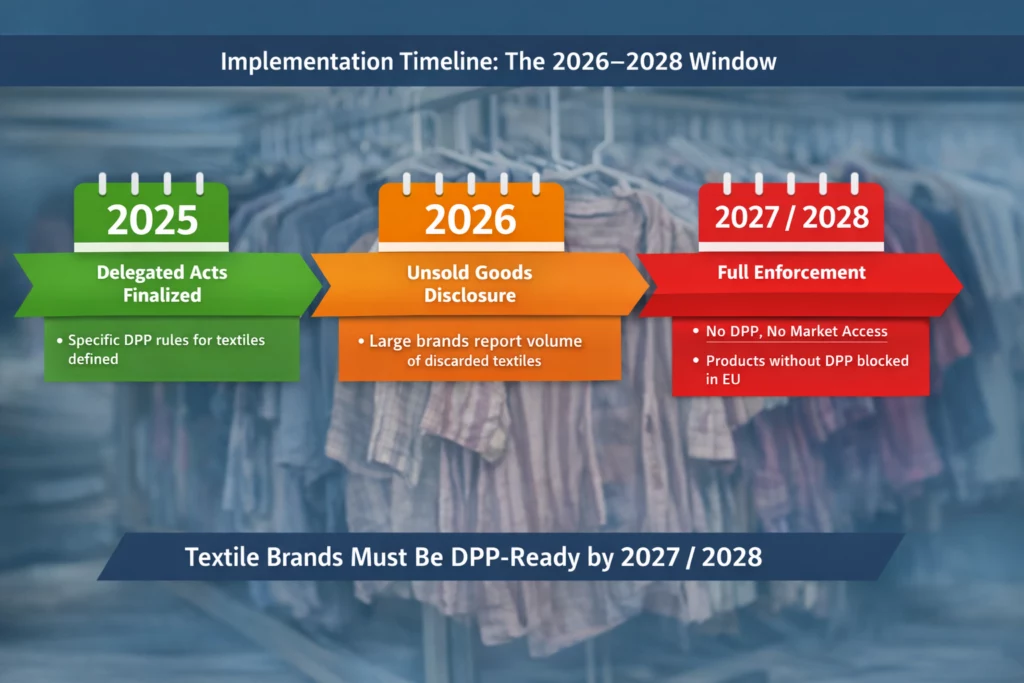
Ban on Destruction of Unsold Goods: Starting in 2026, large enterprises are prohibited from shredding or landfilling unsold textiles and footwear.
Non-compliance with ESPR and Digital Product Passport requirements carries both legal and commercial risks. Legally, products that do not meet ESPR requirements may be restricted or prohibited from being placed on the EU market, face customs delays, enforcement actions, or penalties imposed by national authorities. Commercially, the impact can be even more immediate: EU retailers and brands are expected to require DPP data as part of supplier onboarding and contract renewal. Suppliers unable to provide compliant, verifiable product data risk losing listings, failing buyer audits, and being excluded from long-term sourcing programs. In practice, ESPR non-compliance can result in lost revenue, damaged brand credibility, and reduced access to one of the world’s most valuable textile markets.
New to Digital Product Passports? Read our complete DPP Guide to understand requirements, timelines, and next steps.
Not sure which products need a DPP? Explore our blog on DPP Product Scope to see what’s in,and what’s coming next.
What Are Digital Product Passports (DPPs) for Textiles?
Digital Product Passports (DPPs) for textiles are digital, structured records linked to individual textile products or product batches that store verified information about a product’s composition, origin, sustainability, and lifecycle. Introduced under the EU’s Ecodesign for Sustainable Products Regulation (ESPR), textile DPPs are designed to make product data transparent, accessible, and usable across the entire value chain.
What a Textile DPP Is and How It Works
A textile DPP is typically accessed through a digital carrier such as a QR code, NFC tag, or embedded identifier attached to a garment or textile product. When scanned, it connects to a digital record that contains standardized product data, including material composition, manufacturing processes, supplier information, environmental performance, and care or repair guidance. Unlike static labels or PDFs, DPPs are dynamic they can be updated over time to reflect repairs, resale, recycling, or regulatory changes, creating a living record of the product from production to end-of-life.
Who Can Access DPP Data
DPPs are designed with role-based access, ensuring that different stakeholders see relevant information:
Regulators can access compliance, due-diligence, and audit data to verify ESPR and related regulatory requirements.
Consumers can view transparency information such as fiber content, sustainability claims, durability, and care instructions to support informed purchasing.
Recyclers and repair operators can access material and chemical data needed for safe repair, reuse, or recycling.
Buyers and retailers can use DPP data for supplier qualification, risk assessment, and sustainability reporting. This controlled access balances transparency with data protection and commercial sensitivity.
Why DPPs Are Machine-Readable and Lifecycle-Based
DPPs are machine-readable so that data can be automatically processed by IT systems, customs platforms, compliance tools, and sustainability reporting software. This enables scalability, real-time validation, and interoperability across systems and borders. They are also lifecycle-based, meaning they capture and update information across every stage of a textile product’s life from fiber sourcing and manufacturing to use, repair, resale, and recycling. This lifecycle approach ensures that sustainability and compliance are continuously evidenced, not declared once, aligning textile products with the EU’s circular economy and long-term environmental goals.
The Three Layers of a Textile DPP
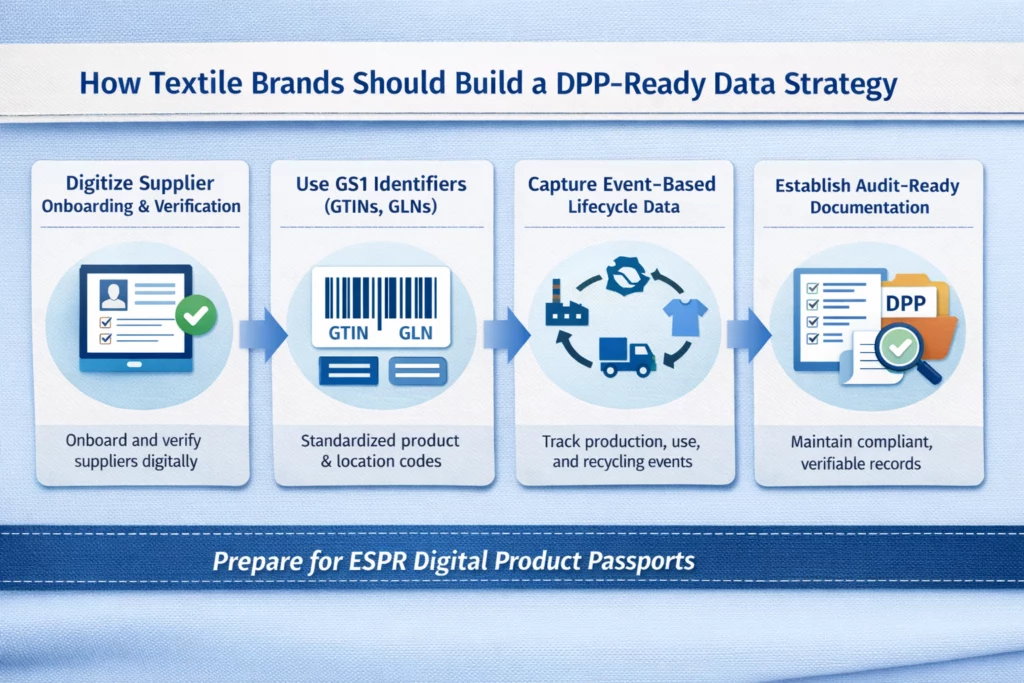
Identity Layer: Unique identifiers (like GS1 GTINs) that distinguish a specific batch or even an individual item.
Data Layer: Technical specs, material composition (e.g., 98% Organic Cotton, 2% Elastane), and environmental footprint data (Carbon/Water).
Instructional Layer: Care instructions to extend life, repair guides, and machine-readable sorting data for recyclers.
Which Textile Products Will Require a Digital Product Passport (DPP)?
Under the EU’s Ecodesign for Sustainable Products Regulation (ESPR), Digital Product Passports (DPPs) will become mandatory for a broad range of textile products placed on the EU market. Textiles are a priority product category due to their environmental footprint, complex global supply chains, and high circularity potential.
Textile Product Categories in Scope
The DPP requirement is expected to cover:
Apparel: clothing for adults and children, including fashion, workwear, and sportswear
Footwear: shoes, boots, and related products
Home textiles: bedding, towels, curtains, upholstery, carpets, and rugs
Technical and industrial textiles: textiles used in automotive, construction, healthcare, protective equipment, and other industrial applications
The scope is intentionally broad, ensuring traceability and sustainability data across both consumer-facing and industrial textile products.
Expected Phased Rollout Timelines
DPPs will not apply to all textile products at once. The EU will introduce them through delegated acts, with a phased rollout by product group:
Textiles and apparel are among the first priority sectors, with requirements expected to take effect in the mid-to-late 2020s.
Initial phases will likely focus on high-volume, high-impact products such as clothing and footwear, followed by more specialized textile categories.
Each delegated act will define the exact data requirements, timelines, and enforcement dates, giving brands a limited transition period to comply.
Early preparation is critical, as system changes, supplier onboarding, and data collection can take 12–24 months.
What “Placed on the EU Market” Legally Means
“Placed on the EU market” has a specific legal meaning under EU law. A textile product requires a DPP if it is:
First made available on the EU market, whether for sale or free distribution
Sold directly or indirectly into the EU, including through distributors, retailers, or e-commerce
Manufactured inside or outside the EU country of origin does not exempt a product
This means non-EU brands, contract manufacturers, private-label suppliers, and online sellers shipping to EU customers will all fall under DPP obligations. Even products made outside the EU but sold into EU markets must comply fully with DPP requirements.
What Data Will Textile Brands Need for DPPs?
Under the EU Ecodesign for Sustainable Products Regulation (ESPR), Digital Product Passports (DPPs) for textiles require brands to disclose standardized, machine-readable product data that proves compliance, sustainability, and traceability across the full lifecycle. This is not marketing content it is regulated, auditable data.
1. Product Identity & Material Composition
Textile DPPs must clearly define what the product is made of. This includes detailed fiber composition (e.g., cotton, polyester, viscose), blend percentages, fabric weights, and the use of chemicals, dyes, and finishing treatments. Accurate material data enables recyclability, safe handling, and regulatory verification, and prevents greenwashing claims.
2. Supplier & Manufacturing Data
Brands must provide multi-tier supply chain visibility, typically from Tier 1 (cut-and-sew) through Tier 3 (raw material processing). This includes supplier identities, manufacturing site locations, and key processing steps such as spinning, dyeing, finishing, and assembly. This data supports traceability, risk assessment, and enforcement of due-diligence obligations.
3. Sustainability & Circularity Metrics
DPPs must include quantifiable sustainability indicators, such as product-level carbon footprint, energy and water intensity, recycled or bio-based content, and durability metrics. Circularity data repairability, reuse potential, and recyclability is essential to support extended product lifecycles and the EU’s circular economy goals.
4. Compliance & Due Diligence Data
Textile DPPs must demonstrate compliance with EU regulations including REACH (restricted substances), chemical safety requirements, and environmental and human-rights due diligence expectations. Brands must disclose identified risks, mitigation measures, and supporting documentation, enabling regulators and buyers to verify lawful and responsible production.
Why Tier-2 and Tier-3 Supplier Data Is Mandatory
In textile supply chains, the highest environmental and human-rights risks sit upstream, not at Tier-1 factories. Dyeing, finishing, spinning, and raw-material processing (Tier-2 and Tier-3) account for most chemical pollution, water use, carbon emissions, and labor risk. As a result, regulators and buyers now require visibility beyond cut-and-sew operations.
Declarations alone are no longer accepted because they are self-reported, static, and unverifiable. Under ESPR and related due-diligence rules, brands must provide traceable, auditable evidence of where and how materials were processed not just supplier assurances.
Real-world example: Multiple global fashion brands have faced public backlash and regulatory scrutiny after sourcing cotton and viscose linked to forced labor and polluting dye houses despite Tier-1 suppliers being “compliant.” Without Tier-2 and Tier-3 data, brands could not prove responsible sourcing, leading to delistings, reputational damage, and contract losses.
What are the Common Gaps That Break Textile DPP Compliance
Many textile brands underestimate how existing data practices undermine Digital Product Passport (DPP) readiness.
Manual supplier questionnaires and spreadsheets are one of the biggest failure points they are error-prone, difficult to validate, and impossible to scale across multi-tier supply chains. Regulators and buyers increasingly reject manually compiled data because it lacks verifiable audit trails.
Inconsistent material and supplier identifiers create another major gap. When the same fabric, mill, or chemical supplier is labeled differently across PLM, ERP, and sourcing systems, brands cannot establish a single source of truth breaking traceability and lifecycle continuity required by DPPs.
Static sustainability claims also fail DPP requirements. Claims that are not linked to real lifecycle events such as repairs, resale, or recycling cannot be updated or verified over time, making them non-compliant under ESPR’s lifecycle-based model.
Finally, disconnected systems prevent data flow across product design, sourcing, production, and compliance teams. Without integrated PLM, ERP, and traceability platforms, brands struggle to generate machine-readable, audit-ready DPPs at scale, putting EU market access at risk.
How Digital Traceability Platforms Enable ESPR DPP Compliance
Digital traceability platforms are becoming the core infrastructure for ESPR and Digital Product Passport (DPP) compliance, replacing fragmented, manual workflows with structured, verifiable data systems. They allow textile brands to move from declarations to evidence-based compliance at scale.
Centralized supplier and material data repositories create a single source of truth for product, material, and supplier information across Tier 1–Tier 3. Instead of duplicating data across PLM, ERP, and sustainability tools, brands maintain standardized identifiers, certifications, and material attributes in one system ensuring consistency and audit readiness.
Event-based traceability feeding DPPs captures real lifecycle events such as fiber sourcing, dyeing, manufacturing, shipping, repair, resale, and recycling. Each event is time-stamped and linked to the product’s digital identity, enabling DPPs to function as living records rather than static documents an explicit ESPR requirement.
Automated reporting for ESPR, CSRD, EUDR, and ESG eliminates manual data compilation. Structured traceability data can be automatically transformed into regulatory disclosures, due-diligence files, and buyer-specific reports, reducing compliance cost while improving accuracy and response speed during audits.
AI-driven supplier data validation and risk scoring, as implemented in the TraceX platform, strengthens upstream compliance. TraceX uses AI to validate supplier submissions, flag anomalies, assess risk across tiers, and prioritize corrective actions helping brands focus on high-risk materials, regions, or processes before issues escalate.
TraceX solutions act as the digital backbone that connects suppliers, materials, and lifecycle events into DPP-ready, machine-readable outputs, enabling textile brands to meet ESPR requirements, protect EU market access, and turn compliance into a competitive advantage.
DPPs Will Redefine Textile Market Access
Digital Product Passports (DPPs) are no longer optional they are the new gateway to EU market access for textile brands. Early adopters who build DPP-ready systems will not only ensure regulatory compliance but also strengthen brand credibility, supply chain transparency, and buyer trust. Far from being a one-time reporting task, DPPs are infrastructure for the circular, sustainable, and traceable supply chains of the future, enabling brands to differentiate themselves, unlock premium markets, and stay ahead in an increasingly regulated and competitive landscape.
Wondering how DPPs actually work behind the scenes? Explore our deep dive on DPP Architecture.
What are Digital Product Passports (DPPs) for textiles?
DPPs are digital, machine-readable records containing verified product information, including material composition, supplier data, lifecycle metrics, and compliance details, enabling traceability and sustainability verification across the supply chain.
Which textile products require a DPP?
Apparel, footwear, home textiles, and technical textiles placed on the EU market will require DPPs, with phased rollout starting in the mid-to-late 2020s.
What data must textile brands include in a DPP?
Brands must report product identity, material composition, multi-tier supplier information, sustainability metrics (carbon footprint, recyclability, durability), and compliance with REACH and ESG standards.
Who can access DPP data?
Regulators, buyers, recyclers, repair operators, and consumers (with role-based access) can view relevant product information to verify compliance, traceability, and sustainability claims.
Why is early DPP readiness important for brands?
Early adoption ensures regulatory compliance, avoids market access delays, strengthens brand credibility, enables audit-ready documentation, and positions brands as leaders in traceable, sustainable supply chains.
Start using TraceX
Transparency, Trust, & Success for your Climate Journey.
We use cookies on our website to give you the most relevant experience by remembering your preferences and repeat visits. By clicking “Accept All”, you consent to the use of ALL the cookies. However, you may visit "Cookie Settings" to provide a controlled consent.
This website uses cookies to improve your experience while you navigate through the website. Out of these, the cookies that are categorized as necessary are stored on your browser as they are essential for the working of basic functionalities of the website. We also use third-party cookies that help us analyze and understand how you use this website. These cookies will be stored in your browser only with your consent. You also have the option to opt-out of these cookies. But opting out of some of these cookies may affect your browsing experience.
Necessary cookies are absolutely essential for the website to function properly. These cookies ensure basic functionalities and security features of the website, anonymously.
Cookie
Duration
Description
cookielawinfo-checkbox-analytics
11 months
This cookie is set by GDPR Cookie Consent plugin. The cookie is used to store the user consent for the cookies in the category "Analytics".
cookielawinfo-checkbox-functional
11 months
The cookie is set by GDPR cookie consent to record the user consent for the cookies in the category "Functional".
cookielawinfo-checkbox-necessary
11 months
This cookie is set by GDPR Cookie Consent plugin. The cookies is used to store the user consent for the cookies in the category "Necessary".
cookielawinfo-checkbox-others
11 months
This cookie is set by GDPR Cookie Consent plugin. The cookie is used to store the user consent for the cookies in the category "Other.
cookielawinfo-checkbox-performance
11 months
This cookie is set by GDPR Cookie Consent plugin. The cookie is used to store the user consent for the cookies in the category "Performance".
viewed_cookie_policy
11 months
The cookie is set by the GDPR Cookie Consent plugin and is used to store whether or not user has consented to the use of cookies. It does not store any personal data.
Functional cookies help to perform certain functionalities like sharing the content of the website on social media platforms, collect feedbacks, and other third-party features.
Performance cookies are used to understand and analyze the key performance indexes of the website which helps in delivering a better user experience for the visitors.
Analytical cookies are used to understand how visitors interact with the website. These cookies help provide information on metrics the number of visitors, bounce rate, traffic source, etc.
Advertisement cookies are used to provide visitors with relevant ads and marketing campaigns. These cookies track visitors across websites and collect information to provide customized ads.
Download the 2026 Traceability Scorecard and Benchmark Your Supply Chain Across 10 Critical Capabilities.
Download our eBook
Don’t Wait for an Audit to Find Your EUDR Gaps
The 2026 Simplification Package changes how HS codes, DDS pass-through and geolocation rules apply to you. Get the free guide and 20-point readiness checklist before enforcement catches you unprepared.