Decoding GS1 Identifiers for End-to-End Traceability
Published
, 17 minute read
Share this article
Quick summary: Decoding GS1 identifiers for end-to-end traceability learn how GTINs, GLNs, SSCCs, and Digital Link enable compliant, interoperable supply chains.
Traceability fails when everyone speaks a different language. Modern supply chains are expected to answer simple questions instantly: Where did this product come from? What is it made of? Is it safe? Is it compliant? Yet many organizations still use internal SKUs, spreadsheets, or partner-specific codes. The result? Confusion, data gaps, failed audits, and broken traceability. Traceability only works when everyone speaks the same identification language and that language is GS1.GS1 Identifiers are globally standardized codes such as GTINs for products, GLNs for locations, and SSCCs for logistics units that uniquely identify items, facilities, and shipments across supply chains.
They enable end-to-end traceability by linking physical products to consistent, machine-readable digital records at farm, factory, warehouse, and market levels. By eliminating fragmented SKUs and manual reconciliation, GS1 Identifiers ensure interoperable data exchange, auditability, and real-time visibility. They form the foundation for regulatory compliance, recalls, sustainability reporting, and Digital Product Passports across complex, multi-supplier value chains.
Traceability is not just about collecting data it’s about connecting data. Without a common identification language, supply chains fragment. With GS1 identifiers, they align. That’s why GS1 identifiers are widely considered the language of traceability spoken by products, understood by systems, and trusted by regulators worldwide.
Key Takeaways
GS1 identifiers are globally standardized IDs that uniquely identify products (GTIN), locations (GLN), shipments (SSCC), and assets, forming the foundation of end-to-end traceability.
They go far beyond barcodes by enabling consistent data sharing across suppliers, systems, and borders.
GS1 Digital Link extends this foundation by connecting physical products to live digital data through QR codes powering Digital Product Passports, recalls, and consumer transparency.
When used correctly, GS1 identifiers link origin, batch, product, and shipment data into a single, auditable trail; when misused or treated as mere labels, they create traceability gaps and compliance risk.
Platforms from TraceX operationalize GS1 by embedding these identifiers into multi-tier supplier onboarding, Digital Link–ready architectures, and compliance-by-design workflows turning GS1 from static codes into live, trusted traceability.
What Are GS1 Identifiers?
GS1 is a global, neutral, non-profit standards organization that develops and maintains the most widely used identification and data-sharing standards in the world. Its mission is simple but critical: enable different organizations, systems, and countries to identify, capture, and share information about products, locations, and assets in a consistent way.
GS1 operates in more than 100 countries and underpins everyday supply chain operations across industries such as:
Retail and e-commerce
Food and agriculture
Pharmaceuticals and healthcare
Textiles and apparel
Logistics and transportation
When a product scans at checkout, moves through a warehouse, crosses a border, or appears in a regulatory database, it is very often using a GS1 identifier. This global acceptance makes GS1 the foundation of modern supply chain interoperability.
How GS1 enables unique, standardized product identification
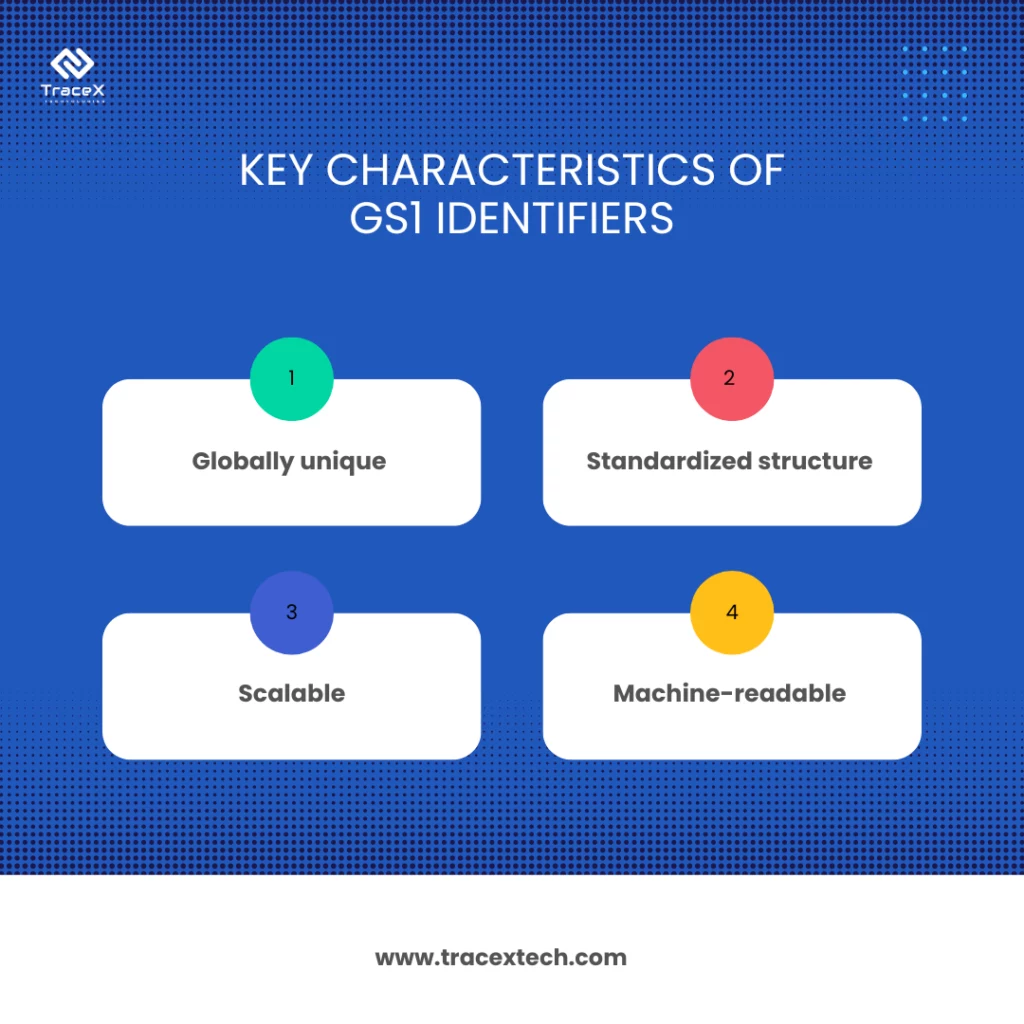
At the core of GS1 traceability standards is the principle of global uniqueness.
GS1 assigns companies a GS1 Company Prefix, which they use to create identifiers that are guaranteed to be unique worldwide. These identifiers follow standardized structures and rules so that any system, anywhere, can interpret them correctly.
For example:
A GTIN uniquely identifies a product
A GLN uniquely identifies a location or company
A batch or serial number, combined with a GTIN, enables precise traceability
Because these identifiers follow GS1 traceability standards, they allow supply chain events production, transformation, shipping, receiving, and sale to be linked together reliably.
Explore our deep dive into GS1 standards and how they power modern traceability
Go deeper on GS1 traceability, and how to make it work in practice
Comparison: Internal SKU vs. GS1 Identifier
Feature
Internal SKU (Stock Keeping Unit)
GS1 Identifier (e.g., GTIN / GLN)
Primary Purpose
Internal inventory and accounting.
Cross-border trade and regulatory compliance.
Scope of Meaning
Private (only your company understands it).
Universal (recognized by every scanner in the world).
Uniqueness
Local. Another company could use the same code.
Global. Guaranteed to be unique to your product.
Structure
Alphanumeric and flexible (often human-readable).
Numeric-only and standardized (machine-optimized).
Persistence
Can be changed if your warehouse logic changes.
Permanent. It stays with the product forever.
DPP Compliance
Non-compliant. Cannot be used for the DPP link.
Mandatory. The “backbone” of the DPP data carrier.
Interoperability
Zero. Systems outside your company cannot “read” it.
High. Enables seamless data exchange with recyclers.
Why GS1 identifiers matter for GS1 traceability standards
GS1 traceability standards rely on one foundational idea: you cannot trace what you cannot uniquely identify.
By using GS1 identifiers:
Products can be traced from origin to consumer
Data from multiple parties can be linked without ambiguity
Audits and recalls become faster and more accurate
Digital initiatives like Digital Product Passports (DPPs) become feasible
GS1 identifiers transform traceability from isolated tracking into a connected, end-to-end data ecosystem.
Core GS1 Identifiers Explained (With Use Cases)
GS1 identifiers form the backbone of traceability by uniquely identifying what the product is, where it is, and how it moves through the supply chain. Each identifier serves a specific role, and together they create a complete, auditable traceability system.
GTIN (Global Trade Item Number)
The GTIN uniquely identifies a product at the item or SKU level anywhere in the world.
What it identifies
Finished products
Consumer items
Trade units (cases, packs)
Each product configuration size, packaging, formulation receives its own GTIN.
Where it is used
Retail: product scanning at checkout and inventory management
Logistics: identifying items inside shipments
Recalls: pinpointing affected products quickly and accurately
Digital Product Passports (DPPs): linking a physical product to its digital record
The GTIN is the foundation of product-level traceability. When combined with batch/lot or serial numbers, it enables:
End-to-end tracking from production to sale
Accurate recall execution
Reliable product data sharing across systems
Without a GTIN, product data cannot be consistently linked across organizations.
GLN (Global Location Number)
The GLN uniquely identifies locations and legal entities within a supply chain.
What it identifies
Farms and plantations
Factories and processing facilities
Warehouses and distribution centers
Suppliers, brand owners, and certification bodies
A GLN can represent both physical locations and legal entities.
Where it is used
Location-based traceability (where something was grown, made, or stored)
Audits and inspections
Regulatory reporting
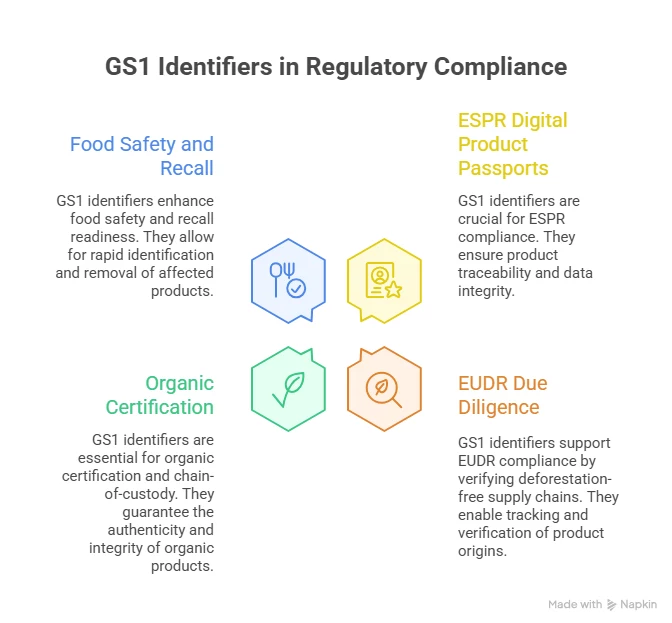
GLNs play a key role in regulations and sustainability frameworks, including:
EUDR (EU Deforestation Regulation) – verifying origin and sourcing locations
Organic certification – linking certified operators and sites
ESG reporting – attributing impacts to specific facilities or regions
By standardizing location identification, GLNs remove ambiguity from compliance and audit processes.
SSCC (Serial Shipping Container Code)
The SSCC uniquely identifies logistics units such as pallets, cartons, and containers.
What it identifies
Pallets
Shipping containers
Mixed or homogeneous logistics units
An SSCC identifies the unit being shipped, not the individual products inside it.
Where it is used
Transportation and warehousing
Advance Shipping Notices (ASNs)
Goods receiving and cross-docking
SSCCs enable:
Shipment-level visibility
Tracking of custody changes between parties
Faster receiving and fewer errors
By linking SSCCs to the GTINs they contain, organizations gain full visibility from shipment → pallet → product.
GRAI & GIAI (Assets & Returnables)
GRAI (Global Returnable Asset Identifier) and GIAI (Global Individual Asset Identifier) identify assets, not products.
What they identify
Reusable transport items (crates, kegs, pallets)
Equipment and tools
Machines and high-value assets
GRAI: for asset types (e.g., a pool of reusable crates)
GIAI: for uniquely identifying individual assets
Where they are used
Asset tracking and utilization
Maintenance and lifecycle management
Reverse logistics and returns
As supply chains move toward reuse and circularity, asset identification becomes essential. GRAI and GIAI support:
Tracking reuse cycles
Reducing loss and theft
Measuring environmental impact of reusable assets
These identifiers are increasingly important in circular economy and sustainability initiatives.
How these GS1 identifiers work together
True traceability happens when GS1 identifiers are combined:
GTIN → What is the product?
GLN → Where was it produced, processed, or stored?
SSCC → How did it move?
GRAI/GIAI → What assets were involved?
Together, they form a connected traceability framework that is interoperable, auditable, and globally trusted.
GS1 Digital Link – Bridging Physical Products to Digital Data
GS1 Digital Link is a GS1 standard that connects a physical product’s GS1 identifier (such as a GTIN) to live, web-based digital information using a QR code or other scannable data carrier.
In simple terms:
GS1 Digital Link turns a barcode into a web link that points to trusted, up-to-date product data.
Instead of encoding only a static number, the GS1 Digital Link encodes a URL structure that systems, regulators, and consumers can all interpret consistently.
How GS1 Digital Link connects QR codes to live product data
Traditional barcodes only tell systems what a product is. GS1 Digital Link goes further by enabling access to everything known about that product.
Here’s how it works:
A GS1 identifier (e.g., GTIN + batch/serial) is embedded in a GS1 Digital Link URL
That URL is encoded into a QR code on the product or packaging
When scanned, the link routes the user or system to the appropriate digital resource based on context
The same QR code can deliver:
Consumer-facing information (ingredients, origin, sustainability claims)
Regulatory data (certifications, compliance records)
Supply chain data (batch, recall status, logistics events)
This is the foundation of GS1 QR code traceability one code, many trusted data destinations.
Enabling Digital Product Passports, consumer transparency, and recalls
Digital Link allows a product’s GS1 identifier to act as the primary key for its DPP, ensuring:
Persistent product identity across the lifecycle
Real-time access to verified data
Interoperability across platforms and countries
Consumer transparency
With a simple smartphone scan, consumers can access:
Product origin and materials
Environmental and social impact information
Instructions for use, repair, or recycling
Because the data is linked dynamically, it can be updated without changing the packaging.
Faster and more accurate recalls
In recall situations, GS1 Digital Link enables:
Batch- or serial-specific recall information
Targeted alerts rather than blanket recalls
Reduced risk and cost for brands and retailers
Why GS1 Digital Link is central to ESPR and DPP interoperability
The Ecodesign for Sustainable Products Regulation (ESPR) and related EU initiatives require products to be connected to standardized, interoperable digital data.
GS1 Digital Link is central to this because it:
Uses globally recognized GS1 identifiers
Supports machine-readable and human-readable access
Works across industries and borders
Avoids vendor lock-in and proprietary QR schemes
By separating identity (GS1 identifier) from data storage (digital endpoints), Digital Link ensures that DPPs remain flexible, future-proof, and interoperable.
This makes GS1 Digital Link a natural fit for regulatory-driven traceability and sustainability frameworks.
Why GS1 Digital Link matters for GS1 QR code traceability
GS1 Digital Link transforms QR codes from marketing tools into trust anchors for traceability.
It enables:
One QR code for consumers, supply chains, and regulators
Live, updateable product data
Scalable compliance with global regulations
Seamless integration with GS1 traceability standards
How GS1 Identifiers Enable End-to-End Traceability
End-to-end traceability means being able to answer quickly and with evidence where a product came from, what happened to it, and where it went. GS1 identifiers make this possible by providing a shared, globally understood identification framework that links every step of the supply chain.
GS1 identifiers create a connected chain of identity across supply chain events.
Farm or origin A GLN identifies the farm, plantation, or extraction site.
Batch or lot Batch/Lot numbers capture when and where raw materials were produced or harvested.
Product A GTIN identifies the specific product configuration created from that batch.
Shipment and logistics An SSCC identifies the pallet or container transporting those products.
Market and destination GLNs identify warehouses, retailers, or export destinations.
Because each step uses GS1 identifiers, data from different parties can be linked without ambiguity. This creates a continuous digital trail from origin to consumer.
Ensuring consistent data across suppliers and systems
Modern supply chains involve many independent actors farmers, processors, manufacturers, logistics providers, retailers each using different IT systems.
GS1 identifiers act as a common reference layer that ensures:
The same product is recognized identically across all systems
Location data is interpreted consistently across countries
Events recorded by one party can be trusted and reused by another
Instead of mapping dozens of internal codes, systems align on GS1 identifiers as the single source of identity, enabling interoperability across ERP, WMS, blockchain, IoT, and regulatory platforms.
Powering batch-level, product-level, and location-level traceability
GS1 identifiers support multiple levels of traceability, depending on regulatory and business needs.
Batch-level traceability GTIN + batch/lot number enables tracing groups of products produced under the same conditions—essential for food safety and recalls.
Product-level (unit-level) traceability GTIN + serial number enables individual item tracking, critical in pharmaceuticals, electronics, and high-value goods.
Location-level traceability GLNs allow organizations to track where products were grown, processed, stored, or sold.
Because these identifiers are standardized, companies can scale from basic compliance to advanced traceability without redesigning their data model.
Common Mistakes Companies Make With GS1 Identifiers
GS1 identifiers are often adopted to “check a box” for labelling or retail requirements. When that happens, companies miss their real value as a data foundation for end-to-end traceability. The result is fragmented systems, audit fatigue, and growing compliance risk.
Treating GS1 as a barcode project, not a data foundation
Many organizations view GS1 purely as a packaging or labelling requirement something owned by the packaging or retail team. GTINs are printed on products but not used in backend systems. Traceability data lives separately from GS1 identifiers. Barcodes exist without meaningful digital linkage
Treat GS1 identifiers as master data keys that link operational, regulatory, and sustainability data across the organization.
Inconsistent use across suppliers and regions
GS1 identifiers are used correctly in some regions or business units, but not others. Suppliers may use different identifier formats, Local codes instead of GS1 IDs and Incomplete or incorrect GS1 data. What goes wrong is traceability breaks at supplier handoffs, data cannot be aggregated globally and manual mapping and reconciliation increase. Traceability is only as strong as its weakest link. Inconsistent GS1 usage prevents organizations from achieving end-to-end visibility, especially in global or multi-tier supply chains.
Define clear GS1 governance
Not linking GS1 IDs to sustainability and compliance data
GS1 identifiers are used for logistics and inventory but are not connected to certifications, ESG metrics, origin and deforestation data and Digital Product Passports. Sustainability data cannot be verified at product level, compliance evidence must be recreated for every audit and reporting becomes manual and error-prone. Regulations increasingly require proof, not just claims. Without GS1 identifiers as the linking key, sustainability and compliance data remain siloed and unverifiable.
When these mistakes compound, organizations experience:
Traceability gaps
Audit fatigue
Compliance risk
How TraceX Uses GS1 for End-to-End Traceability
GS1-aligned product, batch, and location identification
TraceX solutions natively supports GS1 identifiers as first-class data objects, not add-ons.
GTINs for product-level identification
Batch / lot and serial numbers for production-level traceability
GLNs for farms, factories, warehouses, and suppliers
This ensures that every traceability event origin, processing, transformation, shipment is anchored to globally unique GS1 identities.
Digital Link-ready architecture for DPPs and consumer access
TraceX is designed to be GS1 Digital Link–ready by default.
Products can be linked to QR codes powered by GS1 Digital Link
Each scan resolves to live, role-specific data:
Regulators see compliance evidence
Supply chain partners see traceability data
Consumers see transparency and sustainability information
This architecture makes TraceX a natural backbone for:
Digital Product Passports (DPPs)
Consumer transparency initiatives
Batch-specific recalls and updates
Multi-tier supplier onboarding using GS1 standards
Traceability breaks when suppliers don’t speak the same data language. TraceX solves this by using GS1 standards as the onboarding baseline.
Suppliers onboard using GS1 identifiers, not proprietary codes
Farms, processors, and traders are identified via GLNs
Products and materials align to GTINs and batch structures
This allows TraceX to scale traceability beyond tier-1, reaching upstream origins where most compliance risk lives.
Compliance-by-design across ESG, EUDR, ESPR, and certifications
TraceX embeds GS1 identifiers directly into compliance workflows so compliance is designed in, not bolted on.
EUDR: GLN-based origin tracking and due-diligence evidence
ESPR & DPPs: GS1 Digital Link–enabled product identities
ESG reporting: Product- and location-level impact attribution
Certifications: Verifiable linkage between certificates, sites, and products
Because all compliance data is anchored to GS1 identifiers, it is:
Reusable across audits
Verifiable at product and batch level
Ready for regulators, customers, and partners
See how TraceX turns GS1 identifiers into live, audit-ready traceability
GS1 is not a barcode system, it is the backbone of traceability.
GS1 is often seen at the checkout scanner, but its real power lies far beyond the barcode. By providing a shared, globally trusted identity for products, locations, and shipments, GS1 makes traceability possible at scale. It is the invisible backbone that connects data across suppliers, systems, and borders turning fragmented records into a single, verifiable story. In an era of rising regulation, digital product passports, and consumer demand for transparency, GS1 is not optional infrastructure; it is the foundation on which compliant, intelligent, and trustworthy supply chains are built.
What are GS1 identifiers and why are they important for traceability?
GS1 identifiers are globally unique, standardized codes (such as GTINs and GLNs) used to identify products, locations, and shipments. They are essential for traceability because they ensure that data from different suppliers and systems refers to the same item or location, enabling accurate tracking, audits, and recalls.
How do GS1 identifiers support end-to-end traceability across supply chains?
GS1 identifiers link every stage of a product’s journey from origin and batch to shipment and market using a common identification language. This allows data to flow seamlessly across organizations, eliminates manual reconciliation, and supports batch-, product-, and location-level traceability.
Are GS1 identifiers required for regulatory compliance and Digital Product Passports?
While not always explicitly mandated, GS1 identifiers are increasingly a de facto requirement for compliance with regulations such as EUDR and ESPR. They also serve as the foundation for Digital Product Passports by providing a consistent, interoperable product identity that connects physical goods to verified digital data.
Start using TraceX
Transparency, Trust, & Success for your Climate Journey.
We use cookies on our website to give you the most relevant experience by remembering your preferences and repeat visits. By clicking “Accept All”, you consent to the use of ALL the cookies. However, you may visit "Cookie Settings" to provide a controlled consent.
This website uses cookies to improve your experience while you navigate through the website. Out of these, the cookies that are categorized as necessary are stored on your browser as they are essential for the working of basic functionalities of the website. We also use third-party cookies that help us analyze and understand how you use this website. These cookies will be stored in your browser only with your consent. You also have the option to opt-out of these cookies. But opting out of some of these cookies may affect your browsing experience.
Necessary cookies are absolutely essential for the website to function properly. These cookies ensure basic functionalities and security features of the website, anonymously.
Cookie
Duration
Description
cookielawinfo-checkbox-analytics
11 months
This cookie is set by GDPR Cookie Consent plugin. The cookie is used to store the user consent for the cookies in the category "Analytics".
cookielawinfo-checkbox-functional
11 months
The cookie is set by GDPR cookie consent to record the user consent for the cookies in the category "Functional".
cookielawinfo-checkbox-necessary
11 months
This cookie is set by GDPR Cookie Consent plugin. The cookies is used to store the user consent for the cookies in the category "Necessary".
cookielawinfo-checkbox-others
11 months
This cookie is set by GDPR Cookie Consent plugin. The cookie is used to store the user consent for the cookies in the category "Other.
cookielawinfo-checkbox-performance
11 months
This cookie is set by GDPR Cookie Consent plugin. The cookie is used to store the user consent for the cookies in the category "Performance".
viewed_cookie_policy
11 months
The cookie is set by the GDPR Cookie Consent plugin and is used to store whether or not user has consented to the use of cookies. It does not store any personal data.
Functional cookies help to perform certain functionalities like sharing the content of the website on social media platforms, collect feedbacks, and other third-party features.
Performance cookies are used to understand and analyze the key performance indexes of the website which helps in delivering a better user experience for the visitors.
Analytical cookies are used to understand how visitors interact with the website. These cookies help provide information on metrics the number of visitors, bounce rate, traffic source, etc.
Advertisement cookies are used to provide visitors with relevant ads and marketing campaigns. These cookies track visitors across websites and collect information to provide customized ads.
Download the 2026 Traceability Scorecard and Benchmark Your Supply Chain Across 10 Critical Capabilities.
Download our eBook
Don’t Wait for an Audit to Find Your EUDR Gaps
The 2026 Simplification Package changes how HS codes, DDS pass-through and geolocation rules apply to you. Get the free guide and 20-point readiness checklist before enforcement catches you unprepared.