Guide to ESPR: Ecodesign for Sustainable Products Regulation
Published
, 14 minute read
Share this article
Quick summary: Explore ESPR compliance, requirements, legal framework, and the mandatory Digital Product Passport. Learn how manufacturers, importers, and SMEs can meet sustainability and regulatory standards in the EU.
The Ecodesign for Sustainable Products Regulation (ESPR) is redefining how products enter and move within the EU market. The Ecodesign for Sustainable Products Regulation (ESPR) is the EU’s comprehensive framework replacing the Ecodesign Directive to ensure products meet strict sustainability standards. It mandates durability, reparability, recyclability, energy efficiency, and material transparency across specified product groups. ESPR requires manufacturers and importers to comply with market surveillance, documentation, and reporting obligations, with penalties for non-compliance. A key feature is theDigital Product Passport (DPP), enabling traceable product data, interoperability, and audit-ready records. By adhering to ESPR, businesses can secure EU market access, demonstrate environmental responsibility, and align with circular economy objectives.
Beyond simply meeting energy efficiency or material standards, ESPR enforces a holistic approach to sustainability, covering durability, reparability, recyclability, and transparency of environmental impact.
For businesses, non-compliance is a serious risk: products that fail to meet ESPR requirements can face market access restrictions, fines, and reputational damage, particularly among increasingly eco-conscious consumers and B2B buyers. Early adoption not only ensures compliance but also positions companies as leaders in the circular economy.
Key Takeaways
The Ecodesign for Sustainable Products Regulation (ESPR) is the EU’s flagship framework for embedding sustainability, durability, and transparency into products placed on the EU market.
It replaces the Ecodesign Directive with enforceable, product-specific requirements covering design, energy efficiency, material transparency, and environmental footprinting.
ESPR introduces mandatory Digital Product Passports (DPPs) to ensure traceability, auditability, and regulatory oversight across product lifecycles.
For manufacturers and importers, compliance requires structured data, governance readiness, and continuous reporting making digital traceability and compliance platforms essential for meeting ESPR obligations and maintaining EU market access.
What Is the ESPR Regulation?
The Ecodesign for Sustainable Products Regulation (ESPR) is a landmark EU regulation that sets mandatory sustainability requirements for products placed on the EU market. It expands ecodesign beyond energy-related products to cover almost all physical goods, embedding sustainability across the entire product lifecycle from design and material sourcing to use, repair, and end-of-life.
Objectives of ESPR and Why It Replaces the Ecodesign Directive
ESPR replaces the earlier Ecodesign Directive to address its limitations. While the directive focused mainly on energy efficiency, ESPR introduces a broader, binding framework that:
Improves durability, reparability, and recyclability
Reduces environmental and carbon footprints
Enhances material transparency and traceability
Enables circular economy business models Unlike the directive, ESPR is a regulation, meaning it applies uniformly across all EU member states without national transposition.
Scope: Products and Sectors Covered
ESPR applies to nearly all products sold in the EU, including:
Consumer goods (electronics, textiles, furniture)
Industrial and intermediate products
Components and materials (in later phases) Energy-related products remain in scope, but ESPR significantly expands coverage across manufacturing, retail, and importers.
Key Benefits for Sustainability and the Circular Economy
ESPR drives systemic change by:
Designing out waste and premature obsolescence
Enabling repair, reuse, and recycling at scale
Supporting Digital Product Passports (DPPs) for transparency
Creating a level playing field for sustainable innovation
For businesses, ESPR turns compliance into a competitive advantage in a regulation-driven, sustainability-first EU market.
Explore our complete guide to EU Green Deal regulations and understand how ESPR, CSRD, and EUDR are reshaping product and supply chain compliance.
Read our in-depth blog on the Digital Product Passport (DPP) to learn what data is required, how interoperability works, and how to prepare ahead of enforcement.
ESPR Legal Framework: Understanding Compliance and Governance
The Ecodesign for Sustainable Products Regulation (ESPR) establishes a robust legal framework to ensure that sustainability requirements are enforceable and consistent across the EU. Unlike the previous Ecodesign Directive, which required transposition into national laws, ESPR is a regulation directly applicable in all member states, eliminating legal fragmentation.
Differences Between Ecodesign Directive and ESPR
Scope Expansion: The directive mainly addressed energy-related products; ESPR covers nearly all products, including textiles, electronics, furniture, and industrial goods.
Mandatory Sustainability Criteria: ESPR imposes binding requirements for durability, reparability, recyclability, material transparency, and environmental impact.
Digital Integration: ESPR mandates Digital Product Passports (DPPs) for certain products to facilitate compliance and traceability.
Uniform Enforcement: Regulations are applied uniformly, reducing discrepancies in enforcement across member states.
Delegated Acts and Regulatory Updates
Delegated Acts: ESPR’s technical details, such as specific product requirements and compliance timelines, are defined through delegated acts issued by the European Commission.
Dynamic Updates: Delegated acts allow regular updates to reflect technological advances, emerging materials, and best practices in sustainability.
Industry Guidance: These acts serve as official references for manufacturers, importers, and retailers to meet regulatory obligations.
Product Groups Under ESPR
Phased Implementation: Product groups are prioritized based on environmental impact and market relevance. Early focus includes electronics, textiles, and energy-related products, followed by consumer goods and industrial components.
Sectoral Requirements: Each product group may have tailored requirements for durability, reparability, recyclability, chemical content, and energy efficiency.
Market Surveillance and Enforcement Rules
Market Surveillance Authorities (MSAs): National authorities monitor compliance, conduct inspections, and verify that products meet ESPR criteria.
Penalties: Non-compliance can result in fines, product recalls, or bans on EU market access.
Traceability and Documentation: Manufacturers must maintain records, material data, and product passports to demonstrate compliance.
Harmonization: The regulation ensures consistent enforcement across EU countries, reducing legal ambiguity and strengthening buyer confidence.
This legal architecture ensures that ESPR is not just a guideline but a binding regulatory tool, enabling companies to integrate sustainability into product design while maintaining full compliance across Europe.
ESPR Requirements: What Manufacturers and Importers Must Deliver
The Ecodesign for Sustainable Products Regulation (ESPR) sets comprehensive requirements for product design, performance, and information disclosure to drive sustainability across the EU market. Compliance is mandatory, and manufacturers, importers, and distributors must ensure that products meet the technical, environmental, and informational standards outlined below.
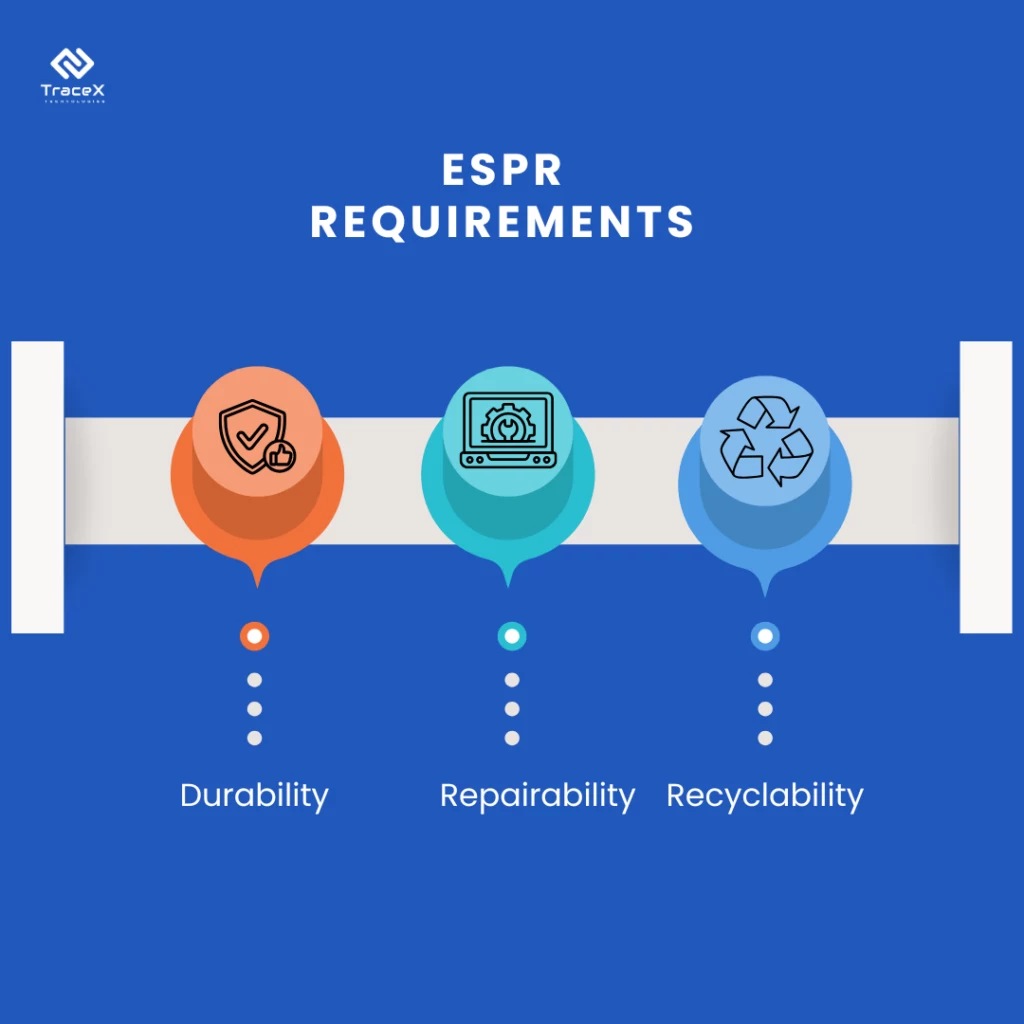
Durability, Reparability, and Recyclability
Durability: Products must be designed to last longer, reducing premature replacement and waste. ESPR evaluates mechanical, chemical, and functional lifespans based on intended use.
Reparability: Components should be easy to replace or repair, with accessible spare parts and repair manuals, enabling consumers and service providers to extend product life.
Recyclability: Products must be designed for end-of-life recovery, including separation of materials, labeling for recyclers, and minimizing mixed-material assemblies that hinder circularity.
Energy Efficiency Standards
ESPR expands energy-related design beyond appliances to all product categories where energy use is relevant.
Operational energy consumption, including standby and auxiliary power, must meet thresholds defined in delegated acts.
These standards reduce lifecycle greenhouse gas emissions and support EU climate goals.
Material Transparency and Environmental Footprint Metrics
Material Declaration: Companies must disclose all substances, components, and critical raw materials.
Environmental Footprint: ESPR encourages quantified assessments of carbon footprint, water usage, and resource intensity.
Restricted Substances Compliance: Ensures products avoid harmful chemicals, aligning with REACH and other EU chemical regulations.
Information Requirements for Manufacturers and Importers
Digital Product Passport (DPP): For many product categories, ESPR mandates a digital record containing durability, reparability, material composition, and end-of-life instructions.
Labels and User Instructions: Products must provide clear guidance on repair, maintenance, and recycling to consumers and service providers.
Compliance Documentation: Manufacturers and importers must retain records demonstrating adherence to ESPR criteria for audits and market surveillance.
By enforcing durability, reparability, recyclability, energy efficiency, and material transparency, ESPR ensures products are sustainable from design to end-of-life, enabling circular economy practices and regulatory compliance across the European Union.
ESPR & Compliance: Ensuring Your Products Meet EU Sustainability Standards
The Ecodesign for Sustainable Products Regulation (ESPR) introduces rigorous compliance obligations for manufacturers, importers, and distributors to ensure that all products entering the EU market meet environmental and circular economy standards. Understanding and implementing these requirements is critical to avoid penalties, market restrictions, and reputational damage.
Compliance Checklist and Mandatory Documentation
Product Assessment: Companies must verify that products comply with durability, reparability, recyclability, energy efficiency, and material transparency requirements.
Technical Documentation: Maintain detailed records including design data, material composition, environmental footprint calculations, and repair manuals.
Digital Product Passport (DPP): For applicable categories, a digital record must be created, storing information on product lifecycle, sustainability features, and end-of-life handling.
Audit Readiness: Documentation should be readily accessible for EU market surveillance authorities to inspect compliance.
Penalties and Enforcement Mechanisms
Market Surveillance: EU authorities can perform random checks or investigations to ensure products meet ESPR standards.
Non-Compliance Consequences: Violations can result in fines, product recalls, sales bans, or restrictions on market access.
Corrective Actions: Companies may be required to update labeling, repair instructions, or redesign products to achieve compliance.
Compliance Considerations for SMEs
Resource Constraints: Small and medium enterprises may face challenges in technical documentation, lifecycle assessments, and DPP integration.
Support Mechanisms: SMEs are encouraged to leverage consultants, shared platforms, and ESPR guidance tools to simplify compliance while minimizing costs.
Gradual Adoption: Pilot implementation for a few product lines can help SMEs scale compliance processes effectively.
Manufacturer vs Importer Obligations
Manufacturers: Responsible for design compliance, technical documentation, and providing repair & recycling instructions.
Importers: Must ensure products sourced outside the EU comply with ESPR, verify documentation, and maintain traceability for market surveillance.
Distributors: Obliged to pass on relevant product information and avoid placing non-compliant items on the market.
By adhering to the ESPR compliance framework, companies can mitigate regulatory risk, safeguard market access, and position products as sustainable and circular, aligning with evolving EU environmental standards.
Digital Product Passport (DPP) Under ESPR
The Digital Product Passport (DPP) is a cornerstone of the Ecodesign for Sustainable Products Regulation (ESPR), designed to make product sustainability data traceable, verifiable, and accessible across the value chain. It fundamentally changes how products are documented, sold, and regulated in the EU.
Why DPP Is Mandatory and Its Role in Traceability
Under ESPR, the DPP is mandatory for regulated product groups to ensure transparency across the product lifecycle. The DPP:
Links materials, components, and suppliers to a specific product or batch
Provides proof of compliance with durability, reparability, recyclability, and environmental footprint requirements
Enables market surveillance authorities, buyers, and recyclers to access trusted sustainability data
Prevents greenwashing by tying sustainability claims to verifiable, product-level data
In practice, the DPP becomes the single source of truth for sustainability, compliance, and circularity information.
Rules and Standards for Data Capture and Interoperability
ESPR mandates that DPP data must be:
Structured and machine-readable (not PDFs or static documents)
Interoperable across systems, platforms, and borders
Accessible via standardized identifiers such as QR codes or digital links
Key data categories include:
Product identification and origin
Material composition and hazardous substances
Environmental footprint and performance indicators
Repair, reuse, and recycling instructions
Compliance declarations
The EU is aligning DPP standards with open data models, APIs, and international norms to ensure seamless data exchange across manufacturers, importers, distributors, and regulators.
Timeline for DPP Adoption and Implementation Strategies
2026 onward: DPP becomes mandatory by product group, starting with high-impact sectors
Phased rollout: Companies must comply as their product categories are regulated
Implementation best practices:
Start with data mapping across design, sourcing, and manufacturing
Replace spreadsheets with digital traceability platforms
Ensure suppliers can contribute verified data
Design DPP systems that scale across products and geographies
Under ESPR, the Digital Product Passport is not just a compliance requirement it is the digital backbone of sustainable product markets, enabling transparency, trust, and circularity at scale.
How Technology Platforms Support ESPR Compliance
Technology platforms play a critical role in enabling ESPR compliance by turning complex regulatory requirements into operational, auditable workflows. As ESPR introduces product-level sustainability rules and mandates the Digital Product Passport (DPP), companies can no longer rely on manual documentation or fragmented systems.
Centralized ESG & Product Data Management
ESPR requires structured, product-specific data on materials, durability, recyclability, and environmental footprint. Digital platforms consolidate data from suppliers, manufacturing, logistics, and compliance teams into a single system of record eliminating silos and inconsistencies.
Digital Product Passport (DPP) Enablement
Technology platforms generate and maintain ESPR-compliant DPPs, ensuring:
Machine-readable, interoperable data
Secure access for regulators, buyers, and recyclers
Version control as delegated acts evolve
End-to-End Traceability
ESPR compliance depends on proof of origin and material transparency. Traceability platforms link:
Raw materials → components → finished products
Supplier declarations → verified sustainability attributes This ensures sustainability claims are backed by verifiable product-level data, not averages.
Automated Compliance & Audit Readiness
Platforms replace spreadsheets with:
Automated checks against ESPR requirements
Immutable audit trails
Rapid response to market surveillance and inspections
How a Digital Product Passport Solution Enables ESPR-Ready Compliance
To operationalize the Ecodesign for Sustainable Products Regulation (ESPR), companies need a digital foundation that bridges the gap between physical products and their lifecycle data. A specialized digital product passport solution provides the necessary framework to:
Implement Product and Batch-Level Traceability: Track materials across complex, multi-tier supply chains to meet granular data requirements.
Align with Interoperability Standards: Utilize a digital product passport architecture that is structured to be machine-readable and compatible with EU-wide standards.
Establish Blockchain-Backed Audit Trails: Ensure data integrity and prevent manipulation through immutable records of sustainability claims.
Enable Supplier Collaboration: Use integrated tools to capture verified material data directly at the source, from raw fiber to final assembly.
Scale with Regulatory Evolution: Deploy compliance workflows that automatically adapt as new ESPR delegated acts are introduced for specific product categories.
Moving Beyond Reactive Compliance
By connecting traceability and sustainability data in one unified platform, businesses can move from a defensive regulatory posture to a future-proof product strategy. Leveraging a robust digital product passport solution ensures that your brand isn’t just checking a box, but is actively participating in the transition to a circular economy.
ESPR is a data regulation at its core.
Technology platforms and specifically traceability-led solutions from TraceX are essential to meet ESPR requirements efficiently, credibly, and at scale.
ESPR as the Foundation of Europe’s Sustainable Product Future
The Ecodesign for Sustainable Products Regulation (ESPR) marks a structural shift in how products are designed, marketed, and regulated in the EU. By embedding durability, transparency, and traceability into product requirements and mandating Digital Product Passports ESPR moves sustainability from voluntary claims to enforceable standards. For manufacturers, importers, and brands, early adoption of digital, traceability-led compliance is no longer optional. Those who act now will not only reduce regulatory risk but also gain long-term competitiveness in an increasingly circular, data-driven EU market.
Read our guide to product traceability and learn how end-to-end visibility improves compliance, recall readiness, and buyer trust.
Explore how material traceability works from raw inputs to finished products and why it’s critical for sustainability and regulatory reporting.
Understand the EU Green Deal’s impact on supply chains and what new regulations mean for manufacturers and importers.
Frequently Asked Questions (FAQ’s)
When does ESPR come into force and who must comply?
ESPR entered into force in 2024, with requirements rolling out through delegated acts by product category. All manufacturers, importers, and distributors placing products on the EU market will be subject to compliance.
Is the Digital Product Passport mandatory under ESPR?
Yes. The Digital Product Passport is a core ESPR requirement for regulated product groups, enabling transparency on materials, sustainability attributes, and compliance data across the product lifecycle.
How should companies prepare for ESPR compliance?
Companies should begin by mapping product data gaps, digitizing sustainability and material information, and implementing traceability and DPP-ready platforms to ensure audit-ready compliance as requirements evolve.
Start using TraceX
Transparency, Trust, & Success for your Climate Journey.
We use cookies on our website to give you the most relevant experience by remembering your preferences and repeat visits. By clicking “Accept All”, you consent to the use of ALL the cookies. However, you may visit "Cookie Settings" to provide a controlled consent.
This website uses cookies to improve your experience while you navigate through the website. Out of these, the cookies that are categorized as necessary are stored on your browser as they are essential for the working of basic functionalities of the website. We also use third-party cookies that help us analyze and understand how you use this website. These cookies will be stored in your browser only with your consent. You also have the option to opt-out of these cookies. But opting out of some of these cookies may affect your browsing experience.
Necessary cookies are absolutely essential for the website to function properly. These cookies ensure basic functionalities and security features of the website, anonymously.
Cookie
Duration
Description
cookielawinfo-checkbox-analytics
11 months
This cookie is set by GDPR Cookie Consent plugin. The cookie is used to store the user consent for the cookies in the category "Analytics".
cookielawinfo-checkbox-functional
11 months
The cookie is set by GDPR cookie consent to record the user consent for the cookies in the category "Functional".
cookielawinfo-checkbox-necessary
11 months
This cookie is set by GDPR Cookie Consent plugin. The cookies is used to store the user consent for the cookies in the category "Necessary".
cookielawinfo-checkbox-others
11 months
This cookie is set by GDPR Cookie Consent plugin. The cookie is used to store the user consent for the cookies in the category "Other.
cookielawinfo-checkbox-performance
11 months
This cookie is set by GDPR Cookie Consent plugin. The cookie is used to store the user consent for the cookies in the category "Performance".
viewed_cookie_policy
11 months
The cookie is set by the GDPR Cookie Consent plugin and is used to store whether or not user has consented to the use of cookies. It does not store any personal data.
Functional cookies help to perform certain functionalities like sharing the content of the website on social media platforms, collect feedbacks, and other third-party features.
Performance cookies are used to understand and analyze the key performance indexes of the website which helps in delivering a better user experience for the visitors.
Analytical cookies are used to understand how visitors interact with the website. These cookies help provide information on metrics the number of visitors, bounce rate, traffic source, etc.
Advertisement cookies are used to provide visitors with relevant ads and marketing campaigns. These cookies track visitors across websites and collect information to provide customized ads.
Download the 2026 Traceability Scorecard and Benchmark Your Supply Chain Across 10 Critical Capabilities.
Download our eBook
Don’t Wait for an Audit to Find Your EUDR Gaps
The 2026 Simplification Package changes how HS codes, DDS pass-through and geolocation rules apply to you. Get the free guide and 20-point readiness checklist before enforcement catches you unprepared.