EUDR for Oleochemical Importers: Compliance for Palm Oil Derivatives
Published
, 12 minute read
Share this article
Quick summary: EUDR compliance in the oleochemical industry learn how to ensure deforestation-free sourcing, manage supplier data, and streamline DDS submission to protect EU market access.
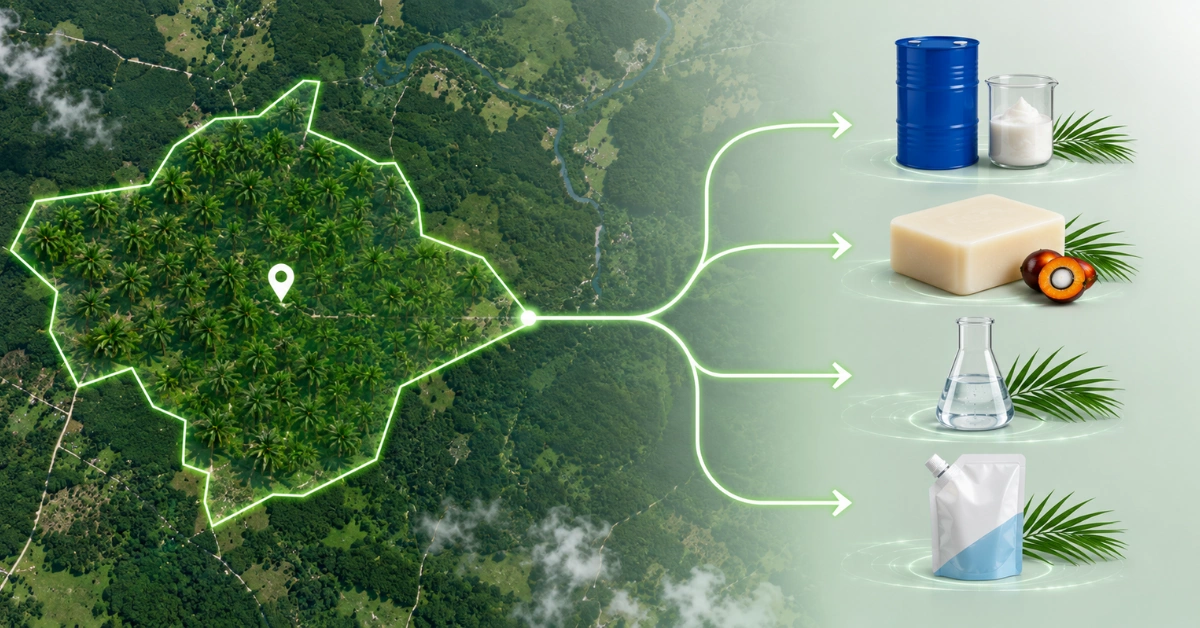
EUDR for oleochemical importers mandates that every palm-derived product placed on the EU market, including fatty acids, fatty alcohols, glycerine, soap, surfactants, and quaternary ammonium compounds, is traceable to plantation-level GPS polygons and was not produced on land deforested after 31 December 2020.
As of December 2025, the EU Council adopted Regulation (EU) 2025/2650, postponing the application of EUDR to:
30 December 2026 — for large and medium operators/traders
30 June 2027 — for micro and small operators
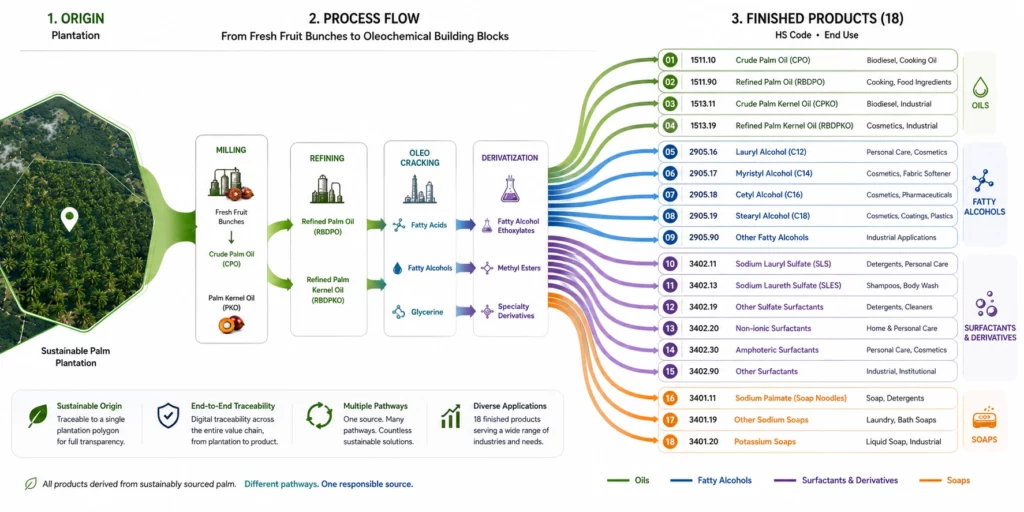
Eighteen palm-oil-derivative HS codes (covering fatty acids, fatty alcohols, esters, glycerol, soaps, surfactants, and polyethers) are now in scope. RSPO and ISCC certifications support risk mitigation but do NOT replace the Due Diligence Statement (DDS) requirement.
EUDR + OLEOCHEMICALS — KEY STATS (2026)€22.4B → €42B Europe palm oil market growing at 7.23% CAGR (2024–2033) 64% of EU palm oil imports originate from Indonesia and Malaysia both flagged for traceability gaps 34% of EU palm oil imports are likely linked to deforested land (European Commission impact assessment) €50–€120 / MT estimated EUDR compliance cost for palm oil derivatives 4% of EU annual turnover maximum penalty for EUDR non-compliance + shipment seizure 60–65% of EU palm-derivative contracts will require geolocation + 3rd-party certification by 2028 (up from ~35% in 2024)
Want to see how your current supplier data stacks up against EUDR’s plot-level polygon requirement before your first DDS deadline?
Every palm-oil-derivative HS code now in scope under EUDR (with examples)
If your customs declarations include any of the codes below, your shipment is subject to EUDR even when the palm content has been chemically transformed beyond recognition. Each finished oleochemical must be traceable back to the plantation plots where the original palm fruit was grown.
HS Code
Product
Typical use case
Why traceability breaks
ex 1516 20
Palm, palm kernel, and babassu oils (hydrogenated/inter-esterified)
Note: The ‘ex’ prefix means partial coverage — only the portion of the HS code linked to palm-oil-derived content falls under EUDR. Your tariff classification team must work with sustainability/compliance to identify which line items are affected.
Why Oleochemical derivatives are uniquely hard to trace under EUDR
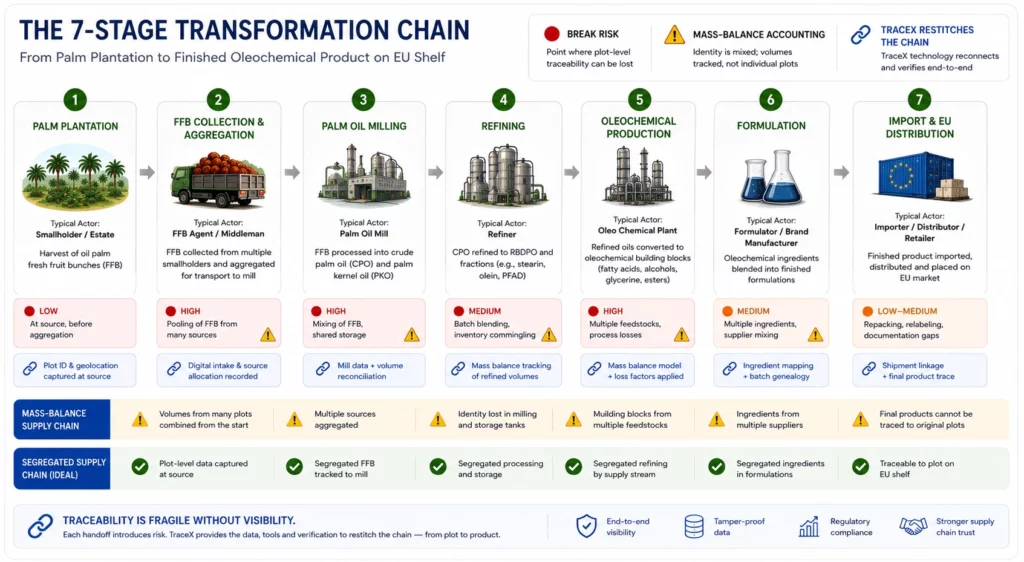
A crude palm oil shipment moves from plantation → mill → refinery in 2–3 hops. An oleochemical product moves through up to 7 transformation stages, crosses multiple processors and borders, and is often mass-balanced rather than physically segregated. By the time a fatty alcohol or a quat reaches the EU, the original plantation polygon has typically been lost.
The chain-of-custody break points
Smallholder farm → FFB aggregator: aggregators collect Fresh Fruit Bunches from hundreds of farms. Without digital onboarding, plot-level data is lost at the first hop.
Refinery → fatty acid splitter: crude palm oil is hydrolyzed into fatty acids and glycerol. Origin is now an audit trail, not a physical property.
Fatty acid → fatty alcohol (hydrogenation): another transformation, another mass-balance ledger.
Fatty alcohol → surfactant / quat / ester: derivatization step at a chemical manufacturer that may source from 5+ upstream suppliers.
Formulator → finished product: a soap bar or fabric softener may contain palm-derived inputs from 10+ original mills.
EU operator places product on market: must file DDS referencing every original plantation polygon.
This is the gap RSPO and ISCC do not close. Both schemes verify practices at the mill or cooperative level. EUDR demands evidence at the plot (polygon) level, validated against satellite deforestation data with a 31 December 2020 cut-off.
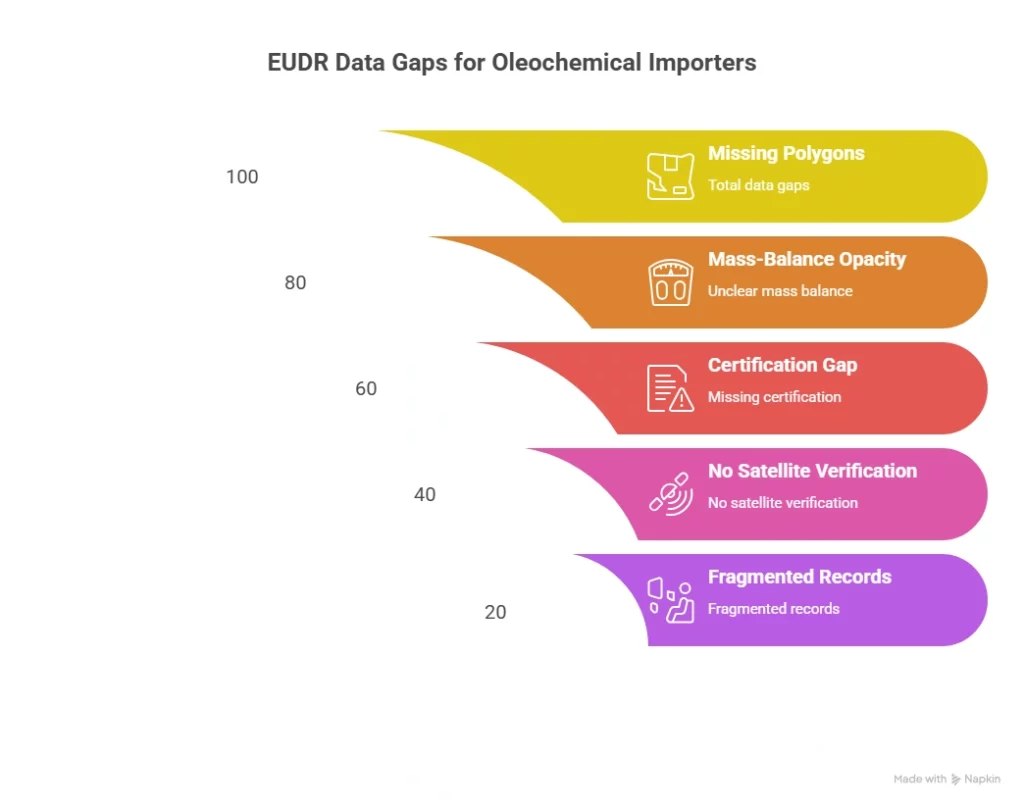
The 5 EUDR data gaps stopping oleochemical importers from filing a defensible DDS
These are the five gaps we see most often when reviewing supplier data for oleochemical importers. Each one needs to close before a Due Diligence Statement can be submitted on TRACES.
Gap 1 — No plot-level polygons from upstream mills
Pain: Your mill supplier sends a certificate that says ‘RSPO Mass Balance.’ That is not a polygon. EUDR requires latitude/longitude for every plot of land that contributed to the shipment. Without polygons, you cannot run the deforestation risk check, and the DDS will be rejected.
What good looks like: GeoJSON polygons (or single-point coordinates for plots under 4 hectares) covering 100% of the FFB volume in your shipment. Linked to mill-level transaction records.
Proof: Operators that have onboarded suppliers digitally including smallholder cooperatives are filing DDS in under 5 working days. Manual collection takes 6–12 weeks per supplier tier.
Gap 2 — Mass-balance accounting masks plot origin
Pain: Most oleochemical supply chains operate on mass balance. The molecules in your fatty alcohol drum cannot be physically linked to a specific plantation. EUDR requires you to demonstrate that the volume placed on the market is matched by an equivalent volume of verified deforestation-free input upstream.
What good looks like: A digital ledger that records every input volume, its plot of origin, and every transformation event with timestamps. Auditable from finished SKU back to plantation.
Proof: Operators using blockchain-anchored transaction records can demonstrate volume reconciliation to EU competent authorities in hours, not weeks.
Gap 3 — RSPO / ISCC certificates treated as DDS equivalent
Pain: Procurement teams often assume an RSPO Segregated or ISCC EU certificate equals EUDR compliance. It does not. RSPO uses a 2007 deforestation cut-off; EUDR uses 31 December 2020. ISCC focuses on GHG emissions and biodiversity, not plot-level deforestation evidence.
What good looks like: Certification is treated as a risk-reduction signal that feeds into your overall risk assessment alongside satellite imagery, country risk classification, and supplier history.
Proof: The European Forest Institute’s gap analysis of MSPO vs EUDR identified information gaps in deforestation, legality, geolocation, and traceability. The same gaps apply to RSPO and ISCC.
Gap 4 — No satellite verification of plot deforestation status
Pain: Even with polygons in hand, you still have to prove no deforestation occurred after 31 December 2020. EU competent authorities will cross-check your DDS against satellite data. If a plot shows recent forest loss, the shipment is blocked.
What good looks like: Automated satellite verification (Hansen Global Forest Change, JRC Tropical Moist Forest, Planet Labs) for every polygon in your supply base, with continuous monitoring for new alerts.
Proof: Operators with real-time satellite alerts catch deforestation events at the polygon level within 24 hours before contaminated lots ship.
Gap 5 — Transformation records that survive audit
Pain: EU operators must keep DDS records for 5 years. Most oleochemical companies have transformation data scattered across ERP, lab notebooks, certificates of analysis, and supplier emails. Reconstructing a single shipment’s traceability for an audit takes weeks.
What good looks like: A single audit-ready system that links the finished product batch → all transformation events → all input lots → all upstream polygons, with original-source documents attached.
Proof: Audit response times drop from weeks to under an hour when the chain is digitally stitched at the time of transaction (not reconstructed post-hoc).
How many of these five data gaps are open in your current EUDR readiness assessment?
Get a free TraceX EUDR readiness scorecard — we’ll benchmark your supplier data, certification coverage, and DDS readiness against the EU TRACES requirements.
What a compliant Due Diligence Statement for palm derivatives must contain
Under Article 8 of Regulation (EU) 2023/1115, every DDS for an oleochemical product placed on the EU market whether soap, surfactant, fatty alcohol, or glycerine must include the following:
How TraceX closes the EUDR gap for oleochemical importers
TraceX EUDR Solutions is built for commodities including palm and its derivatives that move through complex, multi-tier, mass-balanced supply chains. The platform links every transformation event to the original plantation polygon, runs continuous satellite verification, and auto-generates DDS submissions in the EU TRACES format.
EUDR requirement
TraceX capability
Benefit for oleochemical importers
Plot-level geolocation
GPS polygon collection via mobile app for smallholders + bulk import for estates; auto-validation against country borders
Onboard a full supplier tier in <14 days vs. 6–12 weeks manually
Deforestation risk verification
Automated satellite layer (Hansen + JRC TMF + Planet) per polygon, with continuous monitoring & alerts
Catch new forest loss within 24 hours; quarantine affected lots before shipment
Supplier onboarding & data collection
Tier-aware supplier portal with multi-language UI; KYC, certificates, polygons, and transaction data in one record
70% reduction in DDS prep time across the supply base
Reconstruct any finished-SKU’s polygon trail in <1 hour, not weeks
Mass-balance reconciliation
Volume accounting engine that matches compliant input volume against output volume, by SKU and shipment
Demonstrate volume integrity to EU competent authorities on demand
DDS generation & TRACES submission
Auto-populated DDS in EU TRACES format; bulk submission and amendment workflow
Cut DDS filing time from days to minutes per shipment
5-year audit trail
Immutable, timestamped records (blockchain-optional) with attached source documents
Audit response time drops from weeks to <1 hour
Ready to see how a defensible DDS for your top-10 SKUs would actually be built — using your real supplier data?
In a 30-minute working session with the TraceX EUDR team, we’ll map your HS codes to your suppliers, identify the polygon gaps, and walk through a sample DDS for one of your SKUs.
EUDR 2026 enforcement timeline what oleochemical importers need to do, and by when
The EU Council adopted Regulation (EU) 2025/2650 in December 2025, postponing EUDR application by 12 months. This is the current legally binding timeline.
Penalties for non-compliance
Up to 4% of annual EU turnover per infringement
Confiscation of non-compliant products and revenues
Temporary exclusion from EU public procurement and EU funding (up to 12 months)
Temporary ban on placing relevant commodities/products on the EU market
Public naming of infringing operators (reputational risk for brand-owning customers of your oleochemicals)
The bottom line for oleochemical importers
If you import any product carrying one of the 18 HS codes listed above into the EU, you have approximately 7 months to onboard your supply base, collect plot-level polygons, run satellite risk verification, and prove you can generate a defensible Due Diligence Statement on TRACES. Operators that wait until Q4 2026 to start will not make the deadline supplier onboarding for tier-2+ palm supply chains routinely takes 8–12 weeks per tier even with digital tooling.
The companies that are ready are doing three things now:
Mapping their HS codes and identifying every line item with palm-derived content
Onboarding upstream mills, refiners, and aggregators into a single digital traceability system
Running test DDS submissions on TRACES against current data and fixing gaps quarter by quarter
Frequently Asked Questions: EUDR Compliance for Oleochemicals
Are palm oil derivatives like fatty acids and fatty alcohols actually in scope of EUDR?
Yes. EUDR applies to palm oil and “relevant products” derived from it. The annex to Regulation (EU) 2023/1115 as amended lists 18 HS codes covering fatty acids, fatty alcohols, glycerol, esters, quats, soaps, surfactants, and polyethers. If your product carries any of these HS codes and the input is palm-derived, you must file a DDS.
Does my RSPO Segregated or ISCC EU certificate satisfy EUDR?
No. RSPO and ISCC verify sustainability practices at the mill or cooperative level. EUDR requires plot-level geolocation polygons, a 31 December 2020 deforestation cut-off, and a Due Diligence Statement filed in EU TRACES. Certification supports risk mitigation but does not replace any of these legal requirements.
I import a finished oleochemical from a non-EU supplier — am I the operator or the trader?
If your EU entity is the first to place the product on the EU market, you are the operator and you carry the full DDS obligation. If you receive the product from another EU operator who has already filed DDS, you are a downstream trader with reduced obligations under the 2025 revision.
What geolocation accuracy does EUDR require for palm oil plots?
Polygons (latitude/longitude vertices) for every plot larger than 4 hectares. For plots of 4 hectares or less, a single coordinate point is sufficient. The data must cover 100% of the volume placed on the market — no exceptions for hard-to-trace smallholder supply.
What happens if one polygon in my supply base shows post-2020 deforestation?
That specific lot of FFB cannot be placed on the EU market. You must exclude it from your DDS or restructure the supply to a compliant alternative source. EU competent authorities can cross-check your DDS against independent satellite data; mis-declaration is itself a violation.
How long do I need to keep DDS records?
Five years from the date the product was placed on the EU market. Records include polygons, satellite verification, supplier declarations, transformation logs, and risk assessment documentation.
Will the EUDR deadline move again?
The December 2025 Council revision postponed application to 30 December 2026 for large/medium operators and 30 June 2027 for micro/small operators.. Core due diligence and traceability obligations were not relaxed only the start date moved and some downstream simplifications were added.
I’m an oleochemical manufacturer based outside the EU does EUDR apply to me?
Indirectly, yes. EUDR applies to operators placing product on the EU market. As an upstream supplier you must provide the polygon and traceability data your EU customer needs to file their DDS otherwise they will source elsewhere. Most EU buyers are now writing EUDR data clauses into supply contracts for HS 1516, 1520, 2905, 2915, 3401, and 3824 categories.
Can mass-balance accounting still be used under EUDR?
Yes, but with a critical constraint: the compliant input volume entering your transformation step must equal or exceed the output volume you declare as compliant. You need a digital volume reconciliation engine that links input polygons to output lots not a paper ledger.
What’s the difference between EUDR and the UK Forest Risk Commodities (FRC) rules?
EUDR applies to imports into the EU; UK FRC (under Schedule 17 of the Environment Act 2021) applies to UK businesses above a turnover threshold. UK FRC currently does not require plot-level polygons or DDS but UK-based oleochemical exporters to the EU still face EUDR via their EU buyers.
Start using TraceX
Transparency, Trust, & Success for your Climate Journey.
We use cookies on our website to give you the most relevant experience by remembering your preferences and repeat visits. By clicking “Accept All”, you consent to the use of ALL the cookies. However, you may visit "Cookie Settings" to provide a controlled consent.
This website uses cookies to improve your experience while you navigate through the website. Out of these, the cookies that are categorized as necessary are stored on your browser as they are essential for the working of basic functionalities of the website. We also use third-party cookies that help us analyze and understand how you use this website. These cookies will be stored in your browser only with your consent. You also have the option to opt-out of these cookies. But opting out of some of these cookies may affect your browsing experience.
Necessary cookies are absolutely essential for the website to function properly. These cookies ensure basic functionalities and security features of the website, anonymously.
Cookie
Duration
Description
cookielawinfo-checkbox-analytics
11 months
This cookie is set by GDPR Cookie Consent plugin. The cookie is used to store the user consent for the cookies in the category "Analytics".
cookielawinfo-checkbox-functional
11 months
The cookie is set by GDPR cookie consent to record the user consent for the cookies in the category "Functional".
cookielawinfo-checkbox-necessary
11 months
This cookie is set by GDPR Cookie Consent plugin. The cookies is used to store the user consent for the cookies in the category "Necessary".
cookielawinfo-checkbox-others
11 months
This cookie is set by GDPR Cookie Consent plugin. The cookie is used to store the user consent for the cookies in the category "Other.
cookielawinfo-checkbox-performance
11 months
This cookie is set by GDPR Cookie Consent plugin. The cookie is used to store the user consent for the cookies in the category "Performance".
viewed_cookie_policy
11 months
The cookie is set by the GDPR Cookie Consent plugin and is used to store whether or not user has consented to the use of cookies. It does not store any personal data.
Functional cookies help to perform certain functionalities like sharing the content of the website on social media platforms, collect feedbacks, and other third-party features.
Performance cookies are used to understand and analyze the key performance indexes of the website which helps in delivering a better user experience for the visitors.
Analytical cookies are used to understand how visitors interact with the website. These cookies help provide information on metrics the number of visitors, bounce rate, traffic source, etc.
Advertisement cookies are used to provide visitors with relevant ads and marketing campaigns. These cookies track visitors across websites and collect information to provide customized ads.
Download the 2026 Traceability Scorecard and Benchmark Your Supply Chain Across 10 Critical Capabilities.
Download our eBook
Don’t Wait for an Audit to Find Your EUDR Gaps
The 2026 Simplification Package changes how HS codes, DDS pass-through and geolocation rules apply to you. Get the free guide and 20-point readiness checklist before enforcement catches you unprepared.