Germany is Europe’s largest food manufacturing market, supplying packaged food products across the European Union and international markets. From dairy, bakery, beverages, confectionery, meat processing, frozen foods, and ready-to-eat meals to coffee and spices, packaging plays a critical role in protecting products, maintaining quality, and ensuring efficient distribution.
Today, packaging is no longer evaluated solely on functionality or cost. It has become a central focus of European sustainability policy.
The Packaging and Packaging Waste Regulation (PPWR) introduces a harmonized regulatory framework that fundamentally changes how packaging is designed, manufactured, documented, and managed throughout its lifecycle. Unlike the previous Packaging Directive, PPWR is a directly applicable EU regulation, creating consistent packaging requirements across all Member States, including Germany.
For food manufacturers, compliance extends well beyond reducing plastic usage or lightweighting packaging. Organizations must demonstrate that packaging has been optimized, designed for recyclability, supported by comprehensive technical documentation, and aligned with emerging requirements for recycled content, labeling, and producer responsibility.
Businesses that begin preparing now will be better positioned to reduce compliance risks, improve operational efficiency, strengthen retailer relationships, and meet growing consumer expectations for sustainable packaging.
In this guide, we’ll explore what PPWR means for food manufacturers in Germany, the key compliance requirements, implementation challenges, and how digital solutions can simplify packaging governance.
Key Takeaways
- PPWR applies to all packaging placed on the EU market, including primary, secondary, and transport packaging used by food manufacturers.
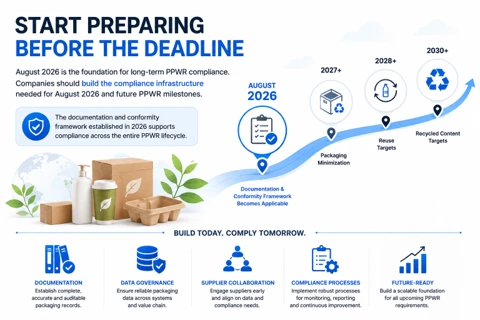
- Core provisions begin applying from 12 August 2026, with additional obligations phased in over subsequent years.
- Manufacturers must optimize packaging design, improve recyclability, maintain technical documentation, and collaborate closely with packaging suppliers.
- Successful compliance requires centralized packaging data, supplier documentation, and continuous governance rather than disconnected spreadsheets.
- Digital platforms help organizations streamline packaging information management, supplier collaboration, and audit readiness.
What is the Packaging and Packaging Waste Regulation (PPWR)?
The Packaging and Packaging Waste Regulation (PPWR) is the European Union’s new legislative framework designed to reduce packaging waste, promote circularity, and improve the sustainability of packaging placed on the EU market.
Unlike the previous Packaging and Packaging Waste Directive, which allowed Member States to implement different national rules, PPWR establishes a harmonized set of packaging requirements applicable across all EU countries.
The regulation covers the entire packaging lifecycle, including:
- Packaging design
- Packaging minimization
- Design for recyclability
- Recycled content
- Packaging labeling
- Technical documentation
- Packaging conformity assessment
- Extended Producer Responsibility (EPR)
- Reuse obligations for applicable packaging categories
The objective is to minimize unnecessary packaging while ensuring materials remain in the circular economy for as long as possible.
For Germany’s food industry, PPWR represents one of the most significant packaging regulatory changes in recent decades, requiring manufacturers to rethink packaging governance across product development, procurement, operations, sustainability, and compliance functions.
Do You Know Your Responsibilities Under PPWR?
Understanding your responsibilities as an economic operator is the first step toward building a successful PPWR compliance strategy.
Read our complete guide to PPWR Roles & Responsibilities.
Why PPWR Matters for Food Manufacturers in Germany
Germany is Europe’s largest producer of packaged food products and one of the region’s leading exporters. Every year, millions of products are packaged using plastics, paperboard, glass, aluminum, steel, flexible laminates, and composite materials before reaching retailers, food service providers, and consumers.
This makes food manufacturers one of the sectors most affected by PPWR.
Packaging is no longer judged only by its ability to protect products or reduce costs. Regulators, retailers, and consumers increasingly expect manufacturers to demonstrate that packaging has been intentionally designed to minimize waste while supporting circular economy objectives.
For many organizations, this means reviewing packaging portfolios that have remained unchanged for years and strengthening collaboration with suppliers to improve packaging performance.
Key focus areas include:
- Eliminating unnecessary packaging components
- Improving packaging recyclability
- Increasing recycled material usage where required
- Maintaining detailed packaging specifications
- Collecting supplier declarations
- Managing technical documentation
- Demonstrating compliance during audits and customer assessments
For manufacturers operating across multiple production facilities or selling in several EU markets, managing these requirements manually can quickly become complex.
Planning your PPWR compliance journey? Learn how leading manufacturers are digitizing packaging compliance and preparing for the 2026 requirements.
→ Visit the PPWR for Manufacturers Hub
Which Food Manufacturers Are Affected?
PPWR impacts virtually every food manufacturer placing packaged products on the EU market, regardless of company size. Whether you’re an established multinational or a growing regional brand, compliance becomes essential if your products reach European consumers.
Industries affected include:
- Dairy manufacturers
- Bakery and confectionery producers
- Beverage manufacturers
- Meat and seafood processors
- Frozen food manufacturers
- Ready-to-eat meal producers
- Snack manufacturers
- Coffee and tea processors
- Chocolate manufacturers
- Spice manufacturers
- Edible oil producers
- Fruit and vegetable processors
- Organic food brands
- Private label manufacturers
- Contract food manufacturers
The regulation also covers virtually every packaging format, including plastic and glass bottles, metal cans, cartons, flexible pouches, corrugated boxes, trays, labels, shrink wrap, pallets, and transport packaging.
Simply put, if your business places packaged food products on the EU market, PPWR should already be part of your compliance strategy.
Understand Your Packaging Scope Before You Begin
Identifying which packaging formats fall under PPWR is the first step toward building a successful compliance program.
Explore our complete PPWR Scope Guide.
Key PPWR Requirements for Food Manufacturers
1. Packaging Minimization
PPWR requires packaging to contain only the material necessary to protect, transport, preserve, and market the product.
Manufacturers should evaluate opportunities to:
- Eliminate unnecessary packaging components
- Reduce excessive headspace
- Optimize packaging dimensions
- Lower material consumption
- Minimize empty space in transport packaging
Besides supporting compliance, optimized packaging can reduce material usage, transportation costs, and environmental impact.
2. Design for Recyclability
Packaging should be designed so it can be effectively collected, sorted, and recycled within existing recycling systems.
Food manufacturers should assess whether packaging:
- Uses recyclable materials
- Avoids difficult-to-recycle material combinations
- Supports efficient sorting processes
- Aligns with future recyclability performance requirements
Making informed design decisions today will help organizations remain compliant as EU recyclability standards continue to evolve.
3. Recycled Content Requirements
PPWR introduces mandatory recycled content targets for specific categories of plastic packaging.
To prepare, manufacturers should:
- Identify plastic packaging across product portfolios
- Understand current recycled content levels
- Obtain declarations from packaging suppliers
- Maintain evidence supporting compliance
- Monitor future regulatory updates
Meeting these requirements will require close collaboration with packaging suppliers while ensuring food safety and product quality remain uncompromised.
4. Packaging Labeling and Consumer Information
PPWR aims to improve consumer understanding of how packaging should be sorted, recycled, or disposed of.
Depending on packaging type, manufacturers may need to provide information relating to:
- Material composition
- Recycling instructions
- Packaging identification
- Appropriate disposal methods
- Reuse systems, where applicable
For businesses managing hundreds or thousands of SKUs, maintaining consistent labeling across multiple markets requires strong packaging data governance.
5. Technical Documentation and Compliance Records
One of PPWR’s most significant changes is the requirement to maintain comprehensive technical documentation demonstrating packaging compliance.
Rather than scattered files and spreadsheets, organizations will need structured, accessible records that can be produced quickly during audits or customer requests.
Technical documentation is more than paperwork it’s the evidence behind your compliance.
Read our complete guide to PPWR Technical Documentation.
6. Extended Producer Responsibility (EPR)
Extended Producer Responsibility (EPR) remains an important component of packaging compliance across Europe.
Food manufacturers placing packaged products on the EU market are responsible for accurately reporting packaging placed on the market and meeting applicable producer responsibility obligations.
While EPR continues to be administered at the Member State level, PPWR complements these systems by introducing harmonized packaging design and documentation requirements across the European Union.
Reliable packaging data will become essential for both EPR reporting and PPWR compliance.
Common PPWR Compliance Challenges
Many food manufacturers already maintain packaging information within ERP, PLM, or quality management systems. However, critical packaging data is often fragmented across procurement, R&D, sustainability, quality assurance, regulatory affairs, and manufacturing teams.
Common challenges include:
- Packaging data spread across multiple systems
- Difficulty collecting supplier information
- Inconsistent packaging specifications across sites
- Limited visibility into packaging composition
- Manual document management
- Version control issues
- Lengthy audit preparation
- Limited cross-functional collaboration
- Difficulty responding to retailer and customer requests
As packaging regulations become more complex, manual processes and disconnected documentation are unlikely to provide the governance required for long-term compliance.
How TraceX Simplifies PPWR Compliance
Preparing for PPWR requires more than collecting documents it requires a structured approach to managing packaging information across the organization.
TraceX PPWR Solutions helps food manufacturers centralize packaging data, supplier collaboration, technical documentation, and compliance records within a single digital platform.
With TraceX, organizations can:
- Centralize packaging specifications and material data
- Streamline supplier collaboration and declarations
- Maintain audit-ready technical documentation
- Improve packaging data quality and governance
- Reduce manual effort through digital workflows
- Build a scalable foundation for future regulatory requirements
By digitizing packaging compliance, manufacturers can improve efficiency while remaining prepared for evolving EU regulations.

Conclusion
The Packaging and Packaging Waste Regulation represents a significant shift in how packaging is managed across the European Union. For Germany’s food manufacturers, compliance is no longer limited to selecting sustainable materials it requires a comprehensive approach to packaging design, supplier collaboration, technical documentation, and governance.
Organizations that begin preparing today will be better positioned to meet regulatory expectations, strengthen customer confidence, and reduce future compliance burdens.
Rather than viewing PPWR solely as a regulatory obligation, manufacturers can use it as an opportunity to optimize packaging, improve sustainability, reduce operational costs, and build more resilient supply chains. A centralized digital platform plays a vital role in making this transition efficient, transparent, and scalable.
FAQs
Does PPWR apply to food manufacturers in Germany?
Yes. Food manufacturers placing packaged products on the EU market are responsible for ensuring that the packaging used complies with the applicable provisions of the PPWR. This includes maintaining the documentation and evidence needed to demonstrate compliance.
Does PPWR apply to food-contact packaging?
Yes. Food-contact packaging is within the scope of PPWR. In addition to PPWR obligations, food-contact packaging must continue to comply with applicable EU food-contact material legislation and any other relevant regulatory requirements.
What documentation should food manufacturers maintain?
Typical documentation includes packaging specifications, supplier declarations, technical documentation, conformity assessment records, Declaration of Conformity (DoC), material composition information, recycled content evidence, laboratory reports, and supporting compliance documentation.
When should food manufacturers begin preparing for PPWR?
Organizations should begin preparing well before the 12 August 2026 application date. Early preparation provides time to review packaging portfolios, engage suppliers, establish documentation processes, and implement packaging data management systems.
How can digital traceability support PPWR compliance?
Digital traceability platforms centralize packaging specifications, supplier declarations, technical documentation, recycled content data, and compliance records. This improves collaboration, simplifies audits, reduces manual administration, and helps organizations maintain accurate, up-to-date compliance information across the packaging lifecycle.