
EUDR Compliance for Rubber Parts Exporters in India requires full traceability, legality verification, and deforestation-free assurance for all rubber materials used in automotive and industrial components. Indian exporters must provide plantation-level geolocation data, supplier declarations, and risk assessments for HS 4001–4017 products before shipping to the EU. To remain competitive, companies need digital traceability systems, GPS-validated sourcing, and compliant Due Diligence Statements (DDS). Meeting these requirements is essential for uninterrupted EU market access and strengthening India’s position as a key supplier of high-quality automotive rubber parts.
Stay ahead of the 2025 regulation with our expert guide on Due Diligence Statements, traceability workflows, and category-specific obligations for operators, traders, and downstream entities.
India is one of the world’s fastest-growing suppliers of automotive and industrial rubber components, exporting items such as hoses, belts, seals, gaskets, vibration-control parts, O-rings, and engineered rubber assemblies to major markets including the EU, the UK, the United States, and Southeast Asia. With exports valued at over USD 3 billion annually, India’s rubber parts industry forms a critical link in global automotive, machinery, and engineering supply chains.
Production is supported by a strong manufacturing ecosystem spread across Tamil Nadu, Maharashtra, Gujarat, Haryana, and Karnataka. However, most natural rubber used in rubber parts manufacturing is sourced from India’s fragmented smallholder-dominated plantation system, where nearly 90% of raw rubber comes from thousands of small farmers. This creates significant traceability gaps—particularly in geolocation mapping, legality verification, and chain-of-custody tracking—all of which are now core compliance requirements under the EU Deforestation Regulation (EUDR).
Under EUDR, rubber-based products including key HS codes such as HS 4001, 4005, 4006, 4008, 4010, 4011, 4016, and 4017 must be proven deforestation-free, legally sourced, and traceable back to plantation polygons. This applies to raw rubber inputs and all rubber-derived components integrated into automotive, industrial, and engineered products exported to the EU.
With due diligence obligations coming into force on 30 December 2025 for large and medium operators and 30 June 2026 for MSMEs, Indian exporters must upgrade compliance systems, strengthen supply-chain transparency, and adopt digital traceability solutions capable of linking thousands of upstream suppliers to each exported shipment.
By adopting AI-powered deforestation monitoring, blockchain-backed origin verification, and GeoJSON-based geolocation mapping, India’s rubber parts manufacturers can meet EUDR expectations, safeguard EU market access, and position themselves as preferred suppliers in an increasingly sustainability-driven global automotive and industrial landscape.
Master the step-by-step process of submitting Due Diligence Statements under the new EUDR rules.
Read the blog on filing DDS for EUDR compliance
Don’t wait until deadlines tighten learn how traceability, digital documentation, and risk intelligence can keep your exports compliant and competitive.
Read our latest blog on EUDR rubber regulations
What are the Key Challenges Faced by the Indian Rubber Parts Export Sector Under the EUDR
India’s rubber parts exporters from automotive component suppliers to industrial rubber manufacturers—face a unique and complex set of challenges under the EU Deforestation Regulation (EUDR). While India has a strong manufacturing base, EUDR compliance requires an entirely different level of traceability, documentation, and risk management particularly because the regulation targets upstream raw rubber sourcing, not just finished components.
1. Tracing Natural Rubber Inputs Back to Plantation-Level Polygons
Although exporters deal in finished rubber parts, EUDR requires them to trace every gram of natural rubber used in production back to its plantation of origin.
Why this is difficult in India:
- 85–90% of India’s natural rubber comes from smallholder farmers, often without digital maps or land records.
- Many manufacturers source via dealers or processors, with no visibility into upstream supply chains.
- Plantation polygons not GPS points are mandatory under EUDR, complicating data collection.
This creates a major traceability gap for Indian rubber parts exporters.
2. Fragmented and Multi-Tier Supply Chains
India’s rubber parts industry depends on:
- Smallholders → local latex dealers → processors → compounders → manufacturers → exporters
This chain may include 5–7 intermediaries, each with partial or missing documentation.
EUDR requires a full chain-of-custody audit trail, but:
- Documentation is inconsistent
- Supplier networks constantly change
- Traceability breaks at dealer and compounder levels
Manufacturers must now collect and verify data they never previously handled.
3. Mixing and Aggregation of Rubber Material
Rubber used in parts production is often:
- Mixed across multiple farmers
- Blended during processing
- Converted into compounds with unclear origins
Under EUDR, mixed lots must be separated or fully traced, but most Indian compounders:
- Do not maintain batch-level origin records
- Do not segregate inputs by plantation
- Lack digital systems for volume reconciliation
This makes DDS creation extremely challenging.
4. Limited Availability of Legality Documents
To submit a DDS, exporters must verify:
- Land ownership or usage rights
- Legality of cultivation
- Absence of deforestation post-2020
Most smallholders:
- Do not have updated land titles
- Operate on inherited or informal land
- Lack digital copies of documentation
Validating legality across thousands of small farms is a massive undertaking.
5. Geolocation & Polygon Mapping Capacity Gaps
India lacks:
- Sufficient trained mapping personnel
- Standardized GIS tools
- Farmer adoption of digital mapping
Polygon mapping at scale is costly and slow especially across India’s diverse rubber-growing regions.
6. Lack of Integrated Digital Traceability Systems
Most rubber part manufacturers still rely on:
- Paper records
- Excel-based tracking
- WhatsApp documentation
- Manual traceability audits
EUDR requires:
- Digital traceability
- GeoJSON data
- Blockchain-level proof
- Automated data logs
The gap between current practices and EUDR expectations is substantial.
7. Compliance Burden for MSMEs
India’s rubber parts export sector is dominated by MSMEs, many of whom:
- Lack compliance teams
- Have no GIS or sustainability expertise
- Are unaware of EUDR implications
Even though MSMEs have until June 2026, many risk non-compliance due to limited capacity.
8. Rising Costs of Compliance
Exporters face additional expenses for:
- Supplier mapping
- Third-party audits
- Digital traceability platforms
- Satellite risk assessments
- Documentation and record-keeping
This increases operational costs especially where margins are tight.
9. High Risk of EU Shipment Rejection
If documentation is incomplete or polygons are inaccurate, the EU may:
- Reject shipments
- Impose penalties
- Suspend an exporter’s ability to trade
Given the complexity of Indian supply chains, rejection risk is significantly higher for rubber parts.
10. Dependency on Overseas Buyers for Clarity
Many EU buyers have:
- Varying interpretation of EUDR rules
- Differing documentation expectations
- Inconsistent risk classifications
This leaves Indian exporters confused about what level of compliance is “acceptable.”
India’s rubber parts exporters face challenges that stem from:
- Highly fragmented upstream supply
- Lack of plantation-level traceability
- Limited digital data infrastructure
- Complex mixing in processing
- Heavy reliance on smallholder rubber farmers
Without rapid digitization, supplier onboarding, and polygon mapping at scale, India’s rubber parts exports face significant disruption under EUDR.
How TraceX Simplifies EUDR Compliance for Rubber Parts Exporters in India
The EU Deforestation Regulation (EUDR) requires Indian exporters of rubber parts including seals, gaskets, hoses, belts, vibration-control components, and industrial rubber goods to prove that every natural-rubber input used in manufacturing is legally sourced, deforestation-free, and traceable to the plantation of origin. For India’s rubber parts sector, which depends heavily on smallholder rubber supply chains, compounders, processors, and multi-tier intermediaries, achieving this level of traceability is a major challenge. The TraceX EUDR Compliance Platform delivers an automated, digital-first solution that simplifies end-to-end compliance while strengthening India’s competitiveness in EU markets.
End-to-End Digital Traceability for Rubber Components
TraceX platform connects natural rubber suppliers, compounders, processors, and rubber parts manufacturers into one unified digital ecosystem. Each batch of natural rubber or compound used in a part is assigned a unique digital ID linked to farm polygons, legality documents, and processing records establishing complete chain-of-custody visibility from plantation to finished rubber component (HS 4016/4017).
Automated Data Capture & DDS Generation for Every Export Shipment
Manufacturers and sourcing teams can capture farm geolocation, land-use documents, compound batch details, and supplier data through mobile-enabled tools. The platform automatically compiles all necessary information into an EUDR-compliant Due Diligence Statement (DDS), eliminating manual paperwork and ensuring fast, error-free submissions via the EU’s central DDS system.
Blockchain-Based Proof of Origin for Industrial Rubber Inputs
Each material movement from latex to block rubber to compound to finished rubber part is recorded on the TraceX blockchain ledger. This immutable audit trail provides verifiable proof that all natural rubber inputs in an exported component are legal and deforestation-free, building trust with EU automotive, machinery, and industrial buyers.
Smallholder Integration & Geo-Mapping of Upstream Raw Material Sources
India’s rubber parts exporters depend on a complex upstream network of smallholder growers across Kerala, Tamil Nadu, Karnataka, and the Northeast. TraceX enables easy onboarding and polygon mapping of these farmers, ensuring that even the smallest supplier is EUDR-visible. Each farmer’s profile includes ownership records, production details, certifications, and compliance status.
AI-Powered Deforestation Risk Detection Across Complex Supply Chains
Using satellite imagery and machine-learning analytics, TraceX platform continuously monitors sourcing landscapes for deforestation, encroachment, or unlawful land-use change. Exporters receive automated alerts, allowing proactive mitigation before a shipment is flagged or rejected by EU authorities.
A Collaborative, Audit-Ready Data Ecosystem for Indian Rubber Parts Manufacturers
TraceX serves as a secure, shareable compliance hub where manufacturers, processors, compounders, suppliers, auditors, and EU customers can access verified data and documentation. This reduces audit time, accelerates EU clearance, and minimizes risk across the supply chain.
Transforming EUDR Compliance Into a Competitive Advantage
By combining blockchain-backed traceability, AI-driven risk intelligence, supplier onboarding, and automated DDS workflows, TraceX enables India’s rubber parts exporters to convert compliance complexity into market leadership. Exporters strengthen their reputation for sustainability, secure uninterrupted EU market access, and position Indian rubber components as reliable, fully compliant, and future-ready.
What EUDR Compliance Means for India’s Rubber Parts Exporters
The EU Deforestation Regulation (EUDR) marks a major shift for India’s rubber parts exporters, requiring them to prove through verifiable data that every natural rubber input used in their components is legally sourced, deforestation-free, and fully traceable to its plantation of origin. Unlike previous buyer-led sustainability checks, EUDR is a mandatory, shipment-level regulatory requirement, and non-compliance can result in shipment rejection, legal penalties, or loss of EU market access.
For Indian exporters of gaskets, seals, hoses, belts, vibration dampers, moulded components, tyres, and industrial rubber goods, EUDR compliance impacts multiple layers of the supply chain:
Plantation-Level Traceability Becomes Non-Negotiable
Exporters must link each batch of natural rubber or compound back to:
- Verified farm polygons (not PIN codes or regions)
- Legal land-use documentation
- Proof of no deforestation post-31 December 2020
This is challenging because India’s natural rubber ecosystem is 85–90% smallholder-driven and lacks centralized farm data.
Full Transparency Across a Multi-Tier Supply Chain
Rubber parts manufacturers typically source:
- Natural rubber → processors → compounders → moulding units → exporters
EUDR requires transparency across all these layers, even when intermediaries are small, unorganized, or undocumented.
Mandatory DDS (Due Diligence Statement) Filing for Every Shipment
Every export consignment to the EU must have an approved DDS that includes:
- Farm geolocation polygons
- Legality verification
- Risk assessment and mitigation documentation
Incorrect or missing data may automatically trigger EU customs blocks.
Higher Scrutiny for Indian Manufacturers
Because the EU has flagged natural rubber as a deforestation-linked commodity, Indian exporters face:
- Higher documentation expectations
- Greater audit frequency
- More stringent risk scoring
Competitive Pressure from Southeast Asian Suppliers
Countries like Thailand and Vietnam have strong geolocation and traceability systems. To remain competitive, Indian exporters must accelerate digital compliance or risk losing buyer confidence.
A Pathway to Market Differentiation
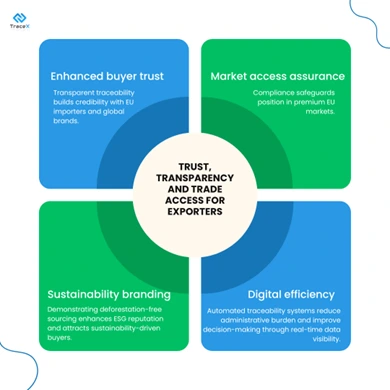
While EUDR creates operational pressure, compliance can position Indian exporters as:
- Trusted suppliers with superior traceability
- Preferred vendors for EU OEMs
- Leaders in sustainable rubber manufacturing
Exporters who adopt digital traceability early will be better placed to secure long-term supply contracts with automotive, industrial, and engineering firms across the EU.
Strengthening India’s Position in the Global Rubber Parts Supply Chain
EUDR Compliance for Rubber Parts Exporters in India is no longer just a regulatory requirement it is a strategic gateway to sustaining and expanding EU market access. By adopting digital traceability, plantation-level geolocation mapping, and automated DDS workflows, Indian exporters can confidently demonstrate deforestation-free sourcing, reduce compliance risks, and build stronger trust with European automotive and industrial buyers. Early compliance will not only shipments but also position India as a future-ready, sustainable manufacturing hub in the global rubber parts ecosystem.
Understand the key components of EUDR compliance and how to streamline your DDS process efficiently.
Read the blog on EUDR Due Diligence
Learn how AI-driven automation and intelligent workflows simplify data collection, verification, and reporting.
Explore the blog on Agentic AI for EUDR
Discover how digital onboarding bridges the gap between smallholders and EUDR compliance.
Read our blog: Smallholder Onboarding for EUDR Compliance
FAQs
What is EUDR compliance for India’s rubber parts exporters?
EUDR compliance requires Indian exporters to prove that all rubber products are deforestation-free, legally sourced, and traceable to their plantation of origin before entering the EU market. safeguard
Why is EUDR compliance important for India’s rubber parts industry?
The EU is a major destination for India’s rubber parts exports. Compliance ensures continued market access, strengthens buyer trust, and positions exporters as sustainability leaders in the global value chain.
What are the key requirements for Indian exporters?
Indian exporters must map supply chains to the farm level, capture geolocation coordinates (GeoJSON), verify legal sourcing, and submit a Due Diligence Statement (DDS) via the EU portal before shipment.
What challenges do Indian rubber parts exporters face with EUDR?
Common challenges include fragmented smallholder networks, limited digital infrastructure, manual documentation, and lack of standardized traceability frameworks across the value chain.
What are the long-term benefits of EUDR compliance for Indian exporters?
Beyond meeting EU regulations, compliance drives supply chain transparency, builds brand credibility, enhances ESG performance, and opens access to premium global markets demanding sustainable rubber for the Indian exporters.