EUDR Due Diligence Workflow: From Data Collection to Risk Assessment
Published
, 13 minute read
Share this article
Quick summary: EUDR Due Diligence Workflow helps teams collect supplier data, validate geolocation, assess risk, mitigate issues, and prepare defensible DDS records.
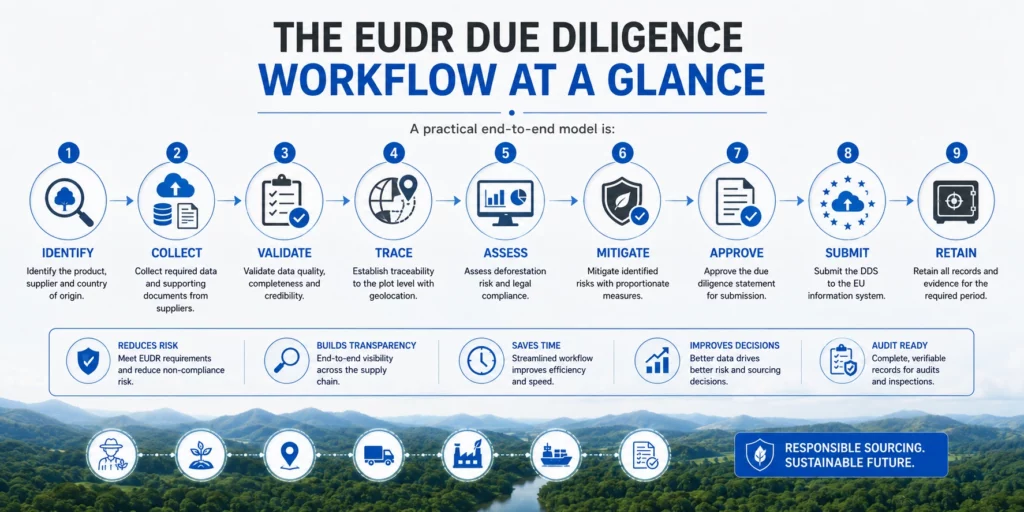
An effective EUDR due diligence workflow should not be treated as a document-submission exercise. It should operate as a connected process that moves from data collection to validation, risk assessment, mitigation and, finally, DDS preparation.
For businesses dealing with EUDR-relevant commodities, the Due Diligence Statement (DDS) is often viewed as the final compliance task. But a DDS is only as reliable as the information and decisions behind it.
The real work starts much earlier: identifying relevant products, collecting supplier information, mapping production plots, validating geolocation, gathering evidence, assessing risk and documenting mitigation where necessary.
That is why EUDR compliance is won upstream. If the underlying supply-chain data is incomplete or disconnected, a technically correct DDS process cannot solve the problem.
Explore how TraceX can help you manage supplier data, farm plots, geolocation, risk assessment, traceability and DDS preparation with a free EUDR trial.
EUDR due diligence is a three-step process: collect the required information, assess the risk of non-compliance, and mitigate risk where necessary.
The DDS is the outcome—not the starting point. A strong EUDR Due Diligence Workflow begins with structured supplier, product, quantity, country-of-production and geolocation data.
Geolocation is central to traceability. Businesses need to connect relevant products back to the plots where the commodities were produced and maintain the relationships between plots, suppliers, commodities and products.
Data quality directly affects risk assessment. Incomplete, inconsistent or unreliable supplier and plot information can increase supply-chain risk and make due diligence harder to substantiate.
Risk assessment must reflect the actual supply chain. Factors such as country context, deforestation prevalence, supply-chain complexity, legality and the reliability of available information need to be considered.
Risk mitigation should be a documented workflow. Where risk is more than negligible, businesses may need additional information, verification, audits or other appropriate measures before proceeding.
Traceability should connect the entire chain:Supplier → Farm/Plot → Geolocation → Commodity → Batch → Product → Shipment → DDS
EUDR compliance is not a one-time exercise. Operators need to maintain and update their due diligence systems, review them at least annually and retain relevant records for five years.
Technology can make the workflow scalable. Digital workflows can help centralise supplier data, validate geolocation, connect evidence, track risk assessments and maintain an auditable record of compliance decisions.
What Is an EUDR Due Diligence Workflow?
An EUDR due diligence workflow is the structured process an operator follows to collect the information required for due diligence, assess the risk that relevant products are non-compliant, and mitigate identified risks where necessary before placing relevant products on the EU market or exporting them.
The European Commission describes due diligence as a three-step process: information collection, risk assessment and risk mitigation. Operators must reach no or negligible risk before placing relevant products on the EU market or exporting them.
In practice, the workflow needs to connect regulatory requirements with operational supply-chain data.
Discover how to build an effective EUDR due diligence process—from supplier data and farm geolocation to risk assessment, mitigation and DDS preparation.
Each step depends on the previous one. If supplier information is incomplete, plot data cannot be reliably connected. If geolocation is unreliable, risk assessment may be compromised. If risk mitigation is not documented, the final compliance decision may be difficult to defend.
Step 1: Identify Relevant Products and Supply Chains
The first step is determining which products and supply-chain flows fall within the EUDR scope applicable to the business.
Businesses should identify relevant commodities and products, applicable product classifications, suppliers, sourcing countries and the routes through which products enter or leave the EU.
Identify relevant commodities and products.
Map applicable HS codes and product references.
Identify suppliers and sourcing locations.
Map import, export and EU-market flows.
Determine which products require a DDS or applicable declaration.
Step 2: Collect Supplier and Product Information
Once relevant products are identified, the business needs to collect the information required under EUDR.
Article 9 information requirements include information about the operator and product, quantity, country of production and the geolocation of all plots where the relevant commodity was produced. Depending on the commodity and product, additional information can apply.
Supplier and operator details
Product description and applicable classification
Quantity
Country of production
Production plots and geolocation
Production date or applicable time range
Relevant supporting evidence
This information should be captured in a structured way rather than accumulated as disconnected supplier attachments.
Step 3: Capture and Validate Geolocation
For many EUDR supply chains, geolocation is one of the most operationally challenging data elements.
A plot polygon or coordinate set needs to be associated with the correct farmer, supplier, commodity and production information. The European Commission’s Information System supports location entry through maps, individual coordinates and bulk uploads, including GeoJSON.
A strong workflow therefore validates geolocation before the data reaches the final due diligence stage.
Check that coordinates or polygons are present.
Validate geometry and file structure.
Confirm the plot is linked to the correct supplier or producer.
Check commodity and production-period information.
Identify duplicate, incomplete or inconsistent plot records.
EUDR requires operators to provide the geolocation of all relevant production plots, along with the applicable production date or time range. For complex supply chains, keeping thousands of plots accurate, validated and connected to the right products can become a major compliance challenge.
This allows compliance teams to answer a critical question: which production plots support the relevant product being placed on the EU market?
The connection becomes especially important when a product contains commodities originating from multiple plots. EUDR information requirements call for the geolocation of all relevant production plots.
Discover how digital traceability can help you manage farm-level geolocation, supplier data, batch traceability, risk assessment and due-diligence records in one connected workflow.
EUDR due diligence requires more than geolocation. Operators need information and evidence supporting the relevant due-diligence conclusions, including evidence concerning deforestation-free production and legal production.
Supplier declarations, permits, certificates, invoices, land-use information, audit records and other documents may form part of the evidence set depending on the supply chain and applicable requirements.
The important principle is to connect evidence to the record it supports. Instead of storing documents in an unstructured folder, businesses should be able to answer: which supplier, plot, commodity, batch or product does this evidence relate to?
See how a leading tire manufacturer used farm-level geolocation, batch traceability, risk assessment, SAP integration and digital DDS workflows to connect natural rubber from origin to finished tires.
Discover how TraceX helped create a transparent, auditable chain of custody while reducing manual compliance effort and strengthening EU market readiness.
Risk assessment is the point where collected information becomes a compliance decision.
The EUDR framework requires operators to assess the risk of relevant products being non-compliant, taking into account the information collected and the criteria specified in the regulation. The objective is to establish whether there is no or only negligible risk.
A practical risk workflow can assess factors such as:
Country or regional risk context
Deforestation and forest degradation indicators
Complexity of the supply chain
Reliability and completeness of supplier information
Quality of geolocation data
Evidence supporting legal production
Potential inconsistencies or gaps in the data
The exact assessment methodology should be aligned with the regulation and the operator’s documented due-diligence procedure.
Risk assessment is at the heart of EUDR due diligence. Learn how to evaluate country risk, supply-chain complexity, geolocation, deforestation indicators, legality and data reliability and identify when additional risk mitigation may be required.
If the risk assessment identifies more than negligible risk, the operator cannot simply proceed to submission.
Additional information, verification, audits or other risk-mitigation measures may be required before the product can be placed on the EU market or exported.
Flag the relevant supplier, plot, product or batch.
Request additional information.
Assign verification or review activities.
Record mitigation evidence.
Reassess the risk after mitigation.
Document the final decision.
This creates an auditable trail showing not only the final decision, but how the business arrived at it.
Step 8: Approve the Due-Diligence Record
Before DDS preparation, the business should have a controlled approval point.
The compliance team should be able to confirm that required information is present, geolocation is validated, relevant evidence has been reviewed and the risk assessment supports a no-or-negligible-risk conclusion.
A structured approval workflow reduces the possibility of incomplete records moving directly into submission.
Step 9: Prepare and Submit the DDS
Once due diligence is complete and the applicable conditions are met, the operator can prepare the DDS using the EUDR Information System.
The European Commission’s Information System supports creation and management of DDSs and simplified declarations, including product characteristics, quantities and locations, and provides an API for bulk management.
For businesses handling large volumes, preparing structured records upstream can significantly reduce the amount of manual reconstruction required at this stage.
Learn how to move from supplier and product data to geolocation, risk assessment and a submission-ready DDS using the EUDR Information System. The European Commission provides the Information System specifically for submitting and managing Due Diligence Statements.
Step 10: Retain the Records and Maintain Traceability
DDS submission is not the end of the compliance workflow.
Businesses need to retain relevant due-diligence records and maintain the relationships between the submitted information and the underlying supply-chain evidence.
The European Commission’s current implementation guidance states that documents related to due diligence must be kept for five years from the date the product is placed on the EU market or exported.
The DDS reference also becomes relevant to downstream traceability, with operators required to pass the reference number to direct downstream buyers in applicable circumstances.
Common EUDR Due Diligence Workflow Mistakes
Treating the DDS as the starting point rather than the final output.
Collecting supplier documents without connecting them to products or plots.
Managing geolocation as a standalone GIS file.
Using unvalidated polygons or coordinates.
Failing to connect production plots to batches and finished products.
Performing risk assessment manually without a consistent workflow.
Starting risk mitigation only when a shipment is already waiting for clearance.
Losing the audit trail behind the final compliance decision.
These gaps can turn a repeatable due-diligence process into a last-minute reconciliation exercise.
Learn how to identify common DDS errors, fix the underlying data and build a submission-ready EUDR due diligence record.
TraceX EUDR Solutions can help businesses build a connected EUDR due diligence workflow by bringing supplier, farm, plot, geolocation, commodity, transaction, batch, evidence and risk information into a structured traceability environment.
Centralise supplier and farm-level data.
Manage plot geolocation and connect it to source records.
Trace commodities through purchases, batches and processing.
Link supporting documents and evidence to relevant records.
Support risk assessment and mitigation workflows.
Maintain approval and audit trails.
Create structured records that support DDS preparation.
Connect compliance information with broader supply-chain traceability.
The objective is not simply to digitise due diligence. It is to create a traceable chain from source data to compliance decision.
See how TraceX helps you manage supplier onboarding, farm-level geolocation, plot validation, deforestation risk assessment and DDS preparation in one connected platform.
EUDR teams often focus on the final question: “Can we file the DDS?” A better question is: “Can we reproduce the evidence and reasoning behind this DDS?”
Instead of chasing supplier data when a shipment is ready, businesses can build continuous workflows that collect information at source, validate it, connect it to products and assess risk before the final transaction.
Production dates or time ranges recorded where applicable
Supporting evidence connected to the relevant records
Products and batches linked to source plots
Risk assessment completed
Risk mitigation completed where required
Final due-diligence decision approved
DDS prepared and submitted
Reference information and supporting records retained
Conclusion
A scalable EUDR due diligence workflow is not a single compliance form. It is a connected process that starts with product and supplier identification and continues through data collection, geolocation validation, traceability, evidence management, risk assessment, mitigation, DDS preparation and record retention.
For businesses managing hundreds or thousands of suppliers, farms, plots, batches and products, the ability to connect these records can make EUDR compliance more repeatable and defensible.
The key takeaway is simple: don’t build your EUDR process around the DDS. Build it around the data and decisions that make the DDS defensible.
Ready to strengthen your EUDR due diligence workflow? Explore how TraceX can help connect supplier data, farm plots, geolocation, traceability, evidence and risk assessment in one structured workflow.
Frequently Asked Questions (FAQ’s)
What are the three steps of EUDR due diligence?
The European Commission describes EUDR due diligence as information collection, risk assessment and risk mitigation where necessary. Operators must reach no or negligible risk before placing relevant products on the EU market or exporting them.
What data is required for EUDR due diligence?
Key Article 9 information includes operator and product details, quantity, country of production and geolocation of the relevant production plots. Additional information may apply depending on the commodity and product.
Why is geolocation important in the EUDR workflow?
Geolocation links the relevant commodity to its production origin. It is a core part of the information required for due diligence and needs to be connected to the appropriate production plots and supply-chain records.
What happens if EUDR risk is not negligible?
Where the risk assessment identifies more than negligible risk, the operator needs to take appropriate risk-mitigation measures and cannot place the relevant product on the EU market or export it until the applicable due-diligence requirements are satisfied.
Can EUDR due diligence be automated?
Technology can automate and structure many operational activities, including data collection, validation, traceability, evidence management and workflow routing. The final legal responsibility for due diligence remains with the relevant operator.
How long must EUDR due-diligence records be retained?
The European Commission’s current implementation guidance states that due-diligence documents must be kept for five years from the date the relevant product is placed on the EU market or exported.
Start using TraceX
Transparency, Trust, & Success for your Climate Journey.
We use cookies on our website to give you the most relevant experience by remembering your preferences and repeat visits. By clicking “Accept All”, you consent to the use of ALL the cookies. However, you may visit "Cookie Settings" to provide a controlled consent.
This website uses cookies to improve your experience while you navigate through the website. Out of these, the cookies that are categorized as necessary are stored on your browser as they are essential for the working of basic functionalities of the website. We also use third-party cookies that help us analyze and understand how you use this website. These cookies will be stored in your browser only with your consent. You also have the option to opt-out of these cookies. But opting out of some of these cookies may affect your browsing experience.
Necessary cookies are absolutely essential for the website to function properly. These cookies ensure basic functionalities and security features of the website, anonymously.
Cookie
Duration
Description
cookielawinfo-checkbox-analytics
11 months
This cookie is set by GDPR Cookie Consent plugin. The cookie is used to store the user consent for the cookies in the category "Analytics".
cookielawinfo-checkbox-functional
11 months
The cookie is set by GDPR cookie consent to record the user consent for the cookies in the category "Functional".
cookielawinfo-checkbox-necessary
11 months
This cookie is set by GDPR Cookie Consent plugin. The cookies is used to store the user consent for the cookies in the category "Necessary".
cookielawinfo-checkbox-others
11 months
This cookie is set by GDPR Cookie Consent plugin. The cookie is used to store the user consent for the cookies in the category "Other.
cookielawinfo-checkbox-performance
11 months
This cookie is set by GDPR Cookie Consent plugin. The cookie is used to store the user consent for the cookies in the category "Performance".
viewed_cookie_policy
11 months
The cookie is set by the GDPR Cookie Consent plugin and is used to store whether or not user has consented to the use of cookies. It does not store any personal data.
Functional cookies help to perform certain functionalities like sharing the content of the website on social media platforms, collect feedbacks, and other third-party features.
Performance cookies are used to understand and analyze the key performance indexes of the website which helps in delivering a better user experience for the visitors.
Analytical cookies are used to understand how visitors interact with the website. These cookies help provide information on metrics the number of visitors, bounce rate, traffic source, etc.
Advertisement cookies are used to provide visitors with relevant ads and marketing campaigns. These cookies track visitors across websites and collect information to provide customized ads.
Download the 2026 Traceability Scorecard and Benchmark Your Supply Chain Across 10 Critical Capabilities.
Download our eBook
Don’t Wait for an Audit to Find Your EUDR Gaps
The 2026 Simplification Package changes how HS codes, DDS pass-through and geolocation rules apply to you. Get the free guide and 20-point readiness checklist before enforcement catches you unprepared.