PPWR for Food and Beverage Companies: The 2026 Compliance Playbook
Published
, 12 minute read
Share this article
Quick summary: PPWR for food and beverage companies is now in force. See the 2026 obligations, phased deadlines, and how one data layer makes compliance repeatable.
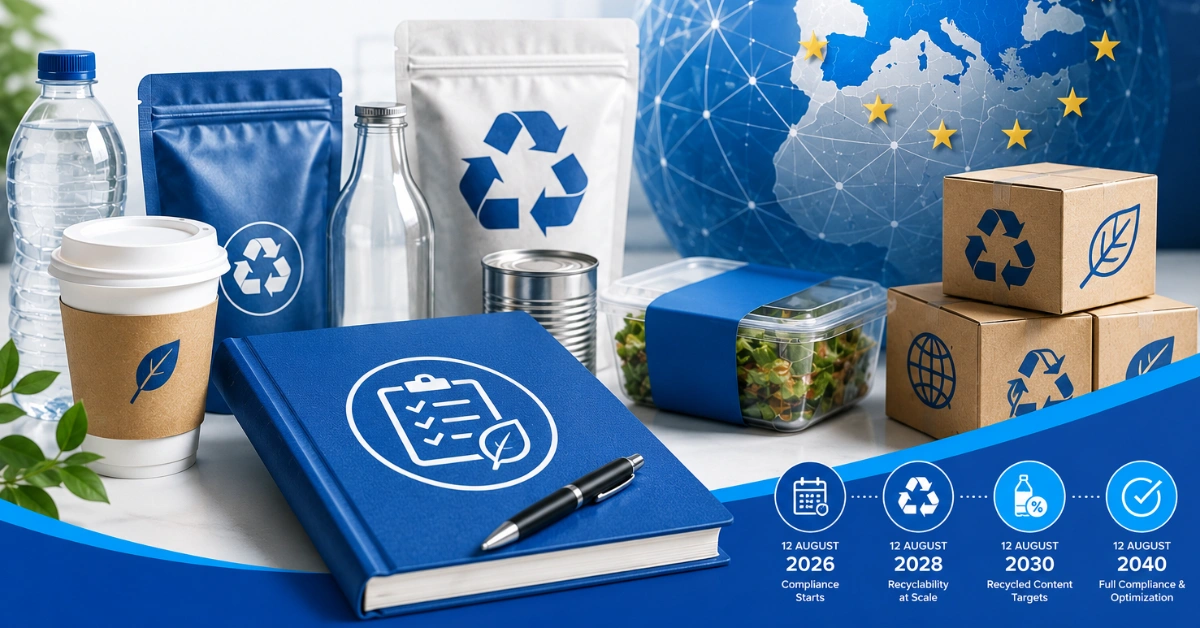
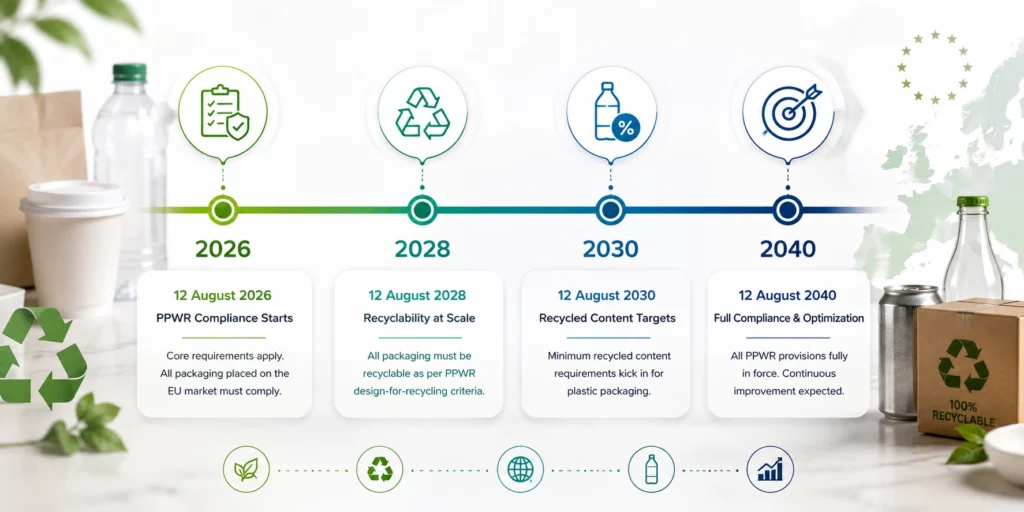
PPWR for food and beverage companiesis the set of obligations under Regulation (EU) 2025/40 that governs how packaged food and drink is designed, documented, and reported across the EU. Since 12 August 2026 it has applied directly in all 27 Member States replacing Directive 94/62/EC with PFAS limits on food-contact packaging, an EU Declaration of Conformity, and Extended Producer Responsibility already live. Recycled-content, design-for-recycling, and beverage reuse targets phase in from 1 January 2030. The regulation is manageable; the evidence trail behind every SKU is where teams struggle.
Key takeaways
Already live: Reg. (EU) 2025/40 has applied EU-wide since 12 August 2026. It is a regulation, so there is no national transposition to wait for.
PFAS from day one: food-contact packaging must meet PFAS limits 25 ppb for any individual non-polymeric PFAS, 250 ppb for the sum, and 50 ppm total fluorine.
Prove conformity: every packaging type needs an EU Declaration of Conformity (Article 39) backed by technical documentation (Annex VII).
2030 wave: recycled-content minimums, design-for-recycling grades, the 50% empty-space cap, and beverage reuse targets apply from 1 January 2030.
The real problem: holding component-, SKU-, and material-level evidence for every packaging item, in every market, on demand not any single rule.
Why PPWR for food and beverage companies is a data problem, not a packaging problem
Compliance rarely fails at packaging design it fails when you cannot produce the evidence for a specific SKU, in a specific market, on request.
Hundreds of SKUs, each with multiple components (bottle, cap, closure, label, tray, film, secondary carton).
Material specs, PFAS test results, and recycled-content data scattered across supplier PDFs, emails, and spreadsheets.
The same product sold across many Member States, each with its own EPR registration and reporting cadence.
For most teams, PPWR for food and beverage companies does not fail at the whiteboard it fails at the evidence stage. A recyclability claim, a recycled-content percentage, or a PFAS result is only as good as your ability to retrieve the underlying record when an enforcement authority or a retail buyer asks. Food and beverage portfolios make this acute: frequent supplier switches, seasonal packaging changes, and per-component obligations multiply the number of documents you must keep current. When a single bottle ships into eight markets, the manual model quietly breaks and it usually breaks in an audit, not in a planning meeting.
Are you a manufacturer preparing for the new EU packaging rules?
Read our guide on PPWR for Manufacturers to understand what the regulation means for manufacturing businesses and what they need to start preparing around packaging design, recyclability, recycled content, packaging data, labelling, EPR and compliance documentation.
What PPWR for food and beverage companies requires in 2026 and beyond
Some duties are already enforceable; the heavier design and reporting targets land on 1 January 2030.
Live now (from 12 Aug 2026): PFAS limits on food-contact packaging, EU Declaration of Conformity plus technical documentation, economic-operator identification on packaging, EPR registration, and for non-EU sellers an authorised representative under Article 45.
From 1 Jan 2030: minimum recycled content (30% for PET beverage bottles and other contact-sensitive PET; 10% for other contact-sensitive plastics; 35% for remaining plastic packaging), design-for-recycling grades, a maximum 50% empty-space ratio, and beverage reuse targets starting at 10%.
Other milestones: harmonised labelling from 2028, 90% separate collection of single-use plastic and metal beverage containers by 2029, “recycled at scale” from 2035, and stricter recycled-content and recyclability thresholds through 2038–2040.
PPWR for food and beverage companies did not arrive as a blank slate it stacks obligations onto packaging you already sell. The PFAS restriction alone touches common food formats such as grease-resistant paperboard, moulded-fibre trays, and barrier films. Meanwhile the recycled-content and recyclability rules force a design conversation with every supplier, and each claim must be substantiated component by component, because conformity is assessed per component caps, labels, and bottles are each evaluated on their own.
Wondering what PFAS restrictions under the PPWR mean for your packaging?
Read our guide on PFAS in PPWR to understand what businesses need to know about the use of per- and polyfluoroalkyl substances (PFAS) in food-contact packaging, the restrictions involved, and what manufacturers and packaging companies should consider when preparing for compliance.
How one data layer makes PPWR for food and beverage companies repeatable
Connect packaging evidence to the SKU and the market once, then reuse it for every declaration, EPR filing, and buyer request.
A single record per packaging component material, weight, recyclability grade inputs, recycled-content %, PFAS test evidence, supplier.
Obligations mapped to each market so EPR registration and reporting are driven by data, not memory.
Declarations of Conformity and audit packs generated from the same source rather than rebuilt by hand.
This is where a supply-chain traceability platform earns its place. The TraceX platform is designed to hold packaging and material data as a structured, queryable layer rather than a folder of PDFs so the evidence behind a claim is attached to the SKU and the market it ships to [pending product-team sign-off]. Instead of chasing suppliers each audit cycle, teams capture component data once and reuse it: PFAS results, recycled-content percentages, and recyclability inputs flow into the EU Declaration of Conformity and into per-market EPR reporting from one place [pending product-team sign-off]. That is what turns PPWR for food and beverage companies from a recurring fire drill into a workflow you can run on demand.
Do you know exactly what packaging your business is putting on the market?
Read our guide on Packaging Inventory to understand how businesses can build a clear view of their packaging materials, components, quantities, suppliers and product-level data.
The benefit, in buyer terms: fewer last-minute supplier chases, faster responses to retail-customer compliance questionnaires, and defensible records when a Member State authority asks. One connected data layer means a packaging change a new cap resin, a relabelled tray updates every downstream declaration and report instead of triggering a manual scramble. Handled this way, PPWR for food and beverage companies becomes a source of speed rather than a standing liability.
PPWR for food and beverage companies: three example scenarios
The same rules land very differently on a beverage brand, a snack maker, and a non-EU exporter.
These three composites show what PPWR for food and beverage companies looks like in practice. They are illustrative, not real named customers.
Are you a brand owner selling products in the EU? PPWR could have a direct impact on how you manage your packaging.
Read our guide on PPWR for Brand Owners to understand what the regulation means for packaging design, recyclability, recycled content, labelling, EPR, packaging data and compliance documentation.
Scenario 1 – Beverage brand with PET bottles across the EU
For a beverage brand, PPWR for food and beverage companies converges on a single bottle. A soft-drinks company sells the same 500 ml PET bottle in eight Member States, and under PPWR it faces three overlapping duties: a 30% recycled-content minimum for the bottle from 2030, a beverage reuse target beginning at 10% the same year, and inclusion in deposit-return schemes targeting 90% separate collection by 2029. With a connected data layer, the recycled-content percentage per production site and the reuse-format share are tracked as live figures so the brand can see, per market, whether it is on track rather than reconstructing it at year-end
Scenario 2 – Snack manufacturer using grease-resistant paperboard
A snack producer uses moulded-fibre trays and grease-resistant paperboard classic PFAS-exposure formats. Since 12 August 2026 each food-contact component must sit under the PFAS limits, evidenced by supplier test data, and each packaging type needs an EU Declaration of Conformity with technical documentation behind it. Holding PFAS certificates against the specific component and SKU means the Declaration of Conformity is assembled from existing records, not chased from scratch before every product launch.
Scenario 3 – Non-EU food exporter selling into six Member States
A US-based sauces exporter ships into six EU markets but has no EU establishment. PPWR requires an authorised representative under Article 45 in each Member State where it makes packaging available, plus EPR registration in each. Mapping every SKU to its destination markets turns a tangle of registrations into a checklist: which representative covers which market, which EPR scheme is filed, and what packaging data each one needs.
Most compliance tools are point solutions: one for PFAS documents, another for EPR filings, a spreadsheet for recycled content. That fragments the very evidence PPWR asks you to connect. TraceX’s position is “one data layer, many regulations” capture packaging and material data once, at the component and SKU level, and reuse it across PPWR, CSRD, and the wider sustainability reporting stack.
For food and beverage teams, that means the same record that proves a PFAS limit today feeds a recycled-content report in 2030 instead of standing up a new process for every deadline
PPWR for food and beverage companies: manual approach vs a traceability platform
The gap between the two columns below is exactly where PPWR for food and beverage companies quietly costs teams time. A spreadsheet can record a PFAS result or a recycled-content figure once, but it cannot connect that figure to the SKU, the market, and the declaration that depend on it so every audit and buyer questionnaire starts from scratch.
Compliance task
Manual / spreadsheets
TraceX platform
PFAS evidence
Certificates hunted from suppliers per launch, stored in email and folders.
Test results attached to the exact component and SKU, retrievable on demand.
Declaration of Conformity
Rebuilt by hand for each packaging type; version drift across files.
Generated from the underlying component records; updates when data changes.
Recycled content (2030)
Percentages tracked in ad-hoc sheets, hard to average per site per year.
Recorded per component and rolled up per site and year for reporting .
Per-market EPR
Registrations and filings tracked from memory and reminders.
Obligations mapped to each destination market and SKU.
Audit / buyer request
Days of document assembly under pressure.
Evidence pack pulled from one source, per SKU and market .
TraceX’s PPWR solution helps food and beverage companies manage packaging compliance by bringing product, packaging and supplier data into one connected workflow. Teams can track packaging components across products such as bottles, cans, cartons, pouches, caps and labels along with material type, weight, recycled content, recyclability information and supporting supplier documentation. This makes it easier to identify missing data, maintain packaging records, and prepare the information needed for PPWR and EPR requirements across EU markets. Instead of relying on scattered spreadsheets, supplier emails and documents, businesses can build a structured packaging inventory linked to their products and suppliers. For food and beverage companies managing large product portfolios and multiple packaging formats, TraceX can provide greater visibility into packaging data and help create a more organised, auditable approach to ongoing packaging compliance.
Book a walkthrough of how the TraceX platform holds packaging evidence at the component and SKU level, and turns PPWR duties into a repeatable workflow across every market you sell in.
PPWR for food and beverage companies: a buyer’s evaluation checklist
A credible approach to PPWR for food and beverage companies should let you answer yes to each of these before you commit:
Can it hold evidence at the component level (cap, label, bottle, tray, film), not just the finished product?
Does it map obligations to each destination market so EPR and authorised-representative duties are visible per SKU?
Can it generate an EU Declaration of Conformity and an audit pack from the same underlying records?
Does it track recycled content per site and year the way the 2030 targets are measured?
Does the same data layer extend to CSRD and wider sustainability reporting, so PPWR is not a standalone silo?
Will it flag when a packaging change invalidates an existing declaration or report?
PPWR for food and beverage companies rewards teams who treat compliance evidence as reusable data rather than one-off paperwork. The regulation is already live and the 2030 wave is close enough to plan for now so the operators who connect their packaging data once will spend the next four years reporting from a system, while everyone else keeps rebuilding the same records by hand.
Frequently Asked Questions (FAQ’s)
When did PPWR start applying to food and beverage companies?
Regulation (EU) 2025/40 entered into force on 11 February 2025 and has applied across all 27 EU Member States since 12 August 2026. As a regulation it takes direct effect, so there is no separate national transposition step. Later obligations recycled content, recyclability grades, and reuse targets phase in from 1 January 2030.
Does PPWR ban PFAS in food packaging?
It restricts them. From 12 August 2026, food-contact packaging cannot be placed on the EU market above the PFAS limit values: 25 ppb for any individual non-polymeric PFAS, 250 ppb for the sum of non-polymeric PFAS, and 50 ppm for total fluorine. Common food formats such as grease-resistant paperboard and moulded-fibre trays are the usual exposure points.
What is an EU Declaration of Conformity under PPWR?
It is the manufacturer’s formal statement, under Article 39, that a packaging type meets PPWR requirements. It must be backed by technical documentation (Annex VII) and a conformity assessment. Where packaging falls under several EU acts, a single combined declaration is allowed provided the relevant acts are clearly identified.
When do recycled-content targets start for food and beverage packaging?
From 1 January 2030. Plastic packaging must meet minimum post-consumer recycled content: 30% for PET beverage bottles and for other contact-sensitive PET packaging, 10% for other contact-sensitive plastics, and 35% for remaining plastic packaging — measured as a plant-level annual average. Targets rise again by 2040.
Do non-EU food and beverage companies have to comply with PPWR?
Yes, if they place packaged products on the EU market. A producer without an EU establishment must appoint an authorised representative for EPR under Article 45 in each Member State where it makes packaging available, and register with the relevant EPR schemes.
Does PPWR require reusable packaging for beverages?
It sets reuse targets rather than an outright mandate. From 1 January 2030, final distributors of alcoholic and non-alcoholic beverages must offer at least 10% of their products in reusable packaging within a reuse system, rising toward 40% by 2040, subject to exemptions. Member States may add their own national rules.
How is PPWR different from the old Packaging Directive?
Directive 94/62/EC was a directive each Member State transposed it into national law, creating divergence. PPWR is a regulation with direct, uniform effect across the EU, and it adds binding PFAS limits, recycled-content and recyclability requirements, reuse targets, and stronger EPR and conformity obligations.
Start using TraceX
Transparency, Trust, & Success for your Climate Journey.
We use cookies on our website to give you the most relevant experience by remembering your preferences and repeat visits. By clicking “Accept All”, you consent to the use of ALL the cookies. However, you may visit "Cookie Settings" to provide a controlled consent.
This website uses cookies to improve your experience while you navigate through the website. Out of these, the cookies that are categorized as necessary are stored on your browser as they are essential for the working of basic functionalities of the website. We also use third-party cookies that help us analyze and understand how you use this website. These cookies will be stored in your browser only with your consent. You also have the option to opt-out of these cookies. But opting out of some of these cookies may affect your browsing experience.
Necessary cookies are absolutely essential for the website to function properly. These cookies ensure basic functionalities and security features of the website, anonymously.
Cookie
Duration
Description
cookielawinfo-checkbox-analytics
11 months
This cookie is set by GDPR Cookie Consent plugin. The cookie is used to store the user consent for the cookies in the category "Analytics".
cookielawinfo-checkbox-functional
11 months
The cookie is set by GDPR cookie consent to record the user consent for the cookies in the category "Functional".
cookielawinfo-checkbox-necessary
11 months
This cookie is set by GDPR Cookie Consent plugin. The cookies is used to store the user consent for the cookies in the category "Necessary".
cookielawinfo-checkbox-others
11 months
This cookie is set by GDPR Cookie Consent plugin. The cookie is used to store the user consent for the cookies in the category "Other.
cookielawinfo-checkbox-performance
11 months
This cookie is set by GDPR Cookie Consent plugin. The cookie is used to store the user consent for the cookies in the category "Performance".
viewed_cookie_policy
11 months
The cookie is set by the GDPR Cookie Consent plugin and is used to store whether or not user has consented to the use of cookies. It does not store any personal data.
Functional cookies help to perform certain functionalities like sharing the content of the website on social media platforms, collect feedbacks, and other third-party features.
Performance cookies are used to understand and analyze the key performance indexes of the website which helps in delivering a better user experience for the visitors.
Analytical cookies are used to understand how visitors interact with the website. These cookies help provide information on metrics the number of visitors, bounce rate, traffic source, etc.
Advertisement cookies are used to provide visitors with relevant ads and marketing campaigns. These cookies track visitors across websites and collect information to provide customized ads.
Download the 2026 Traceability Scorecard and Benchmark Your Supply Chain Across 10 Critical Capabilities.
Download our eBook
Don’t Wait for an Audit to Find Your EUDR Gaps
The 2026 Simplification Package changes how HS codes, DDS pass-through and geolocation rules apply to you. Get the free guide and 20-point readiness checklist before enforcement catches you unprepared.