PPWR Compliance for Brand Owners: What the August 2026 Deadline Really Demands
Published
, 11 minute read
Share this article
Quick summary: Brand owners placing packaged products on the EU market face a decisive PPWR compliance shift from August 2026. This guide explains why your trademark can make you the responsible “manufacturer,” what documentation and evidence you need, and how a structured packaging data workflow can reduce audit risk, EPR complexity, and last-minute compliance pressure.
PPWR compliance for brand owners means proving that every packaged product you place on the EU market under your own name or trademark meets the Packaging and Packaging Waste Regulation (Regulation (EU) 2025/40) and being able to show the documentation on demand. If your brand is on the box, the pouch, or the parcel, the regulation almost certainly treats you as the “manufacturer,” and the paperwork stops with you.
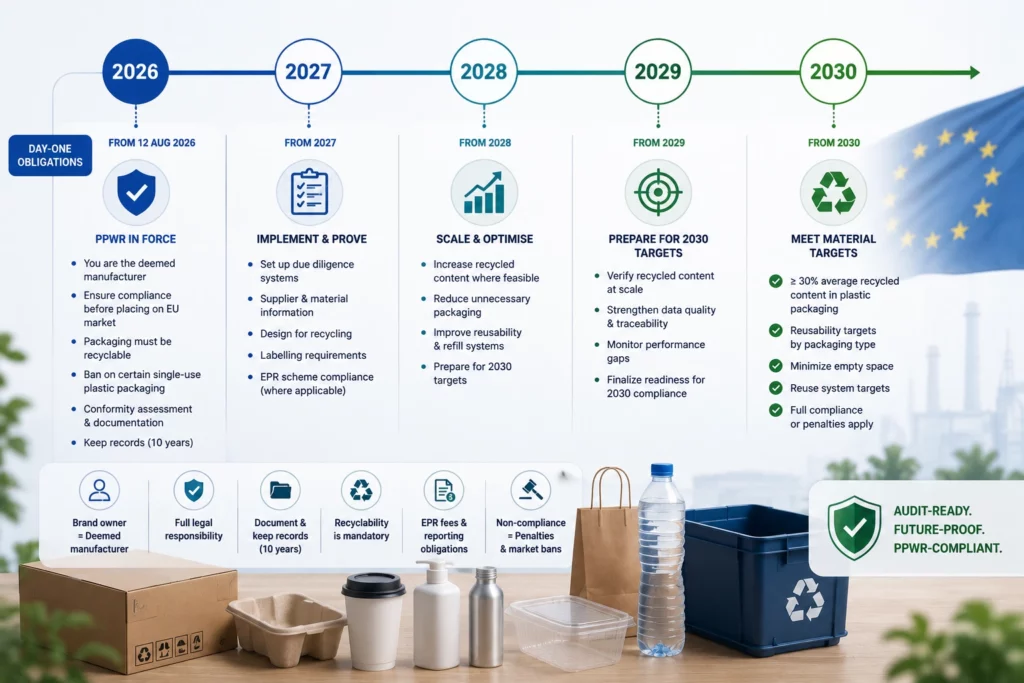
Under PPWR (Regulation (EU) 2025/40), a brand owner whose name or trademark appears on packaging is generally the deemed “manufacturer.” From 12 August 2026 that role must: (1) hold a Declaration of Conformity and technical file for every packaging unit placed on the EU market; (2) meet day-one substance rules the PFAS food-contact ban and heavy-metal limits and the Article 6(1) recyclability requirement; and (3) register and report under Extended Producer Responsibility (EPR) in each member state where the packaging is sold. Later milestones (design-for-recycling grades, recycled-content targets, single-use bans) phase in from 1 January 2030. In practice, brand owners meet these obligations by mapping every SKU to its packaging components and evidence, then keeping that evidence current as suppliers and formats change.
Key takeaways
PPWR compliance for brand owners is triggered by your name or trademark on the packaging — it typically makes you the “manufacturer,” so the compliance burden lands on you, not your co-packer.
Three obligations hit on 12 August 2026: a Declaration of Conformity per packaging unit, substance rules (PFAS food-contact ban plus heavy-metal limits), and the Article 6(1) recyclability requirement.
EPR registration and reporting apply in every EU market where you sell there is no general small-business exemption.
The heavy obligations (recyclability grades, recycled content, single-use bans) phase in from 1 January 2030 so 2026 is the year to build the data foundation, not the finish line.
The real bottleneck is data: brand owners must connect packaging specs, supplier evidence, and per-market rules across thousands of SKUs. Cleara AI turns that into a repeatable workflow.
Not Sure Where PPWR Compliance Begins?
Get a clear starting point mapped to your specific packaging and markets. Talk to a PPWR expert who’s guided teams like yours through exactly this.
Why PPWR compliance for brand owners starts with the “manufacturer” trap
The single most misunderstood point in PPWR compliance for brand owners is who actually carries the obligation. Many brand teams assume their contract packer, co-manufacturer, or packaging supplier is the “manufacturer” on the hook. The regulation reads it the other way around.
Under PPWR, where packaging or a packaged product carries a name or trademark, the owner of that name or trademark is presumed to be the manufacturer for the regulation’s purposes not the business that physically produced the packaging. For a brand owner, that is a step-change: the Declaration of Conformity, the substance evidence, and the technical file are your responsibility, even when you never touched a printing plate or a filling line.
PPWR brand owner pain points that surface in every audit
Packaging data lives everywhere and nowhere. Specs sit in supplier PDFs, ERP master data, artwork files, and someone’s inbox with no single source of truth per SKU.
Supplier evidence is incomplete. You cannot sign a Declaration of Conformity you cannot substantiate, and most co-packers have not yet supplied recyclability, recycled-content, or PFAS statements.
Multi-market EPR is a moving target. Registration and reporting differ by member state, and fees are eco-modulated by recyclability grade, so weak packaging data quietly inflates cost.
The clock is fixed. Most obligations apply from 12 August 2026, and there is no grace period for placing non-compliant packaging on the market after that date.
Left to spreadsheets, this becomes a fire drill every time a supplier switches a film, a format changes, or a new market opens. The job to be done is not “write one declaration” it is to keep thousands of packaging units continuously defensible.
What PPWR compliance for brand owners requires by 12 August 2026
Brand owner obligations under PPWR fall into three day-one buckets, plus the EPR duties that run market-by-market. Here is the plain-language breakdown.
PPWR brand owner obligation 1: Declaration of Conformity per packaging unit
From 12 August 2026, a Declaration of Conformity and supporting technical documentation must exist for every packaging unit placed on the EU market, confirming it meets the applicable articles. The file has to be retained (commonly cited as five to ten years) and made available to market-surveillance authorities. For a brand owner, that means one defensible evidence pack per packaging type not a single blanket statement.
Learn what a PPWR Declaration of Conformity should include, the supporting technical documentation you’ll need, and how to maintain compliance throughout the packaging lifecycle.
PPWR brand owner obligation 2: substance restrictions from day one
PFAS in food-contact packaging: a strict ban applies from the application date, with concentration limits (cited as [25 ppb] per individual substance, [250 ppb] for the sum, and [50 ppm] total fluorine). There is no transition for existing stock and no exemption for recycled material.
Heavy metals and substances of concern: the combined limit for lead, cadmium, mercury, and hexavalent chromium is cited as [100 mg/kg], and manufacturers must be able to show that substances of concern have been minimised.
PPWR brand owner obligation 3: the Article 6(1) recyclability requirement
From the application date, all packaging placed on the EU market must be recyclable, assessed under the existing standard (cited as EN 13430:2004). This is a softer test than the design-for-recycling grades that arrive in 2030, but it is the first time recyclability is legally enforceable across all 27 member states at once and it is part of what your Declaration of Conformity has to stand behind.
PPWR brand owner obligation 4: EPR registration and reporting
Extended Producer Responsibility is not new, but PPWR harmonises the core rules. Brand owners must register in every member state where they place packaging on the market, report packaging volumes and materials, and pay fees that are eco-modulated by recyclability grade so better packaging data can directly lower cost. There is no general exemption for small enterprises.
What August 2026 is and is NOT
12 August 2026 starts your operational obligations (documentation, substances, recyclability, EPR). It is not the day non-compliant packaging is banned outright the design-for-recycling grades, recycled-content targets, and single-use format bans phase in from 1 January 2030. The brand owners who are ready in 2030 are the ones who built their data foundation in 2026.
How TraceX closes the PPWR compliance gap for brand owners
Every PPWR brand owner obligation above resolves to the same underlying problem: structured, per-SKU packaging data that stays current as products, suppliers, and rules change. TraceX PPWR Solutions is built to make that a workflow rather than a fire drill.
Capabilities that map to PPWR brand owner obligations
SKU-to-packaging mapping: every product is linked to its packaging components (primary, grouped, transport), so nothing is invisible when an authority asks for evidence.
Supplier document capture: recyclability, recycled-content, and PFAS declarations are requested, stored, and version-tracked against the exact packaging unit they support.
Declaration of Conformity generation: the technical file and DoC are assembled from linked evidence, so the document you sign is traceable to its source [confirm DoC-generation scope with product team].
Per-market EPR support: packaging volumes and materials are structured for member-state registration and reporting, with recyclability grade surfaced so eco-modulated fees are visible.
ERP integration: Platform syncs packaging and SKU master data from your existing systems [e.g. SAP, Oracle, Microsoft Dynamics ] rather than forcing a parallel spreadsheet.
Change alerts: when a supplier swaps a material or a format changes, the affected packaging units and their evidence are flagged for re-verification.
The point of PPWR brand owner compliance is not a one-time document sprint it is a living evidence base that survives audits, market expansions, and supplier changes without another all-hands scramble.
Learn PPWR at Your Own Pace — No Strings Attached
Prefer to do your homework first? Download the handbook for a complete grounding in PPWR before you decide on any next step.
The benefit: PPWR compliance for brand owners as a workflow, not a fire drill
When packaging data is structured and connected, the day-one obligations stop being a threat and become a routine. Brand owners see three concrete gains.
Protected market access. You can produce a Declaration of Conformity and technical file for any SKU on demand, so a market-surveillance request or marketplace check does not stall your listings.
Lower EPR cost over time. Because fees are eco-modulated by recyclability grade, accurate packaging data and visible grades let you target the changes that actually reduce fees.
Readiness for 2030. The same evidence base that satisfies 2026 obligations is what you extend for design-for-recycling grades and recycled-content targets — no second migration.
Manual vs automated PPWR compliance for brand owners
Use this to pressure-test any PPWR compliance approach whether you build internally or evaluate a platform.
☐ Can you identify every SKU where your name or trademark makes you the deemed “manufacturer”?
☐ Is every packaging unit mapped to its components and to a single source of truth?
☐ Do you hold current supplier evidence for recyclability, recycled content, and PFAS?
☐ Can you generate a Declaration of Conformity and technical file per packaging unit on demand?
☐ Are you registered for EPR in every member state where you place packaging on the market?
☐ Is recyclability grade visible so you can manage eco-modulated EPR fees?
☐ Does a supplier or format change automatically flag affected packaging for re-verification?
☐ Does the system connect to your ERP so packaging data stays in sync?
☐ Is your 2026 evidence base extendable to the 2030 design-for-recycling and recycled-content targets?
Proof: PPWR compliance for brand owners built on traceability
TraceX PPWR Solutions applies the same traceability discipline used across regulated supply chains — linking each product to structured, verifiable evidence — to packaging. For a brand owner, that means the Declaration of Conformity you sign is backed by supplier documents, packaging specs, and per-market rules that are all connected in one place.
See PPWR compliance for brand owners in action
Book a exploratory call and we’ll map a sample of your SKUs to their packaging evidence and show a Declaration of Conformity assembled live so you can see 12 August 2026 readiness as a workflow.
Are brand owners really the “manufacturer” under PPWR?
In most cases, yes. Where packaging carries a name or trademark, PPWR presumes the owner of that mark is the manufacturer for the regulation’s purposes not the co-packer that physically produced it. That means the Declaration of Conformity and technical file are the brand owner’s responsibility. Confirm your specific setup, since unmarked packaging can be treated differently.
When does PPWR compliance for brand owners actually start?
Most obligations apply from 12 August 2026 under Regulation (EU) 2025/40, after an 18-month transition. Day-one duties include the Declaration of Conformity, substance restrictions, and the Article 6(1) recyclability requirement. Heavier obligations — design-for-recycling grades, recycled-content targets, and single-use format bans — phase in from 1 January 2030.
Is there a small-business exemption?
No general one. PPWR does not provide a blanket exemption for micro or small enterprises; core design, documentation, and EPR obligations apply to operators placing packaging on the EU market regardless of size. Some sector-specific adjustments exist (for example, certain medical or B2B packaging).
What is a Declaration of Conformity and how many do I need?
It is documented evidence that a packaging unit meets the applicable PPWR requirements, backed by a technical file that must be retained and shown to authorities. You need one defensible evidence pack per packaging type placed on the market not a single blanket statement covering everything.
Does PPWR affect me if I’m outside the EU?
Yes, if you place packaging or packaged products on the EU market. PPWR applies regardless of where the company is established, and appointing an authorised representative may be required to fulfil producer obligation verify the current requirement for your markets.
What happens if my packaging supplier changes materials?
Your evidence changes with it. You must obtain updated declarations and technical documentation from the new supplier and confirm the new packaging still meets PPWR before placing it on the market. This is why change tracking matters TraceX Solutions flags affected units so nothing slips through.
How does TraceX help with PPWR compliance for brand owners?
TraceX maps every SKU to its packaging, captures and version-tracks supplier evidence, assembles the Declaration of Conformity from linked sources, and structures data for per-market EPR reporting syncing with your ERP so the record stays current
Start using TraceX
Transparency, Trust, & Success for your Climate Journey.
We use cookies on our website to give you the most relevant experience by remembering your preferences and repeat visits. By clicking “Accept All”, you consent to the use of ALL the cookies. However, you may visit "Cookie Settings" to provide a controlled consent.
This website uses cookies to improve your experience while you navigate through the website. Out of these, the cookies that are categorized as necessary are stored on your browser as they are essential for the working of basic functionalities of the website. We also use third-party cookies that help us analyze and understand how you use this website. These cookies will be stored in your browser only with your consent. You also have the option to opt-out of these cookies. But opting out of some of these cookies may affect your browsing experience.
Necessary cookies are absolutely essential for the website to function properly. These cookies ensure basic functionalities and security features of the website, anonymously.
Cookie
Duration
Description
cookielawinfo-checkbox-analytics
11 months
This cookie is set by GDPR Cookie Consent plugin. The cookie is used to store the user consent for the cookies in the category "Analytics".
cookielawinfo-checkbox-functional
11 months
The cookie is set by GDPR cookie consent to record the user consent for the cookies in the category "Functional".
cookielawinfo-checkbox-necessary
11 months
This cookie is set by GDPR Cookie Consent plugin. The cookies is used to store the user consent for the cookies in the category "Necessary".
cookielawinfo-checkbox-others
11 months
This cookie is set by GDPR Cookie Consent plugin. The cookie is used to store the user consent for the cookies in the category "Other.
cookielawinfo-checkbox-performance
11 months
This cookie is set by GDPR Cookie Consent plugin. The cookie is used to store the user consent for the cookies in the category "Performance".
viewed_cookie_policy
11 months
The cookie is set by the GDPR Cookie Consent plugin and is used to store whether or not user has consented to the use of cookies. It does not store any personal data.
Functional cookies help to perform certain functionalities like sharing the content of the website on social media platforms, collect feedbacks, and other third-party features.
Performance cookies are used to understand and analyze the key performance indexes of the website which helps in delivering a better user experience for the visitors.
Analytical cookies are used to understand how visitors interact with the website. These cookies help provide information on metrics the number of visitors, bounce rate, traffic source, etc.
Advertisement cookies are used to provide visitors with relevant ads and marketing campaigns. These cookies track visitors across websites and collect information to provide customized ads.
Download the 2026 Traceability Scorecard and Benchmark Your Supply Chain Across 10 Critical Capabilities.
Download our eBook
Don’t Wait for an Audit to Find Your EUDR Gaps
The 2026 Simplification Package changes how HS codes, DDS pass-through and geolocation rules apply to you. Get the free guide and 20-point readiness checklist before enforcement catches you unprepared.