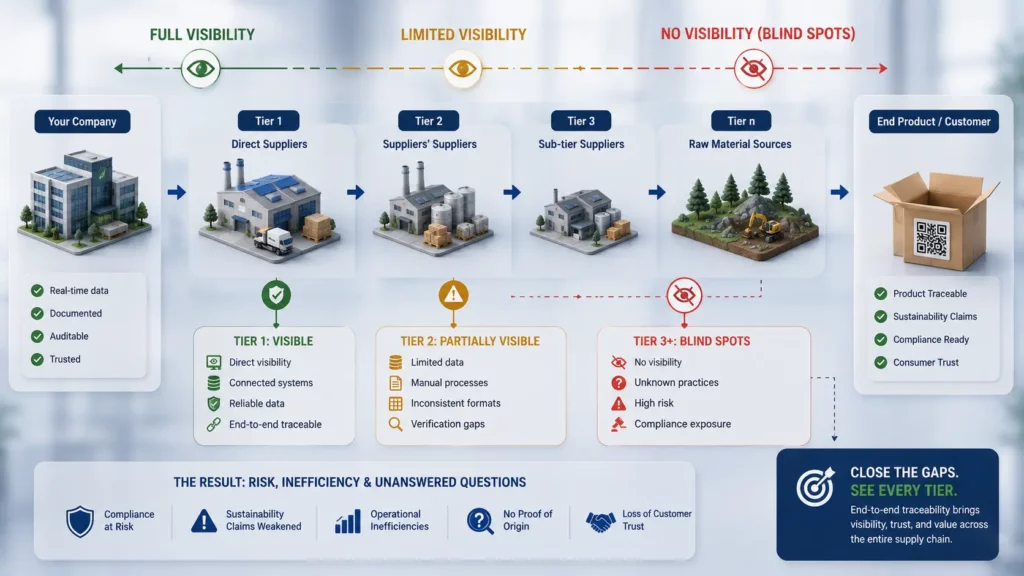
Supply chain traceability is the ability to track every product, material and process across every stage of the supply chain from raw-material origin to final delivery with verifiable, tamper-evident records. It links each handoff between supplier, manufacturer and retailer so you can prove where something came from, how it moved and whether it meets your standards. Done well, supply chain traceability turns an opaque, multi-tier network into a queryable source of truth that protects you in a recall, an audit or a regulator’s inbox. This guide answers the seven questions buyers ask before choosing a system.
Key takeaways
Supply chain traceability tracks products, materials and data from origin to delivery with verifiable records.
Its building blocks are provenance, chain of custody, batch traceability and supplier mapping tied together by real-time data.
It underpins compliance with EUDR (applies 30 Dec 2026), FSMA 204 (20 Jul 2028), ESPR/DPP and ESG reporting.
Most systems fail at Tier 2–Tier 3, where data is manual, inconsistent and unverifiable exactly where audits probe.
Blockchain, IoT and cloud provide the tamper-evidence, sensing and accessibility that manual records can’t.
The right solution is scalable, integrates with your ERP, and links every claim back to a verifiable source.
Ready to See Traceability in Action?
Explore how TraceX can connect suppliers, products, batches and supply-chain events to give your teams greater visibility and control.
Supply chain traceability is the ability to track and verify a product’s full journey every material, process and handoff from origin to end customer.
It answers two questions at once: where did this come from, and can I prove it? A complete picture rests on four building blocks provenance (where and how it was sourced), chain of custody (who held it at each stage), batch traceability (which specific lot is which), and supplier mapping (who supplies whom across every tier). Together, these turn scattered documents into one connected, verifiable history you can reconstruct on demand.
Do You Have the Right Framework for End-to-End Traceability?Learn how to structure your supply chain traceability framework to connect suppliers, products, batches, transactions and data across every stage.
Why does Supply chain traceability matter for businesses?
Supply chain traceability matters because it protects you in a recall, proves compliance, manages supplier risk and builds consumer trust.
Four forces drive adoption: risk management (spot exposure before it becomes a recall or headline), regulatory compliance (evidence for EUDR, FSMA, ESPR and ESG rules), quality assurance (catch issues at the batch, not the brand, level), and consumer trust (the origin story shoppers now reward). In practice, supply chain traceability converts transparency from a marketing line into defensible, auditable proof.
Is Your Supply Chain Ready for Growing Compliance Requirements?Learn how to strengthen supply chain compliance by connecting supplier data, traceability, documentation and regulatory evidence across your value chain.
Most traceability systems fail at Tier 2 and Tier 3, where data is manual, inconsistent and impossible to verify under audit.
Many companies assume they have traceability because they file documents and track shipments internally on paper it looks structured. In reality those systems were never designed for regulatory-grade scrutiny, large-scale aggregation or dynamic risk monitoring. Traceability breaks where custody breaks: at the unmapped supplier, the spreadsheet handoff, the lot that can’t be reconciled by volume. That gap is exactly what a modern supply chain traceability platform is built to close.
Can You See Beyond Your Tier-1 Suppliers?Discover how multi-tier supply chain transparency can help businesses uncover upstream risks, connect supplier data and build visibility from source to end product.
How does supply chain traceability support EUDR and compliance?
Supply chain traceability provides the verifiable, event-based records that EUDR, FSMA 204 and ESPR/DPP now demand.
Regulators no longer accept high-level declarations they want proof of who supplied what, where it originated and when it moved. The EUDR (Regulation (EU) 2023/1115, amended by (EU) 2025/2650) requires deforestation-free due diligence and a Due Diligence Statement, and now applies from 30 December 2026 for large and medium operators (30 June 2027 for micro and small). FSMA 204 adds lot-level food traceability from 20 July 2028, and ESPR introduces the Digital Product Passport. Traceability is how you generate that evidence and retrieve it on demand.
What technologies power supply chain traceability?
Supply chain traceability is powered by blockchain, IoT and cloud for tamper-evidence, real-time sensing and anywhere access.
Blockchain — an immutable, shared ledger that makes every record tamper-evident and auditable across partners.
IoT sensors / RFID — capture real-time conditions (temperature, location, movement) automatically, without line of sight.
Cloud platform — centralises data so every stakeholder sees one verified version, accessible anywhere.
How do I choose a supply chain traceability solution?
Choose a supply chain traceability solution that is scalable, integrates with your ERP, and links every claim to a verifiable source.
Weigh three essentials: scalability (it must grow with new products, tiers and markets), integration (it should connect to ERP and inventory tools instead of creating another silo), and usability (staff and suppliers adopt what’s simple to use). The TraceX Traceability & Regulatory Compliance platform brings these together with a blockchain-backed record, real-time monitoring and EUDR-ready reporting, turning fragmented, multi-tier supply chains into one transparent, audit-ready system.
Is Your Supply Chain Ready for Digital Traceability?Discover how digital traceability systems can connect suppliers, products, batches and supply-chain events to improve visibility, compliance and operational control.
“Supply chain traceability isn’t a document you produce for an audit it’s a system that makes the audit a query. If a claim can’t be traced to a verifiable source, treat it as a risk you haven’t priced yet.”
TraceX helps businesses answer the seven questions buyers typically ask before investing in a supply chain traceability solution what can be traced, how deeply it can be traced, where the data comes from, how it integrates with existing systems, whether it scales, how compliance is supported, and what visibility teams gain.
TraceX connects suppliers, farms, raw materials, batches, processing activities, inventory, transactions and downstream movements into a digital traceability workflow, while supporting data capture across multiple supply-chain stakeholders. Its integration capabilities can connect traceability data with enterprise systems, and its dashboards, digital records and evidence management help businesses move from fragmented information to a more connected view of their supply chain. This enables organisations to build traceability progressively from source and batch visibility to end-to-end product journeys while creating a stronger foundation for compliance, audits, recalls and sustainability reporting.
Document-based records vs. platform-based supply chain traceability
The same multi-tier chain, handled two very different ways.
Dimension
Document-based (files / spreadsheets)
TraceX platform
Tier coverage
Strong at Tier 1, blind beyond it
Mapped across every tier
Data integrity
Editable, disputable, siloed
Tamper-evident, shared ledger
Recall trace-back
Days of cross-referencing
Affected lot isolated in seconds
Monitoring
Point-in-time snapshots
Real-time via IoT / RFID
Compliance
Scramble to assemble at audit
EUDR / FSMA / DPP-ready on demand
Consumer proof
Claims with no verifiable trail
Scannable, verified provenance
Buyer’s checklist: choosing a supply chain traceability platform
Confirm any platform you shortlist can do all seven.
Map suppliers and sites across Tier 2 and Tier 3, not just direct suppliers
Capture events via mobile, barcode, QR, RFID and IoT — including offline
Secure records on a tamper-evident (blockchain) ledger
Trace any product or batch forward and backward in seconds
Produce EUDR / FSMA 204 / DPP-aligned records on demand
Integrate with your existing ERP and inventory systems
Scale across commodities, markets and smallholder suppliers
Frequently Asked Questions
What is the difference between traceability and transparency?
Traceability is the ability to track and verify a product’s journey with data; transparency is choosing to share that information with regulators, partners or consumers. Traceability is the capability; transparency is the disclosure it makes possible.
What are the four types of supply chain traceability?
The common building blocks are product traceability, material traceability, batch traceability and chain of custody supported by supplier mapping and provenance. Most robust programs combine several rather than relying on one.
What is the difference between tracking and tracing?
Tracking follows a product forward through the supply chain to its destination; tracing works backward to reconstruct its origin and inputs. A good supply chain traceability system does both from a single identity.
Is supply chain traceability mandatory?
Increasingly, yes. EUDR requires deforestation due diligence (applying 30 December 2026 for large and medium operators), FSMA 204 mandates lot-level food traceability from 20 July 2028, and ESPR introduces the Digital Product Passport across categories.
How does blockchain improve supply chain traceability?
Blockchain stores each record on a shared, immutable ledger, so a claim like “deforestation-free” or “organic” can’t be quietly altered and can be verified by every party which is what makes records defensible in an audit.
How long does it take to implement traceability?
It varies with supply-chain complexity and tiers, but most teams start with one high-risk product or commodity, prove value, then scale. Mobile onboarding and ERP integration shorten time-to-value considerably.
How does supply chain traceability build consumer trust?
By linking a scannable code to a product’s verified origin, handling and certifications, so shoppers can confirm claims for themselves rather than take the label on faith — turning transparency into loyalty.
About cookies on this site
We use cookies on our website to give you the most relevant experience by remembering your preferences and repeat visits. By clicking “Accept All”, you consent to the use of ALL the cookies. However, you may visit "Cookie Settings" to provide a controlled consent.
This website uses cookies to improve your experience while you navigate through the website. Out of these, the cookies that are categorized as necessary are stored on your browser as they are essential for the working of basic functionalities of the website. We also use third-party cookies that help us analyze and understand how you use this website. These cookies will be stored in your browser only with your consent. You also have the option to opt-out of these cookies. But opting out of some of these cookies may affect your browsing experience.
Necessary cookies are absolutely essential for the website to function properly. These cookies ensure basic functionalities and security features of the website, anonymously.
Cookie
Duration
Description
cookielawinfo-checkbox-analytics
11 months
This cookie is set by GDPR Cookie Consent plugin. The cookie is used to store the user consent for the cookies in the category "Analytics".
cookielawinfo-checkbox-functional
11 months
The cookie is set by GDPR cookie consent to record the user consent for the cookies in the category "Functional".
cookielawinfo-checkbox-necessary
11 months
This cookie is set by GDPR Cookie Consent plugin. The cookies is used to store the user consent for the cookies in the category "Necessary".
cookielawinfo-checkbox-others
11 months
This cookie is set by GDPR Cookie Consent plugin. The cookie is used to store the user consent for the cookies in the category "Other.
cookielawinfo-checkbox-performance
11 months
This cookie is set by GDPR Cookie Consent plugin. The cookie is used to store the user consent for the cookies in the category "Performance".
viewed_cookie_policy
11 months
The cookie is set by the GDPR Cookie Consent plugin and is used to store whether or not user has consented to the use of cookies. It does not store any personal data.
Functional cookies help to perform certain functionalities like sharing the content of the website on social media platforms, collect feedbacks, and other third-party features.
Performance cookies are used to understand and analyze the key performance indexes of the website which helps in delivering a better user experience for the visitors.
Analytical cookies are used to understand how visitors interact with the website. These cookies help provide information on metrics the number of visitors, bounce rate, traffic source, etc.
Advertisement cookies are used to provide visitors with relevant ads and marketing campaigns. These cookies track visitors across websites and collect information to provide customized ads.
Other uncategorized cookies are those that are being analyzed and have not been classified into a category as yet.
WhatsApp us
How Mature Is Your Traceability Program?
Download the 2026 Traceability Scorecard and Benchmark Your Supply Chain Across 10 Critical Capabilities.
Download our eBook
Don’t Wait for an Audit to Find Your EUDR Gaps
The 2026 Simplification Package changes how HS codes, DDS pass-through and geolocation rules apply to you. Get the free guide and 20-point readiness checklist before enforcement catches you unprepared.