Ethical Sourcing Practices in Europe: Turning Compliance Pressure Into a Buying Advantage
Published
, 8 minute read
Share this article
Quick summary: Ethical sourcing practices in Europe are now enforceable under EUDR and CSDDD. See what compliant sourcing looks like — and how to prove it with one data layer.
Ethical sourcing practices in Europe are the procurement methods companies use to prove with data, not promises that the goods they buy are free of deforestation, forced or child labour, and human-rights harm across the supply chain. In 2026 they are no longer a voluntary CSR gesture. Under the EU Deforestation Regulation (EUDR) and the Corporate Sustainability Due Diligence Directive (CSDDD), ethical sourcing in Europe is a legal, auditable requirement, and the companies that can produce the evidence fastest win market access and buyer trust.
Key takeaways
Ethical sourcing practices in Europe have shifted from a values statement to a compliance obligation you must evidence.
Two regulations drive buyer urgency: EUDR (from 30 Dec 2026) and CSDDD (from 26 Jul 2029), backed by CSRD reporting.
Certifications such as Fairtrade, FSC and RSPO support ethical sourcing but do not replace geolocation, plot-level evidence or a due diligence statement.
The real bottleneck is retrieval getting supplier and origin evidence out of inboxes fast enough to satisfy an auditor.
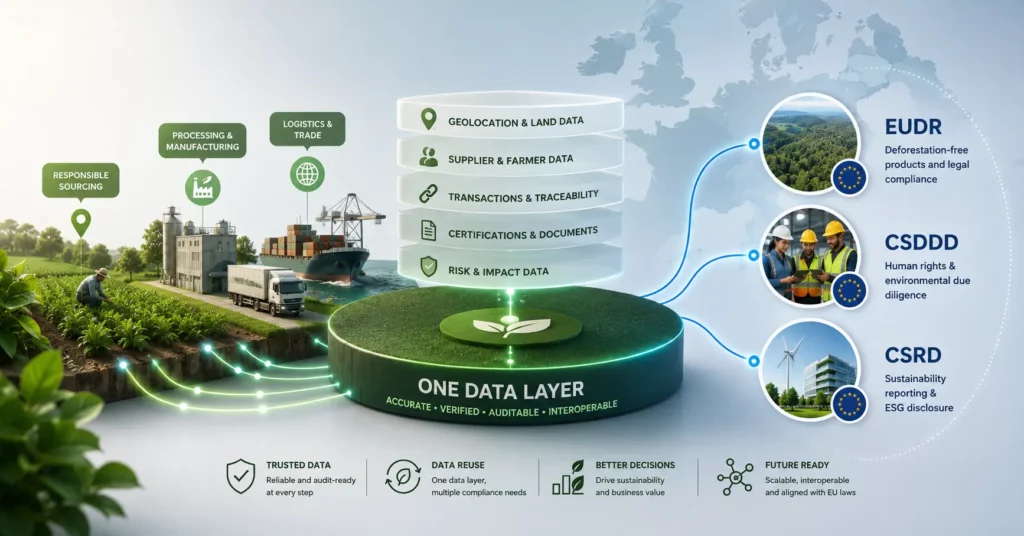
One connected data layer lets you reuse the same sourcing evidence across EUDR, CSDDD and CSRD instead of rebuilding it per rule.
Simplify Regulatory Compliance with TraceXFrom EUDR and PPWR to Digital Product Passports and beyond.
Why Ethical Sourcing Practices in Europe Are Now a Legal Requirement
For years, ethical sourcing practices in Europe were something brands talked about in sustainability reports. That era is over. European buyers now search for this topic because a regulator, a retailer, or a procurement lead is asking them to prove their claims and “we work with good suppliers” is no longer an acceptable answer.
Two pieces of EU law have turned responsible sourcing into a hard obligation:
EU Deforestation Regulation (EUDR): companies placing commodities like coffee, cocoa, soy, palm oil, rubber, timber and cattle on the EU market must prove the goods are deforestation-free using plot-level geolocation and a filed due diligence statement. It applies from 30 December 2026 for large and medium operators and traders, and 30 June 2027 for micro and small operators.
Corporate Sustainability Due Diligence Directive (CSDDD): requires large companies to identify, prevent and account for human-rights and environmental harm across their value chains, with application from 26 July 2029. Even if you sit below the threshold, your customers above it will push these duties down to you.
Add the CSRD reporting layer on top, and the pattern is clear: ethical sourcing in Europe is now judged by the evidence you can produce, not the intentions you can describe. That is exactly why a buyer researching ethical sourcing practices in Europe is really asking a commercial question “what do I need to have in place, and what tool will get me there?”
What Good Ethical Sourcing Practices in Europe Look Like
Effective ethical sourcing practices in Europe rest on four operational pillars. Each one is a place where a buyer either has the evidence or scrambles for it during an audit.
1. Traceability to the source
You need to know where a product actually came from down to the farm plot or forest coupe, not just the exporting country. A German coffee roaster importing from Ethiopia, for example, now has to link each lot back to specific producer coordinates to satisfy EUDR, something a supplier invoice alone never captured.
Build End-to-End EUDR Traceability with Confidence
Fair-labour attestations, land-use records and certificates go stale. Responsible sourcing means holding supplier evidence as living records that flag when a document expires or a new supplier is onboarded not a folder of PDFs rebuilt before each audit.
3. A defensible due diligence trail
For in-scope commodities, ethical sourcing in Europe requires a due diligence statement backed by geolocation and a risk assessment. A French furniture brand sourcing timber has to demonstrate both legality and deforestation-free origin, then file that statement to the EU system and be able to reproduce it on request.
4. Certifications as support, not substitute
This is where buyers most often get caught out. Schemes like Fairtrade, FSC, RSPO and Rainforest Alliance strengthen ethical sourcing practices in Europe and help with risk mitigation but they do not replace EUDR geolocation, plot-level evidence or the due diligence statement. A Dutch chocolate maker using Fairtrade cocoa still has to produce the underlying farm data itself.
Ethical sourcing in Europe has quietly become a data problem, not a policy problem. The companies that struggle aren’t the ones with weak values they’re the ones whose sourcing evidence is scattered across supplier inboxes and spreadsheets. Treat ethical sourcing as one connected data layer, captured once at the source, and every regulation that follows becomes a report you run rather than a project you restart.
Build Ethical Supply Chains with Transparency and Trust
Ethical Sourcing in Europe: Manual Effort vs. a Connected Platform
Most teams start with spreadsheets and email. That holds until the first real audit. Here is how a manual approach compares with a connected data platform for the evidence buyers actually have to produce.
What buyers need to prove
Manual / spreadsheet approach
Connected data platform
Origin & geolocation
Emailed PDFs, no plot coordinates
Plot-level GPS captured at source
Supplier evidence
Chased per audit, often expired
Living supplier records, auto-flagged gaps
EUDR due diligence statement
Rebuilt by hand each shipment
Generated and filed to TRACES
Human-rights / labour data
Sits in separate CSR files
Same record, one data layer
Audit response time
Days of document hunting
Retrieved in minutes
Reusable across regulations
No — redone per rule
Yes — EUDR, CSDDD, CSRD from one base
How to Evaluate an Ethical Sourcing Solution for Europe
If you’re comparing tools to operationalise ethical sourcing practices in Europe, score each option against this buyer checklist before you book a demo:
Does it capture plot-level geolocation at the source, including from smallholders?
Can it generate and file an EUDR due diligence statement to TRACES, not just store documents?
Does it treat supplier and labour evidence as living records with expiry alerts?
Will the same data feed CSDDD and CSRD, or will you rebuild it per regulation?
How fast can you retrieve evidence for an auditor minutes or days?
How TraceX Supports Ethical Sourcing Practices in Europe
TraceX gives sourcing and compliance teams a single platform to capture origin data, manage supplier evidence and produce audit-ready proof for ethical sourcing practices in Europe.Its blockchain-backed traceability records origin and chain-of-custody events as they happen, so the evidence exists before an auditor asks for it. For EUDR specifically, TraceX EUDR Solutions captures plot-level geolocation, runs risk assessment and generates the due diligence statement for filing. Because it all sits on one data layer, the same sourcing records extend to CSDDD human-rights due diligence and CSRD reporting turning compliance from repeated projects into a repeatable process.
Ethical sourcing practices in Europe are procurement methods that use verifiable data to ensure goods are free from deforestation, forced and child labour, and human-rights harm across the supply chain now backed by EU law such as EUDR and CSDDD rather than voluntary policy alone.
Is ethical sourcing a legal requirement in the EU?
Increasingly, yes. EUDR makes deforestation-free due diligence mandatory for in-scope commodities from 30 December 2026, and CSDDD introduces human-rights and environmental due diligence duties from 26 July 2029 for very large companies, which cascade down to their suppliers.
Do certifications like Fairtrade or FSC prove EUDR compliance?
No. Certifications support ethical sourcing and help with risk mitigation, but they do not replace the EUDR requirements for plot-level geolocation, origin evidence and a filed due diligence statement. You still need the underlying data.
Which commodities does EUDR cover?
EUDR covers cattle, cocoa, coffee, oil palm, rubber, soya and wood, plus a range of derived products. Cotton is not an EUDR commodity. Always check the current product scope on EUR-Lex, as the annex has been refined by delegated act.
How is ethical sourcing different from sustainable sourcing?
Sustainable sourcing focuses mainly on environmental impact. Ethical sourcing practices in Europe are broader covering labour rights, human rights and deforestation together which is why they map so directly onto the combined EUDR and CSDDD obligations.
What data do I need for ethical sourcing due diligence?
At minimum: the country and plot-level geolocation of production, supplier identity and evidence, a risk assessment, and a traceable chain of custody linking each shipment back to its source all retrievable on demand.
How do I start improving ethical sourcing practices in Europe?
Map your highest-risk commodities first, capture origin and supplier evidence in one place, and choose a platform that turns that data into an EUDR due diligence statement while remaining reusable for CSDDD and CSRD.
Start using TraceX
Transparency, Trust, & Success for your Climate Journey.
We use cookies on our website to give you the most relevant experience by remembering your preferences and repeat visits. By clicking “Accept All”, you consent to the use of ALL the cookies. However, you may visit "Cookie Settings" to provide a controlled consent.
This website uses cookies to improve your experience while you navigate through the website. Out of these, the cookies that are categorized as necessary are stored on your browser as they are essential for the working of basic functionalities of the website. We also use third-party cookies that help us analyze and understand how you use this website. These cookies will be stored in your browser only with your consent. You also have the option to opt-out of these cookies. But opting out of some of these cookies may affect your browsing experience.
Necessary cookies are absolutely essential for the website to function properly. These cookies ensure basic functionalities and security features of the website, anonymously.
Cookie
Duration
Description
cookielawinfo-checkbox-analytics
11 months
This cookie is set by GDPR Cookie Consent plugin. The cookie is used to store the user consent for the cookies in the category "Analytics".
cookielawinfo-checkbox-functional
11 months
The cookie is set by GDPR cookie consent to record the user consent for the cookies in the category "Functional".
cookielawinfo-checkbox-necessary
11 months
This cookie is set by GDPR Cookie Consent plugin. The cookies is used to store the user consent for the cookies in the category "Necessary".
cookielawinfo-checkbox-others
11 months
This cookie is set by GDPR Cookie Consent plugin. The cookie is used to store the user consent for the cookies in the category "Other.
cookielawinfo-checkbox-performance
11 months
This cookie is set by GDPR Cookie Consent plugin. The cookie is used to store the user consent for the cookies in the category "Performance".
viewed_cookie_policy
11 months
The cookie is set by the GDPR Cookie Consent plugin and is used to store whether or not user has consented to the use of cookies. It does not store any personal data.
Functional cookies help to perform certain functionalities like sharing the content of the website on social media platforms, collect feedbacks, and other third-party features.
Performance cookies are used to understand and analyze the key performance indexes of the website which helps in delivering a better user experience for the visitors.
Analytical cookies are used to understand how visitors interact with the website. These cookies help provide information on metrics the number of visitors, bounce rate, traffic source, etc.
Advertisement cookies are used to provide visitors with relevant ads and marketing campaigns. These cookies track visitors across websites and collect information to provide customized ads.
Download the 2026 Traceability Scorecard and Benchmark Your Supply Chain Across 10 Critical Capabilities.
Download our eBook
Don’t Wait for an Audit to Find Your EUDR Gaps
The 2026 Simplification Package changes how HS codes, DDS pass-through and geolocation rules apply to you. Get the free guide and 20-point readiness checklist before enforcement catches you unprepared.