From Ocean to Plate-Mapping the Seafood Supply Chain
Published
, 18 minute read
Share this article
Quick summary: Learn how aquaculture and seafood supply chains operate, why seafood traceability is critical, and how digital solutions enable end-to-end visibility, compliance, and sustainability in global seafood markets.
Global seafood demand is rising, but so are the risks hidden inside fisheries and aquaculture supply chains. From illegal and unreported fishing to environmental degradation, labor violations, and food safety failures, seafood producers and exporters face unprecedented regulatory and buyer scrutiny. Mapping the Seafood Supply Chain involves digitally tracking seafood from catch or farm through processing, distribution, and export to ensure traceability, sustainability, and regulatory compliance.
India’s fisheries and aquaculture sector plays a pivotal role in its socio-economic development, contributing significantly to food security, livelihoods, and exports. As one of the top three fish-producing countries globally and a leading exporter of seafood, the sector supports over 30 million livelihoods.
The challenge is compounded by the complexity of wild-capture and aquaculture systems, where products pass through multiple hands, locations, and transformations before reaching the market. Without end-to-end visibility, businesses struggle to prove legal sourcing, sustainability, and compliance, putting market access and brand credibility at risk.
This is why mapping the seafood supply chain has become a business necessity, enabling traceability, risk control, and trust across increasingly regulated global seafood markets. It includes source verification, batch-level tracking, chain-of-custody controls, ESG and labor monitoring, and compliance with regulations such as IUU, SIMP, and food safety laws. Effective value chain mapping reduces fraud, prevents illegal sourcing, supports certifications, and builds buyer trust, making it essential for accessing regulated and premium seafood markets.
Key Takeaways
The seafood supply chain spans multiple stages from wild-capture or aquaculture farms through harvest, landing, processing, aggregation, logistics, and export.
Upstream mapping at the source ensures traceability from vessels or farms, capturing catch location, species, feed, and water quality data.
The first point of sale is critical for establishing chain-of-custody and batch integrity, preventing fraud and mislabelling.
During processing and cold chain management, grading, filleting, freezing, and packaging must maintain batch-level traceability while monitoring temperature to preserve quality.
Traceability reduces risks in exports by ensuring compliance, recall readiness, and buyer confidence.
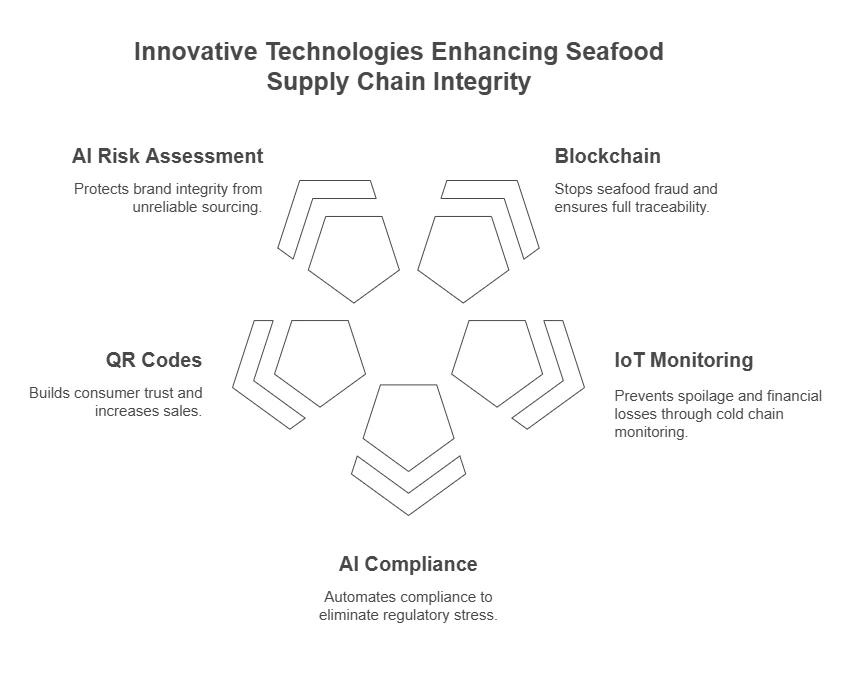
Technology solutions, including digital platforms, GPS, VMS, IoT sensors, QR codes, and blockchain enable seamless data capture and interoperability.
Common challenges include fragmented sourcing, data gaps, mixing during processing, and manual documentation.
TraceX supports end-to-end value chain mapping with batch-level tracking, chain-of-custody control, integration across operations, and buyer-ready dashboards, ensuring compliance, transparency, and operational efficiency.
What are the stages in the Seafood Supply chain?
The seafood supply chain consists of multiple interconnected stages that track the physical movement of seafood as well as the flow of data, documentation, and compliance obligations. While wild-capture fisheries and aquaculture systems differ in production methods, both require end-to-end visibility to meet food safety, sustainability, and trade regulations.
1. Primary Production: Wild-Capture vs Aquaculture
Wild-Capture Fisheries begin with fishing activities at sea or inland waters. Key steps include vessel registration, fishing authorization, gear type selection, and catch reporting. Data such as fishing location (FAO zone), species, catch volume, and date are critical for legality and sustainability compliance.
Aquaculture Systems start on farms where aquatic species are bred, raised, and harvested. This includes hatchery operations, stocking, feeding, water quality management, disease control, and harvest scheduling. Aquaculture requires continuous data on inputs, growth cycles, and environmental conditions.
2. Input & Support Services
This stage includes hatcheries, feed suppliers, veterinary service providers, and equipment suppliers. In aquaculture, traceability extends to feed composition, antibiotic use, and broodstock origin, which are increasingly scrutinized by regulators and buyers.
3. Harvesting & Landing
For fisheries, harvested catch is landed at authorized ports where weight verification, species identification, and landing declarations occur. In aquaculture, harvesting is planned and documented at the farm level, linking pond or cage data to harvested lots.
This stage is critical for establishing first-point traceability and preventing illegal, unreported, and unregulated (IUU) seafood from entering the supply chain.
4. Aggregation, Storage & Transport
Seafood often passes through collectors, cold storage facilities, and transporters. Maintaining lot and batch integrity, temperature control, and chain-of-custody documentation is essential to prevent mixing, mislabelling, or contamination.
5. Processing & Value Addition
Processors handle cleaning, filleting, freezing, cooking, or further transformation. This stage involves batch creation, yield tracking, and labeling. Regulatory data such as HACCP records, food safety tests, and processing logs are generated here.
6. Export, Distribution & Retail
Exporters compile traceability, sustainability, and compliance documentation required for international markets (EU, US, Japan). Importers, distributors, and retailers rely on verified data to meet buyer standards, ecolabels, and regulatory reporting.
Flow of Product, Data & Compliance
Across all stages, seafood moves alongside digital records, catch certificates, farm logs, processing batches, sustainability claims, and regulatory filings. Mapping the fisheries and aquaculture supply chain ensures that product origin, handling, and transformation data remain connected, auditable, and compliant from source to shelf.
This end-to-end visibility is now essential for market access, risk mitigation, and sustainable seafood sourcing.
Explore how digital traceability is revolutionizing the food industry, from farm to fork, enhancing safety, quality, and efficiency.
What is Upstream Mapping: Source-Level Traceability
Upstream mapping is the foundation of seafood traceability, capturing verifiable data at the point of origin, whether from wild-capture fisheries or aquaculture farms. This is where legality, sustainability, and product integrity are first established.
Wild-Capture Fisheries
In wild-capture fisheries, source-level traceability focuses on proving that seafood is legally caught, accurately reported, and sustainably managed.
Vessel Registration and Licensing
Every fishing vessel must be uniquely identified through national or regional registries (flag state, vessel ID, gear type). Valid licenses and fishing authorizations ensure the vessel is permitted to operate in specific waters and target approved species. Digital vessel profiles reduce fraud and simplify verification for buyers and regulators.
Catch Location, Species & Methods
Traceability systems record FAO fishing zones, GPS coordinates, date and time of catch, target species, and fishing gear used. This data is essential for quota management, stock assessments, and buyer transparency. Accurate species identification also helps prevent mislabelling and substitution, a major risk in global seafood trade.
Preventing IUU Fishing
Source-level traceability is a key defence against Illegal, Unreported, and Unregulated (IUU) fishing. By linking catch data to licensed vessels, authorized fishing zones, and landing declarations, digital systems help flag inconsistencies and exclude non-compliant seafood from entering the supply chain. This supports compliance with regulations such as the EU IUU Regulation and U.S. SIMP.
Aquaculture Farming
In aquaculture, upstream traceability centres on farm management, input transparency, and continuous monitoring throughout the production cycle.
Hatcheries, Broodstock & Feed Traceability
Traceability begins at the hatchery, documenting broodstock origin, seed quality, and stocking records. Feed traceability captures feed supplier, composition, additives, and any use of antibiotics or growth enhancers data increasingly demanded by regulators and sustainability programs.
Pond, Cage & RAS Mapping
Each production unit ponds, cages, or Recirculating Aquaculture Systems (RAS) is digitally mapped and uniquely identified. This enables batch-level linkage between specific farm units and harvested seafood, supporting recall readiness and buyer verification.
Monitoring Water Quality & Health Practices
Ongoing data capture on water parameters (temperature, dissolved oxygen, pH), stocking density, feed conversion ratios, and disease management provides visibility into animal welfare and environmental impact. This level of aquaculture farm monitoring supports certifications, reduces biosecurity risks, and improves productivity.
Why Upstream Mapping Matters
By establishing robust source-level traceability in both fisheries and aquaculture, companies can ensure legal compliance, prevent fraud, meet sustainability requirements, and build trust with global seafood buyers starting from the very first point in the value chain.
Why is the First point of Sale critical for seafood traceability?
Harvest, Landing & First Point of Sale
The harvest and landing stage is a critical control point in the fisheries and aquaculture value chain. This is where physical seafood products are first linked to verified data, enabling traceability, legality, and chain-of-custody integrity from the very beginning of commercialization.
Catch Documentation & Landing Declarations
At harvest, detailed catch documentation is created to record what was caught or harvested, where, when, and how. For wild-capture fisheries, this includes vessel ID, fishing zone (FAO area), gear type, species, weight, and date of capture. For aquaculture, harvest records capture farm ID, production unit, harvest date, biomass, and health status.
Landing declarations formally register the seafood at authorized landing sites or ports. These declarations are often required by regulators to verify compliance with quotas, closed seasons, and fishing authorizations. Digital landing records reduce manual errors and help authorities and buyers validate the legality of the product.
Batch Creation at Harvest or Harvest Cycles
Harvest is the moment when traceability batches are created. Seafood is grouped into batches or lots based on harvest date, vessel or farm, species, and handling conditions. In aquaculture, batch creation may align with harvest cycles from specific ponds, cages, or RAS units.
Each batch is assigned a unique identifier that follows the product through processing, storage, and export. Accurate batch creation prevents mixing of compliant and non-compliant seafood, supports quality control, and enables rapid recalls if safety or sustainability issues arise.
Chain-of-Custody Initiation & Ownership Transfer
The first point of sale typically to a landing centre, auction, collector, or processor marks the official start of the chain of custody. At this stage, ownership transfer is digitally recorded, linking the physical product to its traceability data.
Chain-of-custody records capture buyer and seller details, transaction date, batch IDs, quantities, and transport conditions. This ensures continuity of traceability as seafood moves from primary producers into downstream supply chains. Clear custody records are essential for meeting certification requirements, preventing fraud, and maintaining buyer confidence.
Why This Stage Is Critical
Errors or data gaps at harvest and first sale can compromise the entire traceability system. Robust documentation, batch integrity, and custody controls at this stage ensure that seafood entering the market is legal, traceable, and compliant, forming a reliable foundation for downstream processing, certification, and export.
Processing, Cold Chain & Value Addition
Once seafood moves beyond the first point of sale, processing and cold chain management become critical for preserving quality, safety, and traceability. This stage introduces multiple transformation steps, making robust controls essential to prevent data loss, contamination, or fraud.
Seafood processing typically includes grading by size and quality, filleting or other value-added cuts, freezing or chilling, and final packaging. Each step alters the physical form of the product, increasing the risk of traceability breaks if not digitally tracked.
Traceability systems must record where, when, and how each transformation occurs, including facility details, processing methods, yields, and hygiene controls. This data supports food safety compliance, quality assurance, and buyer specifications.
Batch & Lot-Level Traceability Through Transformation
During processing, original harvest batches are often split, combined, or converted into new lots. Effective seafood processing traceability ensures that all output lots remain digitally linked to their input batches.
This input–output mapping allows companies to trace finished products back to specific vessels or farms. It also enables fast, targeted recalls and protects compliant volumes from being impacted by isolated issues.
Cold Chain Integrity & Temperature Monitoring
Seafood is highly perishable, making cold chain integrity essential. Continuous temperature monitoring during storage, transport, and processing helps maintain product quality and prevent spoilage or food safety risks.
Digital sensors and logs capture temperature deviations in real time, creating audit-ready records for regulators and buyers. Maintaining an unbroken cold chain also reduces waste and strengthens export readiness.
Preventing Species Substitution & Fraud
Processing is a high-risk stage for species substitution, dilution, and mislabeling. Batch-level traceability, combined with species verification data and controlled processing workflows, helps prevent fraudulent practices.
By maintaining transparent records of species, origin, and transformation, companies can protect brand reputation, meet certification requirements, and ensure consumer trust.
Why This Stage Matters
Strong controls over processing, cold chain, and value addition ensure that seafood remains safe, authentic, and traceable as it moves toward global markets making this stage central to compliance, quality, and sustainability in the fisheries and aquaculture value chains.
How does Traceability reduce risk in Seafood exports?
Aggregation, Trading & Export Logistics
As seafood moves closer to international markets, aggregation, trading, and export logistics introduce additional complexity. This stage requires tight coordination between physical product flows, documentation, and digital traceability to ensure compliance and buyer confidence.
Aggregation from Multiple Vessels or Farms
Seafood is often aggregated from multiple vessels, landing sites, or aquaculture farms before export. This consolidation increases efficiency but also raises traceability risks if batch integrity is not maintained.
Digital traceability systems ensure that aggregated volumes retain links to their original harvest batches, vessels, or farms. Chain-of-custody models such as identity preserved or mass balance define how compliant volumes can be combined while maintaining transparency and auditability.
Export Documentation & Health Certificates
Exporting seafood requires extensive documentation, including catch certificates, health certificates, certificates of origin, and sustainability declarations. These documents must align with importing country regulations and buyer requirements.
Digitized documentation reduces errors, accelerates customs clearance, and ensures consistency between physical shipments and traceability data critical for avoiding delays, rejections, or penalties.
Linking Batches to Shipments & Destinations
Each export shipment must be digitally linked to the specific batches and lots it contains, along with destination markets and buyers. This shipment-level traceability enables visibility across logistics partners, ports, and cold storage facilities.
Accurate linkage supports real-time tracking, buyer transparency, and compliance with regulations such as IUU controls, SIMP, and food safety laws.
Recall Readiness & Buyer Compliance
In the event of a quality or compliance issue, batch-to-shipment traceability allows companies to quickly identify affected products, destinations, and customers. This recall readiness minimizes financial loss and protects unaffected volumes.
For buyers, especially in regulated markets, this level of traceability is no longer optional it is a core requirement for market access and long-term supplier relationships.
Why This Stage Is Critical
Strong aggregation and export traceability ensures that seafood reaching global markets is legally sourced, fully documented, and recall-ready, enabling exporters to meet regulatory expectations and maintain buyer trust at scale.
Technology Solutions for Seafood Value Chain Mapping
Effective mapping of seafood value chains depends on robust digital infrastructure that connects physical seafood products with verifiable, real-time data across fisheries and aquaculture operations. Technology is the backbone that enables traceability, compliance, and transparency at scale.
Digital Traceability Platforms for Fisheries & Aquaculture
Modern digital seafood traceability platforms provide a centralized system to capture, store, and link data from source to export. These platforms integrate farm, vessel, processing, logistics, and compliance data into a single digital record. By replacing paper-based logs and spreadsheets, they reduce errors, improve audit readiness, and allow businesses to meet buyer and regulatory requirements efficiently.
GPS, VMS, IoT Sensors & Mobile Data Capture
Technologies such as GPS and Vessel Monitoring Systems (VMS) track vessel location and fishing activity, helping verify authorized fishing zones and prevent IUU fishing. In aquaculture, IoT sensors monitor water quality parameters like temperature, oxygen, and pH in real time.
Mobile data capture tools allow fishers, farmers, and inspectors to record harvest, health, and handling data directly in the field even offline ensuring traceability starts at the source.
QR Codes, Blockchain & Digital Product Passports
QR codes link physical seafood products to their digital traceability records, enabling instant access to origin, processing, and sustainability data. Blockchain fisheries solutions add an extra layer of trust by creating immutable records that cannot be altered after entry, making traceability data audit-ready.
Emerging tools like Digital Product Passports (DPPs) extend this concept further by standardizing sustainability, compliance, and lifecycle data for seafood products entering regulated markets.
Interoperability Across Suppliers & Markets
Seafood value chains span countries, systems, and stakeholders. Interoperability ensures that data generated by vessels, farms, processors, and exporters can be shared seamlessly across platforms and borders. Use of open standards (such as GS1 identifiers and APIs) enables smooth data exchange, reduces duplication, and supports global compliance and buyer transparency.
Why Technology Matters
By combining digital platforms, tracking technologies, and interoperable data standards, seafood businesses can build secure, scalable, and transparent value chains transforming traceability from a compliance burden into a strategic advantage.
What are the Common Challenges in Mapping Seafood Value Chains
Mapping seafood and aquaculture value chains is complex due to the fragmented and distributed nature of the industry. Some of the key challenges include:
1. Fragmented and Informal Sourcing
Seafood is often procured from numerous small-scale fishers, farmers, or local aggregators, many of whom operate informally. This makes it difficult to capture consistent data, verify legality, and maintain traceability from the source.
2. Data Gaps at Sea and Remote Farms
Wild-capture fisheries operate in oceans or inland waters, and aquaculture farms are often in remote locations. Limited connectivity and reliance on manual logs lead to missing or delayed data, increasing the risk of non-compliance and traceability gaps.
3. Mixing During Processing and Aggregation
Seafood from multiple vessels or farms is often combined at landing centers, processing facilities, or during transport. Without proper batch-level tracking, it becomes challenging to link final products back to their origin, raising risks of species substitution, fraud, and regulatory non-compliance.
4. Manual Documentation and Audit Fatigue
Traditional paper-based recordkeeping is labour-intensive, error-prone, and difficult to audit. Frequent inspections, buyer checks, and regulatory reporting can overwhelm teams and slow down operations.
How TraceX Supports Seafood & Aquaculture Value Chain Mapping
TraceX Traceability Platform provides digital solutions to overcome these challenges and deliver robust, end-to-end traceability:
1. End-to-End Source-to-Export Traceability TraceX platform captures data from the vessel or farm through processing, storage, and export, ensuring that every seafood batch is fully documented and traceable.
2. Batch-Level Tracking and Chain-of-Custody Control Each harvest or production batch is digitally tagged, enabling identity-preserved or mass-balance chain-of-custody models. This ensures traceability through aggregation, processing, and logistics.
3. Integration with Processing, Logistics, and Exports TraceX platform links data across all stages grading, filleting, freezing, packaging, cold storage, and shipping so operators can monitor product quality, temperature, and compliance continuously.
4. Buyer-Ready Dashboards and Reporting The platform generates automated, audit-ready reports for buyers, regulators, and certifications. Dashboards visualize sustainability metrics, batch history, and compliance status, simplifying decision-making and enhancing market credibility.
Discover how TraceX helps fisheries and aquaculture businesses map their value chains, ensure compliance, and meet global buyer expectations.
In today’s global seafood market, traceability has evolved from a competitive differentiator to a mandatory buyer and regulatory requirement. Consumers, retailers, and regulators expect full visibility into the origin, handling, and sustainability of seafood products. Without robust mapping, businesses risk non-compliance, shipment rejections, and reputational damage. With tightening regulations like the EU IUU Regulation, US SIMP, and stricter import controls, seafood businesses must adopt digital systems that capture end-to-end data from ocean or pond to plate. This ensures batch-level traceability, chain-of-custody integrity, and real-time sustainability reporting.
Learn how digital traceability and monitoring are transforming food safety across the supply chain.
What is the fisheries and aquaculture value chain?
It encompasses all stages of seafood production from wild-capture or aquaculture farms through processing, aggregation, logistics, and export linking products, data, and compliance obligations across the supply chain.
Why is traceability important in seafood supply chains?
Traceability ensures legality, food safety, sustainability, and buyer confidence, while reducing risks like species substitution, fraud, and regulatory non-compliance.
How can companies map complex seafood value chains digitally?
By using digital traceability platforms with batch-level tracking, GPS/VMS data, IoT monitoring, blockchain, and interoperable systems, businesses can capture, store, and share verifiable data from source to plate.
Start using TraceX
Transparency, Trust, & Success for your Climate Journey.
We use cookies on our website to give you the most relevant experience by remembering your preferences and repeat visits. By clicking “Accept All”, you consent to the use of ALL the cookies. However, you may visit "Cookie Settings" to provide a controlled consent.
This website uses cookies to improve your experience while you navigate through the website. Out of these, the cookies that are categorized as necessary are stored on your browser as they are essential for the working of basic functionalities of the website. We also use third-party cookies that help us analyze and understand how you use this website. These cookies will be stored in your browser only with your consent. You also have the option to opt-out of these cookies. But opting out of some of these cookies may affect your browsing experience.
Necessary cookies are absolutely essential for the website to function properly. These cookies ensure basic functionalities and security features of the website, anonymously.
Cookie
Duration
Description
cookielawinfo-checkbox-analytics
11 months
This cookie is set by GDPR Cookie Consent plugin. The cookie is used to store the user consent for the cookies in the category "Analytics".
cookielawinfo-checkbox-functional
11 months
The cookie is set by GDPR cookie consent to record the user consent for the cookies in the category "Functional".
cookielawinfo-checkbox-necessary
11 months
This cookie is set by GDPR Cookie Consent plugin. The cookies is used to store the user consent for the cookies in the category "Necessary".
cookielawinfo-checkbox-others
11 months
This cookie is set by GDPR Cookie Consent plugin. The cookie is used to store the user consent for the cookies in the category "Other.
cookielawinfo-checkbox-performance
11 months
This cookie is set by GDPR Cookie Consent plugin. The cookie is used to store the user consent for the cookies in the category "Performance".
viewed_cookie_policy
11 months
The cookie is set by the GDPR Cookie Consent plugin and is used to store whether or not user has consented to the use of cookies. It does not store any personal data.
Functional cookies help to perform certain functionalities like sharing the content of the website on social media platforms, collect feedbacks, and other third-party features.
Performance cookies are used to understand and analyze the key performance indexes of the website which helps in delivering a better user experience for the visitors.
Analytical cookies are used to understand how visitors interact with the website. These cookies help provide information on metrics the number of visitors, bounce rate, traffic source, etc.
Advertisement cookies are used to provide visitors with relevant ads and marketing campaigns. These cookies track visitors across websites and collect information to provide customized ads.
Download the 2026 Traceability Scorecard and Benchmark Your Supply Chain Across 10 Critical Capabilities.
Download our eBook
Don’t Wait for an Audit to Find Your EUDR Gaps
The 2026 Simplification Package changes how HS codes, DDS pass-through and geolocation rules apply to you. Get the free guide and 20-point readiness checklist before enforcement catches you unprepared.