PPWR Compliance for FMCG Importers in the Netherlands
Published
, 22 minute read
Share this article
Quick summary: Learn how FMCG importers bringing products into the Netherlands can prepare for PPWR compliance, including manufacturer verification, Verpact registration, the Dutch packaging tax, Declaration of Conformity checks, and August 2026 readiness.
The Packaging and Packaging Waste Regulation (PPWR) is set to transform how Fast-Moving Consumer Goods (FMCG) importers bring packaged products into the Netherlands and the wider European Union. For businesses that import packaged foods, beverages, household products, personal care items, home care products, pet care products, or other consumer goods from outside the EU, PPWR introduces a distinct and demanding set of obligations.
Unlike manufacturers, importers do not design or produce packaging themselves — yet under PPWR they carry direct legal responsibility for confirming that packaging placed on the EU market for the first time already meets every applicable requirement. This makes verification, documentation, and supplier oversight the centre of an importer’s compliance strategy.
Unlike the previous Packaging and Packaging Waste Directive, PPWR is a regulation that applies directly across all EU Member States. This creates a consistent compliance framework while significantly raising the stakes for importers who place packaging from non-EU manufacturers onto the Dutch and EU markets.
For FMCG importers managing multiple overseas suppliers, diverse product portfolios, private-label ranges, and large volumes of packaging SKUs, achieving compliance requires far more than a customs declaration. It demands rigorous supplier verification, centralized documentation, and digital processes capable of proving — on demand — that every consignment of packaging entering the EU already complies.
Importers that begin preparing today will be better positioned to avoid customs delays, respond to market surveillance requests, and protect their business from the compliance and reputational risks of non-conforming packaging.
Key Takeaways
If your business imports packaged consumer goods into the Netherlands from outside the EU, PPWR introduces new verification and record-keeping responsibilities before goods ever reach the market.
Key compliance areas for importers include:
Verifying the manufacturer’s conformity assessment
Confirming a valid Declaration of Conformity (DoC) exists
Reviewing technical documentation for completeness
Checking packaging labelling and marking requirements
Understanding when an importer becomes a “manufacturer” (Article 21)
Appointing or verifying a Netherlands-based authorised representative
Verpact registration regardless of import volume
Dutch packaging tax threshold and offset assessment
Packaging data and supplier documentation management
Substance restriction checks
Corrective action and market withdrawal readiness
Audit and market surveillance readiness
Rather than treating PPWR as a one-time customs formality, FMCG importers should establish scalable verification processes that support supplier onboarding, private-label programs, and future regulatory developments.
Prepare for PPWR Before Compliance Deadlines Arrive
PPWR implementation requires more than understanding regulatory requirements — it requires a structured verification and documentation roadmap built around your supply chain.
What Is the Packaging and Packaging Waste Regulation (PPWR)?
The Packaging and Packaging Waste Regulation (PPWR) establishes a harmonized legal framework governing packaging placed on the European Union market, regardless of whether it originates inside or outside the EU.
Its objective is to reduce packaging waste, improve recyclability, promote recycled content, encourage reuse, and support the EU’s transition toward a circular economy.
Unlike the Packaging and Packaging Waste Directive, which required implementation through national legislation, PPWR applies directly across all EU Member States. For importers, this means the same obligations apply whether packaging is sourced from Berlin or Bangkok — there is no lighter-touch regime simply because packaging is manufactured outside the EU.
The regulation addresses packaging throughout its lifecycle, including:
Packaging design
Packaging minimization
Design for recyclability
Recycled plastic content
Reuse systems
Packaging labelling
Technical documentation
Declaration of Conformity
Market surveillance
Extended Producer Responsibility (EPR)
For FMCG importers, compliance is not about redesigning packaging — it is about proving, through documented evidence, that the packaging your overseas suppliers manufacture already meets these requirements before it enters the EU market.
Why PPWR Matters for FMCG Importers in the Netherlands
The Netherlands is one of the largest import gateways in Europe for packaged consumer goods, with the Port of Rotterdam serving as a primary entry point for products sourced from manufacturers across Asia, the Americas, the UK, and other non-EU regions for domestic consumption and re-export across the European Union.
FMCG importers bring in products across numerous categories, including:
Packaged foods
Soft drinks and beverages
Dairy and frozen foods
Snacks and confectionery
Household cleaning products
Laundry detergents
Home care products
Personal care products
Pet food
Private-label consumer packaged goods
These products arrive in a wide range of packaging formats, including PET and HDPE bottles, glass containers, aluminium cans, flexible pouches, plastic tubs, trays, folding cartons, corrugated shipping cases, shrink wrap, pallets, and display-ready packaging.
Under PPWR, importers are legally responsible for ensuring that packaging manufactured outside the EU complies with applicable requirements before it is placed on the EU market for the first time. This obligation exists independently of the overseas manufacturer’s own compliance efforts — if the manufacturer’s documentation is incomplete, the importer, not a distant supplier, is the party EU authorities will hold accountable.
Compliance therefore extends well beyond customs clearance. Importers must engage directly with overseas manufacturers, packaging suppliers, laboratories, freight forwarders, and EU-based logistics partners to collect, verify, and retain compliance evidence before goods are released to the Dutch market.
Without structured verification processes, importers may experience:
Customs and border delays
Detained or rejected consignments
Incomplete or inconsistent supplier documentation
Increased retailer compliance requests
Costly packaging rework at the point of import
Difficulty responding to market surveillance inspections
Increased administrative burden across multiple suppliers
At the same time, Dutch retailers and consumers are demanding more sustainable, verifiably compliant packaging — making PPWR readiness a competitive differentiator for importers who get it right early.
How PPWR Interacts with the Netherlands’ Verpact and Packaging Tax System
The Netherlands already regulates packaging placed on its market through Verpact (formerly Stichting Afvalfonds Verpakkingen, the Dutch Packaging Waste Fund), operating under the Besluit beheer verpakkingen 2014 (Packaging Management Decree). PPWR does not replace this system; it adds a harmonized EU conformity layer, and its recyclability grading will progressively reshape how Verpact calculates fees.
For FMCG importers, this means several separate but connected compliance tracks:
PPWR conformity — verifying the overseas manufacturer’s conformity assessment, technical documentation, and Declaration of Conformity
Verpact registration and reporting — registering as a producer or importer, declaring packaging weight by material category, and paying eco-modulated fees where applicable
The Dutch packaging tax — a separate excise-style levy administered by the Belastingdienst (Dutch Tax Administration), which operates alongside Verpact contributions rather than replacing them
Deposit-return system (statiegeld) compliance — for single-use beverage packaging already in scope, with further categories added under PPWR Article 50
The Netherlands operates a split threshold system that importers frequently misjudge. For standard packaging, the reporting and payment threshold is 50,000 kg per year — below that, an importer is generally exempt from Verpact fees and annual declarations. However, there is no threshold at all for packaging subject to the EU Single-Use Plastics Directive or for items covered by the deposit-return system: even a single unit brings full registration and reporting obligations. From 12 August 2026, PPWR removes any remaining volume-based exemption for foreign sellers — all overseas businesses placing packaging on the Dutch market must register, regardless of quantity.
Running alongside Verpact, the Dutch packaging tax adds a second, separate compliance track administered by the Belastingdienst, with its own threshold and an offset mechanism against Verpact contributions already paid. This dual-system structure is considered a Dutch peculiarity compared to most other EU markets, and importers should not assume that registering with Verpact automatically satisfies their packaging tax position, or vice versa.
The Human Environment and Transport Inspectorate (ILT) enforces both the Verpact framework and PPWR compliance in the Netherlands, with an annual reporting deadline of 31 July. Importers should also note that Verpact’s fee structure is being realigned to PPWR’s Article 11 recyclability grading (Grades A through C): packaging below Grade C faces an outright market ban from 1 January 2030, and only Grade A and B packaging will be permitted from 1 January 2038 — so importers sourcing lower-grade packaging today should plan supplier transitions well ahead of these milestones.
Understand Your Responsibilities Under PPWR
Manufacturers, importers, distributors, and brand owners each have distinct responsibilities under PPWR. As an importer, your role is defined by Article 3 of the regulation: you are the economic operator established in the EU who first places packaging or packaged products from a third country on the EU market.
Critically, importers do not issue their own Declaration of Conformity. Instead, before releasing goods to the Dutch market, an importer must verify that the non-EU manufacturer has already carried out the conformity assessment, compiled the technical documentation, and issued a valid DoC. The importer’s obligation is one of diligent verification, retention, and cooperation with authorities — not of original conformity assessment.
What Should FMCG Importers Prioritize Before the August 2026 PPWR Deadline?
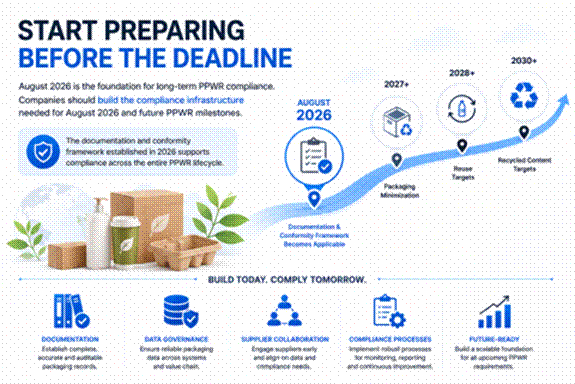
Although several PPWR obligations — including packaging minimization, recycled content targets, and reuse requirements — will be introduced progressively, 12 August 2026 marks the first major compliance milestone.
From this date, importers placing packaged products on the Dutch and EU market should be prepared to demonstrate that every consignment is backed by valid conformity evidence.
Rather than waiting until shipments are held at the border, FMCG importers should build the verification, documentation, and digital infrastructure needed to support long-term compliance.
The following seven priorities should form the foundation of every importer’s PPWR compliance strategy.
1. Verify the Manufacturer’s Conformity Assessment
Before releasing any consignment, importers should confirm that the overseas manufacturer has completed a valid packaging conformity assessment for every packaging format and material used.
For FMCG importers, this means building a standard pre-shipment verification checkpoint into procurement and logistics workflows, rather than treating it as a customs-time afterthought.
2. Confirm a Valid Declaration of Conformity (DoC) Exists
PPWR requires an EU Declaration of Conformity (DoC) confirming that packaging complies with applicable regulatory provisions.
Importers must obtain and retain a copy of the manufacturer’s DoC for every packaging type before goods are placed on the market — and must be able to produce it to Dutch and EU authorities on request. For businesses working with dozens of overseas suppliers, tracking DoCs manually across spreadsheets and email quickly becomes unmanageable.
3. Check Packaging Labelling and Marking Compliance
Imported packaging must carry the required identification markings, including batch or serial information and the responsible economic operator’s name and contact address. Where the manufacturer is outside the EU, importers must also ensure their own name and address appear on the packaging or accompanying documentation as required.
Reviewing artwork and labelling before shipment helps avoid costly relabelling or rework once goods have already left the country of origin.
4. Understand When You Become the “Manufacturer” (Article 21)
Under Article 21, an importer that places packaging or packaged products under its own brand or trademark — or that modifies packaging in a way that may affect compliance — is reclassified as the manufacturer. This shifts the full weight of conformity assessment, technical documentation, and DoC issuance onto the importer.
This is especially relevant for private-label programs, where an importer sources generic products from an overseas supplier and sells them under its own brand. Importers should map their private-label portfolio now to identify where this reclassification applies.
5. Appoint or Verify a Netherlands-Based Authorised Representative Where Needed
From 12 August 2026, PPWR makes it mandatory for foreign sellers with no establishment in the Netherlands to appoint a Netherlands-based authorised representative, legally responsible for registration, reporting, and payment of eco-fees on the importer’s behalf. Importers should confirm whether their manufacturers already have one in place and, where they do not, factor this into supplier onboarding requirements.
6. Register with Verpact, Check Thresholds, and Assess Packaging Tax Exposure
Alongside PPWR conformity checks, importers should register with Verpact and confirm whether their import volumes fall under, at, or above the 50,000 kg reporting threshold — remembering that Single-Use Plastics and deposit-return items carry no threshold at all. Importers should also determine, separately, whether they owe the Dutch packaging tax administered by the Belastingdienst, and whether any Verpact contributions already paid can offset that liability.
7. Build a Robust Packaging Data and Supplier Verification Strategy
Importer compliance depends on accurate, complete, and accessible supplier data. Many FMCG importers continue managing overseas supplier documentation across disconnected spreadsheets, email chains, freight-forwarder records, and shared drives.
As PPWR requirements expand, fragmented supplier data creates unnecessary complexity and increases the risk of releasing non-compliant packaging onto the market. A centralized packaging data and supplier verification strategy improves visibility across sourcing regions and strengthens audit readiness — and makes Verpact declarations and packaging tax reconciliation easier to manage against the same underlying packaging data.
Which FMCG Packaging Is Covered Under PPWR?
One of the most common questions FMCG importers ask is whether PPWR applies only to specific packaging materials or product categories.
The answer is simple: PPWR applies to virtually all packaging placed on the EU market, irrespective of the material used, the type of consumer product it contains, or whether the packaging was manufactured inside or outside the EU.
Whether you import packaged foods, beverages, dairy products, frozen foods, household cleaners, detergents, home care products, pet food, or personal care products, the packaging accompanying these products is generally within scope of the regulation.
For FMCG importers, compliance extends beyond consumer-facing packaging to include secondary and transport packaging used to move goods from the country of origin to the Dutch market.
Primary Packaging
Primary packaging comes into direct contact with the product and plays a vital role in preserving product quality, ensuring hygiene, extending shelf life, and enhancing consumer convenience.
PET beverage bottles
HDPE detergent bottles
Plastic tubs
Glass jars
Aluminium beverage cans
Flexible pouches
Stand-up pouches
Sachets
Food trays
Paper cartons
Aerosol cans
Plastic containers
Milk cartons
Beverage cartons
Primary packaging represents one of the largest verification areas for importers because it directly influences recyclability, material composition, recycled content, and packaging design decisions made entirely by the overseas manufacturer.
Secondary Packaging
Secondary packaging groups products together for retail presentation and distribution while providing additional protection.
Folding cartons
Multipacks
Promotional packaging
Shelf-ready packaging
Display boxes
Shrink wrap
Cardboard sleeves
Retail display units
Although secondary packaging may never come into direct contact with the product, it is still subject to PPWR requirements. Importers should include secondary packaging within their supplier verification checklists and documentation records.
Transport Packaging
Transport packaging protects goods throughout international shipping, warehousing, and distribution — a stage importers manage directly.
Corrugated shipping cartons
Stretch films
Pallets
Pallet wraps
Plastic crates
Protective inserts
Bulk transport containers
Intermediate packaging
Transport packaging often represents a significant volume of imported material and should not be overlooked when assessing PPWR obligations, particularly since importers directly control freight and logistics arrangements.
Imported Packaging — The Core of an Importer’s Compliance Scope
Because imported packaging is, by definition, an importer’s entire area of responsibility, businesses should ensure every overseas supplier provides complete compliance documentation before goods are shipped.
Typical documentation to collect includes:
Material specifications
Packaging declarations
Technical documentation
Laboratory reports
Recycled-content information
Supplier compliance statements
The manufacturer’s Declaration of Conformity
Strong supplier collaboration — including pre-shipment checklists and standardized documentation templates — is essential for maintaining complete and accurate compliance records across a global supplier base.
Does PPWR Apply to Every Packaging Material?
Yes. Importers should assess every packaging material used across their sourcing portfolio, including:
Plastic
Paper
Cardboard
Glass
Aluminium
Steel
Flexible films
Composite materials
Laminates
Multi-layer packaging
Each material presents different regulatory considerations relating to recyclability, recycled content, material composition, and future packaging design requirements. Creating a comprehensive, supplier-mapped packaging inventory is one of the first and most important steps toward PPWR compliance for importers.
PPWR introduces several interconnected obligations affecting packaging design, recyclability, and documentation. As an importer, your role is not to implement these requirements yourself but to verify — with evidence — that your overseas manufacturers already have.
1. Packaging Minimization
Packaging should contain only the amount of material necessary to protect, preserve, transport, handle, and market products safely. Although Article 10 packaging minimization requirements become applicable later in the PPWR implementation timeline, importers should begin requesting evidence from suppliers today.
2. Design for Recyclability
Packaging should be designed to facilitate efficient collection, sorting, and recycling. Importers should request recyclability assessments from manufacturers as a standard part of supplier onboarding and periodic re-verification.
3. Recycled Plastic Content
PPWR introduces phased recycled content requirements for specific plastic packaging categories. Importers should begin preparing by:
Requesting recycled-content declarations from suppliers
Verifying supporting laboratory documentation
Monitoring packaging specifications for changes
Tracking recycled-content percentages by SKU and supplier
4. Reuse and Refill
PPWR encourages increased use of reusable and refillable packaging systems where appropriate. Importers should assess whether overseas suppliers can support reuse-compatible formats as retailer and regulatory expectations evolve.
5. Substance Restrictions
Packaging materials should comply with applicable restrictions relating to substances of concern. Importers should maintain visibility, through supplier declarations, into:
Material composition
Additives
Heavy metals
Adhesives
Printing inks
Coatings
Chemical declarations
Supplier compliance statements
Early and structured supplier engagement improves transparency while reducing the risk of goods being detained at the border pending further documentation.
6. Packaging Labelling
PPWR introduces harmonized packaging labelling intended to improve recycling and waste sorting across the European Union. Importers should review supplier artwork approval processes and ensure imported packaging carries compliant labelling before shipment, including material identification, recycling instructions, and recycled-content information where applicable.
Although overseas manufacturers produce packaging components, FMCG importers remain directly responsible for ensuring packaging complies before it is placed on the Dutch and EU market for the first time.
Compliance requires collaboration across multiple business functions, including:
Procurement and Sourcing
Customs and Trade Compliance
Regulatory Affairs
Quality Assurance
Supply Chain and Logistics
Legal
Sustainability
Retailer and Customer Relations
Importers managing multiple overseas suppliers, private-label ranges, and product portfolios should establish standardized supplier verification and documentation processes across the business — before goods reach a Dutch port or warehouse.
Documentation Required for PPWR Compliance
Documentation provides the evidence supporting every packaging compliance decision. Importers should centralize documentation collected from overseas manufacturers to improve governance, visibility, and audit readiness.
Manufacturer-Issued Documentation to Collect
Declaration of Conformity (DoC)
Technical documentation
Conformity assessment records
Packaging specifications
Material composition and Bills of Materials (BOMs)
Packaging weights and dimensions
Supplier Documentation
Supplier declarations
Material certifications
Compliance statements
Laboratory reports
Recycled-content declarations
Importer-Retained Documentation
Records confirming verification checks performed
Internal compliance procedures and checklists
Corrective action records
Correspondence with the Netherlands-based authorised representative, where applicable
Verpact registration confirmation and annual packaging declarations
Recycled-content certificates and other supplier evidence supporting Verpact and packaging tax filings
Version-controlled compliance records
Maintaining structured documentation enables importers to respond quickly to customs authorities, retailer sustainability questionnaires, and market surveillance inspections while reducing administrative effort.
Building a Future-Ready PPWR Compliance Strategy for FMCG Importers
As the Packaging and Packaging Waste Regulation (PPWR) reshapes packaging compliance across Europe, FMCG importers must move beyond understanding the regulation and begin embedding supplier verification into sourcing, procurement, logistics, and customs operations.
Unlike manufacturers, FMCG importers manage relationships with overseas suppliers across multiple countries, time zones, and documentation standards — spanning thousands of SKUs, private-label programs, seasonal packaging, and retailer-specific formats. This complexity makes verification significantly more challenging than for a manufacturer with in-house production.
Achieving PPWR compliance requires more than a customs checklist — it demands centralized supplier data, standardized documentation collection, structured verification workflows, and digital processes that can scale across a global supplier base.
Organizations that invest in these capabilities today will not only be better prepared for upcoming PPWR milestones but will also reduce border delays, strengthen supplier accountability, and lower long-term compliance costs.
Common PPWR Compliance Challenges for FMCG Importers
1. Verifying Manufacturers You Don’t Directly Control
Unlike manufacturers, importers cannot simply change internal processes to fix a compliance gap — they depend entirely on overseas suppliers to generate accurate conformity assessments, technical documentation, and DoCs. Chasing corrections across time zones and language barriers slows resolution.
2. Complex, Multi-Country Supplier Networks
Packaging materials and finished goods are often sourced from multiple manufacturers across different countries, each with its own documentation standards, formats, and levels of PPWR awareness. Without standardized templates, collecting consistent compliance evidence becomes increasingly resource-intensive.
3. Fragmented Supplier Documentation
Many FMCG importers still manage supplier and packaging information across:
Freight-forwarder records
Customs broker communications
Supplier portals and email chains
Individual spreadsheets
Shared drives
Centralizing this information is essential for maintaining a single source of truth ahead of every shipment.
4. Private-Label and Article 21 Reclassification Risk
Every private-label product sourced from an overseas supplier carries a risk of being reclassified from importer to manufacturer under Article 21, shifting full conformity assessment and DoC obligations onto the importer. Without a clear mapping of which SKUs are private-label, this risk can go unnoticed until a market surveillance inspection.
5. Border Delays and Detained Consignments
Incomplete or missing conformity documentation can result in shipments being held at customs, creating costly delays and disrupting retailer delivery commitments.
6. Growing Documentation Requirements
PPWR requires importers to retain comprehensive conformity evidence for every packaging type sourced from every supplier. Managing this manually across a large supplier base often leads to:
Inconsistent records
Missing or outdated DoCs
Duplicate documentation
Increased audit preparation time
7. Preparing for Future PPWR Requirements
Many PPWR obligations will be introduced in phases over the coming years. Importers need verification systems that can adapt to future requirements relating to:
Packaging minimization
Recycled content
Design for recyclability
Reuse targets
Harmonized labelling
Extended Producer Responsibility (EPR)
Building scalable verification processes today reduces future implementation effort as more overseas suppliers come into scope.
How Digital Traceability Supports PPWR Compliance for Importers
Managing supplier verification across a global sourcing base requires connected, accurate, and continuously updated information. Digital traceability platforms help importers centralize compliance evidence while improving collaboration with overseas manufacturers, customs partners, and internal teams.
Centralized Supplier and Packaging Data
Maintain structured information relating to:
Manufacturer conformity assessments and DoCs
Packaging specifications and material composition
Packaging Bills of Materials
Product-to-packaging-to-supplier relationships
A single source of truth eliminates duplicate records and improves data accuracy across every sourcing country.
Digital Manufacturer Onboarding and Verification
Digitally onboard overseas manufacturers and collect:
Declarations of Conformity
Technical documentation
Material declarations
Laboratory reports
Recycled-content evidence
Automated reminders help reduce delays and improve documentation completeness ahead of each shipment.
Technical Documentation Management
Maintain version-controlled technical files containing engineering drawings, test reports, conformity assessment records, and Declarations of Conformity received from every manufacturer — simplifying customs checks and market surveillance inspections.
Workflow Automation
Standardize pre-shipment verification through configurable workflows that include supplier document review, compliance validation, internal approvals, and document version control — reducing manual effort while improving consistency across suppliers.
Audit and Border Readiness
Respond quickly to customs authorities, retailer sustainability questionnaires, and market surveillance inspections. Centralized documentation enables faster access to compliance evidence when a shipment is queried.
Cross-Functional Collaboration
Enable procurement, customs and trade compliance, regulatory affairs, quality assurance, and logistics teams to work from the same supplier and packaging data — improving visibility while reducing duplication across departments.
Simplify PPWR Compliance with TraceX
Managing PPWR compliance across multiple overseas manufacturers, private-label programs, and packaging formats requires a digital approach. TraceX’s PPWR Solution helps FMCG importers centralize supplier verification, streamline documentation collection, automate compliance workflows, and maintain audit-ready records from a single platform.
Whether you import packaged foods, beverages, household products, home care products, pet food, or other consumer goods, TraceX simplifies PPWR compliance across your entire supplier network.
With TraceX, FMCG Importers Can:
Centralize manufacturer DoCs and technical documentation across all suppliers
Track packaging specifications and material composition by SKU and origin country
Digitize overseas manufacturer onboarding and documentation collection
Maintain version-controlled compliance records for every shipment
Flag private-label SKUs at risk of Article 21 reclassification
Track Verpact registration status, threshold exposure, and packaging tax evidence alongside PPWR conformity records
Track recycled-content declarations and supplier evidence
Monitor packaging or supplier changes through structured workflows
Improve collaboration across procurement, customs, regulatory affairs, and quality teams
Respond quickly to customs queries, retailer requests, and market surveillance inspections
Instead of managing verification through disconnected spreadsheets and email, TraceX provides a scalable digital platform that supports continuous PPWR compliance for importers.
Conclusion
The Packaging and Packaging Waste Regulation represents one of the most significant changes to packaging compliance in recent years — and for FMCG importers, it shifts real legal responsibility onto the business bringing goods into the EU, even when packaging design decisions were made entirely overseas.
For FMCG importers bringing products into the Netherlands, compliance is no longer a matter of trusting supplier assurances — it requires rigorous verification, centralized documentation, and digital processes capable of proving conformity for every shipment.
Organizations that begin preparing now can reduce customs delays, strengthen supplier accountability, improve packaging transparency, and respond more effectively to retailer and regulatory requirements.
As the 12 August 2026 implementation milestone approaches, importers should focus on verifying manufacturer documentation, mapping private-label reclassification risk, and digitizing supplier verification workflows.
Those that adopt a proactive, digital-first approach will be well positioned not only for PPWR compliance but also for the broader transition toward sustainable, circular packaging across their supply chains.
Frequently Asked Questions
Does PPWR apply to FMCG importers in the Netherlands?
Yes. Any FMCG importer placing packaged products from outside the EU onto the Dutch or EU market for the first time must verify that the packaging complies with applicable PPWR requirements, register with Verpact regardless of volume, and retain supporting documentation.
Do importers need to issue their own Declaration of Conformity?
No. Importers do not issue their own DoC. Instead, they must verify that the non-EU manufacturer has already carried out the conformity assessment, prepared technical documentation, and issued a valid DoC before goods are placed on the market.
When does an importer become a manufacturer under PPWR?
Under Article 21, an importer that places packaging or packaged products under its own brand or trademark, or that modifies packaging in a way that may affect compliance, is reclassified as the manufacturer and takes on the full conformity assessment and documentation obligations.
Which packaging is covered under PPWR?
PPWR applies to primary, secondary, and transport packaging across materials including plastic, paper, cardboard, glass, metal, flexible films, and composite packaging — regardless of where the packaging was manufactured.
Does PPWR replace the Netherlands’ Verpact system or the packaging tax?
No. PPWR layers new EU-wide conformity obligations on top of the Netherlands’ existing framework. Importers must continue registering with Verpact where applicable, assessing their separate Dutch packaging tax exposure with the Belastingdienst, and complying with statiegeld deposit-return requirements, while also meeting PPWR’s conformity assessment, DoC, and documentation requirements. From 12 August 2026, foreign sellers must register with Verpact regardless of volume, removing the previous threshold-based exemption for non-EU businesses.
How can TraceX help with PPWR compliance for importers?
TraceX provides a centralized digital platform that streamlines overseas manufacturer verification, documentation collection, technical documentation management, conformity checks, and audit readiness — helping FMCG importers build scalable, continuous PPWR compliance processes.
Start using TraceX
Transparency, Trust, & Success for your Climate Journey.
We use cookies on our website to give you the most relevant experience by remembering your preferences and repeat visits. By clicking “Accept All”, you consent to the use of ALL the cookies. However, you may visit "Cookie Settings" to provide a controlled consent.
This website uses cookies to improve your experience while you navigate through the website. Out of these, the cookies that are categorized as necessary are stored on your browser as they are essential for the working of basic functionalities of the website. We also use third-party cookies that help us analyze and understand how you use this website. These cookies will be stored in your browser only with your consent. You also have the option to opt-out of these cookies. But opting out of some of these cookies may affect your browsing experience.
Necessary cookies are absolutely essential for the website to function properly. These cookies ensure basic functionalities and security features of the website, anonymously.
Cookie
Duration
Description
cookielawinfo-checkbox-analytics
11 months
This cookie is set by GDPR Cookie Consent plugin. The cookie is used to store the user consent for the cookies in the category "Analytics".
cookielawinfo-checkbox-functional
11 months
The cookie is set by GDPR cookie consent to record the user consent for the cookies in the category "Functional".
cookielawinfo-checkbox-necessary
11 months
This cookie is set by GDPR Cookie Consent plugin. The cookies is used to store the user consent for the cookies in the category "Necessary".
cookielawinfo-checkbox-others
11 months
This cookie is set by GDPR Cookie Consent plugin. The cookie is used to store the user consent for the cookies in the category "Other.
cookielawinfo-checkbox-performance
11 months
This cookie is set by GDPR Cookie Consent plugin. The cookie is used to store the user consent for the cookies in the category "Performance".
viewed_cookie_policy
11 months
The cookie is set by the GDPR Cookie Consent plugin and is used to store whether or not user has consented to the use of cookies. It does not store any personal data.
Functional cookies help to perform certain functionalities like sharing the content of the website on social media platforms, collect feedbacks, and other third-party features.
Performance cookies are used to understand and analyze the key performance indexes of the website which helps in delivering a better user experience for the visitors.
Analytical cookies are used to understand how visitors interact with the website. These cookies help provide information on metrics the number of visitors, bounce rate, traffic source, etc.
Advertisement cookies are used to provide visitors with relevant ads and marketing campaigns. These cookies track visitors across websites and collect information to provide customized ads.
Download the 2026 Traceability Scorecard and Benchmark Your Supply Chain Across 10 Critical Capabilities.
Download our eBook
Don’t Wait for an Audit to Find Your EUDR Gaps
The 2026 Simplification Package changes how HS codes, DDS pass-through and geolocation rules apply to you. Get the free guide and 20-point readiness checklist before enforcement catches you unprepared.