EUDR Chain of Custody: How to Build an Unbroken, Audit-Ready Trail from Plot to Port
Published
, 10 minute read
Share this article
Quick summary: Learn how to build a reliable chain of custody for EUDR compliance with this step-by-step guide. Discover best practices for traceability, batch tracking, and due diligence to protect market access and reduce compliance risks.
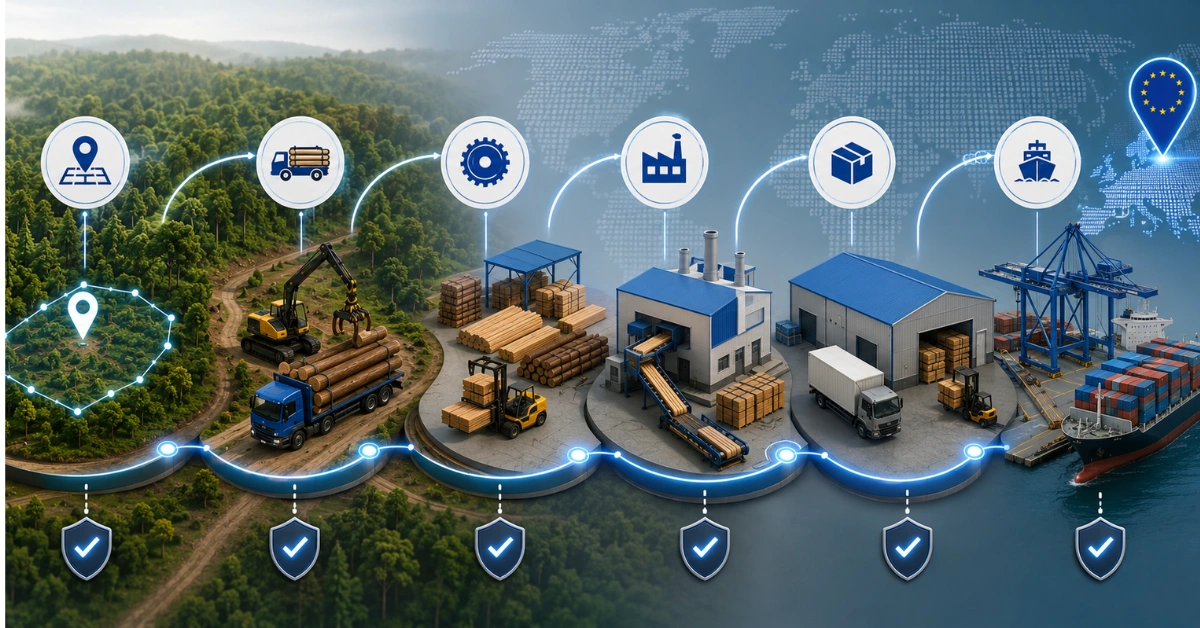
EUDR chain of custody is the documented, timestamped, tamper-evident record that tracks every custody transfer of a forest-risk commodity from the geolocated plot of origin, through aggregators, processors and exporters, to the EU importer. Under the EU Deforestation Regulation, this trail must stay unbroken: a single undocumented handoff can invalidate a shipment’s deforestation-free claim and block it at the EU border. A compliant chain links farm-level GPS coordinates and legality evidence to batch IDs at each stage, then feeds that data into a Due Diligence Statement (DDS) submitted to the EU Information System.
Key takeaways
EUDR chain of custody is a hard market-access requirement, not a sustainability nicety certifications alone do not satisfy it.
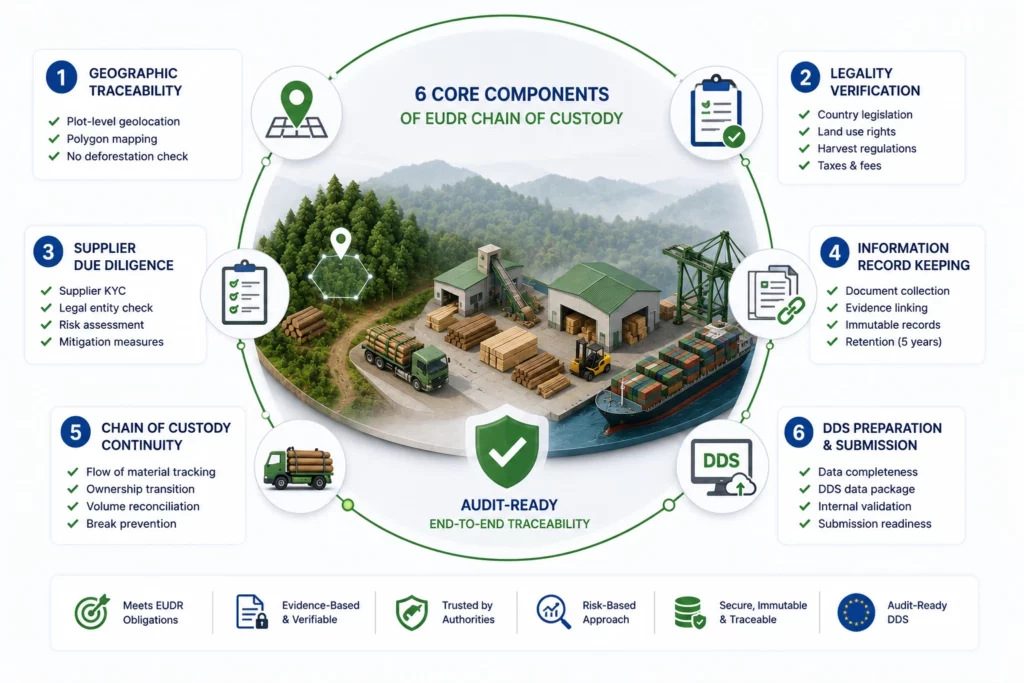
Six components make a chain of custody defensible: source identification, supplier legality checks, batch segregation, custody-transfer records, tamper-proof storage, and automated DDS generation.
The weakest point is aggregation where commodities from many plots are pooled and the link to a geolocated source is lost.
The May 2026 simplification package refined product scope and eased burden by ~[75]%, but left the geolocation, risk-assessment and DDS obligations intact.
Large and medium operators must comply by 30 December 2026; micro and small operators by 30 June 2027.
A digital chain of custody GPS-linked at source and blockchain-backed through every handoff turns “certified” into “provable.”
What EUDR Chain of Custody Really Means
An EUDR chain of custody answers one question at every handoff: can you prove exactly where this product came from, who handled it, and whether it meets the EU’s deforestation-free criteria? For agri-exporters, processors and compliance leads, that proof not the product quality is what now determines EU market access.
Under the EU Deforestation Regulation, it is no longer enough to say your supply chain is sustainable; you must demonstrate it with traceable, timestamped, tamper-proof data. The challenge is that most supply chains still run on fragmented systems, spreadsheets and trust-based verbal commitments exactly what a chain of custody cannot be built on.
Chain of custody is the backbone of compliance here is what breaks it and what a defensible trail requires.
Verbal supplier assurance does not hold up under audit.
A shared spreadsheet between middlemen is not traceable.
Certificates without origin-linked batches are not enough.
For the wider regulation, see EUDR explained and the full EUDR compliance guide.
Real-world scenario. A West African cocoa exporter believed it was compliant because every farmer was certified. When an EU buyer requested plot-level traceability with mapped geolocation for each batch, the exporter hit a wall: certifications were not linked to actual batches, farms were not geo-mapped, and no digital trail existed. The deal was lost. That is a broken chain of custody in practice and it is why the trail, not the certificate, is the asset.
EUDR Chain of Custody Requirements: The 6 Components of a Defensible Trail
1. Source identification (geolocation at the plot)
Every batch must begin with farm-level geolocation exact GPS coordinates or polygon boundaries, not a village or district name. This is the digital fingerprint that proves the commodity did not originate on land deforested after 31 December 2020. No geolocation, no entry to the EU.
Accurate geolocation data is essential for demonstrating that commodities are sourced from deforestation-free land. Learn what EUDR requires, how to collect compliant geolocation data, and common mistakes to avoid.
Are the farmers operating on legal land with recognised tenure rights, and can you validate it with documentation? This is where many chains break especially with smallholders who lack formal land titles. Even where paperwork is informal, the verification process must be recorded and traceable to the batch it supports.
EUDR requires businesses to demonstrate that commodities are not only deforestation-free but also produced in accordance with the laws of the country of origin. Learn what legality evidence you’ll need and how to build a robust due diligence process.
Each batch needs a unique identifier batch ID, QR code or token that follows the product through every handoff, from farmer to processor to shipper. Without batch-level IDs, you cannot connect farm GPS to the exported product, and the DDS cannot map a shipment to its deforestation-free source.
4. Custody-transfer records
Every time the product changes hands cooperative to processor, processor to exporter — you need a digital log: date, time, quantity, and who transferred to whom. A missing handoff is a black hole in the trail, and under EUDR one broken link can collapse the whole chain of custody.
5. Tamper-proof data storage
Collecting data is not enough; it must be stored so auditors can see it was not altered or backdated. This is why many exporters adopt blockchain-backed traceability a tamper-evident record of events that builds trust with buyers and competent authorities alike.
6. Due Diligence Statement (DDS) generation
This is the endgame. All the batch, GPS, custody and legality data feeds into an automated DDS submitted to the EU Information System for every relevant shipment. Learn how to file a DDS for EUDR. No valid DDS, no trade.
Where the Chain of Custody Breaks Under EUDR: The Aggregation Problem
When coffee, cocoa or palm oil from hundreds of plots is bulked before sale, the link back to a specific geolocated source is severed and with it, your ability to prove deforestation-free origin. Commodities routinely pass through four to six intermediaries before reaching a downstream manufacturer, and each informal handoff is a potential data gap. The fix is upstream digitisation: capture farmgate transaction data at the point of first purchase, before commodities commingle. See aggregated traceability under EUDR for the full breakdown.
How Digital Platforms Streamline Chain of Custody for EUDR
GPS & legality capture at source
Field agents collect farm GPS data on a smartphone offline where connectivity is poor verify plot boundaries against restricted zones, and link every farm to a legally recognised land document. You build buyer trust before the shipment even leaves port.
Batch-wise traceability, built in at the farmgate
Every batch gets a unique ID at collection, is instantly tied to its farm origin, and carries quality and quantity data captured on the spot. The chain of custody starts at the farmgate, not the warehouse.
Real-time custody logs and deforestation alerts
As product moves from farmer to aggregator to processor to exporter, digital logs record each handover timestamped and geotagged so the audit trail writes itself. Risk scoring flags farms near high-risk or deforested areas and triggers alerts before non-compliant product enters your chain, shifting you from reactive to proactive compliance.
One-click DDS generation with role-based access
Once GPS, legality, custody and batch data are linked, the platform auto-generates a submission-ready DDS no compiling PDFs from five systems. Exporters, processors, auditors and field agents all use one platform but see only what their role requires. For how this connects to your existing stack, see EUDR interoperability and integration.
See How a Global Tire Manufacturer Built an EUDR-Ready Chain of Custody
Discover how end-to-end traceability, digital supplier collaboration, and chain of custody management helped a leading tire manufacturer strengthen EUDR compliance and improve supply chain transparency.
TraceX EUDR Solutions is a purpose-built EUDR compliance platform that secures the chain of custody for forest-risk commodities end to end from farm-level geolocation and land-legality verification to batch-level traceability, custody transfers, and automated DDS generation. With blockchain-backed records, geospatial intelligence and mobile-first field tools, it lets exporters, processors and importers maintain an unbroken, verifiable, audit-ready chain of custody while reducing operational friction.
Geo-coordinates & import tracking — onboards raw materials with GeoJSON/polygon coordinates so every batch traces back to its source.
EUDR reporting — comprehensive reporting against any object in the supply chain, single or multiple JSONs, for internal audit and regulatory submission.
Batch compliance flagging — flags batches compliant or non-compliant by deforestation status across raw, aggregated and onboarded goods.
Rule-based restrictions — blocks sale, transfer or manufacturing of non-compliant batches so only EUDR-conforming product moves through the chain.
Agentic AI onboarding — auto-ingests supplier documents, extracts land records and KYC data, and validates/corrects polygon geometry before DDS submission. [Verify feature naming.]
See your EUDR chain of custody in action
Book a personalized demo of TraceX and watch a shipment trace from geolocated plot to submission-ready DDS with an unbroken, audit-ready chain of custody at every handoff.
EUDR Chain of Custody: A Buyer’s Evaluation Checklist
Can it capture GPS polygon boundaries for every plot, and validate GeoJSON before DDS submission?
Does it work offline for smallholder onboarding in low-connectivity regions?
Are custody transfers logged automatically timestamped, geotagged, tamper-evident?
Can it preserve plot-level traceability through aggregation, splitting and merging?
Does it generate a validated, submission-ready DDS and connect directly to the EU Information System / TRACES?
Does it retain 5 years of audit-ready records and surface them on demand?
Does it integrate with your ERP (e.g. SAP, Oracle, Microsoft Dynamics)?
Frequently Asked Questions (FAQ’s)
Why is chain of custody critical for EUDR compliance?
Because an EUDR chain of custody provides the transparent, unbroken record of how a commodity moved through the supply chain the only way to prove deforestation-free sourcing and legal land use. Without it, even a high-quality, certified shipment can be flagged, delayed or rejected at the EU border.
What should a strong chain of custody include under EUDR?
Farm-level geolocation, supplier legality evidence, batch-level identifiers, custody-transfer logs, tamper-proof storage, and automated DDS generation aligned with EU Information System requirements.
Do FSC or RSPO certifications satisfy the chain of custody?
No. Certifications support risk assessment and mitigation, but they do not replace geolocation data, plot-level evidence or the Due Diligence Statement. A certified supply chain without GPS-linked batches will still fail an EUDR audit.
How does aggregation affect the chain of custody?
Aggregation pools commodities from many plots and severs the link to a geolocated source the most common cause of a broken trail. The fix is capturing farmgate data before commodities commingle..
What changed for chain of custody under the May 2026 simplification package?
The package refined product scope and is expected to cut compliance cost by ~75%, but the core obligations geolocation, risk assessment and DDS — remain fully in place. The application dates were not delayed.
When must my chain of custody be operational?
Large and medium operators must comply from 30 December 2026; micro and small operators (outside the timber sector) from 30 June 2027. Building a digital chain of custody is a multi-month project, so the practical window is now.
How do digital platforms improve the chain of custody?
They automate traceability, centralise supplier data, and generate real-time, audit-ready reports removing the manual errors and last-minute scrambles of spreadsheet-based tracking.
Start using TraceX
Transparency, Trust, & Success for your Climate Journey.
We use cookies on our website to give you the most relevant experience by remembering your preferences and repeat visits. By clicking “Accept All”, you consent to the use of ALL the cookies. However, you may visit "Cookie Settings" to provide a controlled consent.
This website uses cookies to improve your experience while you navigate through the website. Out of these, the cookies that are categorized as necessary are stored on your browser as they are essential for the working of basic functionalities of the website. We also use third-party cookies that help us analyze and understand how you use this website. These cookies will be stored in your browser only with your consent. You also have the option to opt-out of these cookies. But opting out of some of these cookies may affect your browsing experience.
Necessary cookies are absolutely essential for the website to function properly. These cookies ensure basic functionalities and security features of the website, anonymously.
Cookie
Duration
Description
cookielawinfo-checkbox-analytics
11 months
This cookie is set by GDPR Cookie Consent plugin. The cookie is used to store the user consent for the cookies in the category "Analytics".
cookielawinfo-checkbox-functional
11 months
The cookie is set by GDPR cookie consent to record the user consent for the cookies in the category "Functional".
cookielawinfo-checkbox-necessary
11 months
This cookie is set by GDPR Cookie Consent plugin. The cookies is used to store the user consent for the cookies in the category "Necessary".
cookielawinfo-checkbox-others
11 months
This cookie is set by GDPR Cookie Consent plugin. The cookie is used to store the user consent for the cookies in the category "Other.
cookielawinfo-checkbox-performance
11 months
This cookie is set by GDPR Cookie Consent plugin. The cookie is used to store the user consent for the cookies in the category "Performance".
viewed_cookie_policy
11 months
The cookie is set by the GDPR Cookie Consent plugin and is used to store whether or not user has consented to the use of cookies. It does not store any personal data.
Functional cookies help to perform certain functionalities like sharing the content of the website on social media platforms, collect feedbacks, and other third-party features.
Performance cookies are used to understand and analyze the key performance indexes of the website which helps in delivering a better user experience for the visitors.
Analytical cookies are used to understand how visitors interact with the website. These cookies help provide information on metrics the number of visitors, bounce rate, traffic source, etc.
Advertisement cookies are used to provide visitors with relevant ads and marketing campaigns. These cookies track visitors across websites and collect information to provide customized ads.
Download the 2026 Traceability Scorecard and Benchmark Your Supply Chain Across 10 Critical Capabilities.
Download our eBook
Don’t Wait for an Audit to Find Your EUDR Gaps
The 2026 Simplification Package changes how HS codes, DDS pass-through and geolocation rules apply to you. Get the free guide and 20-point readiness checklist before enforcement catches you unprepared.