Quick summary: Economic operators under PPWR: use 10 real supply-chain scenarios to pin down your exact role and obligations before the 12 August 2026 deadline hits.
Economic operators under PPWR are the businesses the regulation assigns packaging obligations to: manufacturers, suppliers, importers, distributors, authorised representatives, final distributors and fulfilment service providers. Your obligations follow what you actually do in the supply chain not your job title or industry. A single company can hold several roles at once, and a private-label seller or brand owner is often treated as the manufacturer even when someone else physically makes the packaging
Economic operators under PPWR is the phrase that trips up almost every compliance team we speak to because the regulation assigns duties by what a company does, not by what it calls itself. The Packaging and Packaging Waste Regulation (Regulation (EU) 2025/40) applies across the EU from 12 August 2026, and it treats packaging as a chain of responsibilities rather than a single company’s problem.
A packaged product rarely comes from one place. Raw materials, packaging components, filling, branding, importing, warehousing and retail are usually spread across several organisations often in different countries. PPWR maps obligations onto each of those functions. The rule to hold onto is simple:
“Your responsibility depends on what you do, not what your company calls itself.”
This guide skips the legal definitions and walks through ten real supply-chain scenarios so you can find your own role and the roles of everyone you depend on.
Keep Selling into the EU — Compliantly
Non-compliant packaging can be pulled from EU shelves. See how TraceX gives you the evidence trail to prove conformity and protect your market access.
“Economic operator” is an umbrella term. Under Article 3, it covers manufacturers, suppliers, importers, distributors, authorised representatives, final distributors and fulfilment service providers.
Responsibility follows function, not label. What you do to the packaged product decides your obligations.
Roles stack. One legal entity can be manufacturer, importer and producer simultaneously each with its own duties.
Contracts do not transfer legal obligations. A supplier clause cannot move a manufacturer’s Declaration of Conformity duty onto someone else.
Brand owners and private-label sellers are usually manufacturers under Article 21, even without touching a production line.
PPWR applies from 12 August 2026 to every operator placing packaging on the EU market with no general SME exemption.
Understanding Economic Operators under PPWR in a Real Supply Chain
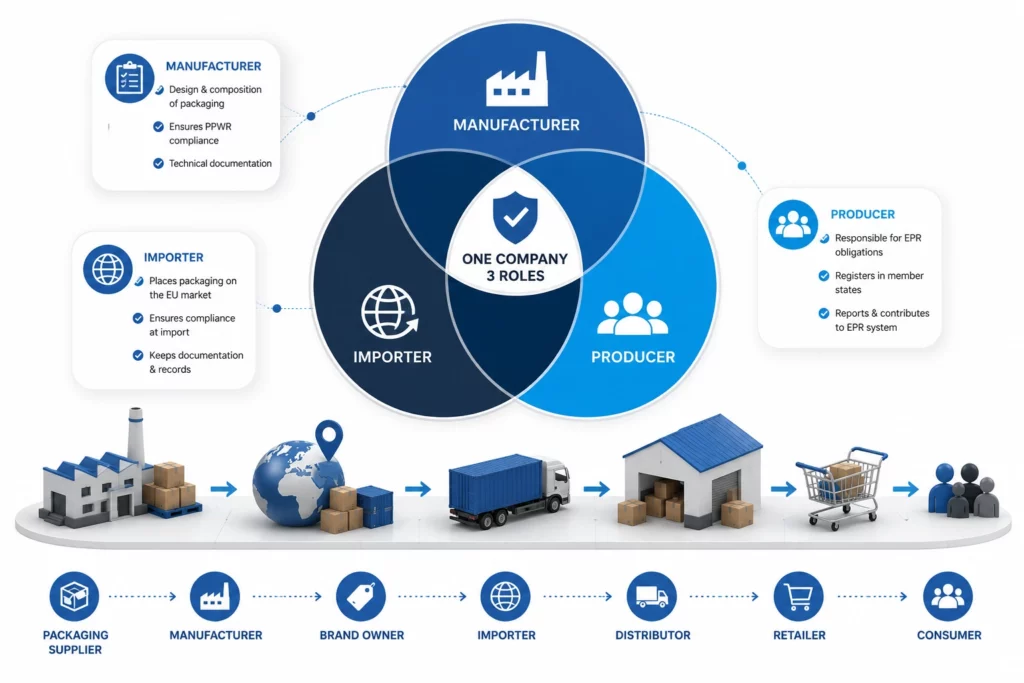
Before the scenarios, here is how the roles sit along a typical chain. One company may perform several functions, several companies may share a single obligation, and critically responsibilities do not automatically pass down the chain through purchase contracts.
The Economic Operators PPWR Recognises
PPWR draws one distinction that catches people out: the difference between a manufacturer (responsible for product conformity) and a producer (responsible for Extended Producer Responsibility registration, reporting and fees). The same business is frequently both. Here is the shorthand:
Manufacturer — makes the packaging, or has it made and markets it under its own name or trademark. Carries the heaviest duties: conformity assessment (Module A, internal production control), technical documentation, the Declaration of Conformity, and labelling.
Supplier — provides packaging or components and must hand up the data and declarations the manufacturer needs.
Importer — an EU-established operator placing third-country packaging on the EU market for the first time. Must verify the non-EU manufacturer did the conformity work before selling.
Distributor — makes packaging available further down the chain. Lighter duties: check that labels, markings and documents are present, and never knowingly sell non-compliant packaging.
Authorised representative — an EU-based entity a non-EU producer mandates to handle EPR obligations in a member state. Does not replace the manufacturer’s core compliance duties.
Fulfilment service provider — warehouses, packs, addresses and dispatches goods (typically for online sellers) and must not let handling compromise compliance.
Whether you’re a manufacturer, importer, distributor, packaging supplier, or brand owner, understanding your role is the first step toward compliance.
Economic Operators Under PPWR: 10 Real Supply-Chain Scenarios
Each scenario below states the situation, the roles in play, and the key takeaway. Match yourself to the pattern that fits most companies find they sit in two or three at once.
Scenario 1: Indian Manufacturer → German Importer → German Retailer
An Indian factory produces packaged goods. A German company imports them into the EU, and a German retailer sells them.
Manufacturer: the Indian producer physically makes the packaged product, but sits outside the EU.
Importer: the German company places the goods on the EU market first, so it must verify the manufacturer completed the conformity assessment, technical file and Declaration of Conformity.
Distributor: the German retailer checks labels and documentation and cooperates with authorities.
Key takeaway: Because the manufacturer is outside the EU, the German importer becomes the compliance gatekeeper verifying, not just receiving.
Scenario 2: Contract Manufacturer + Brand Owner
A cosmetics brand designs and sells a product but hires a third-party factory to manufacture it.
Manufacturer (in law): the brand owner, because the product goes to market under its name and trademark.
Contract manufacturer: usually a supplier it produces to spec and provides packaging data and declarations.
Documentation: the brand owner owns the Declaration of Conformity and technical file, even though it never ran the line.
Key takeaway: Marketing under your own brand makes you the manufacturer. You cannot outsource the DoC obligation with a supply contract.
Scenario 3: Private-Label Manufacturing
A retail chain launches its own-brand range, produced by an outside manufacturer and sold under the retailer’s label.
Manufacturer: the retailer, once its brand goes on the packaging this is the classic Article 21 trigger.
Original producer: steps back to a supplier role for the packaged product.
Effect: the retailer inherits conformity, documentation and labelling duties it may not have expected.
Key takeaway: Putting your brand on packaging or modifying packaging already on the market promotes you to manufacturer under Article 21.
Article 21
Where an importer or a distributor places packaging on the market under its own name or trademark or modifies packaging already placed on the market in a way that could affect compliance with the relevant requirements of this Regulation, that importer or distributor shall be considered to be a manufacturer for the purposes of this Regulation and shall be subject to the obligations of the manufacturer under Article 15.
A packaging supplier, contract manufacturer, brand owner, importer and distributor all touch one product.
Overlap: obligations layer rather than transfer each operator keeps its own slice.
Documentation: declarations and technical data must flow upward so the manufacturer can compile a complete file.
Collaboration: gaps between operators are where audits fail, so shared visibility matters.
Key takeaway: PPWR is a shared-accountability regime. The weakest documentation link exposes the whole chain.
Scenario 10: One Company Acting as Manufacturer and Importer
A German company designs a product, manufactures it outside the EU, imports it, and sells it under its own brand.
One legal entity: carries several PPWR roles at once.
Manufacturer duties: conformity assessment, technical file, Declaration of Conformity, labelling.
Importer + producer duties: verification on entry, plus EPR registration, reporting and fees.
Key takeaway: Roles stack. A single company can shoulder manufacturer, importer and producer obligations simultaneously.
Economic Operators Under PPWR: Common Misconceptions
Most non-compliance we see starts with one of these beliefs. Each is wrong under PPWR:
“My supplier handles PPWR.” Suppliers provide data; they do not carry your manufacturer or importer obligations.
“Importers have no packaging obligations.” Importers must verify conformity work and can be treated as manufacturers under Article 21.
“Packaging suppliers are responsible for all compliance.” They support compliance with data, but the packaged-product duty sits with the manufacturer.
“Contracts transfer legal obligations.” They allocate commercial risk, not statutory duties. Regulators pursue the operator, not the clause.
“Retailers are always distributors.” Own-brand or modified packaging turns a retailer into a manufacturer.
“Only manufacturers need documentation.” Importers verify and retain records; distributors and FSPs keep evidence of their checks.
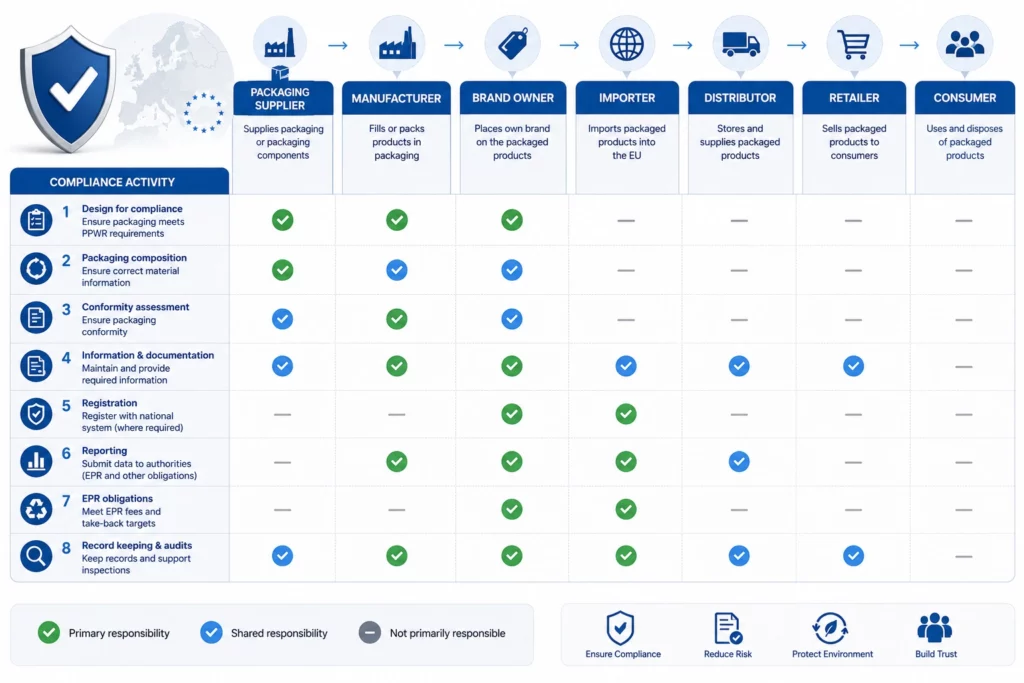
Who Is Responsible for What? The PPWR Responsibility Matrix
This matrix summarises where each economic operator’s duty sits. Use it as a first-pass allocation, then confirm against your own contracts and the current regulation.
Activity
Manufacturer
Importer
Distributor
Pkg. Supplier
Fulfilment
Technical documentation
Owns
Verify
—
Support
—
Declaration of Conformity
Owns
Verify
—
Support
—
Packaging specifications
Owns
Verify
—
Provide
—
Supplier declarations
Compile
Collect
—
Provide
—
Labelling & markings
Owns
Check
Check
Support
Preserve
EPR registration & fees
If producer
If producer
—
—
—
Handling without breaking compliance
—
Yes
Yes
—
Yes
Market-surveillance cooperation
Yes
Yes
Yes
Support
Support
“Owns” = primary legal duty. “Verify/Check” = confirm before placing/making available. “Support/Provide” = supply data. Confirm edge cases against the consolidated regulation.
Five Questions to Identify Your PPWR Role
Answer these to map yourself onto one or more economic-operator roles. Answering “yes” more than once is normal it means your roles stack.
Do you manufacture packaging or packaged products? → Manufacturer duties likely apply.
Do you place third-country goods on the EU market first? → You are an importer.
Do you sell under your own brand or trademark? → Article 21 can make you the manufacturer.
Do you change or re-package goods already on the market? → You may become the manufacturer.
Do you store, pack and ship on behalf of others? → You are a fulfilment service provider.
Why Economic Operators Under PPWR Must Collaborate
PPWR is not a single-company regulation. Because duties layer across manufacturers, packaging suppliers, importers, brand owners, distributors and logistics partners, compliance depends on data moving cleanly between organisations. When a manufacturer cannot access recycled-content figures or material declarations from a supplier, its Declaration of Conformity is exposed. When an importer cannot see the manufacturer’s technical file, it cannot verify what it is legally required to verify.
The practical problem is that legal responsibility and operational control often sit with different companies. A brand owner may be the manufacturer in law yet hold none of the packaging data. An importer may become the de facto compliance coordinator for a non-EU factory. Closing those gaps is a data and workflow challenge, not just a legal one.
The PPWR Brief to Share with Your Leadership
Need to get stakeholders aligned? This handbook gives you the risks, timelines, and requirements in a format built to drive internal decisions.
TraceX PPWR Solutions gives economic operators a shared system for the documentation PPWR demands:
Centralised packaging data so manufacturers, brand owners and importers work from one source of truth.
Supplier collaboration workflows that pull material declarations and recycled-content data up the chain.
Technical documentation management with version control and audit-ready records.
Packaging traceability and cross-company visibility across every operator that touches a SKU.
Compliance workflows mapped to each role’s duties, so nothing falls between organisations.
Frequently Asked Questions (FAQ’s)
Can one company be both a manufacturer and an importer under PPWR?
Yes. If a company designs or brands a product, has it made outside the EU, and then imports it, that single entity holds manufacturer, importer and often producer roles at the same time each with its own obligations.
Who is responsible if products are contract manufactured?
Usually the brand owner. If the product is marketed under your name or trademark, PPWR treats you as the manufacturer, and you own the Declaration of Conformity and technical file even though a third party runs the line.
Does PPWR apply to packaging suppliers?
Packaging suppliers are generally not the economic operator for the packaged product, but they are essential data providers. They must supply material declarations and technical information the manufacturer needs to prove conformity.
Can contracts transfer PPWR responsibilities?
No. Contracts allocate commercial risk between companies, but statutory obligations stay with the operator the regulation names. Authorities enforce against the responsible economic operator, not against a contract clause.
Who is responsible for imported products?
The EU-established importer that first places the goods on the EU market. It must verify the non-EU manufacturer completed the conformity assessment, technical documentation and Declaration of Conformity before selling.
Does Amazon become responsible for PPWR?
Marketplaces are not automatically the economic operator, but they must monitor and verify that their sellers meet PPWR duties. The seller as importer and often manufacturer keeps the underlying obligations.
How do I determine my PPWR role?
Start from what you do, not what you’re called. Work through the five questions above: manufacture, import, own-brand selling, re-packaging, and fulfilment each map to a role and most companies match more than one.
Start using TraceX
Transparency, Trust, & Success for your Climate Journey.
We use cookies on our website to give you the most relevant experience by remembering your preferences and repeat visits. By clicking “Accept All”, you consent to the use of ALL the cookies. However, you may visit "Cookie Settings" to provide a controlled consent.
This website uses cookies to improve your experience while you navigate through the website. Out of these, the cookies that are categorized as necessary are stored on your browser as they are essential for the working of basic functionalities of the website. We also use third-party cookies that help us analyze and understand how you use this website. These cookies will be stored in your browser only with your consent. You also have the option to opt-out of these cookies. But opting out of some of these cookies may affect your browsing experience.
Necessary cookies are absolutely essential for the website to function properly. These cookies ensure basic functionalities and security features of the website, anonymously.
Cookie
Duration
Description
cookielawinfo-checkbox-analytics
11 months
This cookie is set by GDPR Cookie Consent plugin. The cookie is used to store the user consent for the cookies in the category "Analytics".
cookielawinfo-checkbox-functional
11 months
The cookie is set by GDPR cookie consent to record the user consent for the cookies in the category "Functional".
cookielawinfo-checkbox-necessary
11 months
This cookie is set by GDPR Cookie Consent plugin. The cookies is used to store the user consent for the cookies in the category "Necessary".
cookielawinfo-checkbox-others
11 months
This cookie is set by GDPR Cookie Consent plugin. The cookie is used to store the user consent for the cookies in the category "Other.
cookielawinfo-checkbox-performance
11 months
This cookie is set by GDPR Cookie Consent plugin. The cookie is used to store the user consent for the cookies in the category "Performance".
viewed_cookie_policy
11 months
The cookie is set by the GDPR Cookie Consent plugin and is used to store whether or not user has consented to the use of cookies. It does not store any personal data.
Functional cookies help to perform certain functionalities like sharing the content of the website on social media platforms, collect feedbacks, and other third-party features.
Performance cookies are used to understand and analyze the key performance indexes of the website which helps in delivering a better user experience for the visitors.
Analytical cookies are used to understand how visitors interact with the website. These cookies help provide information on metrics the number of visitors, bounce rate, traffic source, etc.
Advertisement cookies are used to provide visitors with relevant ads and marketing campaigns. These cookies track visitors across websites and collect information to provide customized ads.
Download the 2026 Traceability Scorecard and Benchmark Your Supply Chain Across 10 Critical Capabilities.
Download our eBook
Don’t Wait for an Audit to Find Your EUDR Gaps
The 2026 Simplification Package changes how HS codes, DDS pass-through and geolocation rules apply to you. Get the free guide and 20-point readiness checklist before enforcement catches you unprepared.