
Understanding ILPA compliance is essential for businesses bringing timber flooring into Australia. By implementing robust documentation, traceability, and risk assessment processes, flooring importers can minimise compliance risks and strengthen confidence in their supply chains.
Sourcing flooring from global suppliers can open new business opportunities but it also introduces hidden compliance risks. With flooring products often containing multiple timber species, engineered and multi-layer constructions, and materials sourced from different countries, obtaining complete supply chain information can be a major challenge for importers.
Many businesses struggle with missing species data, inconsistent supplier records, and limited visibility into the origin of the timber used in finished flooring products. These gaps can make it difficult to meet Australia’s Illegal Logging Prohibition Act (ILPA) requirements and demonstrate that proper due diligence has been conducted.
Key Takeaways
If you import flooring into Australia, the Illegal Logging Prohibition Act (ILPA) requires importers to conduct due diligence to minimise the risk that illegally harvested timber enters the Australian market. Flooring products containing regulated timber components require careful supplier documentation, species information, country-of-harvest details, and strong traceability practices. Maintaining complete records is essential for demonstrating compliance.
What Is the Illegal Logging Prohibition Act (ILPA)?
Australia’s Illegal Logging Prohibition Act (ILPA) is designed to reduce the risk of illegally harvested timber entering the Australian market. The legislation applies to businesses importing regulated timber products and requires them to conduct due diligence before supplying those products in Australia.
The objectives of ILPA include:
- Preventing illegal logging from entering supply chains.
- Supporting sustainable and responsible forest management.
- Promoting fair competition for legitimate suppliers.
- Strengthening confidence in timber sourcing practices.
Due diligence is a core requirement under ILPA. Importers are expected to understand their supply chains, identify potential risks, and collect information that supports the legality of the timber used in their products.
ILPA requirements may evolve over time, so businesses should regularly review guidance issued by the Australian Government to ensure their compliance processes remain current.
ILPA Compliance for Flooring Importers
ILPA applies to flooring imports into Australia when the products contain regulated timber materials. Timber flooring is one of the more common regulated product categories, and is available in a range of constructions that each carry their own traceability considerations.
Flooring products commonly include timber components such as:
- Solid hardwood flooring boards.
- Engineered timber flooring (a hardwood wear layer over a plywood or HDF core).
- Laminate flooring (an HDF or MDF core with a decorative surface layer).
- Parquet and mosaic flooring.
- Bamboo and other wood-based flooring products.
Because flooring manufacturing often involves global supply chains, a single product may contain several wood species sourced from multiple countries. For example, an engineered oak board may have an oak wear layer harvested in one country, a plywood core manufactured in another country, and final assembly carried out elsewhere. This complexity makes traceability and documentation particularly important.
To meet ILPA requirements, flooring importers should understand:
- Which timber species are present in the product.
- The scientific and common names of those species.
- The country where the timber was harvested.
- The country where processing or manufacturing took place.
- The suppliers and manufacturers involved throughout the supply chain.
- Any supporting documentation that demonstrates the legality of the timber source.
Obtaining this information can sometimes be challenging, particularly when importing engineered or multi-layer flooring products manufactured from materials sourced across several suppliers. Incomplete species information, mixed-origin materials, and limited visibility beyond direct suppliers are common challenges faced by flooring importers.
Applicable customs tariff (HS) classifications vary depending on the type of flooring and the materials used in its construction. Solid timber flooring, engineered flooring, laminate flooring, and parquet may fall under different classifications. Importers should verify current HS codes and regulatory requirements with the relevant Australian authorities. Some products, such as certain bamboo flooring, may also warrant confirmation, as bamboo is botanically a grass rather than a timber but is frequently combined with wood-based backing and adhesives.
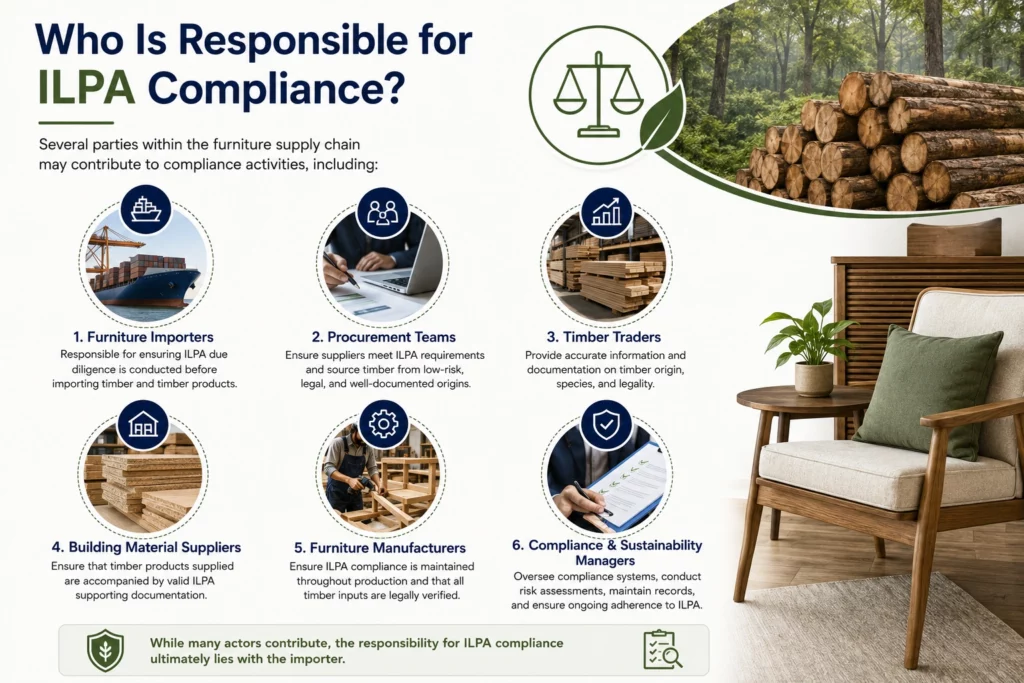
Ultimately, if a flooring product contains regulated timber components, importers are responsible for conducting appropriate due diligence and maintaining records that demonstrate compliance with Australia’s illegal logging framework.
What Information Must Importers Collect?
Effective due diligence under Australia’s Illegal Logging Prohibition Act relies on gathering accurate and complete information about suppliers, products, and the origin of timber materials. For flooring importers, collecting this information is essential because finished products may contain multiple wood components sourced from different countries and suppliers.
The more transparent and traceable the supply chain, the easier it becomes to assess risks and demonstrate compliance with ILPA requirements.
Supplier Information
Importers should first identify the businesses involved in supplying and manufacturing the flooring products. Understanding who is involved in the supply chain helps establish accountability and supports traceability.
Key supplier information typically includes:
- Supplier identity and company details.
- Manufacturer name and location, where applicable.
- Country of harvest where the timber originated.
- Country of processing or manufacturing.
- Contact information for suppliers and production facilities.
- Information about subcontractors or upstream suppliers, if available.
For flooring manufactured through multiple stages, importers may need information from more than one supplier to obtain a complete picture of the supply chain.
Product Information
Importers should also collect detailed information about the flooring products themselves. Product-level information helps identify the timber materials used and enables businesses to assess potential risks associated with particular species or sourcing regions.
Important product information may include:
- Scientific (botanical) names of timber species.
- Common names used by suppliers or manufacturers.
- Product descriptions and ranges.
- Type of flooring and its construction (solid, engineered, or laminate).
- Wood components contained within the product, including wear layer and core.
- Quantity, area, or volume being imported.
Scientific species names are particularly important because common names can vary between countries and may refer to multiple species. Accurate species identification improves risk assessments and helps avoid confusion.
Harvest Information
Information relating to the original source of the timber provides evidence that the materials were legally harvested. Depending on the complexity of the supply chain and the country of origin, the type of documentation available may differ.
Supporting evidence may include:
- Forest concession or harvesting licence information.
- Harvest permits issued by relevant authorities.
- Transport or export documentation.
- Invoices and purchase records.
- Chain of custody documentation.
- FSC or PEFC certification documents, where available.
- Supplier declarations and legality statements.
While certifications and chain of custody systems can provide valuable supporting information, they should be viewed as part of the overall due diligence process rather than a substitute for it.
Why Information Quality Matters
The effectiveness of ILPA due diligence depends not only on collecting documents but also on ensuring the information is complete, accurate, and consistent across the supply chain.
Common issues that can create compliance challenges include:
- Missing species information.
- Conflicting country-of-origin details.
- Incomplete supplier records.
- Lack of evidence supporting legal harvest.
- Limited visibility beyond direct suppliers.
Maintaining high-quality information enables flooring importers to perform more effective risk assessments, respond to audits more efficiently, and build greater confidence in the integrity of their timber supply chains.
Learn what information importers need to collect, why it matters, and how to build a more transparent and audit-ready timber supply chain.
Read the Complete Guide to ILPA Information Collection →
ILPA Due Diligence Requirements for Flooring
Step 1 – Gather supplier documentation
Obtain relevant information from suppliers regarding timber species used, country of harvest, processing locations, and supporting legality documents.
Step 2 – Assess country and species risks
Evaluate whether particular countries, species, or supply chain structures present increased risk, including tropical hardwoods commonly used in flooring.
Step 3 – Evaluate legality evidence
Review all available documentation to determine whether sufficient evidence supports legal harvesting and processing.
Step 4 – Determine whether additional mitigation is required
Where risks remain or information is incomplete, additional documentation or supplier verification may be necessary.
Step 5 – Maintain records
Maintain organised and accessible records demonstrating that due diligence has been conducted. Records should be retained for the period required under applicable regulations.
Explore the ILPA due diligence process, understand your obligations, and learn how to build a more transparent and defensible timber supply chain.
Read the Complete Guide to ILPA Due Diligence →
Common Challenges Faced by Flooring Importers
Flooring supply chains are often more complex than those for many other timber products. A single flooring product may contain multiple wood layers, engineered components, and materials sourced from several countries before reaching Australia. This complexity can make it difficult for businesses to obtain complete information and maintain the level of traceability required for ILPA compliance.
Below are some of the most common challenges faced by flooring importers.
Engineered and Multi-Layer Products
Many flooring products are not made from a single piece of timber. Engineered boards typically combine a hardwood wear layer with a plywood or HDF core, and laminate flooring is built on a fibreboard core with a decorative surface.
Because each layer may have a different species and origin, importers may need to identify and document several materials within a single board, including:
- The species used in the hardwood wear layer.
- The timber used in the plywood core.
- The fibre used in HDF or MDF cores.
This layered construction makes it more difficult to collect complete species and origin information.
High-Risk and Tropical Hardwood Species
Flooring is frequently made from tropical hardwoods such as merbau, acacia, and various tropical oak species. Some of these species, or the regions they come from, may be associated with higher risk under due diligence frameworks.
This makes accurate species identification and origin verification especially important, as higher-risk species typically require stronger supporting evidence to demonstrate legal harvest.
Multiple Suppliers Across Different Regions
Flooring manufacturers often source raw materials from several suppliers located in different countries. Timber may be harvested in one country, processed in another, and assembled into finished flooring elsewhere.
This multi-country sourcing model can create challenges such as:
- Inconsistent documentation standards.
- Language barriers.
- Varying levels of supplier transparency.
- Different regulatory environments.
- Delays in obtaining information from overseas suppliers.
As supply chains become more global, maintaining complete records across all suppliers becomes increasingly challenging.
Limited Visibility Beyond Tier-One Suppliers
Many importers have strong relationships with their direct manufacturers but limited insight into upstream suppliers. In some cases, manufacturers purchase materials from multiple sub-suppliers without providing detailed origin information.
This lack of visibility can make it difficult to:
- Identify the original country of harvest.
- Confirm the species used in each layer.
- Verify whether appropriate legality documentation exists.
- Assess risks associated with upstream sourcing practices.
Without transparency beyond tier-one suppliers, businesses may struggle to perform comprehensive due diligence.
Incomplete Species Information
Obtaining accurate species information is one of the most common challenges for flooring importers. Suppliers may provide only generic descriptions such as:
- “Hardwood.”
- “Mixed tropical timber.”
- “Oak engineered.”
- “Laminate.”
However, ILPA due diligence often requires more precise information, including scientific species names. Common names can differ between countries and may refer to several species, creating confusion and increasing compliance risk. Missing or inaccurate species information can delay shipments, complicate risk assessments, and make it harder to demonstrate compliance.
Increased Compliance and Documentation Burdens
These supply chain complexities can make evidence collection significantly more time-consuming. Importers may need to request additional documents, follow up with multiple suppliers, and reconcile conflicting information before completing their due diligence assessments.
Common consequences include:
- Increased administrative workload.
- Delays in gathering required information.
- Greater risk of incomplete records.
- Challenges during audits or compliance reviews.
- Reduced confidence in supply chain transparency.
As regulatory expectations continue to evolve, many flooring importers are investing in stronger traceability processes and digital recordkeeping systems to improve visibility across their supply chains and simplify ILPA compliance.
Can Certifications Help with ILPA Compliance?
Certification programs such as:
- FSC.
- PEFC.
- Chain of Custody certifications.
can provide useful supporting evidence during the due diligence process.
Certification may help businesses:
- Improve supply chain transparency.
- Strengthen responsible sourcing programs.
- Facilitate document collection.
However, certifications support due diligence but do not replace the importer’s obligations under ILPA. Importers remain responsible for assessing risks and ensuring adequate evidence has been collected.
Common ILPA Compliance Mistakes
Common mistakes include:
- Missing species information.
- Documenting only the wear layer and overlooking the core.
- Incomplete supplier records.
- Assuming certifications alone are sufficient.
- Lack of traceability across supply chains.
- Poor document retention practices.
These issues can make it difficult to demonstrate compliance during audits or reviews.
How Traceability Supports ILPA Compliance
For flooring importers, compliance with Australia’s Illegal Logging Prohibition Act extends beyond simply collecting documents. Businesses must be able to demonstrate where timber materials originated, how they moved through the supply chain, and what evidence supports their legality. This is where traceability becomes critical.
Because flooring products often contain multiple timber species, engineered components, and materials sourced from several countries, maintaining visibility across the supply chain can be challenging. Digital traceability systems help businesses organise information, improve transparency, and simplify ongoing compliance activities.
Supplier Data Management
Effective traceability begins with maintaining accurate supplier information. Flooring importers frequently work with numerous manufacturers, distributors, and material suppliers across different regions.
A structured traceability approach helps businesses:
- Maintain up-to-date supplier records.
- Store manufacturer and processing facility information.
- Track relationships between suppliers and products.
- Improve visibility across multi-tier supply chains.
Centralising supplier data reduces reliance on spreadsheets and emails while making information easier to access when needed.
Document Collection and Storage
ILPA due diligence requires importers to gather and maintain a variety of supporting documents. Without a consistent process, records can become fragmented across multiple systems and departments.
Digital traceability helps businesses:
- Collect documents from suppliers more efficiently.
- Store records in a centralised location.
- Organise documentation by supplier, shipment, or product.
- Reduce the risk of missing or duplicated files.
- Improve collaboration between procurement and compliance teams.
Having documents readily available also helps businesses respond faster to information requests and internal reviews.
Species and Origin Tracking
One of the most challenging aspects of flooring compliance is understanding the timber content within finished products. A single board may contain several wood species across its wear layer and core, sourced from different countries.
Traceability systems can help businesses:
- Record scientific and common species names.
- Track countries of harvest and processing.
- Link timber species to specific products and layers.
- Monitor mixed-origin materials across complex supply chains.
Improved species and origin visibility supports more effective risk assessments and helps businesses identify potential compliance gaps earlier.
Evidence Management
Collecting documents is only one part of due diligence. Importers must also be able to demonstrate that they have evaluated and maintained evidence supporting legal harvest and sourcing.
Traceability strengthens evidence management by enabling businesses to:
- Associate supporting documents with individual products or suppliers.
- Maintain historical records.
- Monitor incomplete information.
- Track updates and changes over time.
- Ensure evidence remains accessible for future reviews.
This structured approach helps create a stronger and more defensible compliance process.
Audit Readiness
When documentation is scattered across emails, shared drives, and spreadsheets, preparing for audits or compliance reviews can be time-consuming and stressful.
Traceability improves audit readiness by:
- Providing quick access to records.
- Demonstrating that due diligence processes have been followed.
- Creating a clear history of supplier interactions and evidence collection.
- Reducing the administrative effort required during audits.
Businesses with well-organised traceability systems are often better positioned to respond to regulatory inquiries and demonstrate compliance with confidence.
Reducing Administrative Burdens
Beyond supporting compliance, traceability can improve operational efficiency. Instead of repeatedly requesting the same information from suppliers or manually searching for documents, businesses can access information through a centralised system.
Benefits may include:
- Reduced manual data entry.
- Faster document retrieval.
- Improved collaboration between teams.
- Greater supply chain transparency.
- Increased confidence in sourcing decisions.
As flooring supply chains continue to grow in complexity, digital traceability has become an important tool for helping importers manage risk, strengthen supplier relationships, and support ongoing ILPA compliance efforts.
How TraceX Helps Flooring Importers Simplify ILPA Compliance
TraceX ILPA Solutions helps flooring importers manage ILPA requirements through:
- Supplier onboarding.
- Evidence collection.
- Centralised document management.
- Multi-tier traceability capabilities.
- Compliance workflows.
- Audit-ready recordkeeping.
For flooring importers managing diverse product ranges and multiple suppliers, TraceX helps organise critical information and improve visibility across the supply chain without disrupting existing procurement processes.
Explore the key requirements of Australia’s Illegal Logging Prohibition Act and learn how businesses can build more transparent and compliant timber supply chains.
Read the Complete Guide to ILPA Compliance →
Learn how supply chain traceability supports ILPA compliance and why transparency is becoming increasingly important for timber importers.
Read the Guide to Supply Chain Traceability in ILPA →
Discover how ILPA risk assessments work and the practical steps importers can take to identify and mitigate potential risks.
Read the Complete Guide to ILPA Risk Assessment →
Frequently Asked Questions
Does ILPA apply to flooring imports into Australia?
Yes. Flooring products containing regulated timber materials may be subject to ILPA requirements. Importers should understand the timber content within their products, including both the wear layer and core of engineered and laminate flooring, and conduct appropriate due diligence.
What documents are required for ILPA compliance?
Typical information may include supplier details, country of harvest information, country of processing information, scientific and common species names, product descriptions, quantity information, and supporting legality evidence and certificates where available. Importers should verify current requirements using Australian Government guidance.
Are FSC and PEFC certifications enough for ILPA compliance?
No. FSC, PEFC, and Chain of Custody certifications support due diligence but do not replace the importer’s legal obligations under ILPA.
How long should ILPA records be retained?
Records should be retained for the period specified under applicable regulations. Businesses should confirm current requirements with relevant Australian authorities.
What happens if importers fail to conduct due diligence?
Failure to conduct due diligence may expose businesses to regulatory consequences and increased supply chain risks. Maintaining robust documentation and traceability processes helps businesses demonstrate compliance efforts.