PPWR Compliance for Pharma Importers India: Your EU Readiness Guide
Published
, 8 minute read
Share this article
Quick summary: PPWR Compliance for Pharma Importers India: what Regulation (EU) 2025/40 means for exporters, the Declaration of Conformity you need, and how to stay EU-ready.
PPWR Compliance for Pharma Importers India is the set of packaging obligations that apply when Indian pharmaceutical companies ship medicines into the EU under Regulation (EU) 2025/40, in force since 12 August 2026. The legal “importer” sits inside the EU, but the design, documentation and data behind every carton, blister pack and shipper trace back to the Indian exporter so real readiness starts in India.
Key takeaways
PPWR (Regulation (EU) 2025/40) has applied in full since 12 August 2026 to all packaging placed on the EU market, regardless of origin.
An “importer” under Article 3(17) is EU-established; Indian pharma firms are non-EU manufacturers/producers whose EU partners will push the evidence burden upstream.
Article 21 reclassifies any EU importer or distributor selling under its own brand as a manufacturer obligating them (and, in practice, you) to produce a Declaration of Conformity and Annex VII technical file.
Two separate authorised-representative roles exist product-conformity (Art. 17) and EPR (Art. 45(3)) and confusing them is the costliest mistake non-EU sellers make.
What PPWR Compliance for Pharma Importers India Actually Means
PPWR Compliance for Pharma Importers India begins with one uncomfortable fact: the Packaging and Packaging Waste Regulation is an EU law, but its consequences land squarely on Indian pharmaceutical exporters.
In plain terms, the PPWR Regulation (EU) 2025/40 is the directly applicable EU rulebook governing every piece of packaging placed on the European market, and it has applied in full since 12 August 2026. For an Indian pharma business, PPWR Compliance for Pharma Importers India means proving that the packaging around your finished-dose products primary blister and bottle packs, secondary cartons and leaflets, and tertiary shippers meets EU design, documentation and reporting rules before your EU importer can legally sell it.
The pain is immediate: your EU customers now ask for a signed Declaration of Conformity and a supporting technical file for the packaging you supply. Without that evidence, consignments stall at customs, get held by market-surveillance authorities, or are quietly de-listed by buyers who cannot carry your compliance risk. Treating packaging as an afterthought is no longer viable for exporters serving Europe.
PPWR Is Here. Is Your Packaging Compliance-Ready? → Read More
Why PPWR Compliance for Pharma Importers India Falls on Your EU Chain
PPWR Compliance for Pharma Importers India is shared across a chain of legally defined roles and understanding who holds which obligation is how you protect your shipments.
Here is how the roles break down:
Importer (Article 3(17)): an operator established in the EU that places third-country packaging on the market. Your EU distributor or subsidiary not you legally holds this role.
Manufacturer by reclassification (Article 21): any importer or distributor that sells packaging under its own name or brand becomes the manufacturer and must run the conformity assessment and sign the Declaration of Conformity so your EU partner pushes the evidence burden straight back to you.
Product-conformity representative (Article 17): optional for non-EU manufacturers, one mandate covers the whole EU, and this representative can hold the Annex VII technical file and act as the market-surveillance contact.
EPR authorised representative (Article 45(3)): mandatory in each member state where you are a producer selling to end users; handles producer registration (for example, Germany’s LUCID) and packaging-volume reporting.
The benefit of mapping this early is control. When you know exactly which document your EU importer will demand, PPWR Compliance for Pharma Importers India becomes a supply step you can plan for you supply the evidence on day one instead of scrambling under a purchase-order hold, the difference between a smooth clearance and a frozen container.
PPWR Roles Explained: Know Your Compliance Responsibilities → Explore the Guide
Most Indian pharma exporters treat PPWR as their EU buyer’s problem. The exporters who win keep contracts do the opposite they hold plot-level packaging specifications, supplier evidence and Declarations of Conformity in one auditable record their EU partners can pull on request. The TraceX platform is built to centralise that packaging and compliance data across suppliers and SKUs [pending product-team sign-off], so PPWR Compliance for Pharma Importers India becomes a document you can produce, not a fire you fight.
Core PPWR Compliance Requirements Indian Pharma Exporters Must Meet
PPWR Compliance for Pharma Importers India rests on a documentation core plus a set of packaging-design duties that now apply to medicines packaging too.
Declaration of Conformity (Annex VIII): a signed statement that each packaging type meets PPWR; the responsible operator must keep it for 5 years (single-use) or 10 years (reusable) from the date of placing on the market.
Technical documentation (Annex VII): the underlying file specifications, material composition, test evidence that the Declaration of Conformity rests on. Annex VII and Annex VIII are not interchangeable.
Design for recycling: packaging must be designed to be recyclable, with recyclability performance grades phasing in through implementing acts.
Minimisation and empty space: packaging must be reduced to the minimum necessary; empty space in grouped, transport and e-commerce packaging must not exceed 40%.
Substances of concern: their presence must be minimised, with specific restrictions (for example on PFAS in food-contact packaging) that exporters should monitor for pharma primary packs.
Recycled content and labelling: recycled-content thresholds apply to plastic components, and harmonised material-identification and separate-collection labels arrive via a marking implementing act.
The proof that this is enforceable is already here: the European Commission published its PPWR guidance document in June 2026, clarifying operator roles and reinforcing that the manufacturer often the brand owner or filler owns the conformity assessment. For Indian exporters, that is you or your EU brand partner, which is why PPWR Compliance for Pharma Importers India is a supply-chain data problem before it is a paperwork problem.
For pharma importers in India, TraceX PPWR Solutions can help build a structured PPWR compliance workflow by centralising packaging and supplier data, collecting material composition and recyclability information, managing technical documentation and supplier declarations, and maintaining packaging records across SKUs. It can also support compliance validation, gap identification and audit-ready evidence, helping importers move away from fragmented spreadsheets, emails and documents.
To see how packaging specifications, supplier evidence and Declarations of Conformity sit in one auditable record
PPWR Compliance for Pharma Importers India: Manual Process vs. TraceX Platform
PPWR Compliance for Pharma Importers India can be run on spreadsheets and email but the gap between manual effort and a connected platform shows the moment an EU buyer or authority asks for evidence.
Task
Manual approach
TraceX platform
Declaration of Conformity
Chased over email per SKU; versions drift
Generated from a single source of packaging data
Annex VII technical file
Scattered across suppliers and inboxes
Consolidated, versioned and audit-ready per packaging type
Supplier evidence
Manual follow-ups; no status visibility
Centralised supplier data capture with gap flags
Buyer / authority request
Days of assembly under a shipment hold
Records surfaced on demand for market surveillance
Multi-market EPR
Tracked country-by-country in silos
Reporting data organised by member state and role
How to Evaluate Your PPWR Compliance for Pharma Importers India Readiness
Before you invest in tooling, use this buyer-evaluation checklist to pressure-test where your PPWR Compliance for Pharma Importers India actually stands and what a compliance platform should do for you:
Have you mapped which EU entity is the legal importer for each destination market?
Can you produce a signed Declaration of Conformity (Annex VIII) for every packaging type on request?
Is your Annex VII technical file complete specifications, materials and test evidence and versioned?
Have you appointed the right representatives (Art. 17 for conformity, Art. 45(3) for EPR) where required?
Do you know your empty-space, recyclability and substances-of-concern status per SKU?
Can you retrieve five- or ten-year retention records without a scramble?
Does your system connect supplier evidence to the finished packaging you export?
If you answered “no” more than twice, PPWR Compliance for Pharma Importers India is currently a risk you are carrying, not a control you own and that is exactly the gap a purpose-built platform closes.
Frequently Asked Questions
Does PPWR apply to Indian pharma exporters if the importer is in the EU?
Yes. PPWR governs all packaging placed on the EU market regardless of origin. While the legal importer must be EU-established, your EU partner will contractually require the Declaration of Conformity and technical file for the packaging you supply, so the obligation flows back to you.
What is the deadline for PPWR compliance?
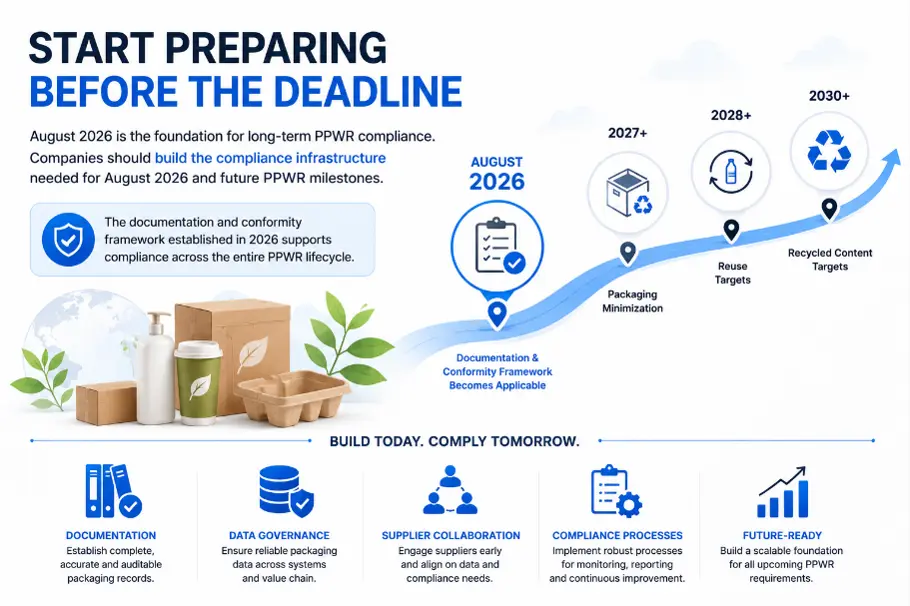
The core of Regulation (EU) 2025/40 has applied since 12 August 2026. Several specific obligations such as reuse targets, recycled-content thresholds and harmonised labelling phase in on later dates through 2030 and beyond via implementing and delegated acts.
Is pharmaceutical packaging exempt from PPWR?
No broad exemption applies. Pharma packaging is in scope; a limited number of format-specific derogations exist and must be confirmed with regulatory counsel. Medicine-safety and serialisation constraints do not remove packaging from PPWR’s design and documentation duties.
Do we need an authorised representative in the EU?
Potentially two. A product-conformity representative under Article 17 is optional and covers the whole EU. An EPR authorised representative under Article 45(3) is mandatory in each member state where you are a producer selling to end users.
What is the difference between Annex VII and Annex VIII?
Annex VII is the technical documentation the underlying evidence file. Annex VIII is the Declaration of Conformity template the signed statement that rests on that file. They are separate documents and cannot be substituted for one another.
How long must we keep the Declaration of Conformity?
The responsible operator must retain the Declaration of Conformity for 5 years for single-use packaging and 10 years for reusable packaging, measured from the date the packaging was placed on the EU market.
How can TraceX help with PPWR compliance for pharma importers India?
The TraceX platform centralises packaging specifications, supplier evidence, Declarations of Conformity and technical files in one auditable record your EU partners can access on request turning a reactive scramble into a repeatable, defensible process.
Start using TraceX
Transparency, Trust, & Success for your Climate Journey.
We use cookies on our website to give you the most relevant experience by remembering your preferences and repeat visits. By clicking “Accept All”, you consent to the use of ALL the cookies. However, you may visit "Cookie Settings" to provide a controlled consent.
This website uses cookies to improve your experience while you navigate through the website. Out of these, the cookies that are categorized as necessary are stored on your browser as they are essential for the working of basic functionalities of the website. We also use third-party cookies that help us analyze and understand how you use this website. These cookies will be stored in your browser only with your consent. You also have the option to opt-out of these cookies. But opting out of some of these cookies may affect your browsing experience.
Necessary cookies are absolutely essential for the website to function properly. These cookies ensure basic functionalities and security features of the website, anonymously.
Cookie
Duration
Description
cookielawinfo-checkbox-analytics
11 months
This cookie is set by GDPR Cookie Consent plugin. The cookie is used to store the user consent for the cookies in the category "Analytics".
cookielawinfo-checkbox-functional
11 months
The cookie is set by GDPR cookie consent to record the user consent for the cookies in the category "Functional".
cookielawinfo-checkbox-necessary
11 months
This cookie is set by GDPR Cookie Consent plugin. The cookies is used to store the user consent for the cookies in the category "Necessary".
cookielawinfo-checkbox-others
11 months
This cookie is set by GDPR Cookie Consent plugin. The cookie is used to store the user consent for the cookies in the category "Other.
cookielawinfo-checkbox-performance
11 months
This cookie is set by GDPR Cookie Consent plugin. The cookie is used to store the user consent for the cookies in the category "Performance".
viewed_cookie_policy
11 months
The cookie is set by the GDPR Cookie Consent plugin and is used to store whether or not user has consented to the use of cookies. It does not store any personal data.
Functional cookies help to perform certain functionalities like sharing the content of the website on social media platforms, collect feedbacks, and other third-party features.
Performance cookies are used to understand and analyze the key performance indexes of the website which helps in delivering a better user experience for the visitors.
Analytical cookies are used to understand how visitors interact with the website. These cookies help provide information on metrics the number of visitors, bounce rate, traffic source, etc.
Advertisement cookies are used to provide visitors with relevant ads and marketing campaigns. These cookies track visitors across websites and collect information to provide customized ads.
Download the 2026 Traceability Scorecard and Benchmark Your Supply Chain Across 10 Critical Capabilities.
Download our eBook
Don’t Wait for an Audit to Find Your EUDR Gaps
The 2026 Simplification Package changes how HS codes, DDS pass-through and geolocation rules apply to you. Get the free guide and 20-point readiness checklist before enforcement catches you unprepared.