PPWR Compliance for Packaging Suppliers: The 2026 Data Handover Playbook
Published
, 13 minute read
Share this article
Quick summary: PPWR compliance for packaging suppliers: supply substance, recyclability & recycled-content data your brand-owner customers need to sign their DoC.
PPWR compliance for packaging suppliers means giving your brand-owner customers the verified evidence they need to sign an EU Declaration of Conformity for every packaging unit they place on the EU market. Under Regulation (EU) 2025/40, which generally applies from 12 August 2026, the party whose brand appears on the packaging is the “manufacturer” and holds the legal duty. But that declaration is only as good as the data underneath it substance and PFAS results, recycled-content figures, recyclability assessments and minimisation evidence and that data lives with you, the supplier. In practice, suppliers who can hand over structured, traceable, audit-ready packaging data keep their shelf space. Suppliers who send back PDFs and spreadsheets risk being de-selected.
PPWR compliance for packaging suppliers has quietly become one of the most commercially loaded phrases in your customer relationships and most suppliers only feel it when the data requests start arriving. In plain terms, the PPWR is the EU Packaging and Packaging Waste Regulation, Regulation (EU) 2025/40, a directly applicable law that replaces the 30-year-old Packaging Directive (94/62/EC) and generally applies from 12 August 2026 across all 27 member states. It moves packaging compliance from the back end of the product lifecycle (what happens to waste) to the front end (what has to be proven before packaging reaches the shelf).
For a packaging supplier, that shift lands squarely on your desk. Your customers the brand owners whose name sits on the pack are the legal “manufacturer” under the regulation. They must draw up and sign a Declaration of Conformity. But they cannot substantiate a single claim in that declaration without evidence from you. This guide breaks down exactly what PPWR compliance for packaging suppliers involves, what is enforceable on 12 August 2026, and how to turn the data handover from a fire drill into a competitive advantage.
Key takeaways
The DoC duty sits with your customer the data duty sits with you. PPWR compliance for packaging suppliers is fundamentally a data-handover job, not a paperwork job.
12 August 2026 is a market-access gate, not a reporting deadline. Packaging without a valid Declaration of Conformity cannot legally be placed on the EU market.
What bites first: substances of concern. PFAS and heavy-metal limits (Article 5) and minimisation (Article 10) are enforceable from day one; recyclability grades and recycled-content targets phase in later via delegated acts.
Data quality is now a commercial lever. EPR fees are eco-modulated on recyclability, so buyers reward suppliers whose data is clean and validated.
Spreadsheets don’t scale to per-SKU evidence. A traceability platform turns scattered supplier proof into an Annex VII technical file and an Annex VIII declaration on demand.
Discover how TraceX Packaging Data Management Platform centralizes packaging specifications, supplier documentation, technical dossiers, and compliance evidence into a single source of truth helping you prepare for PPWR with confidence.
Why PPWR compliance for packaging suppliers starts with a wall of customer data requests
The first sign of PPWR compliance for packaging suppliers is rarely a regulator. It’s an email from procurement at one of your biggest accounts asking for material breakdowns, PFAS test results and recyclability data per SKU, in a format you’ve never used, with a deadline attached. Here’s why that is happening and why it escalates fast.
The duty flows upstream to you even though the signature isn’t yours.
The evidence bar is higher than anything the old Packaging Directive asked for.
Every packaging format not every product line needs its own file.
Your customers can’t sign the declaration without supplier evidence
Under Article 39 of the PPWR, the manufacturer must draw up a written Declaration of Conformity confirming the packaging meets the applicable requirements in Articles 5 to 12. The practical test for who the manufacturer is: if the brand on the packaging is theirs, the duty is theirs. That means your brand-owner customer signs and becomes personally liable but the declaration rests on a technical file built almost entirely from your data. No supplier evidence, no valid declaration; no valid declaration, no market access. That is why PPWR compliance for packaging suppliers has become a gating condition for keeping the account.
The substances-of-concern squeeze: PFAS and heavy metals under Article 5
The requirement that bites first is chemical. Article 5 restricts substances of concern in packaging including heavy metals and PFAS with specific attention to food-contact packaging. To let their customer declare packaging free from restricted PFAS and heavy metals, suppliers typically need to supply test results, often from ISO/IEC 17025-accredited laboratories, plus full material composition breakdowns. If you supply food-contact formats, expect the scrutiny to be sharpest here, because the declaration is only defensible if the underlying substance evidence is complete and current.
What’s enforceable on 12 August 2026 versus what phases in later
Not everything lands at once, and knowing the sequence protects you from over- or under-preparing. A Declaration of Conformity issued for 12 August 2026 primarily rests on Article 5 (substance restrictions), Article 10 (minimisation, assessed qualitatively) and, where relevant, Article 11 (reusability). The heavier lifts recyclability graded by class and recycled-content targets fold into the declaration later as delegated acts and design-for-recycling criteria are finalised. For suppliers, the message is simple: get substance, minimisation and material data airtight now, and build the pipes to add recyclability and recycled-content evidence as those rules land.
What PPWR compliance for packaging suppliers actually requires: structured, traceable evidence
Meeting PPWR compliance for packaging suppliers isn’t about writing a longer email back. It’s about holding packaging data in a structure that can be validated, versioned and exported into the exact documents your customers’ declarations depend on. Three capabilities separate suppliers who clear the deadline from those who scramble.
A single source of truth for every packaging format’s composition.
Supplier-side capture of substance, recycled-content and recyclability evidence.
One-click generation of the technical file and declaration inputs.
A single source of truth for packaging composition data
The core failure mode is scatter: composition data in one team’s spreadsheet, lab reports in an inbox, recycled-content claims in a PDF from a sub-supplier. PPWR demands a level of data structure well beyond previous standards, because the requirement operates per packaging unit, not per product. TraceX PPWR Solutions centralises material breakdowns, construction details and compliance status for every format so that when a customer asks “prove this pack meets Article 5,” the answer is a query, not an archaeology project
Supplier-side evidence capture: substances, recycled content and recyclability
The declaration your customer signs references specific evidence, and each type has to be collectable and defensible. That includes substance and PFAS test results (ideally from accredited labs), material composition data, recycled-content figures traced back to their source, and recyclability assessments. Because much of this originates with your own upstream sub-suppliers, this is really a two-sided data problem for the supplier you collect proof from below and you hand proof up. A platform built for supply-chain traceability captures both directions in one chain of custody, so a recycled-content claim can be traced to the batch it came from rather than asserted on trust.
Generating audit-ready technical documentation (Annex VII and Annex VIII)
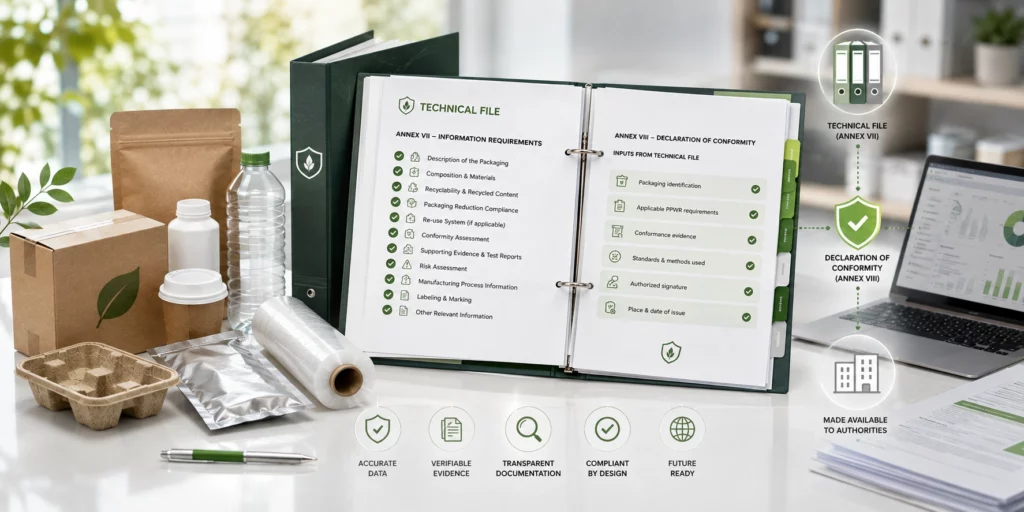
The Declaration of Conformity is short. The technical file underneath it is the real work. The PPWR conformity route for most packaging is Module A internal production control (Article 38 and Annex VII), with the declaration’s mandatory elements set out in Annex VIII. That means the supplier who wins is the one who can produce, on demand, a complete Annex VII technical file and the inputs for an Annex VIII declaration material breakdowns, substance results, minimisation and (as they apply) recyclability and recycled-content evidence. Doing that from spreadsheets for hundreds of formats is where teams lose weeks. Doing it from a system that already holds validated proof is where PPWR compliance for packaging suppliers stops being a bottleneck.
How PPWR compliance for packaging suppliers turns into commercial advantage
Handled defensively, PPWR compliance for packaging suppliers is a cost. Handled well, it’s a moat. The suppliers who make their customers’ declarations easy to sign become the hardest to replace and they protect margin in the process.
Becoming the preferred, audit-ready supplier
When a brand owner is choosing between two functionally identical packaging formats, the tie-breaker is increasingly “which supplier can hand me clean, audit-ready data today?” Procurement is now the owner of the conformity record; a supplier who reduces that team’s workload becomes strategically sticky. Fast, structured data delivery is no longer a nice-to-have it is a selection criterion, and it is where PPWR compliance for packaging suppliers converts directly into retained and expanded accounts.
Protecting your customers’ EPR fee position through data quality
Extended Producer Responsibility fees under PPWR are eco-modulated modulated on recyclability performance. Brand owners who cannot substantiate recyclability or recycled-content claims with validated supplier data face higher fees and audit exposure. That makes your data quality a lever on their cost base. A supplier who delivers traceable, validated recyclability and recycled-content evidence helps customers earn lower eco-modulated fees, which is a benefit you can put a number against in a renewal conversation.
Collect once, reuse everywhere
The teams that clear the deadline treat the technical file as a living dossier and collect proof once so it feeds multiple obligations PPWR, CSRD reporting and customer audits from the same validated source. For a supplier serving many brand owners, each with slightly different templates, a single well-structured data core is what makes PPWR compliance for packaging suppliers repeatable across the whole customer base instead of a per-account project every time.
TraceX helps packaging suppliers simplify PPWR compliance by centralizing packaging specifications, material composition, technical documentation, supplier declarations, and compliance records in a single AI-powered platform. The solution enables suppliers to manage packaging configurations, maintain version-controlled product data, organize technical dossiers and Declarations of Conformity, and securely share compliance information with customers. By digitizing packaging data and streamlining collaboration, TraceX helps packaging suppliers respond faster to customer requests, reduce manual effort, and deliver audit-ready packaging compliance with confidence.
Manual approach vs. TraceX-enabled approach
What the customer needs
Manual / spreadsheet workflow
TraceX workflow
Per-SKU composition data
Rebuilt by hand from emails and files each time it’s requested
Held once per format; returned as a query
PFAS / heavy-metal proof (Art. 5)
Lab PDFs hunted down in inboxes, version unclear
Test results linked to the format and batch, always current
Recycled-content evidence
Asserted from sub-supplier claims, hard to trace
Traced to source batch via chain of custody
Annex VII technical file
Assembled manually, days per format
Exported on demand from validated data
Annex VIII declaration inputs
Re-keyed per customer template
Generated to the required fields, reused across accounts
Audit / update readiness
Reactive scramble when authorities or customers ask
Living dossier, producible on short notice
See how TraceX Solutions turns scattered packaging evidence into audit-ready Annex VII files and declaration inputs your customers can sign without a follow-up email.
Buyer’s evaluation checklist: choosing a PPWR data platform as a packaging supplier
If you’re evaluating tools to operationalise PPWR compliance for packaging suppliers, score each option against the criteria below. Anything that can’t tick most of these will leave you back in spreadsheets by the second audit cycle.
☐ Holds packaging data per format/unit, not just per product line
☐ Captures substance and PFAS evidence and links it to accredited lab reports
☐ Traces recycled-content and recyclability claims to a source batch (chain of custody)
☐ Exports an Annex VII technical file and Annex VIII declaration inputs on demand
☐ Collects evidence from your upstream sub-suppliers, not just from you
☐ Retains documentation to the 5-year / 10-year requirement with version history
☐ Reuses one validated data core across many customer templates
☐ Flags phase-in items (recyclability grades, recycled-content targets) as they become effective
Frquently Asked Questions (FAQ’s)
Does the PPWR Declaration of Conformity obligation fall on the packaging supplier or the brand owner?
The Declaration of Conformity duty sits with the “manufacturer” under the PPWR, that is generally the party whose brand appears on the packaging, i.e. your brand-owner customer, per Article 39. As the supplier, your obligation is to provide the underlying evidence (substance results, composition, recycled content, recyclability) that makes their declaration defensible. One exception: if you place packaging on the EU market under your own name, you may be the manufacturer for those items. Confirm your specific role with legal counsel.
When does PPWR compliance for packaging suppliers become mandatory?
The PPWR (Regulation (EU) 2025/40) generally applies from 12 August 2026, after an 18-month transition from its 11 February 2025 entry into force. From that date, packaging placed on the EU market needs a valid Declaration of Conformity, so your customers will need your data well before then. Note: a proposed delay to January 2027 was under discussion at the time of writing verify the current date before relying on it.
Which PPWR requirements are enforceable on day one versus later?
A declaration issued for 12 August 2026 primarily rests on Article 5 (substance restrictions, including PFAS and heavy metals), Article 10 (minimisation) and, where relevant, Article 11 (reusability). Recyclability graded by class and recycled-content targets phase in later through delegated acts and design-for-recycling criteria, and fold into the declaration as they take effect.
What data will my customers ask me to provide?
Typically: full material composition per packaging format; substance and PFAS test results (often from ISO/IEC 17025-accredited labs, especially for food-contact packaging); recycled-content figures traceable to source; recyclability assessments; and minimisation evidence. Each is an input to the technical file (Annex VII) behind the declaration.
How long does PPWR technical documentation need to be kept?
Retention runs from the last time the packaging is placed on the market: five years for single-use packaging and ten years for reusable packaging. Because the file must stay current and be producible on short notice, most teams keep it in a system rather than in static documents.
Can I meet PPWR requirements with spreadsheets?
For a handful of formats, possibly. At scale it breaks down, because PPWR operates per packaging unit and demands data structure, versioning and traceability beyond what spreadsheets sustain particularly when recycled-content and recyclability claims must trace to a source batch and when the same evidence has to feed many customer templates. This is why suppliers move to a traceability platform.
How does PPWR data quality affect my customers’ costs and my position?
EPR fees under PPWR are eco-modulated on recyclability, so brand owners who can substantiate recyclability and recycled content with validated data pay less. Suppliers who deliver that quality of data help customers lower fees and reduce audit exposure a concrete, quantifiable reason to keep and expand the relationship.
Start using TraceX
Transparency, Trust, & Success for your Climate Journey.
We use cookies on our website to give you the most relevant experience by remembering your preferences and repeat visits. By clicking “Accept All”, you consent to the use of ALL the cookies. However, you may visit "Cookie Settings" to provide a controlled consent.
This website uses cookies to improve your experience while you navigate through the website. Out of these, the cookies that are categorized as necessary are stored on your browser as they are essential for the working of basic functionalities of the website. We also use third-party cookies that help us analyze and understand how you use this website. These cookies will be stored in your browser only with your consent. You also have the option to opt-out of these cookies. But opting out of some of these cookies may affect your browsing experience.
Necessary cookies are absolutely essential for the website to function properly. These cookies ensure basic functionalities and security features of the website, anonymously.
Cookie
Duration
Description
cookielawinfo-checkbox-analytics
11 months
This cookie is set by GDPR Cookie Consent plugin. The cookie is used to store the user consent for the cookies in the category "Analytics".
cookielawinfo-checkbox-functional
11 months
The cookie is set by GDPR cookie consent to record the user consent for the cookies in the category "Functional".
cookielawinfo-checkbox-necessary
11 months
This cookie is set by GDPR Cookie Consent plugin. The cookies is used to store the user consent for the cookies in the category "Necessary".
cookielawinfo-checkbox-others
11 months
This cookie is set by GDPR Cookie Consent plugin. The cookie is used to store the user consent for the cookies in the category "Other.
cookielawinfo-checkbox-performance
11 months
This cookie is set by GDPR Cookie Consent plugin. The cookie is used to store the user consent for the cookies in the category "Performance".
viewed_cookie_policy
11 months
The cookie is set by the GDPR Cookie Consent plugin and is used to store whether or not user has consented to the use of cookies. It does not store any personal data.
Functional cookies help to perform certain functionalities like sharing the content of the website on social media platforms, collect feedbacks, and other third-party features.
Performance cookies are used to understand and analyze the key performance indexes of the website which helps in delivering a better user experience for the visitors.
Analytical cookies are used to understand how visitors interact with the website. These cookies help provide information on metrics the number of visitors, bounce rate, traffic source, etc.
Advertisement cookies are used to provide visitors with relevant ads and marketing campaigns. These cookies track visitors across websites and collect information to provide customized ads.
Download the 2026 Traceability Scorecard and Benchmark Your Supply Chain Across 10 Critical Capabilities.
Download our eBook
Don’t Wait for an Audit to Find Your EUDR Gaps
The 2026 Simplification Package changes how HS codes, DDS pass-through and geolocation rules apply to you. Get the free guide and 20-point readiness checklist before enforcement catches you unprepared.