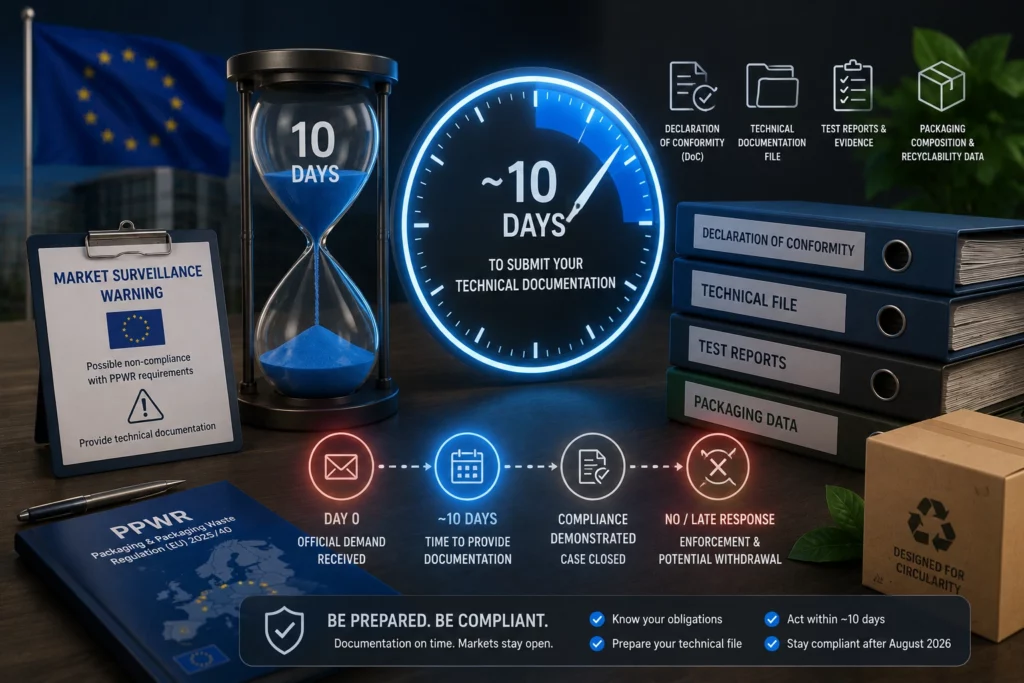
Quick summary: PPWR compliance after August 2026 is a retrieval test: authorities warn first, then demand your DoC and technical file within days. Here is how to be ready.
PPWR compliance enforcement post August 2026 is enforced through market surveillance, not a one-off deadline check. From 12 August 2026, authorities across the EU can act under Regulation (EU) 2019/1020 spot checks, cross-border alerts, and customs signals without needing a complaint. The European Commission’s updated guidance (4 August 2026) confirms a warning-first approach: operators get a chance to correct non-compliance before any prohibition, recall or withdrawal. But the correction window is short, and authorities can demand your full technical documentation in a matter of days. The catch is the penalty gap: the rules bite now, yet most Member States will not finalise fine levels until 12 February 2027. The real exposure is not the fine it is whether you can retrieve a valid Declaration of Conformity on request.
Key takeaways
Enforcement is live, penalties are not. The obligations apply from 12 August 2026; Member States have until 12 February 2027 to set fines so the first year is a warning-and-withdrawal regime.
You get a warning, then a clock. The Commission’s 4 August 2026 guidance requires a warning and corrective-action window before harder measures but the window is measured in days.
Old stock is safe; new stock is not. Packaging produced but not yet placed before 12 August need not be destroyed or relabelled. Anything newly placed after the date must comply, with no grace period.
Retrieval beats perfection. The decisive test is whether you can produce a DoC and technical file fast not whether your packaging was flawless.
Download the Free Declaration of Conformity (DoC) Template
What PPWR Compliance After August 2026 Really Means
PPWR compliance after August 2026 means being able to demonstrate, on demand, that every packaging type you place on the EU market meets the EU Packaging and Packaging Waste Regulation Regulation (EU) 2025/40. The regulation entered into force on 11 February 2025 and applies from 12 August 2026. Because it is a regulation, not a directive, it took effect the same day in all 27 member states, with no national transposition, no country-by-country timing, and no grace period for newly placed stock.
The 12 August date is often described as a deadline. That framing is misleading. It is the day enforcement powers switch on. From then, market-surveillance authorities can test your packaging whenever they choose, and what PPWR compliance after August 2026 actually tests is not whether your packaging is beautiful it is whether you can prove it is compliant, quickly, when someone asks.
Get ahead of PPWR compliance before the gaps become a problem.
Read our PPWR Compliance Readiness Guide for August to understand what you should be reviewing now—from packaging materials and component-level data to supplier documentation, labelling and technical compliance records.
Why PPWR Compliance After August 2026 Is a Retrieval Test
Most operators prepared for a design problem. The surprise is that PPWR compliance after August 2026 behaves far more like a retrieval test: an authority sends a request, a clock starts, and your outcome depends on how fast you can pull the right documents. Three features of the enforcement regime explain why.
The Enforcement Regime Is Warning-First
In guidance updated on 4 August 2026, the European Commission was explicit that enforcement should not disrupt trade flows, supply chains or consumer access to goods. So the first thing PPWR compliance after August 2026 asks of you is not a fine it is a response. An operator that is found non-compliant should first receive a warning and an opportunity to take corrective action; only if the problem persists can a member state prohibit, recall or withdraw the packaging. That sounds forgiving, and at the edges it is. But a warning is not a pause. It is the start of a countdown you either beat with evidence or lose.
Authorities Can Demand Your Technical File in Days
Market surveillance under the PPWR runs on Regulation (EU) 2019/1020, the EU’s horizontal enforcement framework. Authorities do not need a complaint: they can run spot checks, act on notifications from another member state, or respond to a signal from customs at the port of entry. When they ask for your technical documentation, you have a short window commonly cited as around ten days to produce it. In practice, PPWR compliance after August 2026 is decided inside that window. If your Declaration of Conformity and its technical file are scattered across inboxes and shared drives, you will not assemble them in time, and the warning escalates.
From material composition and packaging specifications to conformity assessments, supplier data and compliance records, having the right documentation in place is critical for demonstrating compliance.
Read our guide on PPWR Technical Documentation to understand what needs to be documented, what evidence you should maintain, and how to prepare for PPWR compliance.
The Penalty Gap Hides the Real Risk
Here is the part that lulls teams into waiting: the regulation requires penalties to be effective, proportionate and dissuasive, but it leaves the actual amounts to member states, most of which have until 12 February 2027 to legislate them. There is no EU-wide cap. Because the headline fines are not yet fixed, PPWR compliance after August 2026 can feel low-stakes through the first months. It is not. Withdrawal from the market, blocked shipments at customs and lost retail listings all arrive on the enforcement timeline, not the penalty timeline well before any fine schedule is published.
What Triggers a PPWR Compliance Check After August 2026
Enforcement clusters around three failures. Any one of them can trigger a check on your PPWR compliance after August 2026 and start the corrective clock:
A missing or invalid Declaration of Conformity. Every packaging type placed on the market must be covered by a DoC drawn up against the Annex VIII model, declaring conformity with Articles 5 to 12. No DoC, no lawful placement.
A substance breach. Heavy metals above the combined 100 mg/kg limit, or PFAS in food-contact packaging above 25 ppb for any single substance, are restricted from 12 August 2026. PFAS exceedances are treated as immediate market-exclusion issues.
A labelling or identification failure. Each packaging unit must carry the required identification and producer details under Article 12 whether printed, via QR code, or in accompanying documents.
One nuance saves a lot of panic: existing stock. The Commission has confirmed that packaging already produced but not yet placed on the market by 12 August 2026 does not have to be destroyed, remanufactured or relabelled. Stock already placed before the date may generally be sold through, though sell-through rules vary by member state. The hard line is new placement: anything you put on the market after 12 August must comply.
Treat PPWR compliance after August 2026 as a retrieval problem, not a paperwork problem. The teams that struggle are the ones who spent the run-up perfecting packaging and filing PDFs, then discover during a market-surveillance request that they cannot connect a specific SKU to its specific DoC, test report and technical file inside a ten-day window. The teams that breeze through are the ones who built one source of truth where every packaging type links to its own evidence so answering an authority is a query, not a fire drill. In an enforcement regime that warns first and fines later, speed of proof is the whole game.
PPWR Enforcement Readiness: Spreadsheets vs. a Single Data Layer
The reality of PPWR compliance after August 2026 is that it rewards retrieval speed over everything else. Here is how the two operating models hold up when a market-surveillance request lands with a ten-day clock attached.
When an authority asks…
Spreadsheets & shared drives
Single data layer (TraceX platform)
“Show the DoC for this SKU”
Hunt across folders; hope it is the latest version
One click from SKU to its signed Annex VIII DoC
“Produce the technical file”
Reassemble from emails; days of scramble
Technical file linked and version-controlled per packaging type
“Prove the PFAS / heavy-metal test”
Chase the supplier again
Substance evidence attached to each SKU on file
“Do it within ten days”
Often impossible at portfolio scale
Retrievable in minutes, audit-ready
“Now do it for EPR, DPP, CSRD too”
Rebuild separately per regulation
Same foundation feeds every framework at once
TraceX PPWR Solutions helps businesses generate compliant PPWR Declarations of Conformity (DoCs) by centralising packaging, material, supplier and compliance data in one platform. The system can consolidate the required information, check it against applicable PPWR compliance requirements, identify missing data or documentation, and use the validated information to automate DoC generation. This reduces manual consolidation across spreadsheets and documents while creating a consistent, traceable record of the information supporting each declaration.
See the TraceX platform link every packaging type to its DoC, technical file and test evidence so a market-surveillance request becomes a two-minute query, not a ten-day scramble.
Is every unit’s Article 12 labelling / identification confirmed?
Labelling gaps are a standalone enforcement trigger.
5
Do you know which stock is “already placed” vs “newly placed”?
You may destroy compliant stock or place non-compliant stock by mistake.
Frequently Asked Questions (FAQ’s)
What does PPWR compliance after August 2026 require?
PPWR compliance after August 2026 requires that every packaging type placed on the EU market has a valid Declaration of Conformity (Annex VIII, Articles 5–12), a supporting technical file, evidence it meets substance limits (heavy metals and PFAS), and correct Article 12 labelling all retrievable on request. From 12 August 2026 these are enforced by market-surveillance authorities, not checked once at a deadline.
Are there fines for PPWR non-compliance yet?
Not fixed ones in most countries. The regulation requires penalties to be effective, proportionate and dissuasive, with no EU-wide cap, but leaves amounts to member states most of which have until 12 February 2027 to legislate them. Before then, the real consequences are prohibition, withdrawal, blocked customs clearance and lost listings, which do not wait for a fine schedule.
What happens the moment my packaging is found non-compliant?
Under the Commission’s August 2026 guidance, you should first receive a warning and an opportunity to correct the issue before any prohibition, recall or withdrawal. The window is short, and authorities can request your full technical documentation in a matter of days. If you cannot produce it and fix the issue, the authority can escalate to withdrawal.
Do I have to destroy or relabel existing stock?
No. The Commission has clarified that packaging produced but not yet placed on the market by 12 August 2026 does not have to be destroyed, remanufactured or relabelled. Stock already placed before the date may generally be sold through, though sell-through rules vary by member state. Only new placement after 12 August must comply.
How do market-surveillance authorities actually enforce PPWR?
Through Regulation (EU) 2019/1020, the EU’s horizontal market-surveillance framework. Authorities can run spot checks, act on cross-border notifications, or respond to customs signals without a complaint. The three most common triggers are a missing or invalid DoC, a substance breach, and a labelling or identification failure.
Is 12 August 2026 the only deadline I need to worry about?
No. It is the first hard enforcement date, but the PPWR phases in for years. Tightened recyclability grades and minimum recycled-content thresholds arrive around 2030, and some EPR-related labelling starts from 12 February 2027. Treat it as the start of an enforcement regime, not the end of a project.
How should I get ready for PPWR compliance after August 2026 at scale?
Build one source of truth where each packaging type links to its DoC, technical file and test evidence, so a market-surveillance request becomes a query rather than a scramble. A single structured data layer that stores specs, generates DoCs and links supplier evidence is how operators make the ten-day window a non-event.
Start using TraceX
Transparency, Trust, & Success for your Climate Journey.
We use cookies on our website to give you the most relevant experience by remembering your preferences and repeat visits. By clicking “Accept All”, you consent to the use of ALL the cookies. However, you may visit "Cookie Settings" to provide a controlled consent.
This website uses cookies to improve your experience while you navigate through the website. Out of these, the cookies that are categorized as necessary are stored on your browser as they are essential for the working of basic functionalities of the website. We also use third-party cookies that help us analyze and understand how you use this website. These cookies will be stored in your browser only with your consent. You also have the option to opt-out of these cookies. But opting out of some of these cookies may affect your browsing experience.
Necessary cookies are absolutely essential for the website to function properly. These cookies ensure basic functionalities and security features of the website, anonymously.
Cookie
Duration
Description
cookielawinfo-checkbox-analytics
11 months
This cookie is set by GDPR Cookie Consent plugin. The cookie is used to store the user consent for the cookies in the category "Analytics".
cookielawinfo-checkbox-functional
11 months
The cookie is set by GDPR cookie consent to record the user consent for the cookies in the category "Functional".
cookielawinfo-checkbox-necessary
11 months
This cookie is set by GDPR Cookie Consent plugin. The cookies is used to store the user consent for the cookies in the category "Necessary".
cookielawinfo-checkbox-others
11 months
This cookie is set by GDPR Cookie Consent plugin. The cookie is used to store the user consent for the cookies in the category "Other.
cookielawinfo-checkbox-performance
11 months
This cookie is set by GDPR Cookie Consent plugin. The cookie is used to store the user consent for the cookies in the category "Performance".
viewed_cookie_policy
11 months
The cookie is set by the GDPR Cookie Consent plugin and is used to store whether or not user has consented to the use of cookies. It does not store any personal data.
Functional cookies help to perform certain functionalities like sharing the content of the website on social media platforms, collect feedbacks, and other third-party features.
Performance cookies are used to understand and analyze the key performance indexes of the website which helps in delivering a better user experience for the visitors.
Analytical cookies are used to understand how visitors interact with the website. These cookies help provide information on metrics the number of visitors, bounce rate, traffic source, etc.
Advertisement cookies are used to provide visitors with relevant ads and marketing campaigns. These cookies track visitors across websites and collect information to provide customized ads.
Download the 2026 Traceability Scorecard and Benchmark Your Supply Chain Across 10 Critical Capabilities.
Download our eBook
Don’t Wait for an Audit to Find Your EUDR Gaps
The 2026 Simplification Package changes how HS codes, DDS pass-through and geolocation rules apply to you. Get the free guide and 20-point readiness checklist before enforcement catches you unprepared.