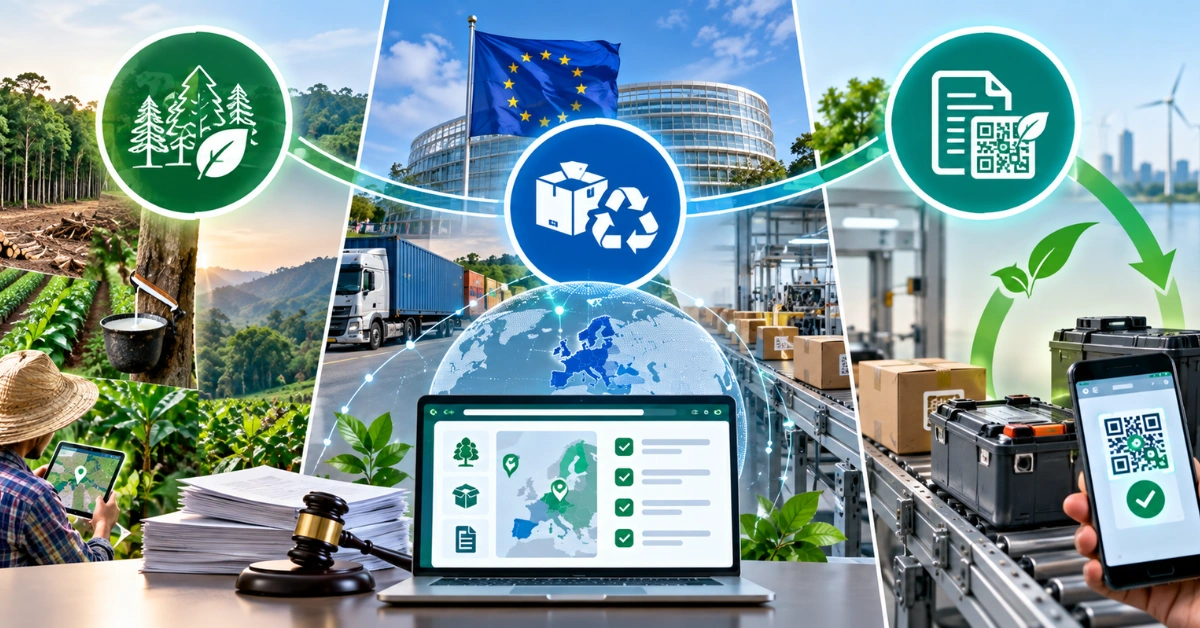
Quick summary: Operationalizing Regulatory Compliances helps teams turn EUDR, PPWR and DPP needs into connected, audit-ready workflows.
From Regulatory Requirements to EUDR, PPWR & DPP Execution
Operationalizing Regulatory Compliances means turning regulatory requirements into repeatable processes, connected data, accountable workflows, and evidence that can stand up to customer, auditor, or regulatory scrutiny. For businesses selling into the European Union, this is increasingly important as requirements such as the EU Deforestation Regulation (EUDR), Packaging and Packaging Waste Regulation (PPWR), and Digital Product Passport (DPP) move compliance from policy documents into day-to-day operations.
The challenge is not simply understanding what a regulation says. A business may know that EUDR requires traceability and geolocation, PPWR introduces packaging requirements across the packaging lifecycle, or DPPs require structured product information. The harder question is: how will that information be collected, validated, connected, updated, and made available when it is needed?
That is the gap between regulatory awareness and operational readiness.
Key Takeaways
Operationalizing Regulatory Compliances means turning requirements into repeatable data and business workflows.
EUDR readiness goes beyond DDS submission and depends on connected source, supplier, traceability, risk and evidence data.
PPWR operationalization requires a reliable packaging data foundation across materials, suppliers, products and markets.
DPP readiness depends on structured, governed product information that can be maintained and shared across the value chain.
ERP and existing systems remain important sources of transactional data, but compliance workflows may require additional source-level, product-level or evidence-level connections.
Compliance data should be validated, monitored and revalidated rather than treated as a one-time collection exercise.
The best test of operational readiness is whether a business can answer a real compliance question using connected evidence without extensive manual reconciliation.
Technology can help turn regulatory requirements into continuous, auditable workflows rather than periodic compliance projects.
Build greater visibility, improve compliance readiness, and turn complex regulatory requirements into practical, scalable processes.
What Does Operationalizing Regulatory Compliances Mean?
Operationalizing Regulatory Compliances means embedding regulatory requirements into the systems and processes that already run the business. Instead of treating compliance as a periodic documentation exercise, organizations create a continuous workflow for collecting data, validating it, identifying gaps, assigning actions, maintaining evidence, and generating the information required for reporting or market access.
For example, an EUDR requirement should not live only in a compliance checklist. It may need to connect supplier information, source plots, geolocation, procurement records, batches, risk information, evidence, and shipments. Similarly, PPWR data may need to connect packaging materials, formats, suppliers, composition, recyclability and market information. DPP readiness depends on structured product data that can be maintained and shared across the value chain.
1. EUDR: From DDS Submission to Supply-Chain Readiness
EUDR is a strong example of why operationalization matters. The European Commission’s 2026 updates include changes to product scope and the EUDR Information System, including updated technical specifications for automated APIs. The Regulation is scheduled to apply from 30 December 2026 for large and medium-sized operators and certain micro and small operators, and from 30 June 2027 for other micro and small operators.
A Due Diligence Statement is an important regulatory output, but it depends on the quality of the data and processes behind it. Businesses need to establish where relevant material comes from, connect source information to supply-chain transactions, assess risk, maintain evidence, and prepare the information required for submission.
In practice, operational EUDR readiness can mean connecting:
Supplier → Source plot → Geolocation Source material → Purchase order → Lot/Batch Batch → Finished product → EU shipment Risk assessment → Evidence → Mitigation actions Compliance data → DDS preparation/submission
The practical test is simple: pick one EU-bound shipment and ask whether the business can trace the relevant material back to its source and retrieve the supporting evidence without a spreadsheet marathon. If it cannot, having a DDS process alone does not demonstrate end-to-end operational readiness.
Understand the key steps to test your EUDR processes, identify compliance gaps, and prepare your supply chain for enforcement before issues become shipment delays or compliance risks.
2. PPWR: Turning Packaging Data into an Operational Workflow
The Packaging and Packaging Waste Regulation (PPWR) began applying across the EU from 12 August 2026. It establishes a harmonised framework covering packaging and packaging waste and addresses requirements across the packaging lifecycle. The Commission also highlights requirements around packaging composition, reuse or recoverability, and phased measures including restrictions that apply from 2030.
For businesses, PPWR operationalization starts with reliable packaging data. Packaging information may sit across procurement, suppliers, product development, quality, sustainability, logistics and EPR processes. If these functions maintain separate records, producing a consistent compliance view can become difficult.
An operational PPWR workflow can connect:
Packaging material and component → Supplier Packaging format → Product/SKU Material composition → Recycled-content or sustainability attributes Packaging design → Recyclability/reuse requirements Market placement → Reporting and EPR-related information Supporting documentation → Compliance evidence
The goal is not simply to create a PPWR report. It is to establish a dependable packaging data foundation that can be updated as materials, suppliers, products and markets change.
Understand what PPWR means after August 12, what requirements apply now, and how to prepare your business for the upcoming compliance milestones.
3. DPP: From Product Data to a Digital Product Record
The Digital Product Passport (DPP), established under the Ecodesign for Sustainable Products Regulation (ESPR), is designed to make relevant product information accessible through a digital record. The Commission describes the DPP framework as including requirements around the passport, identifiers, a registry and web portal; information can include attributes such as durability, reparability, recycled content and availability of spare parts, depending on applicable product requirements.
Operationalizing DPP requirements therefore means treating product data as a managed business asset rather than a one-time document. Product information may originate in PLM, ERP, supplier systems, manufacturing records, quality systems and sustainability databases. These sources need clear ownership and a mechanism for keeping the resulting product information accurate and current.
A DPP-ready operating model can connect:
Product identity → Model/SKU/serial or other applicable identifier Material and component data → Supplier and sourcing records Product attributes → Sustainability and performance information Manufacturing information → Relevant product-level records Circularity information → Repair, reuse, recycling or end-of-life information where applicable Approved product data → Digital product passport output
Understand the ESPR and DPP requirements, what they mean for your business, and how to start preparing your product data for the digital future.
Although EUDR, PPWR and DPP address different regulatory objectives, they share an operational challenge: compliance depends on data distributed across the value chain. The data may be owned by different teams, captured in different systems, received from different suppliers, and updated at different times.
That creates four recurring problems: fragmented data, weak data ownership, manual reconciliation, and compliance information that becomes outdated. A company can therefore be technically capable of producing a report while still struggling to prove that the underlying information is complete, consistent and connected.
Operationalizing Regulatory Compliances is about solving that underlying data and workflow problem.
How TraceX Helps Operationalize Regulatory Compliance
The TraceX Regulatory Compliance Platform is purpose-built to operationalize complex sustainability regulations, including EUDR, PPWR, ILPA, and Digital Product Passport (DPP), through mature, regulator-facing workflows rather than a general-purpose data solution adapted for compliance. Built on a common platform foundation, TraceX provides dedicated solution designs for EUDR and PPWR, with production deployments across industries including paper, tyres, laminates, natural rubber, cacao, soy, coffee, and industrial goods. The platform connects regulatory workflows with EU-facing processes, audit-ready evidence, supplier engagement, and configurable rules-as-data architecture, enabling businesses to adapt to evolving regulatory requirements without repeatedly rebuilding their compliance systems.
TraceX approaches regulatory compliance as a connected supply-chain workflow rather than a standalone reporting exercise. The platform can help organizations bring together supplier, farm, procurement, traceability, product and compliance information so teams can move from fragmented records toward a more structured source of truth.
For EUDR, this can mean connecting source-level geolocation and supplier information with procurement, material movements, batches, evidence and shipments. For broader regulatory workflows, the same principle applies: identify the required data, connect it to the business transaction or product it supports, validate it, maintain evidence and make it available for the relevant compliance process.
The value is not simply automation. It is visibility: knowing what data exists, what is missing, where a compliance workflow is breaking, and what needs attention before a customer, auditor or regulatory process exposes the gap.
EUDR, PPWR and DPP compliance can quickly become fragmented across suppliers, products, procurement systems and spreadsheets.
TraceX helps businesses connect supply-chain and compliance data into structured workflows that improve visibility, traceability and readiness.
A Practical Framework for Operationalizing Regulatory Compliances
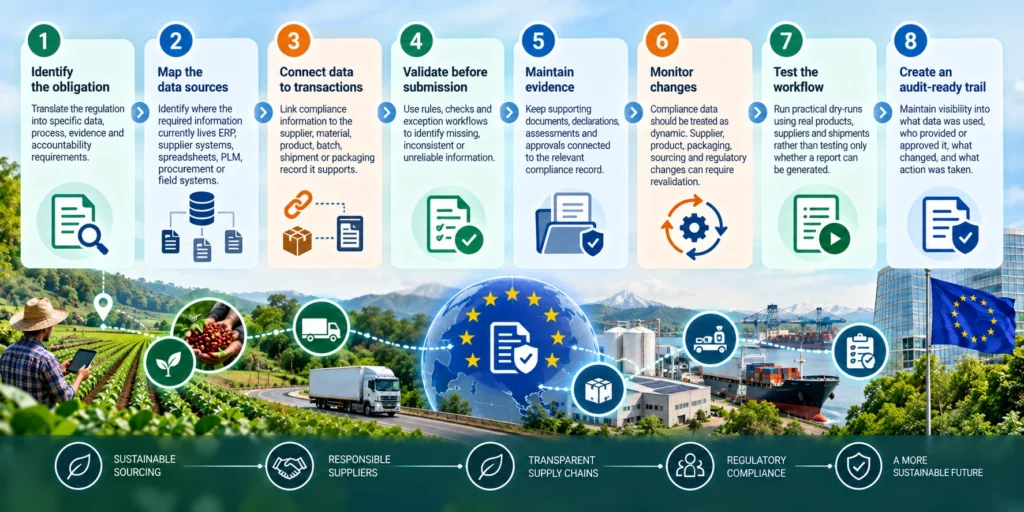
1. Identify the obligation Translate the regulation into specific data, process, evidence and accountability requirements.
2. Map the data sources Identify where the required information currently lives ERP, supplier systems, spreadsheets, PLM, procurement or field systems.
3. Connect data to transactions Link compliance information to the supplier, material, product, batch, shipment or packaging record it supports.
4. Validate before submission Use rules, checks and exception workflows to identify missing, inconsistent or unreliable information.
5. Maintain evidence Keep supporting documents, declarations, assessments and approvals connected to the relevant compliance record.
6. Monitor changes Compliance data should be treated as dynamic. Supplier, product, packaging, sourcing and regulatory changes can require revalidation.
7. Test the workflow Run practical dry-runs using real products, suppliers and shipments rather than testing only whether a report can be generated.
8. Create an audit-ready trail Maintain visibility into what data was used, who provided or approved it, what changed, and what action was taken.
Why Operationalization Matters More Than Documentation
A compliance document can show what a company says it does. An operational workflow shows how the company actually does it. That distinction becomes critical when regulations depend on information coming from multiple suppliers, systems and stages of a supply chain.
The strongest compliance programs therefore do not ask only, “Do we have the required document?” They ask, “Can we trace the data behind it, validate it, explain it, and reproduce the process when required?”
Conclusion
EUDR, PPWR and DPP may look like separate compliance programs, but they point to the same business challenge: regulatory requirements increasingly depend on reliable, connected and continuously maintained data. Knowing the regulation is necessary. Operationalizing it is what makes compliance repeatable.
For businesses, the next step is to move from “We understand the requirements” to “We can execute and prove the process.” That means connecting the data, systems, suppliers, products and transactions behind compliance and continuously testing whether the workflow still works as the business changes.
Frequently Asked Questions (FAQ’s)
What does operationalizing regulatory compliances mean?
It means embedding regulatory requirements into business processes, data systems, validation workflows, evidence management and accountability so compliance can be performed consistently rather than handled as a one-time documentation exercise.
Why is EUDR a good example of operational compliance?
EUDR requires businesses to connect source-level information, geolocation, supply-chain traceability, risk information and evidence to regulatory submissions. This makes data and process integration essential.
How does PPWR require operationalization?
PPWR creates requirements around packaging and packaging waste across the lifecycle. Businesses need structured packaging information that can be maintained across suppliers, products, markets and reporting processes.
What is the role of DPP in regulatory compliance?
DPP provides a digital mechanism for making relevant product information accessible across the value chain. Operational readiness requires governed product data and processes for maintaining that information.
Can an ERP alone manage all regulatory compliance requirements?
An ERP can remain an important source of procurement, inventory, production and shipment data, but additional compliance or traceability workflows may be needed where regulations require source-level geolocation, evidence, product attributes or specialized regulatory processes.
How can companies test regulatory readiness?
Use real-world dry runs. Select an actual product, supplier, batch or shipment and test whether the organization can retrieve the required data, evidence and relationships without extensive manual reconciliation.
Start using TraceX
Transparency, Trust, & Success for your Climate Journey.
We use cookies on our website to give you the most relevant experience by remembering your preferences and repeat visits. By clicking “Accept All”, you consent to the use of ALL the cookies. However, you may visit "Cookie Settings" to provide a controlled consent.
This website uses cookies to improve your experience while you navigate through the website. Out of these, the cookies that are categorized as necessary are stored on your browser as they are essential for the working of basic functionalities of the website. We also use third-party cookies that help us analyze and understand how you use this website. These cookies will be stored in your browser only with your consent. You also have the option to opt-out of these cookies. But opting out of some of these cookies may affect your browsing experience.
Necessary cookies are absolutely essential for the website to function properly. These cookies ensure basic functionalities and security features of the website, anonymously.
Cookie
Duration
Description
cookielawinfo-checkbox-analytics
11 months
This cookie is set by GDPR Cookie Consent plugin. The cookie is used to store the user consent for the cookies in the category "Analytics".
cookielawinfo-checkbox-functional
11 months
The cookie is set by GDPR cookie consent to record the user consent for the cookies in the category "Functional".
cookielawinfo-checkbox-necessary
11 months
This cookie is set by GDPR Cookie Consent plugin. The cookies is used to store the user consent for the cookies in the category "Necessary".
cookielawinfo-checkbox-others
11 months
This cookie is set by GDPR Cookie Consent plugin. The cookie is used to store the user consent for the cookies in the category "Other.
cookielawinfo-checkbox-performance
11 months
This cookie is set by GDPR Cookie Consent plugin. The cookie is used to store the user consent for the cookies in the category "Performance".
viewed_cookie_policy
11 months
The cookie is set by the GDPR Cookie Consent plugin and is used to store whether or not user has consented to the use of cookies. It does not store any personal data.
Functional cookies help to perform certain functionalities like sharing the content of the website on social media platforms, collect feedbacks, and other third-party features.
Performance cookies are used to understand and analyze the key performance indexes of the website which helps in delivering a better user experience for the visitors.
Analytical cookies are used to understand how visitors interact with the website. These cookies help provide information on metrics the number of visitors, bounce rate, traffic source, etc.
Advertisement cookies are used to provide visitors with relevant ads and marketing campaigns. These cookies track visitors across websites and collect information to provide customized ads.
Download the 2026 Traceability Scorecard and Benchmark Your Supply Chain Across 10 Critical Capabilities.
Download our eBook
Don’t Wait for an Audit to Find Your EUDR Gaps
The 2026 Simplification Package changes how HS codes, DDS pass-through and geolocation rules apply to you. Get the free guide and 20-point readiness checklist before enforcement catches you unprepared.