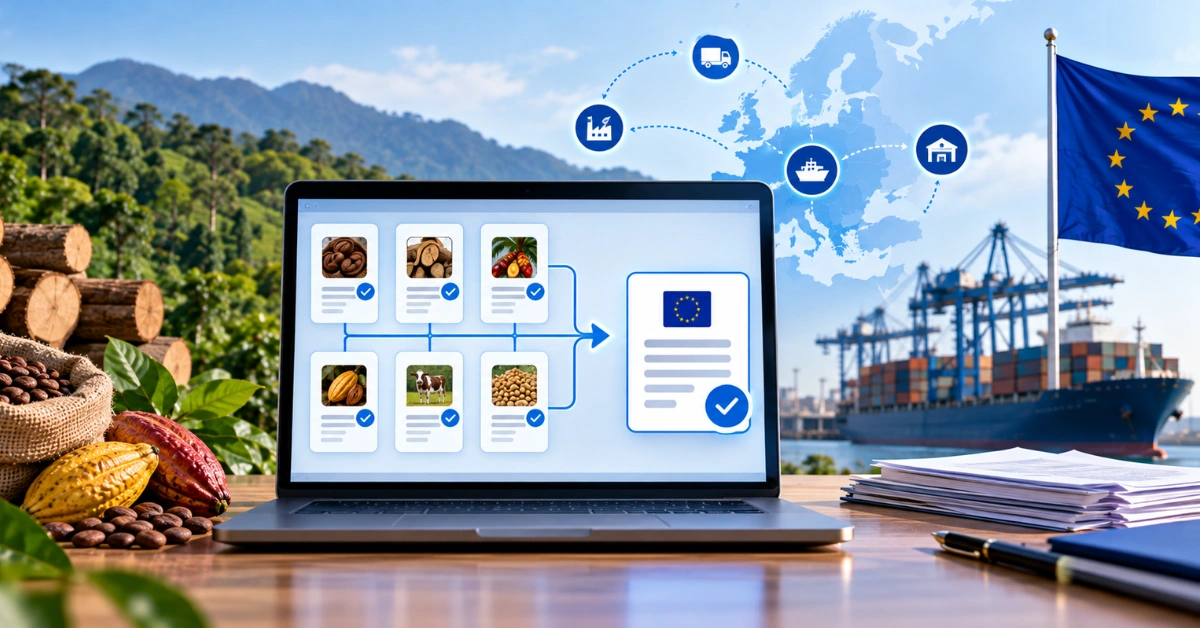
For high-volume EUDR operations, EUDR DDS Grouping can simplify how multiple existing declarations are represented for compliance and communicated downstream. It does not, however, remove the underlying due diligence obligation. Companies still need accurate source data, geolocation, risk assessment and supporting evidence before declarations are submitted.
EUDR compliance is becoming increasingly operational for companies placing regulated commodities and products on the EU market or exporting them from the EU. One practical challenge is managing large numbers of Due Diligence Statements (DDS) and simplified declarations, especially where companies have many suppliers, source plots, products or shipments.
A significant change came with Commission Implementing Regulation (EU) 2026/1565, adopted on 13 July 2026. The regulation amends the rules governing the EUDR Information System and introduces Article 8a, which allows Information System users to group previously submitted DDS or simplified declarations by referencing existing reference numbers or declaration identifiers. The measure addresses technical file-size limitations and aims to reduce disruption to customs procedures.
December 2026 is approaching. Is your supply chain actually ready?
Move from spreadsheets and fragmented supplier data to a traceable, audit-ready EUDR workflow with TraceX.
Article 8a is an important operational change for companies dealing with high volumes of EUDR declarations. It allows previously submitted DDS or simplified declarations to be grouped through a new declaration that references their existing identifiers. The grouped declaration then represents the referenced declarations for EUDR compliance purposes.
For companies, the most important preparation is not the grouping action itself. It is the quality of the data underneath each declaration.
The businesses best positioned to benefit will be those that can already connect suppliers, source locations, quantities, products, batches, shipments, evidence and declaration references in a controlled digital workflow.
If your EUDR process still relies on spreadsheets, email attachments and manually reconciled declaration numbers, now is the right time to assess whether your data architecture can scale with the regulation.
What Is EUDR DDS Grouping?
EUDR DDS Grouping is the mechanism introduced through Article 8a of the amended Information System rules. A user can submit a new DDS or simplified declaration that references individual DDS or simplified declarations previously submitted by the same Information System user, or, where applicable, for the same operator or micro or small primary operator by an authorised representative.
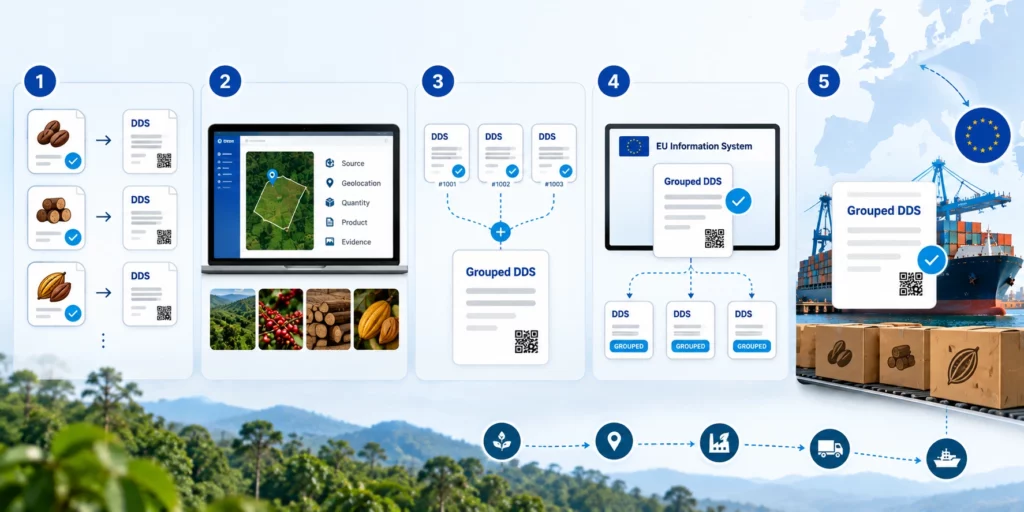
Once the grouping is created, the individual referenced declarations receive a GROUPED status. The grouped DDS or simplified declaration represents the referenced declarations for EUDR compliance purposes. Instead of communicating the individual reference numbers or declaration identifiers, the user can communicate or make available the reference number or declaration identifier of the grouped declaration.
The European Commission’s Information System documentation describes grouping as voluntary. It is particularly relevant where companies face large data volumes and technical limitations associated with individual declarations.
The simplified declaration can reduce administrative complexity for eligible micro and small primary operatorsbut companies still need accurate product, quantity, production and source-location information.
Why Article 8a Matters for High-Volume EUDR Operations
Article 8a creates a structured way to consolidate references to declarations that have already been submitted. For exporters, importers and other supply-chain participants, the practical value is not simply fewer numbers to communicate. The larger opportunity is to design an EUDR process in which source-level information is collected once, validated, connected to products and shipments, and then reused through controlled declaration workflows.
This is especially relevant for coffee, cocoa, rubber, wood, furniture, plywood and other supply chains where one shipment can involve multiple upstream sources or declarations. A digital traceability system can maintain the relationship between suppliers, source locations, batches, products, shipments and DDS reference numbers, making grouping easier to manage without losing the underlying traceability chain.
How EUDR DDS Grouping Works
The process can be understood in five steps.
Create and submit individual DDS or simplified declarations. Each receives a reference number or declaration identifier and an associated verification number.
Maintain the underlying compliance data. The company must retain the source, geolocation, quantity, product and evidence information supporting the declarations.
Create a new grouped DDS or simplified declaration. The new declaration references previously submitted declarations using their reference numbers or declaration identifiers.
The Information System assigns the grouped declaration its own reference number or identifier and gives the referenced declarations a GROUPED status.
Use the grouped declaration for the relevant compliance communication. The grouped declaration represents the individual declarations for EUDR compliance purposes, subject to Article 8a.
A key operational consequence is that declarations used as references for grouping cannot simply be treated as independent, freely amendable records while the grouping is active. Companies therefore need strong controls over declaration lifecycle, data quality and version management.
What Changed in the EUDR Information System?
Regulation (EU) 2026/1565 contains several Information System changes beyond grouping. It removes references to the TRACES infrastructure from the implementing rules to support a more flexible and future-proof IT architecture. It also establishes that Information System users create one single account, with the possibility of creating different roles under that account.
The regulation also provides rules for simplified declarations by micro or small primary operators, contingency arrangements and other system-management measures. The Commission’s current documentation confirms that the Information System supports dashboard-based management and machine-to-machine API access for bulk management.
For companies, the direction is clear: EUDR compliance is increasingly becoming a structured digital-data process rather than a one-time document exercise.
The EUDR Information System is where operators and traders submit and manage their Due Diligence Statementsbut successful submission starts with accurate, structured supply-chain data.
From supplier information and geolocation to DDS management and traceability, make your EUDR process ready for scale.
What EUDR DDS Grouping Does Not Mean
Grouping should not be interpreted as a shortcut around due diligence.
It does not eliminate the need to collect required Article 9 information. It does not replace risk assessment and, where necessary, risk mitigation. It does not make inaccurate geolocation, incorrect quantities or unsupported legality and deforestation-free evidence acceptable. It also does not transfer the operator’s regulatory responsibility to the Information System or to a software provider.
The safest approach is to treat grouping as an administrative and technical capability built on top of a reliable traceability process. If the underlying declarations are wrong, grouping them does not fix the underlying compliance problem.
How Companies Should Prepare for EUDR DDS Grouping
Companies should prepare their data architecture before trying to optimise declaration submission.
First, establish unique identities for suppliers, farms or production areas, materials, products and shipments. Second, maintain accurate geolocation and source information and connect it to relevant commodity quantities. Third, create a clear relationship between upstream inputs and finished products or export shipments. Fourth, maintain the evidence supporting legality and deforestation-free status. Fifth, maintain a declaration register containing reference numbers, verification numbers, status, quantities, associated products and shipment relationships.
A digital EUDR platform can then provide a single operational layer connecting supplier data, geolocation, batch traceability, evidence, risk assessment and DDS management. This becomes particularly valuable when a company needs to create, track, group or communicate large numbers of declarations.
EUDR DDS Grouping for Furniture and Wood Supply Chains
Furniture exporters are a strong example of where structured declaration management matters. A single EU-bound furniture shipment can involve multiple timber suppliers, species, production areas, sawmills, processors and finished-product SKUs.
The key question is not simply whether a DDS reference exists. It is whether the company can connect the relevant declaration to the wood input, source location, supplier, quantity, processing records and final shipment.
For a wooden furniture exporter, the ideal digital chain is:
This structure allows compliance teams to understand what sits behind each declaration and gives commercial teams a more reliable way to respond to EU customer requests for traceability evidence.
From geolocation and legality evidence to complex supply chains and end-to-end traceability, discover the key challenges wood businesses need to address under EUDR.
The introduction of grouping highlights a broader shift in EUDR operations. Companies should not build their compliance process around manually creating declarations at the end of the supply chain. Instead, they should create a continuously maintained data model that can generate the information required for declarations when needed.
This means validating supplier submissions, checking geolocation formats, detecting missing information, monitoring changes, linking quantities to batches and shipments, maintaining evidence and tracking declaration status.
For businesses managing hundreds or thousands of EUDR-relevant transactions, the goal should be to make compliance data reusable. Once reliable source data exists, it can support due diligence, customer responses, internal audits, customs readiness and declaration management.
How TraceX Can Help
TraceX EUDR Solutions can help companies operationalise EUDR compliance by connecting supplier and farm data, geolocation, traceability, risk and evidence with downstream products and shipments. Instead of treating the DDS as an isolated regulatory document, TraceX can help establish the data chain that supports the declaration process.
For organisations affected by the new grouping capability, the opportunity is to maintain a controlled register of DDS references and connect them to the transactions, products and source data they represent. This can reduce manual reconciliation and help teams understand which declarations contribute to a shipment or grouped declaration.
The objective is not simply to submit more DDS faster. It is to build a traceable, auditable and scalable EUDR operating model.
Is Your EUDR Data Ready for DDS Grouping?
EUDR DDS Grouping can simplify declaration management, but only when the underlying supply-chain data is structured and reliable.
Ask yourself: Can you trace one EU-bound shipment back to its suppliers and source locations? Can you reconcile quantities between source material, batches and shipments? Can you retrieve the evidence supporting each declaration? Can you track every DDS reference and its current status? Can you identify which declarations contribute to a shipment or grouped declaration?
If the answer is no, your biggest EUDR challenge may not be the Information System it may be your underlying traceability process.
Frequently Asked Questions (FAQ’s)
What is EUDR DDS Grouping?
EUDR DDS Grouping allows a new DDS or simplified declaration to reference previously submitted declarations, with the grouped declaration representing those declarations for EUDR compliance purposes.
Does grouping remove the need for due diligence?
No. Grouping does not remove the underlying EUDR due diligence requirements or responsibility for accurate information and evidence.
Can simplified declarations also be grouped?
Yes. Article 8a applies to both Due Diligence Statements and Simplified Declarations.
What happens to declarations used in a grouping?
They receive a GROUPED status in the Information System and are represented by the grouped declaration while that grouping is active.
Does grouping solve poor-quality source data?
No. Companies still need accurate geolocation, product, quantity, supplier and supporting compliance information.
Can companies automate EUDR declaration management?
The Commission provides API capabilities for bulk management of DDS and simplified declarations. A dedicated traceability platform can also structure and validate the underlying data before submission.
How should furniture exporters prepare?
Connect timber suppliers and source locations to material batches, furniture SKUs and EU shipments, while maintaining evidence and declaration references.
Start using TraceX
Transparency, Trust, & Success for your Climate Journey.
We use cookies on our website to give you the most relevant experience by remembering your preferences and repeat visits. By clicking “Accept All”, you consent to the use of ALL the cookies. However, you may visit "Cookie Settings" to provide a controlled consent.
This website uses cookies to improve your experience while you navigate through the website. Out of these, the cookies that are categorized as necessary are stored on your browser as they are essential for the working of basic functionalities of the website. We also use third-party cookies that help us analyze and understand how you use this website. These cookies will be stored in your browser only with your consent. You also have the option to opt-out of these cookies. But opting out of some of these cookies may affect your browsing experience.
Necessary cookies are absolutely essential for the website to function properly. These cookies ensure basic functionalities and security features of the website, anonymously.
Cookie
Duration
Description
cookielawinfo-checkbox-analytics
11 months
This cookie is set by GDPR Cookie Consent plugin. The cookie is used to store the user consent for the cookies in the category "Analytics".
cookielawinfo-checkbox-functional
11 months
The cookie is set by GDPR cookie consent to record the user consent for the cookies in the category "Functional".
cookielawinfo-checkbox-necessary
11 months
This cookie is set by GDPR Cookie Consent plugin. The cookies is used to store the user consent for the cookies in the category "Necessary".
cookielawinfo-checkbox-others
11 months
This cookie is set by GDPR Cookie Consent plugin. The cookie is used to store the user consent for the cookies in the category "Other.
cookielawinfo-checkbox-performance
11 months
This cookie is set by GDPR Cookie Consent plugin. The cookie is used to store the user consent for the cookies in the category "Performance".
viewed_cookie_policy
11 months
The cookie is set by the GDPR Cookie Consent plugin and is used to store whether or not user has consented to the use of cookies. It does not store any personal data.
Functional cookies help to perform certain functionalities like sharing the content of the website on social media platforms, collect feedbacks, and other third-party features.
Performance cookies are used to understand and analyze the key performance indexes of the website which helps in delivering a better user experience for the visitors.
Analytical cookies are used to understand how visitors interact with the website. These cookies help provide information on metrics the number of visitors, bounce rate, traffic source, etc.
Advertisement cookies are used to provide visitors with relevant ads and marketing campaigns. These cookies track visitors across websites and collect information to provide customized ads.
Download the 2026 Traceability Scorecard and Benchmark Your Supply Chain Across 10 Critical Capabilities.
Download our eBook
Don’t Wait for an Audit to Find Your EUDR Gaps
The 2026 Simplification Package changes how HS codes, DDS pass-through and geolocation rules apply to you. Get the free guide and 20-point readiness checklist before enforcement catches you unprepared.